
Last updated: July 29, 2026
Quick Answer: Christian LitRPG is a fiction subgenre that combines the game-mechanic storytelling of LitRPG (characters who gain stats, levels, and skills) with faith-rooted themes, Christian worldview, and earned grace rather than cheap resolution. It’s clean, story-driven, and built for readers who want real stakes alongside real belief. The subgenre is small but growing fast, with new titles appearing in 2026 and active reader communities forming around it.
Key Takeaways
- LitRPG is a fiction genre where characters experience the world through visible game mechanics, stat sheets, leveling up, skill trees, as part of the actual story.
- Christian LitRPG applies that structure to stories where faith is load-bearing, not decorative. Grace has to be earned through the plot, not handed over at the end.
- The subgenre is distinct from both standard Christian fantasy (no game mechanics) and secular LitRPG (no faith framework).
- Content in Christian LitRPG is typically clean, no graphic violence, no explicit content, no profanity, but the stakes are real.
- New releases in 2026, including Kenneth Bliss’s Canthany Rising: A Christian LitRPG Adventure, signal the subgenre is moving from scattered experiments to a self-identified category.
- Reader communities on Facebook and Reddit are actively discussing Christian LitRPG premises, including eschatology-based storylines.
- The genre skews toward adult readers, not just young adults, though it crosses age groups.
- Silas Bellhaven’s The Measured Debt series is a current example of Christian LitRPG built around earned progression and faith under fire.
What Is LitRPG and How Does It Work?
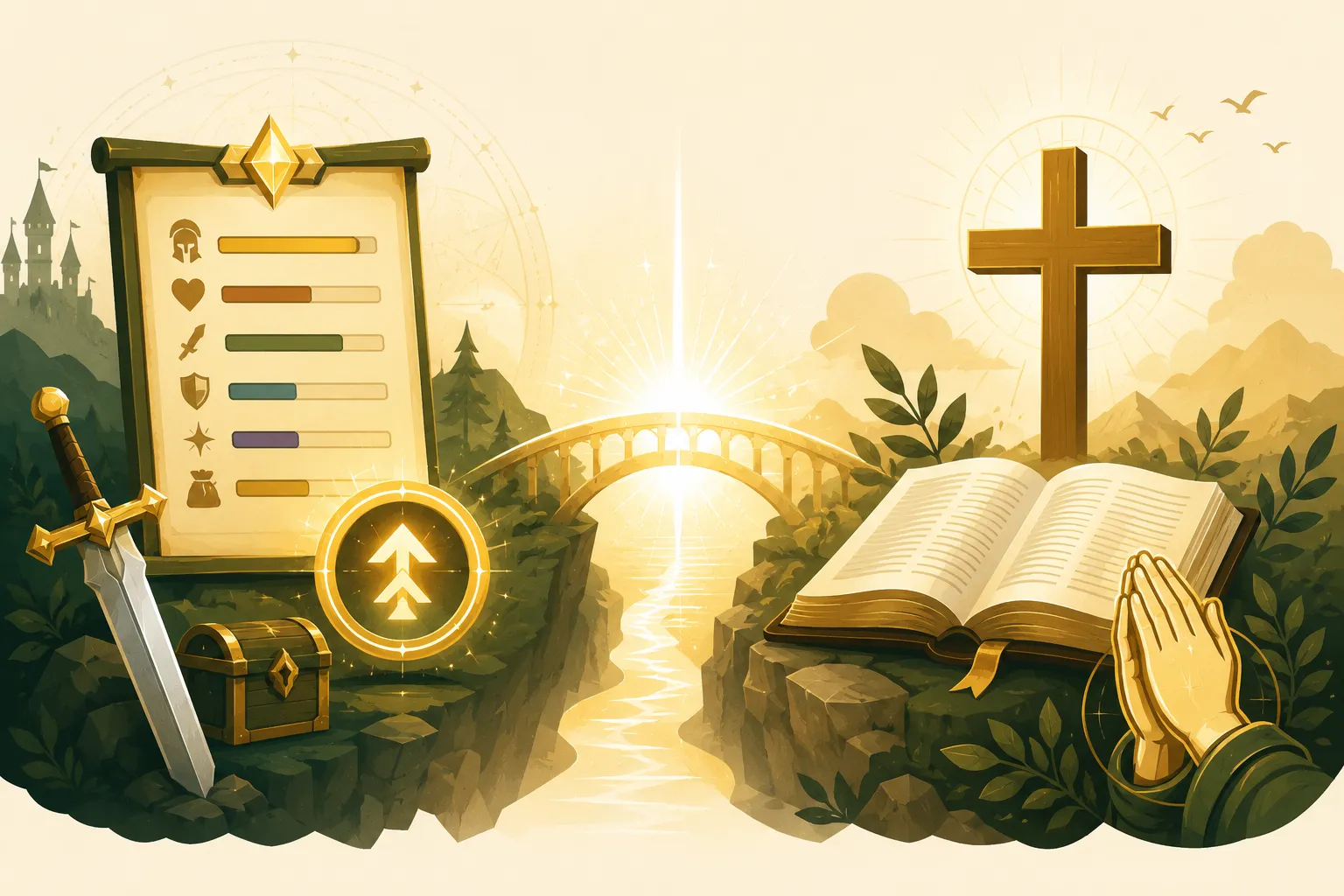
LitRPG, short for Literary Role-Playing Game, is a fiction genre where the game is part of the story’s reality. Characters don’t just fight monsters or solve problems; they see their stats, track their experience points, and level up in ways the narrative acknowledges directly. Think of it as fiction that borrows the internal logic of video games or tabletop RPGs and makes that logic visible on the page.
A typical LitRPG scene might show a character receiving a notification after a battle:
[Skill Acquired: Iron Grip, Passive. Strength checks +4. Cooldown: None.]
That’s not flavor text. In LitRPG, that notification changes what the character can do next. The game system is cause and effect, not decoration.
Where does the game system aspect come from? The genre traces its roots to Russian web fiction in the early 2010s, particularly Dmitry Rus’s Play to Live series, before spreading through English-language platforms like Royal Road and Kindle Unlimited. The core appeal is progression, readers get to watch a character grow in measurable, satisfying ways, with every gain costing something first [6].
By 2026, community-tracked release lists on r/ProgressionFantasy show over 110 LitRPG e-book titles in a single month, which gives some sense of how much creative space the genre now holds [19].
What Makes Christian LitRPG Different from Regular Fantasy?
Christian LitRPG is different from regular Christian fantasy because the game-mechanic structure becomes the vehicle for faith questions, not just adventure. In standard Christian fantasy, faith might show up as a character’s belief system or a world’s theology. In Christian LitRPG, the system itself, the leveling, the stat-tracking, the cost of progression, becomes a way to ask what growth actually requires.
The difference matters. A character who prays and gains a skill point isn’t just doing something pious. The system is asking: what did that prayer cost, and what does it mean that it worked? That’s a different kind of storytelling than a fantasy hero who happens to believe in God.
Key distinctions:
- Progression is earned, not given. Grace shows up after cost, not instead of it. A character’s faith is tested through the mechanics, not narrated around them.
- The game world has moral weight. Choices inside the system carry consequence. Mercy and justice aren’t abstractions, they’re variables the story tracks.
- Clean content is the baseline. Christian LitRPG holds to the same content standards as other clean Christian fiction: no graphic violence, no explicit content, no profanity. The tension comes from stakes, not shock.
Is Christian LitRPG Actually Religious, or Just Fantasy with Faith Elements?
Christian LitRPG is genuinely faith-rooted, not just faith-flavored. The distinction is whether belief functions as a plot device or as the load-bearing structure of the story. In the best Christian LitRPG, God is real inside the world, and the game mechanics reflect that reality, prayer shapes outcomes, covenant matters, and the character’s relationship with faith is tested and proven through what happens, not stated in narration.
Kenneth Bliss’s Canthany Rising: A Christian LitRPG Adventure, released June 22, 2026, describes itself as blending “biblical inspiration, psionics, and immersive LitRPG storytelling” where “prayer shapes destiny.” That’s not a fantasy novel with a cross on the cover. The faith architecture is structural [Canthany Rising press release].
Silas Bellhaven’s The Measured Debt series operates the same way. At Federated Record, Eamon Kersey’s progression through collapsed corridors is tracked by a position series that keeps asking why he’s always the one left standing. The record doesn’t lie, and neither does the cost of what he’s spent to survive.
Why Are People Getting Into Christian LitRPG Right Now?
Several things are converging in 2026 to make this the right moment for Christian LitRPG to find its readers.
The LitRPG genre is enormous and still expanding. With over 110 new titles tracked in a single month [19], there’s room for subgenres and niches that didn’t have critical mass before. Readers who’ve exhausted secular LitRPG are looking for something that handles faith honestly.
Christian fiction readers are hungry for new formats. The Christian fiction market has shown consistent growth, and Kindle Unlimited subscribers who read clean fiction are among the most voracious readers in the indie space [1][2]. Many of them have already crossed into fantasy, the step into LitRPG mechanics is smaller than it looks.
The genre fits the faith. LitRPG’s core structure, you earn what you get, progression costs something, the record doesn’t lie, maps cleanly onto earned grace and faith under fire. The mechanics aren’t fighting the theology. They’re running parallel to it.
Community is forming. A May 2026 thread in a major LitRPG Facebook group asked specifically for Christian LitRPG books based on the Rapture, drawing multiple responses and suggesting an active subcommunity around explicitly Christian scenario-design [LitRPG Facebook Rapture thread]. LitRPG Con 2026 in Denver sold out, and the genre’s reader-centric culture is more hospitable to faith-based content than legacy SF/fantasy institutions have been [PublishersArchive events listing].

Christian LitRPG vs. Regular Christian Fiction: What’s the Difference?
Regular Christian fiction, cozy mystery, western, psychological thriller, epic fantasy, uses story to explore faith. Christian LitRPG does that too, but adds a visible progression system that becomes part of how faith is tested and expressed.
| Feature | Regular Christian Fiction | Christian LitRPG |
|---|---|---|
| Faith role | Character worldview, theme | Load-bearing structure |
| Progression | Emotional/spiritual arc | Visible stats, levels, skills |
| Audience | Broad Christian fiction readers | LitRPG readers + Christian fiction crossover |
| Content | Clean (varies by publisher) | Clean, with real stakes |
| Game mechanics | Absent | Central to the story |
The reader who picks up a Mercy House Mystery in Juniper Gap, Tennessee is getting faith as lived experience, doubt, service, failure, and grace in the ordinary Tuesday that suddenly isn’t ordinary. The reader who picks up The Cost of Being Chosen gets all of that, plus a position series that tracks every choice Eamon Kersey makes and asks what the record really proves.
Does Christian LitRPG Have Graphic Content or Violence?
No. Christian LitRPG, as a self-identified category, holds to clean content standards. That means no graphic violence, no explicit content, and no profanity. Tension comes from stakes, moral, spiritual, relational, not from shock.
This is worth saying clearly because secular LitRPG can run dark. Some of the most popular titles in the broader genre include brutal combat, explicit content, and language that would disqualify them from any Christian fiction shelf. Christian LitRPG is a deliberate departure from that. The cost of progression is real, but the story earns its weight through consequence and character, not graphic detail.
Who Reads Christian LitRPG, Young Adults or Adults?
Christian LitRPG skews toward adults, not primarily young adults, though it crosses age groups. The LitRPG genre as a whole draws heavily from adult readers who grew up with video games and tabletop RPGs, many of them now in their 30s, 40s, and 50s. Christian fiction readers on Kindle Unlimited trend toward women aged 35-65 [1][2]. Christian LitRPG sits at the intersection of those two groups.
That said, the game-mechanic structure is accessible to younger readers, and clean content makes it appropriate for teen readers as well. The primary audience, though, is adult readers who want both the progression satisfaction of LitRPG and the faith honesty of Christian fiction, stories that walk with them, not talk at them.
Best Christian LitRPG Books to Start With
The category is still forming, but there are clear starting points in 2026.
Start here:
- The Cost of Being Chosen (The Measured Debt, Book 1) by Silas Bellhaven, Eamon Kersey’s name keeps clearing every collapse at Federated Record, until the position series starts asking why he’s always the one left standing. Earned progression, no cheap grace. Amazon
- The Remembered Route (The Measured Debt, Book 2), A corridor route Eamon swears he never walked shows up twice in the record, and someone needs it to stay that way. Amazon
- The Borrowed Yield (The Measured Debt, Book 3), The numbers Eamon built his reputation on were never fully his, and the debt against them has finally come due. Amazon
- Canthany Rising: A Christian LitRPG Adventure by Kenneth Bliss (June 2026), Explicitly marketed as Christian LitRPG, blending biblical inspiration and psionics with immersive game-mechanic storytelling.
Browse the full Measured Debt series: Series page
Common Complaints About Christian LitRPG, What to Watch For
Every subgenre has its pitfalls. Here’s what readers report as the most common frustrations:
- Faith as decoration, not structure. Some books slap a cross on a standard LitRPG plot and call it Christian. The faith doesn’t change how the story works. Readers who want genuine integration will feel the difference immediately.
- Preachy resolution. A character levels up, has a crisis, and then gets a tidy conversion moment that resolves everything. That’s not earned grace, that’s a formula. The best Christian LitRPG lets faith be doubted, worked through, and proven by what it costs.
- Thin game mechanics. Some authors use LitRPG framing loosely, a few stat boxes, no real system logic. Readers who come from secular LitRPG will notice if the mechanics don’t have internal consistency.
- Inconsistent clean content. Not every book marketed as “Christian” holds the same content standard. Check reviews before assuming.
Choose Christian LitRPG if: you want progression fiction with real moral weight, faith that functions as more than backstory, and clean content you don’t have to vet page by page.
Skip it if: you want pure power-fantasy LitRPG with no faith dimension, or if you prefer Christian fiction without game-mechanic structure.
Can You Enjoy Christian LitRPG If You’re Not Religious?
Yes, with honest expectations. The game mechanics, progression structure, and character stakes in Christian LitRPG work as story regardless of the reader’s personal faith. A non-religious reader who enjoys LitRPG and doesn’t mind a protagonist whose worldview is genuinely Christian will find plenty to engage with.
What won’t work is reading Christian LitRPG as secular LitRPG with religious flavor. The faith is structural, not optional. God is real inside these worlds. Characters pray, and it matters. If that framing is a barrier, the genre isn’t a fit, and that’s fine. But readers who are curious about faith-rooted storytelling, or who simply want clean LitRPG with moral weight, often find the subgenre more satisfying than they expected.
How Long Are Christian LitRPG Books and Series?
Christian LitRPG books tend to run in the 60,000-90,000 word range for novels, which is standard for Kindle Unlimited fiction. Novelettes like Canthany Rising run shorter, around 20,000-30,000 words, and serve as good entry points for readers new to the subgenre.
Series length varies. The Measured Debt currently runs three books, each building on the same protagonist and position-series framework. Secular LitRPG series often run much longer (10-20+ books), and Christian LitRPG may follow that pattern as the subgenre matures. For now, three-book arcs with complete story resolution per book are common.
Where to Find Christian LitRPG Recommendations and Communities
The best places to find Christian LitRPG in 2026:
- Kindle Unlimited, Search “Christian LitRPG” directly. The category is small enough that most relevant titles surface quickly.
- r/ProgressionFantasy (Reddit), The broader LitRPG community, with monthly release lists that include niche titles [18][19]. Search for “Christian” within the community.
- LitRPG Facebook groups, Active communities explicitly discussing Christian LitRPG premises, including eschatology-based storylines [LitRPG Facebook Rapture thread]. The May 2026 thread asking for Rapture-based LitRPG drew real engagement.
- Silas Bellhaven’s author page, Amazon author page for The Measured Debt series and related clean Christian fiction across mystery, fantasy, thriller, and western.
- LitRPG Con, The genre’s reader-focused convention (Denver, July 2026) reflects the indie-first culture where Christian LitRPG is most likely to grow [PublishersArchive events listing].
Conclusion
What is Christian LitRPG and why readers are discovering it comes down to a simple convergence: a fiction genre built on earned progression meeting a faith tradition built on the same principle. Grace that costs nothing proves nothing. LitRPG’s mechanics, the visible record of what a character has spent and gained, turn out to be a surprisingly honest framework for stories where faith is tested and proven through the plot, not delivered as a sermon.
The subgenre is still forming. New titles are arriving in 2026, communities are organizing around it, and the readers who’ve found it tend to stay. For anyone who’s wanted LitRPG without the graphic content, or Christian fiction with a structure that feels genuinely new, this is the right moment to look.
Actionable next steps:
- Start with The Cost of Being Chosen (The Measured Debt, Book 1), it’s the clearest current example of what earned progression looks like inside a faith-rooted LitRPG framework. Read on Amazon
- Browse the full Measured Debt series at the series page.
- Search “Christian LitRPG” in Kindle Unlimited to see what’s arrived in 2026.
- Check the LitRPG Facebook communities for reader discussions, the Rapture-based LitRPG thread from May 2026 is a good entry point into where the community is headed.
Hope in the dark takes different shapes in different genres. In Christian LitRPG, it shows up in a stat sheet that records what faith actually cost, and what it was worth.
FAQ
What does LitRPG stand for? LitRPG stands for Literary Role-Playing Game. It’s a fiction genre where characters experience visible game mechanics, stat sheets, leveling, skill acquisition, as part of the story’s reality, not as a metaphor.
Is Christian LitRPG the same as Christian fantasy? No. Christian fantasy uses a faith worldview within a fantastical setting. Christian LitRPG adds visible game-mechanic progression as a structural element, making the leveling and stat system part of how faith is tested and expressed.
Where did LitRPG originate? LitRPG originated in Russian web fiction in the early 2010s, particularly through Dmitry Rus’s Play to Live series, before spreading to English-language platforms like Royal Road and Kindle Unlimited [6].
Is Christian LitRPG appropriate for teens? Generally yes. Clean Christian LitRPG holds to no graphic violence, no explicit content, and no profanity. The primary audience is adults, but the content is appropriate for teen readers.
What is The Measured Debt series about? The Measured Debt by Silas Bellhaven follows Eamon Kersey at Federated Record, where a position series tracks every collapse he survives and every choice he makes, until the record starts asking questions he can’t answer cleanly. It’s Christian LitRPG built around earned progression and faith under fire.
Can non-Christians enjoy Christian LitRPG? Yes, if the faith framework doesn’t function as a barrier. The game mechanics and character stakes work as story for any reader. Non-religious readers who want clean LitRPG with moral weight often find the subgenre satisfying.
How is grace handled in Christian LitRPG? In the best Christian LitRPG, grace is earned, it arrives after cost, not instead of it. Characters doubt, fail, and work through faith before mercy shows up. There are no clean conversion moments that resolve everything without consequence.
What is Canthany Rising? Canthany Rising: A Christian LitRPG Adventure by Kenneth Bliss is a 2026 novelette that blends biblical inspiration, psionics, and LitRPG storytelling. Released June 22, 2026, it’s one of the clearest recent examples of Christian LitRPG as a self-identified category.
How many books are in a typical Christian LitRPG series? Current series tend to run three books, with complete story resolution per book. As the subgenre matures, longer series are likely, following the pattern of secular LitRPG.
Where can I find Christian LitRPG books? Kindle Unlimited is the best starting point. Search “Christian LitRPG” directly, or browse Silas Bellhaven’s Amazon author page for The Measured Debt series.
Does Christian LitRPG include end-times or Rapture storylines? Some authors and readers are actively exploring eschatology-based LitRPG premises. A May 2026 Facebook thread in a major LitRPG group specifically asked for Rapture-based Christian LitRPG, drawing multiple responses, suggesting this is a growing direction within the subgenre.
What’s the difference between Christian LitRPG and progression fantasy? Progression fantasy is a broader category that includes LitRPG, any story where a character grows in measurable ways. Christian LitRPG is progression fantasy with a faith-rooted worldview and clean content standards. Not all progression fantasy is LitRPG (some lacks visible game mechanics), and not all LitRPG is Christian.
References
[1] Christian Fiction 14 7 Yearly Surge Dramatic Market Expansion Data – https://www.firmenpresse.de/pressrelease734029/christian-fiction-14-7-yearly-surge-dramatic-market-expansion-data.html
[2] The Rise Of Christian Fiction Market Trends Regional Dynamics And Future Predictions For 2026 – https://www.alibaba.com/product-insights/the-rise-of-christian-fiction-market-trends-regional-dynamics-and-future-predictions-for-2026.html
[6] Litrpg Evolution – https://wildflintbooks.com/blog/litrpg-evolution
[18] March 2026 LitRPG Ebook List – https://www.reddit.com/r/ProgressionFantasy/comments/1ri4b82/march_2026_litrpg_ebook_list/
[19] June 2026 LitRPG Ebook List – https://www.reddit.com/r/ProgressionFantasy/comments/1u8kxfu/june_2026_litrpg_ebook_list_mostly_completed/