
{“cover”:”Landscape 1536×1024 editorial hero: a sunlit cottage reading nook in an imagined highland village, mullioned window open to terraced green hills and a distant stone chapel tower, a worn linen armchair with a knit throw, a stack of hardback fantasy novels beside a steaming ceramic mug, pressed wildflowers and a small carved wooden token on the sill, a tiny sleeping dragon-like creature curled on a cushion like a cat, warm amber and sage-green palette with soft navy shadows, natural daylight, shallow depth of field, rule-of-thirds composition, magazine cover polish, absolutely no text or lettering anywhere.”,”content”:[“Landscape 1536×1024 four-panel labelled comparison guide contrasting story tones for faith-rooted fantasy reading: panel one a warm village bakery with lantern light and a friendly hearth-dragon, panel two a moonlit paranormal street with fog and a cloaked figure, panel three a grim ash-covered battlefield with broken banners under grey sky, panel four a small chapel garden with a wooden gate and open gate latch. Short panel headings of one to four words and three concise bullet labels per panel with thin callout lines pointing to key details. Clean cream background, sage-green and deep navy accent palette, flat editorial illustration with crisp vector linework, labels inside a 5% safe margin, no sentences.”,”content2″:””]}

Last updated: November 9, 2026
Quick Answer
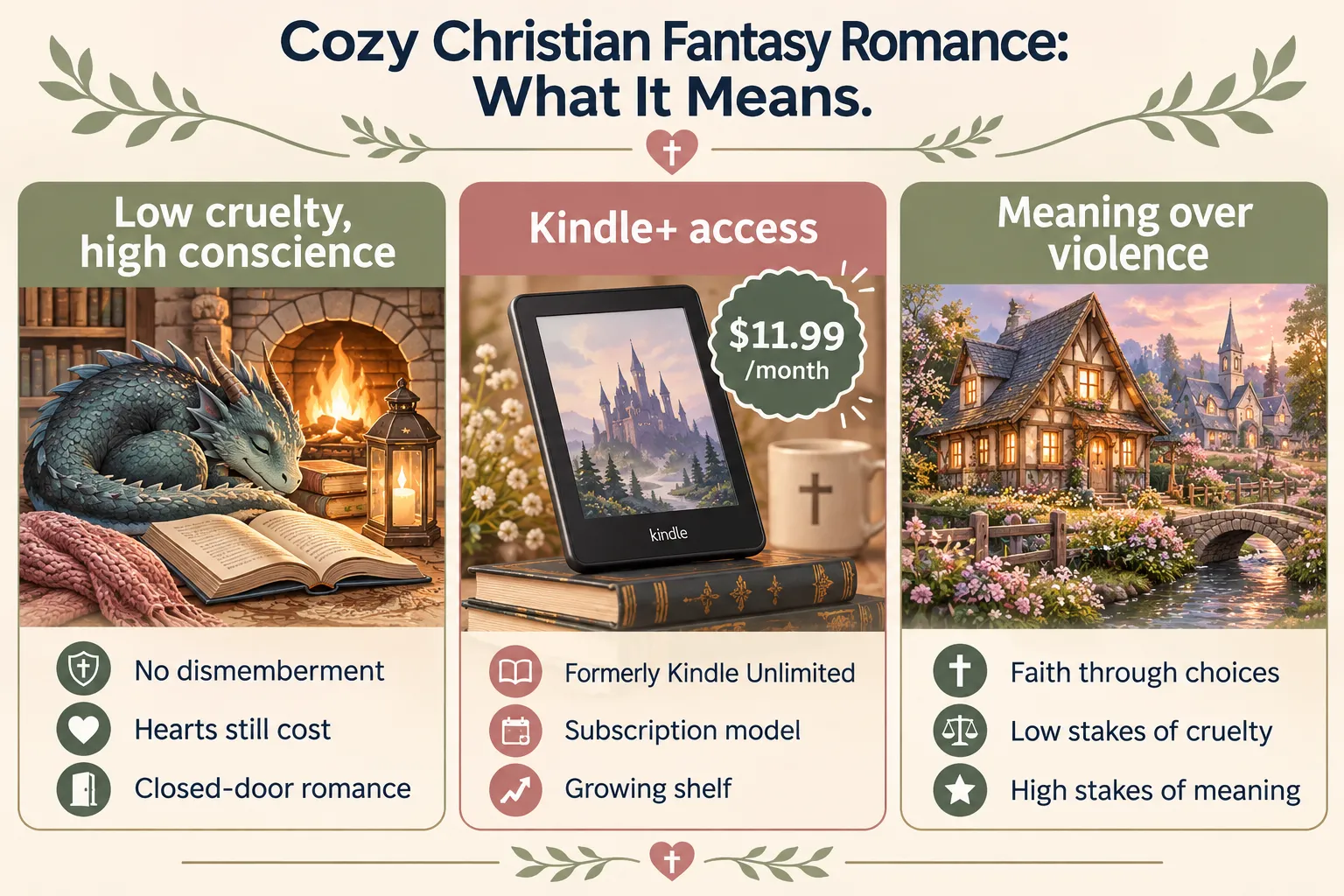
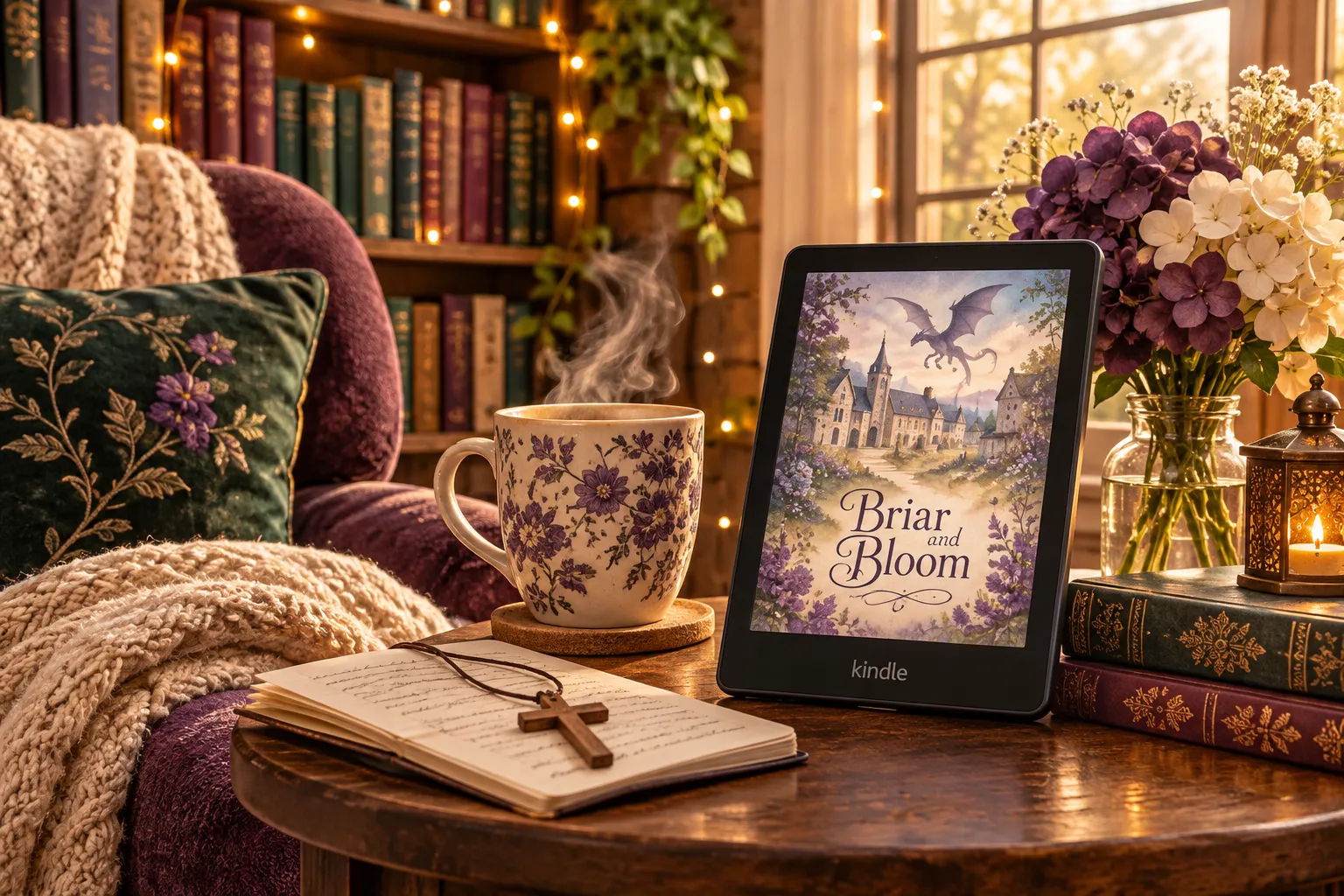
A cozy Christian fantasy romance series for Kindle Unlimited readers is a low-violence, closed-door love story set in a secondary or lightly magical world, where faith is lived out through choices rather than preached in dialogue. Fall 2026 releases such as Briar and Bloom (Gracehaven Book 2, released September 29, 2026) have pushed the subgenre into Amazon’s Christian Fantasy new-release charts, showing real appetite for warm, clean worldbuilding [1]. Kindle Unlimited, renamed Kindle+ on October 22, 2026, now includes eligible audiobooks alongside e-books at $11.99/month in the U.S., which makes binge-reading a long series cheaper than buying book two alone [2][3]. The catch: supply is thin, so readers often have to hunt across adjacent shelves.
Key Takeaways
- Cozy means low stakes of cruelty, not low stakes of meaning: bodies aren’t dismembered, but hearts still cost something.
- Closed-door romance is the near-universal standard; explicit content is effectively absent from the subgenre.
- Kindle+ (formerly Kindle Unlimited) at $11.99/month now bundles eligible audiobooks, which helps for series binges [2].
- Gracehaven Book 1, Ink and Ivy (June 16, 2026), sat near 4.7 stars across roughly 189-198 reviews by early November 2026 [4].
- Found family is the dominant trope, often more central than the romance itself.
- The shelf is hard to search because Amazon has no “cozy Christian fantasy romance” category, titles scatter across Christian Fantasy, Religious SF & Fantasy, and clean romance [1][5].
- Only about one quarter of surveyed readers subscribe to KU, so wide-release alternatives matter [6].
- You do not need to be a Christian to enjoy these books, any more than you need to be Narnian to love Narnia.
What is cozy Christian fantasy romance?
It’s fantasy romance with the cruelty dialed down and the conscience dialed up. The world has magic, maybe a dragon, usually a village with a name you’d want on a mug, and the central conflict turns on whether a character will do the costly right thing rather than whether the kingdom burns.
Three markers define it:
- Scale is intimate. A bakery, a bookshop, a hedge-witch’s garden, a mercy-house on the edge of the map. Empires may loom, but they loom offstage.
- Faith is load-bearing, not decorative. Prayer, covenant, confession, and vow carry plot weight. Nobody delivers a sermon to make it land.
- Grace costs something. The redemption arc has a bill attached. Cheap forgiveness breaks the genre’s promise faster than a graphic scene would.
Comfort earned through honesty about hard things, not by avoiding them. That’s the line between cozy and merely soft.
Best cozy Christian fantasy romance series on Kindle Unlimited right now
The honest answer: the shelf is small and growing fast, so the best approach is to read by flavor rather than waiting for a definitive top-ten list. The Gracehaven books are the clearest 2026 bellwether, Briar and Bloom charted around #6 in Amazon’s new Christian Fantasy releases on October 24 and around #9 in Religious Science Fiction & Fantasy on October 26 [1][5]. Those are early-visibility signals, not proof of long-term sales.
For readers who want the warmth and worldbuilding but can live with romance in a secondary role, covenant fantasy delivers the same emotional register. The Kethara Chronicles opens with The Stone That Remembered, a buried witness-stone surfacing under a ritual court, in a highland empire that wants every act of mercy counted and filed. The Sarel Chronicles begins with The Map of Unanswered Prayers, where a disgraced map-scribe finds a black road appearing on her skin, belonging to a boy the House of Witness refused to record.
Decision rule: choose Gracehaven-style titles if you want the romance front and center; choose covenant fantasy if what you actually love is the warm village, the moral puzzle, and a faith question nobody tidies up. For a broader shelf, see this cross-genre clean Christian TBR for 2026.
Cozy Christian fantasy vs. paranormal romance: what’s the difference?
Paranormal romance builds its tension on danger and desire, vampires, shifters, bargains with things that should not be bargained with. Cozy Christian fantasy builds its tension on conscience. Both can feature magic; only one treats the supernatural as morally neutral set dressing.
| Cozy Christian fantasy romance | Paranormal romance | |
|---|---|---|
| Source of tension | A costly moral choice | Attraction plus physical danger |
| Supernatural rules | Rooted in covenant or created order | Varies; often amoral power |
| Romance heat | Closed door | Frequently explicit |
| Villain type | A system, a ledger, a self-protective institution | A predator or rival |
| Ending | Earned grace, sometimes unresolved threads | Mate-bond resolution |
Common mistake: assuming “clean paranormal” and “Christian fantasy” are interchangeable. A clean paranormal romance may still treat power as morally weightless. The faith-rooted version makes the magic answerable to something. More on that distinction in clean Christian fiction vs. general clean reads.
Do cozy Christian fantasy romances have steam or explicit content?
No. The subgenre is closed-door by definition. Expect longing, hand-holding, a first kiss that arrives on page 240, and a wedding that ends the chapter at the threshold.
What varies is how much romance is present at all. Some series are romance-forward with a clear HEA. Others are romance-light, where a marriage or courtship sits in the background of a larger covenant plot. A few carry a deliberate romance-absent contract, like The Mercy Line western series. Check the series description before book one if heat level or romance presence matters to you.
Edge case: “clean” and “Christian” are not synonyms on Amazon. A clean fantasy romance may have no faith content whatsoever, and a Christian fantasy may include tense off-page violence. Read the sample.
Cozy Christian fantasy romance for adults: is this just YA with a cross on it?
It is not. The core audience is adults, primarily women 35 to 65, and the emotional problems are adult problems: grief that didn’t resolve on schedule, a reputation that outlived the truth, a marriage that needs repair rather than a meet-cute.
What makes a title genuinely adult:
- Protagonists with histories, debts, and jobs rather than destinies.
- Faith that has already been tested once and may not survive a second test.
- Consequences that persist past the final chapter.
If a book reads like a Sunday school lesson with elves, it’s aimed somewhere else. The useful screen: does the main character ever make a decision the author clearly disapproves of, and does the story let it hurt?
How is cozy fantasy different from dark fantasy?
Cozy fantasy limits the kind of suffering it depicts, not the weight of it. Dark fantasy earns its emotional payoff through devastation. Cozy fantasy earns it through small, specific acts of faithfulness that nobody witnessed.
- Dark fantasy: on-page atrocity, moral ambiguity as a thesis, endings that cost a protagonist their soul.
- Cozy fantasy: off-page threat, moral clarity as a thesis, endings where someone tells the truth and pays for it anyway.
Grimdark readers often find cozy fantasy weightless. That reaction usually means the book in hand confused cozy with consequence-free, a real failure mode in the subgenre, not a feature of it.
Are there cozy Christian fantasy romances with dragons or magic systems?
Yes, though the magic tends to run on covenant logic rather than mana. Dragons appear more often as companions, guardians, or hearth creatures than as apocalyptic threats, the cozy register prefers a dragon who sleeps by the oven to one who razes a capital.
Typical magic designs in faith-rooted fantasy:
- Witness magic: stones, cords, maps, or records that cannot lie about what happened.
- Naming magic: a true name restores or indicts.
- Covenant magic: power that only works when a vow is kept, and fails the moment it’s broken.
Readers who care about how these systems are built will find more in the Christian fantasy worldbuilding archive.
Cozy Christian fantasy romance with found family tropes
Found family is the beating heart of this subgenre, and often outranks the romance in reader reviews. The structure is simple: a stranger arrives somewhere small, is fed before they’re trusted, and slowly becomes responsible for people who had no claim on them.
Reliable found-family setups to look for:
- An inn, bakery, mercy-house, or bookshop as the gathering point.
- An elder mentor whose faith is quieter and tougher than the protagonist’s.
- A child or outsider the community initially refused to record or receive.
- A shared meal scene in every single book.
Quick example: in covenant fantasy, the found family usually forms around a record, a prayer list, a ledger, a summons, and the question isn’t who loves whom, but who’s willing to sign their name to the truth.
Why is cozy Christian fantasy romance so hard to find?
Because Amazon has no category for it. Titles get filed under Christian Fantasy, Religious Science Fiction & Fantasy, clean romance, or general fantasy romance, and no single browse node collects them [1][4][5]. Readers end up triangulating from covers and blurbs.
Practical search tactics:
- Start at the Christian Fantasy new releases list and sort by release date rather than popularity [1].
- Search phrases, not genres: “closed door fantasy romance,” “cozy fantasy faith,” “covenant fantasy.”
- Use an author’s full catalog page once you find one you like, in a thin subgenre, author loyalty beats category browsing.
- Follow series pages, not individual books, so new releases surface automatically.
- Check this guide to finding clean reads in a crowded Kindle Unlimited marketplace for filter-level tactics.
Supply is also a business problem. Written Word Media’s 2026 data suggests roughly 80% of authors with one to three books earn under $100 per month, while authors with 25 or more titles do dramatically better, which is why the subgenre’s best offerings tend to be long, fast-releasing series rather than standalones [7].
Longest cozy Christian fantasy romance series and the best starting point
Long-running cozy Christian series are more common in mystery than in fantasy romance, where trilogies dominate. If series length is your priority, the pattern to expect is a three-book fantasy arc paired with a longer cozy catalog from the same author.
Where to start, by reader type:
- New to the subgenre entirely: begin with a trilogy. Three books is enough to judge whether the faith content lands for you without a 10-book commitment.
- Want romance first: start with a Gracehaven-style 2026 release, where the love story drives the plot [1].
- Want cozy warmth with a mystery engine: start with A Donation to Die For, book one of the Mercy House Mysteries, set in Juniper Gap, Tennessee. Ten books, small town, church socials, and secrets nobody sings about.
- Want the fantasy worldbuilding above all: start with The Stone That Remembered.
A ranked look at multi-book options lives in five Christian trilogies worth your Kindle Unlimited subscription.
Where to find cozy Christian fantasy romance if not on Kindle Unlimited
Plenty of the subgenre sits outside the subscription, because only about 38% of surveyed indie authors go all-in on Amazon exclusivity [8]. Wide options include Kobo Plus, Apple Books, Google Play, Scribd/Everand, library apps like Libby and Hoopla, and author direct stores.
Library borrowing is the most underused route. Christian fantasy backlist titles from traditional publishers are frequently available through Libby at no cost, and a hold request costs nothing but patience.
What should you avoid when writing cozy Christian romance?
Avoid solving a faith problem with a conversion scene, and avoid making the romance the reward for righteousness. Both read as transactional, and readers in this space detect it instantly.
Specific failure modes:
- Scripture as plot solvent. A verse quoted at the climax substitutes for a decision the character needed to make.
- Consequence-free coziness. If nobody pays for anything, the comfort is unearned.
- Disclaimer tone. Announcing that a book is clean inside the book itself. Let the prose carry it.
- Villain-as-unbeliever. Faith is interesting when believers fail, not when outsiders do.
- Purple worldbuilding. Three paragraphs on the lichen before anyone speaks.
Craft-level guidance sits in faith in fiction without preaching.
FAQ
Do you need to be Christian to enjoy cozy Christian fantasy romance? No. The genre runs on conscience, consequence, and warmth, which translate fine for any reader. Think Narnia, millions of readers loved it without sharing Lewis’s theology.
Is Kindle Unlimited still called Kindle Unlimited? Amazon renamed it Kindle+ on October 22, 2026, with updated terms published October 21, 2026 [3].
How much does it cost? $11.99 per month in the U.S. as observed in October, November 2026, now including eligible audiobooks alongside e-books [2].
Are these books suitable for teens? Generally yes, though they’re written for adults. Content is closed-door with no profanity or graphic violence; the themes assume adult life experience.
Do cozy Christian fantasy romances always end happily? The romance typically does. The faith thread often ends with something still unresolved, which is intentional.
How long is a typical book in this subgenre? Most run 60,000 to 95,000 words, long enough for a village to feel real, short enough to finish in a weekend.
Can I read a series out of order? Romance-forward series usually require order because the couple arc is sequential. Series with a new protagonist each book can be read standalone.
Why do review counts vary so much between book one and book two? Later books accumulate reviews more slowly. Ink and Ivy had roughly 189-198 reviews by early November 2026 while Briar and Bloom sat near 41-44, normal for a September release [4].
Conclusion
The shelf is thin, the labels are inconsistent, and the search tools are working against you. That’s the real obstacle, not a lack of good books. Start with one trilogy, read it on the subscription so a bad fit costs nothing, and follow the series page rather than the category.
Next steps:
- Open the Christian Fantasy new-releases list and sort by date [1].
- Sample two books, one romance-forward, one covenant-fantasy, and compare how each handles a hard decision.
- Browse the Silas Bellhaven author page and pick a starting series by setting, not genre label.
- Put a library hold on one wide-release title so your reading isn’t tied to a single platform.
Faithfulness in these stories almost never arrives with confirmation. That’s rather the point, and it’s why the warm ones still carry weight.
References
- Digital Text. us.amazon.com.
- Amazon Kindle Content & Subscriptions. amazon.com.
- Amazon Kindle+ Terms. digprjsurvey.amazon.com.
- Digital Text. us.amazon.com.
- Digital Text. us.amazon.com.
- Written Word Media Reader Survey 2026. writtenwordmedia.com.
- Steal What Works. stealwhatworks.com.
- Written Word Media, KU vs. Wide. writtenwordmedia.com.