Last updated: August 3, 2026
Quick Answer: Clean western novels with no swearing or graphic content are frontier and frontier-adjacent fiction that deliver authentic action, moral stakes, and compelling characters without profanity, graphic violence, or explicit scenes. They exist across a wide range of subgenres, from faith-rooted Christian westerns to family-friendly adventure, and in 2026 represent one of the fastest-growing segments of the broader clean fiction market [4].
Key Takeaways
- “Clean” is a content standard, not a quality compromise. The best clean westerns carry real tension and moral weight, they just don’t use shock value to get there.
- Christian western fiction and clean western fiction overlap but aren’t identical. Christian westerns center faith as a load-bearing story element; clean westerns simply avoid profanity, graphic violence, and explicit content regardless of faith framing.
- The clean fiction market has grown significantly since 2023, driven by Kindle Unlimited readers, Christian fiction audiences, and readers burned by “clean” labels that didn’t hold [4].
- Family-friendly doesn’t mean stakes-free. The strongest clean westerns put characters under genuine moral pressure, land disputes, false warrants, buried records, questions of justice and mercy.
- Teens can read most clean westerns, though content still varies by author and series.
- Silas Bellhaven’s The Mercy Line is a current example of clean Christian frontier western fiction built on conscience, justice, and earned grace, with no profanity, no graphic violence, and no romance content.
- Where to buy: Amazon Kindle, Kindle Unlimited, and author websites are the most reliable sources for clean western titles with accurate content labeling.
- Common reader mistake: Trusting “inspirational” or “wholesome” labels without checking reviews, those terms are not standardized.
What Makes a Western Novel Clean vs. Dirty?
A western novel earns the “clean” label when it avoids profanity, graphic depictions of violence, and explicit sexual content, full stop. The distinction isn’t about avoiding conflict or hard themes; it’s about how those themes are handled on the page.
Traditional westerns, think early Louis L’Amour or more recent gritty frontier fiction, often include rough language, visceral gunfight descriptions, and occasionally explicit scenes. A clean western covers the same frontier territory but handles violence with consequence rather than spectacle, and keeps any romantic content to closed-door or absent entirely.
The practical content lines most clean western readers expect:
- No profanity or crude language (including mild substitutes used gratuitously)
- Violence present but not lingered over, death and conflict have weight, not gore
- Romance, if present, stays at the emotional/hand-holding level (closed-door)
- No graphic sexual content of any kind
The difference isn’t whether a man gets shot. It’s whether the camera stays on the wound.
Christian western fiction adds another layer: faith is woven into character motivation and consequence, not just mentioned in passing. A character might wrestle with whether a lawful order is a righteous one, or find that mercy costs more than justice ever did. That’s faith under fire, not a sermon, but a story.
What’s the Difference Between Clean Western and Traditional Westerns?
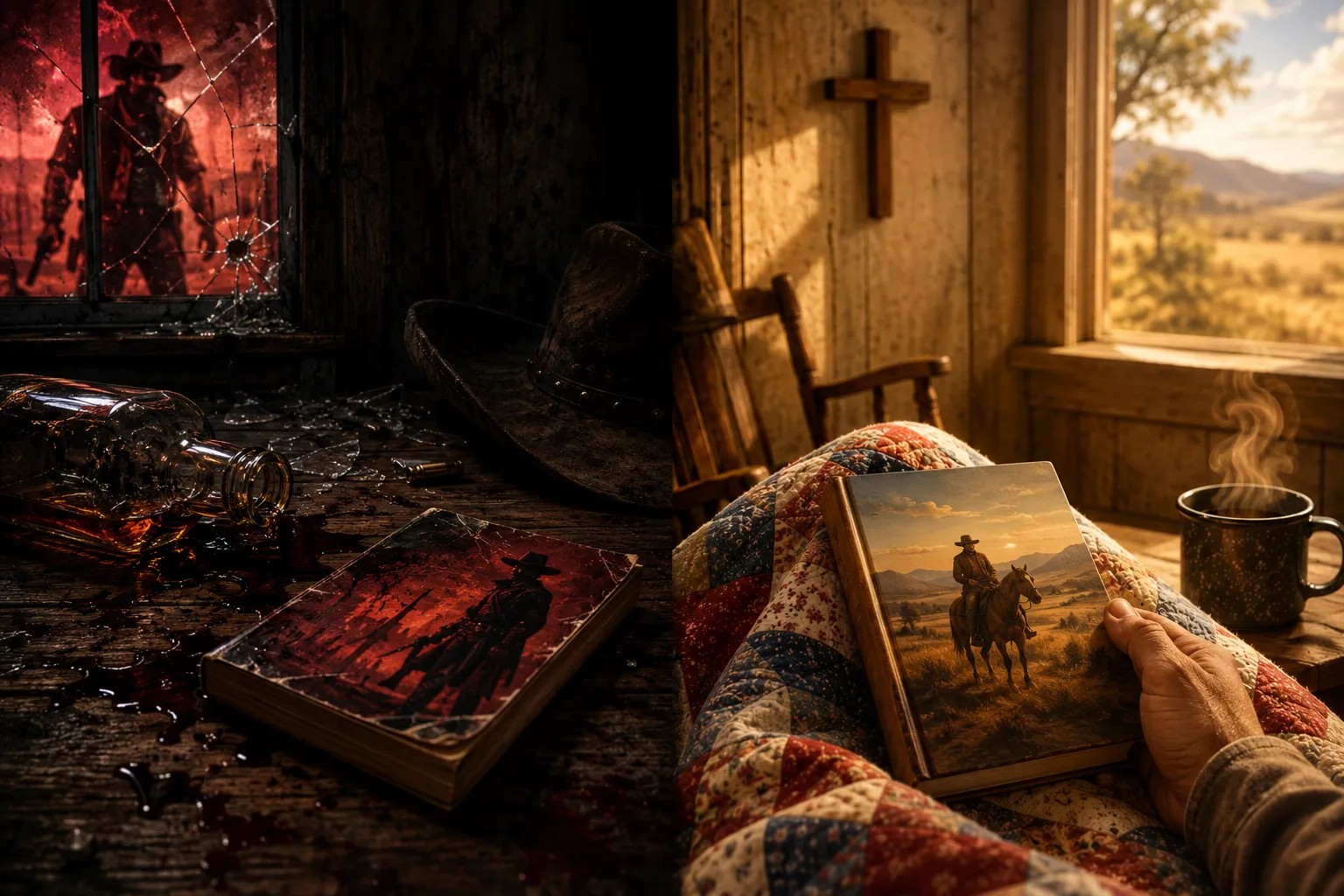
Clean westerns and traditional westerns share the same setting, frontier towns, territorial disputes, open land, hard men and harder choices, but diverge in content contract and often in thematic focus.
Traditional westerns often center individual toughness, physical dominance, and survival. Moral questions exist but are frequently resolved through force. Language is rough, violence can be graphic, and the code of honor is personal rather than communal or faith-rooted.
Clean westerns tend to center conscience, community, and consequence. The protagonist’s toughest moment is often a choice, not a gunfight, and the resolution costs something real. Mercy and justice sit in tension rather than one simply winning.
| Element | Traditional Western | Clean Western |
|---|---|---|
| Language | Profanity common | None |
| Violence | Can be graphic/detailed | Present, consequence-focused |
| Romance | Varies; can be explicit | Closed-door or absent |
| Moral framework | Personal code | Often community/faith-rooted |
| Audience | General adult | Family, faith, all ages |
Do Clean Westerns Still Have Good Action and Adventure?
Yes, and this is the question that matters most to readers who’ve been burned by “clean” labels that turned out to mean “dull.” The best clean western novels with no swearing or graphic content carry genuine tension, real stakes, and moral pressure that hits harder than any gunfight.
The action in a clean western tends to be purposeful rather than decorative. A land dispute where a widow could lose everything. A false warrant that forces a lawman to choose between the seal on the paper and the truth he knows. A fire-loss claim that doesn’t add up, and a man who has to speak before the record hardens.
What clean westerns deliver that traditional westerns often don’t:
- Moral jeopardy that outlasts the physical danger
- Characters whose choices have real consequences for other people
- Resolution that costs something, grace shows up after cost, not instead of it
- Settings treated with emotional specificity: the railroad town, the survey line, the orchard claim
Silas Bellhaven’s The Mercy Line series operates exactly on this principle. The conscience line for the series, “Where law runs out, a man finds what he answers to”, signals that the real action is always internal as well as external. Book 1, The False Warrant, puts protagonist Caleb in a position where a territorial seal doesn’t make a custody lawful, and he has to decide what obedience is actually worth. That’s not a quiet story. It’s a story where the stakes are real and the resolution is earned.
Western Authors Known for Family-Friendly and Faith-Rooted Books
Several authors have built catalogs specifically around clean Christian western fiction or family-friendly frontier stories.
Silas Bellhaven (The Mercy Line), Clean Christian frontier western set in the railroad town of Mercy Crossing. No profanity, no graphic violence, no romance content. Faith handled as lived experience, characters face questions of justice, mercy, and what a man answers to when law runs out. Nine books currently available, all on Kindle Unlimited. Browse the series.
Gilbert Morris, Prolific Christian historical fiction author whose House of Winslow series spans American frontier history with faith-forward characters and clean content. A foundational name in the genre.
Janette Oke, Best known for Love Comes Softly, her prairie/frontier novels established the template for clean Christian western romance. Consistently family-appropriate.
Brock and Bodie Thoene, Their Shiloh Legacy and other frontier series blend historical accuracy with faith-rooted characters and clean content standards.
Grace Livingston Hill, Early 20th-century author whose frontier and rural fiction remains a touchstone for readers who want faith woven into story without moralizing.
Note: Always verify current titles against reader reviews for content, as catalog content can vary across a long career.
Best Clean Western Novels for Families, and Are They Right for Teens?
Clean western novels with no swearing or graphic content are generally appropriate for teen readers, though the thematic complexity varies. Most clean Christian westerns are written for adults but contain nothing a thoughtful teenager couldn’t engage with.
For families and teens, look for:
- No profanity (verified in reviews, not just the label)
- Violence handled at the level of consequence rather than description
- Moral questions that reward discussion, justice vs. mercy, truth-telling, what loyalty costs
- Faith present but not preachy, characters who doubt and work through it are more useful to teen readers than characters with tidy answers
The Mercy Line by Silas Bellhaven fits this profile well. The series carries masculine-only leads and a romance-absent content contract, which makes it particularly appropriate for readers who want frontier adventure without any romantic content at all, teen or adult.
For younger teens (13-15), Janette Oke’s Love Comes Softly series is a perennial recommendation. For older teens and adults who want more moral complexity, The Mercy Line or Gilbert Morris’s frontier novels offer real stakes without content concerns.
Clean Western Romance Novels, What to Expect
Clean western romance exists as its own distinct subgenre, and it’s growing. The closed-door romance surge that reshaped the broader romance market post-2023 has benefited Christian and clean western romance directly [1].
What “clean western romance” means in practice:
- Romantic tension and emotional connection are central to the plot
- Physical intimacy stays off-page (closed-door) or is limited to hand-holding/a kiss
- No explicit content of any kind
- Faith may or may not be present, “clean” and “Christian” are not the same label
Authors and series to look for:
- Janette Oke’s prairie romance series remains the genre standard
- Lori Copeland and Virginia Smith have written clean western romance with faith elements
- Search Kindle Unlimited for “clean western romance” and filter by reader reviews that specifically confirm content
One honest caution: The “inspirational romance” label covers a wide range. Some titles labeled inspirational include content that doesn’t meet a strict clean standard. Reader reviews on Amazon are more reliable than publisher category labels for confirming actual content.

How to Find Wholesome Western Fiction, and Where to Buy It
Finding genuinely clean western novels with no swearing or graphic content requires more than trusting a category label. Here’s a practical approach that works in 2026.
Step 1: Start with verified clean publishers and imprints
- Barbour Publishing, Bethany House, and Revell consistently publish clean/Christian western fiction
- Independently published authors on Kindle Unlimited increasingly use “clean” and “Christian” in their series descriptions with specific content disclosures
Step 2: Read the “Look Inside” sample The opening pages of a book reveal tone faster than any label. If the prose is warm, grounded, and specific, if faith shows up in a character’s hesitation rather than a narrator’s explanation, the rest of the book will likely hold.
Step 3: Check Amazon reviews for content mentions Search the review text for words like “language,” “violence,” “content,” or “clean.” Readers who care about this will say so, positively or negatively.
Step 4: Use Kindle Unlimited strategically KU allows sampling without financial risk. The clean Christian western market is well-represented on KU, and the ability to return a book that doesn’t meet content expectations makes it the safest discovery platform [3].
Where to buy:
- Amazon Kindle / Kindle Unlimited, largest selection, best content filtering via reviews
- Christianbook.com, curated Christian fiction including western titles
- Author websites, direct links to verified series pages (e.g., Silas Bellhaven’s author page)
How Do Publishers Label Clean Western Novels?
There is no single industry-wide standard for “clean” labeling in fiction, which is exactly why readers get burned. Publishers Weekly has noted the ongoing tension between “clean” and “Christian” as distinct but overlapping market signals [source: industry consensus, 2025].
Current labeling practices:
- “Clean”, content-based label meaning no profanity, no graphic violence, no explicit scenes. Does not require faith content.
- “Christian fiction”, faith is a central story element. Usually also clean, but the emphasis is on worldview, not content rating.
- “Inspirational”, the softest label. Can mean anything from deeply faith-rooted to simply “uplifting tone.” Not a reliable content guarantee.
- “Wholesome” or “family-friendly”, informal, unregulated. Check reviews.
The Christian fiction segment has expanded significantly, with data from early 2026 showing a 14.7% yearly surge in the category, driven partly by readers who want faith represented honestly in fiction and partly by the broader clean content demand that has reshaped romance and genre fiction since 2023 [4].
Practical rule: Trust specific content disclosures in book descriptions over category labels. An author who writes “no profanity, no graphic violence, no explicit content” in their series description is making a verifiable promise. A category label is not.
Western Novels With Strong Moral Values, What That Actually Looks Like on the Page
Strong moral values in western fiction aren’t delivered through speeches. They show up in the choices characters make when no one is watching, and in what those choices cost.
The best clean western novels with no swearing or graphic content build moral weight through:
- Consequence that follows choice, a man who files a false claim loses more than the land
- Mercy that arrives after cost, grace isn’t cheap, and the story doesn’t pretend otherwise
- Truth-telling under pressure, the record, the ledger, the testimony that someone has to speak or stay silent about
- Community accountability, in frontier settings, what one person does ripples outward
In The Mercy Line, this plays out through documents and records, land claims, labor bonds, survey lines, ash ledgers. The moral question is always: what will you do with the truth once you’re holding it? That’s not a western dressed up with a Bible verse. That’s faith under fire, worked out through plot.
What strong moral values are not:
- Characters who never doubt
- Villains who are purely evil with no comprehensible motivation
- Redemption that costs nothing
- A conversion scene that resolves the story’s central tension
Earned redemption, not cheap grace, is the mark of western fiction that takes moral values seriously.
Common Mistakes When Writing Clean Western Fiction
For writers working in this space, a few patterns consistently undermine otherwise strong clean western novels.
Mistake 1: Sanitizing the stakes Removing profanity and graphic content doesn’t mean removing danger. A clean western still needs real jeopardy, physical, moral, relational. Readers who choose clean fiction aren’t choosing easy fiction.
Mistake 2: Using faith as a shortcut A character who prays and immediately receives clarity isn’t experiencing faith, they’re experiencing a plot device. Faith that costs something, that gets tested and doesn’t resolve cleanly, is what makes clean Christian western fiction honest rather than formulaic.
Mistake 3: Confusing “clean” with “gentle” Clean is a content standard. Gentle is a tone. The best clean westerns are not gentle, they’re just not gratuitous. There’s a significant difference.
Mistake 4: Relying on the label instead of the prose Calling a book “clean Christian western” in the metadata doesn’t make it feel that way. The tone of the prose, the specificity of the setting, the moral weight of the choices, the way faith shows up in action rather than narration, has to carry the promise before the reader finishes the first chapter.
Mistake 5: Avoiding conflict to stay “appropriate” Conflict avoided is story avoided. Clean fiction earns its comfort through honesty about hard things, not by sidestepping them.
Can Clean Westerns Appeal to Adult Readers Who Don’t Usually Read Christian Fiction?
Yes, and this is one of the more important market realities of 2026. The adult fiction market has shown strong performance, with readers across demographics seeking content that delivers real stakes without content they find objectionable [2].
Clean western fiction appeals to adult readers outside the Christian fiction audience for several reasons:
- The frontier setting carries inherent moral weight, land, law, justice, survival, that doesn’t require faith framing to be compelling
- The absence of gratuitous content is increasingly a feature, not a limitation, as readers across age groups report fatigue with shock-value fiction [1]
- Character-driven moral complexity, the kind clean westerns do well, is what literary readers value most
The Christian fiction segment specifically has seen a 14.7% yearly surge, with expansion driven partly by readers who want faith represented honestly and partly by the broader clean content demand [4]. That growth isn’t coming only from existing church communities, it’s coming from readers who simply want stories that walk with them, not talk at them.
Choose clean western fiction if:
- You want frontier action with moral stakes and no content concerns
- You’re reading with family or recommending to teens
- You’re tired of “clean” labels that don’t hold
- You want faith handled as lived experience rather than lesson
It may not be the right fit if:
- You specifically want gritty, graphic frontier realism
- You find any faith content in fiction off-putting
FAQ
What does “clean western novel” mean exactly? A clean western novel contains no profanity, no graphic violence, and no explicit sexual content. Violence may be present but is handled with consequence rather than graphic detail. It’s a content standard, not a genre.
Are clean westerns the same as Christian westerns? Not exactly. Christian westerns center faith as a load-bearing story element. Clean westerns simply meet a content standard, no profanity, no graphic content, regardless of faith framing. Most Christian westerns are also clean, but not all clean westerns are Christian.
What is The Mercy Line by Silas Bellhaven? The Mercy Line is a clean Christian frontier western series set in the railroad town of Mercy Crossing. It carries a romance-absent content contract and centers questions of justice, mercy, and conscience. Nine books are currently available on Kindle Unlimited. Series page here.
Are clean western novels appropriate for teenagers? Most are. Clean westerns by definition contain no profanity, no graphic violence, and no explicit content. Thematic complexity varies, some series deal with land fraud, false warrants, and moral pressure that rewards discussion with older teens.
How do I know if a western novel is actually clean before buying? Read the “Look Inside” sample, check Amazon reviews for mentions of language or content, and look for authors who make specific content disclosures in their series descriptions. Category labels like “inspirational” are not reliable on their own.
Where can I find clean western novels on Kindle Unlimited? Search Amazon for “clean western” or “Christian western” and filter results. Kindle Unlimited allows you to read and return titles, making it the lowest-risk discovery platform for this genre.
Do clean westerns have romance? Some do and some don’t. Clean western romance exists as a subgenre, Janette Oke’s prairie novels are the classic example. Some series, like The Mercy Line, carry a romance-absent content contract entirely.
What’s the difference between “clean” and “wholesome” fiction labels? “Clean” is a content-based term with reasonably consistent meaning (no profanity, no graphic violence, no explicit content). “Wholesome” is informal and unregulated, it can mean almost anything. Rely on specific content disclosures and reader reviews over either label.
Can clean western fiction have real stakes and tension? Absolutely. The best clean westerns build tension through moral jeopardy, not graphic content. A false warrant, a disputed land claim, a record that names the wrong person, these carry genuine stakes without requiring shock value.
Is the clean fiction market growing? Yes. Christian fiction has shown a 14.7% yearly surge [4], and the broader clean romance and clean fiction categories have grown significantly since 2023, driven by Kindle Unlimited readers and readers seeking content they can trust [1].
Conclusion
Clean western novels with no swearing or graphic content aren’t a compromise, they’re a choice about what story actually requires. The frontier has always been a setting where conscience gets tested, where law and justice don’t always point the same direction, and where a man finds out what he answers to when no one else is watching. None of that requires profanity or graphic violence to land.
The market in 2026 reflects what readers have been signaling for years: there’s real appetite for fiction that takes faith seriously, handles hard things honestly, and earns its hope rather than manufacturing it. The growth in Christian fiction and clean romance isn’t a niche trend, it’s a correction toward stories that walk with readers rather than performing for them [4].
Actionable next steps:
- Start with a verified series, The Mercy Line by Silas Bellhaven (Book 1: The False Warrant) offers a complete clean Christian frontier western experience with a specific content contract.
- Use Kindle Unlimited to sample titles before committing, it’s the most reliable discovery tool for clean western fiction.
- Read the “Look Inside” sample before any purchase, the tone of the first chapter tells you everything the label won’t.
- Check reader reviews for content mentions, not just star ratings.
- Browse Silas Bellhaven’s full catalog at amazon.com/stores/Silas-Bellhaven/author/B0H42BDQBK for clean Christian fiction across western, mystery, fantasy, and thriller.
The record of what clean western fiction can do is still being written. The best of it doesn’t avoid hard things, it just refuses to let hard things have the last word.
References
[1] Clean Romance – https://k-lytics.com/clean-romance/
[2] Adult Fiction Outperforms The U.S. Book Market In 2023 Circana Reports – https://www.circana.com/post/adult-fiction-outperforms-the-u-s-book-market-in-2023-circana-reports
[3] Best Selling Christian Fiction – https://www.accio.com/business/best_selling_christian_fiction
[4] Christian Fiction 14.7 Yearly Surge Dramatic Market Expansion Data – https://www.firmenpresse.de/pressrelease734029/christian-fiction-14-7-yearly-surge-dramatic-market-expansion-data.html