Last updated: August 5, 2026
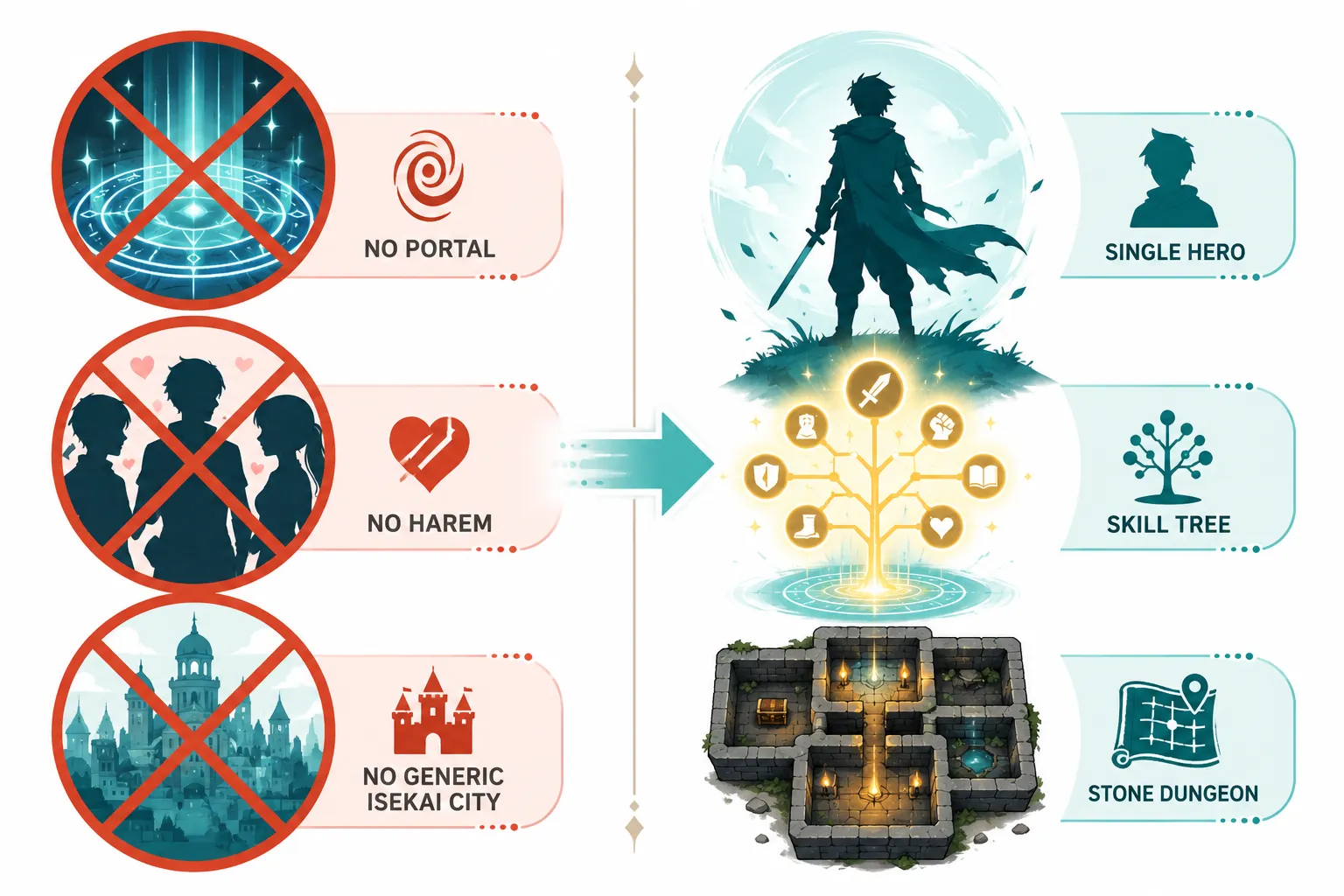
Quick Answer: Clean LitRPG with no harem or isekai cliches exists and is growing, but you have to know where to look. These are game-mechanic-driven fantasy novels that keep the stat screens and skill progression while cutting the transported-to-another-world setup and the romantic-competition subplots that crowd out actual story. The genre has enough of these titles to build a full reading list, and the demand for them is loud, active, and easy to find on any LitRPG community forum.
Key Takeaways
- LitRPG is a fantasy subgenre built around game mechanics, stat screens, leveling systems, skill trees, woven into the narrative itself, not just the setting.
- Isekai means the protagonist is transported to another world; many LitRPG stories use this as a default setup, but it is not required by the genre.
- Harem subplots, where a protagonist accumulates multiple romantic interests, appear frequently in LitRPG but are a tonal choice, not a structural necessity.
- Reader demand for clean LitRPG with no harem or isekai cliches is well-documented across Reddit communities and progression fantasy forums. [2][4][7]
- The LitRPG market has shifted toward a “red ocean” of standard tropes, pushing authors toward differentiation through tone, values, and character depth. [5]
- Clean, faith-rooted LitRPG, like Silas Bellhaven’s The Measured Debt series, demonstrates that earned progression and moral weight can carry a story without either trope.
- Female protagonists in LitRPG can and do avoid harem dynamics entirely; several well-regarded titles center women in purely strategic or character-driven arcs.
- New explicitly Christian LitRPG releases in 2026 signal a growing segment of the market committed to clean, trope-conscious storytelling.
What Is LitRPG and How Is It Different From Regular Fantasy
LitRPG is a subgenre of fantasy fiction where game mechanics, experience points, skill trees, stat screens, level-up notifications, are literally present in the story world and visible to the reader. The characters don’t just live in a fantasy setting; they interact with a system that quantifies their growth.
Regular fantasy might describe a warrior becoming stronger through training and experience. LitRPG shows that same progression as a notification: Strength increased by 3. New skill unlocked: Iron Grip. The mechanics are part of the narrative, not just the backdrop.
What separates good LitRPG from shallow LitRPG is whether the system serves the character or replaces them. In the best examples, the numbers track real moral and emotional cost, every point earned means something was spent.
Why Do So Many LitRPG Stories Have Harem Subplots
Harem subplots became common in LitRPG partly because the genre grew alongside Japanese light novel and web novel traditions where that structure was already normalized. When Western LitRPG authors began writing for platforms like Royal Road, many absorbed those conventions without questioning them. [3]
The result: a protagonist who levels up also tends to attract multiple romantic interests, and those relationships often substitute for genuine character development. Readers who came to LitRPG for progression mechanics and strategy found themselves wading through relationship competition arcs that had nothing to do with the dungeon in front of them.
Why this matters for readers who want clean fiction:
- Harem subplots rarely stay mild, they escalate toward explicit content as a series continues.
- They shift narrative focus from earned growth to social status and attraction.
- They frequently sideline female characters into roles defined entirely by their relationship to the protagonist.
The demand for clean LitRPG with no harem or isekai cliches is not a niche preference. It is a documented, recurring request across every major LitRPG community. [4][7]
LitRPG Recommendations for Readers Who Hate Isekai
Isekai, the “transported to another world” premise, is so common in LitRPG that some readers assume it is the genre. It is not. [2][6]
LitRPG series that avoid isekai setups entirely:
- The Measured Debt by Silas Bellhaven, Set entirely within the world of Federated Record, where a dungeon-clearance system governs labor, debt, and survival. Eamon Kersey was never transported anywhere; he was born into a world where the system is the economy. No portal. No “chosen one from Earth.” (Series page)
- Dungeon Crawler Carl by Matt Dinniman, Earth is invaded and transformed; the protagonist never leaves his own planet’s ruins.
- He Who Fights With Monsters by Jason Cheyne, Technically begins with a transport, but quickly becomes a permanent-resident story focused on strategy and growth rather than the “stranger in a strange land” dynamic.
- Defiance of the Fall by JF Brouwer, The system apocalypse comes to the protagonist’s world; he does not leave it.
Choose isekai-free LitRPG if you want the progression mechanics to feel earned within a coherent world rather than handed to a confused outsider who gets lucky.
How to Find LitRPG That Doesn’t Rely on the Transported-to-Another-World Premise
The most reliable method is to filter by premise, not just genre tag. Search terms that help:
- “system apocalypse” (the game comes to the real world)
- “born into the system” (the character has always lived in a game-mechanic world)
- “dungeon native” (the protagonist is part of the world, not a visitor)
- “LitRPG no portal”, an explicit search term used in Reddit threads [2][4]
Reddit’s r/litrpg community maintains active recommendation threads specifically for non-isekai titles, and the responses are detailed and reader-tested. [2][7] Royal Road’s tagging system allows filtering by “no transported protagonist” in some thread categories. [3]
Common mistake: Assuming that a first-person stat-screen narrative is automatically isekai. Many of the best LitRPG titles use that format with protagonists who are fully native to their world.
Can You Have a Good LitRPG Without a Romantic Subplot
Yes, and in many cases, removing the romantic subplot makes the progression mechanics stronger, not weaker. [8]
When a story’s emotional weight rests entirely on skill development, moral choice, and consequence, the reader invests in the character’s growth rather than their social life. This is the structural logic behind clean LitRPG with no harem or isekai cliches: the system becomes a moral ledger, not a dating score.
Silas Bellhaven’s The Measured Debt operates on exactly this premise. Eamon Kersey’s position in the record keeps shifting not because of who he’s attracted to, but because of what he’s willing to do, and what he isn’t. The cost of each choice shows up in the numbers. Grace, when it arrives, has already been paid for.
Signs a LitRPG handles romance well (or skips it cleanly):
- Romantic elements, if present, affect the plot and cost the character something real.
- Female characters have goals and agency outside of the protagonist’s arc.
- The story doesn’t pause its main tension to resolve a love triangle.
Clean LitRPG With Strong Character Development Instead of Romance
The best clean LitRPG with no harem or isekai cliches replaces romantic tension with something harder to write: moral tension. The character has to make choices that reveal who they actually are, and the system records the result.
What strong character development looks like in LitRPG:
- Skills and stats reflect internal change, not just combat wins.
- The protagonist fails, recalibrates, and earns the next level rather than receiving it.
- Secondary characters have their own arcs that don’t orbit the protagonist’s appeal.
- The world pushes back, the system isn’t always fair, and that unfairness matters.
The Cost of Being Chosen (Book 1 of The Measured Debt) opens with Eamon’s name clearing every collapse at Federated Record, which sounds like a blessing until the position series starts asking why he’s always the last one standing. That question is more interesting than any romantic subplot, and it carries the series without needing one.
LitRPG Books Focused on Progression and Strategy, Not Relationships
These titles are consistently recommended in clean-LitRPG threads for their emphasis on tactical depth and earned advancement: [2][4][9]
| Title | Why It Works | Isekai? | Harem? |
|---|---|---|---|
| The Measured Debt (Bellhaven) | Moral-weight progression, faith-rooted | No | No |
| Dungeon Crawler Carl (Dinniman) | Dark humor, strategic depth, real stakes | No | No |
| Defiance of the Fall (Brouwer) | System apocalypse, long-form power growth | No | No |
| The Land (Elliot Kay) | World-building depth, slow-burn strategy | No | Mild |
| Canthany Rising (Bliss, 2026) | Explicitly clean, Christian, teen-appropriate | No | No |
Note: Content ratings reflect general reader consensus; individual volumes may vary.
LitRPG With Female Protagonists That Avoid Harem Dynamics
Female-led LitRPG that skips harem dynamics is less common than it should be, but it exists and is growing. The key distinction: a female protagonist in a harem-adjacent story is usually positioned as one of the love interests. A female protagonist in clean LitRPG is the one doing the leveling up.
What to look for:
- The protagonist’s goals are defined by the system’s challenges, not by a central male figure.
- Romantic subplots, if present, are secondary and don’t determine the plot’s outcome.
- The character’s skill tree reflects her choices, not her relationships.
The LitRPG community has noted that female-led progression fantasy tends to appear more often in the “cultivation” adjacent space and in Christian or clean-fiction imprints, where the content contract rules out harem structures by default. [8]
What Makes a LitRPG Feel Fresh and Original in 2026
The LitRPG market has moved from novelty to saturation for standard tropes. A July 2026 market analysis described the genre’s shift from “blue ocean” to a “red ocean” for isekai, system apocalypse, harem, and edgy satire, forcing authors toward new differentiators: tone, values, and production quality. [5]
What’s actually fresh right now:
- Moral systems, where the stat screen tracks ethical choices, not just combat wins.
- Grounded worlds, the system exists within a coherent economy or society, not as a floating overlay on a generic fantasy map.
- Faith-rooted progression, earned grace as a mechanic, where redemption costs something and the system records the debt honestly.
- Non-portal premises, the protagonist belongs to the world from the start.
- Clean content as a feature, not a disclaimer, but a structural choice that keeps the story’s tension on the right things.
Kenneth Bliss’s Canthany Rising, announced July 7, 2026, is one of the clearest recent examples: explicitly marketed as clean, Christian, and deliberately scrapping “core tropes” of the genre, with action-focused content appropriate for teen readers and up. That kind of conscious positioning reflects where the market’s underserved readers actually are.
Best Clean LitRPG for Someone New to the Genre Who Wants It Clean
Start with a title that makes the mechanics feel natural rather than mechanical, and that gives you a protagonist worth following before it gives you a stat screen.
Recommended entry points for clean LitRPG with no harem or isekai cliches:
- The Cost of Being Chosen (The Measured Debt, Book 1), Faith-rooted, no harem, no portal, moral weight built into the progression system. (Amazon)
- Dungeon Crawler Carl, Accessible, funny, strategically rich, with real stakes and no harem elements.
- Defiance of the Fall, System apocalypse premise, long series with consistent quality, no transported protagonist.
If you’re new to LitRPG and want it clean, start with a book where the protagonist has something to lose beyond a love interest. The mechanics will make sense once the stakes are real.
Conclusion: Where to Go From Here
Clean LitRPG with no harem or isekai cliches is not a compromise version of the genre. It is the version where the progression mechanics actually mean something, where every level earned reflects a choice made, a cost paid, and a character who had to become someone different to survive what the system put in front of them.
Actionable next steps:
- Browse The Measured Debt series on Amazon (series page), three books, clean content, faith-rooted progression, no harem, no portal.
- Search r/litrpg for “no isekai” or “no harem” threads, the community maintains active, reader-tested recommendation lists. [2][4][7]
- Filter Royal Road by tags, the platform allows genre-specific filtering that can surface non-isekai, non-harem progression fiction. [3]
- Look for clean or Christian LitRPG imprints, the content contract built into faith-based fiction eliminates harem dynamics by default and tends to prioritize earned progression over shock value.
The story worth reading is the one where grace shows up after cost, not instead of it. That kind of LitRPG exists. It just requires knowing what to filter out first.
FAQ
What does “clean LitRPG” mean? Clean LitRPG is progression fantasy with game mechanics that contains no explicit sexual content, no graphic gore, and no profanity. The story’s tension comes from character development, strategy, and moral choice rather than shock value.
Is all LitRPG isekai? No. Isekai, transported to another world, is a common setup but not a requirement. Many LitRPG stories are set in worlds where the game system is native, or where the system invades the protagonist’s own world.
What is a harem subplot in LitRPG? A harem subplot is when the protagonist, usually male, accumulates multiple romantic interests who compete for his attention. It is a tonal and structural choice, not a genre requirement, and it is absent from many well-regarded LitRPG series.
Can LitRPG have faith themes? Yes. Faith-rooted LitRPG treats the progression system as a moral ledger, earned grace, real cost, honest consequence. Silas Bellhaven’s The Measured Debt is the clearest current example of this approach.
Where do readers find non-isekai LitRPG recommendations? Reddit’s r/litrpg community has multiple active threads specifically requesting non-isekai titles. [2][4][7] Royal Road forums also maintain genre-filtered recommendation threads. [3]
Is clean LitRPG only for religious readers? No. Clean content simply means the story avoids explicit material. Many readers who have no faith background prefer clean LitRPG because it keeps the narrative focus on progression and strategy rather than sexual content.
What is the difference between LitRPG and progression fantasy? LitRPG shows game mechanics explicitly in the text, stat screens, notifications, numerical skill levels. Progression fantasy is a broader category that includes any story about a character growing in power or ability, with or without visible mechanics.
Are there clean LitRPG series with female protagonists? Yes, though they are less common than male-led series. Female-led clean LitRPG tends to appear in cultivation-adjacent fiction and faith-based imprints, where harem structures are ruled out by the content contract.
What is the best first clean LitRPG book to read? The Cost of Being Chosen by Silas Bellhaven or Dungeon Crawler Carl by Matt Dinniman are both strong entry points, one faith-rooted and morally weighted, the other strategically rich and darkly funny. Both avoid harem and isekai setups entirely.
Is the clean LitRPG market growing? Yes. July 2026 market analysis noted that standard LitRPG tropes have reached saturation, pushing readers and authors toward differentiation through tone, values, and content quality. [5] New explicitly clean and Christian LitRPG releases in 2026 reflect this shift.
References
[1] What Are Your Predictions For This Genre In 2025 – https://www.reddit.com/r/haremfantasynovels/comments/1hqr0md/what_are_your_predictions_for_this_genre_in_2025/ [2] Looking For Recs New To Litrpg But Not Isekai – https://www.reddit.com/r/litrpg/comments/wopkh0/looking_for_recs_new_to_litrpg_but_not_isekai/ [3] royalroad – https://www.royalroad.com/forums/thread/120466 [4] Litrpg Books That Arent Isekai Or System – https://www.reddit.com/r/litrpg/comments/1idkju6/litrpg_books_that_arent_isekai_or_system/ [5] Best Selling Litrpg Books – https://www.accio.com/business/best-selling-litrpg-books [6] Litrpg Got Isekaid Into The Mainstreamand Thats Bad – https://fantasylitguy.blog/2025/06/05/litrpg-got-isekaid-into-the-mainstreamand-thats-bad/ [7] Any Recommendations On Nonisekai Nonreincarnation – https://www.reddit.com/r/litrpg/comments/1gj5x0h/any_recommendations_on_nonisekai_nonreincarnation/ [8] Tell Me About Your Litrpg Reading Habitsfor – https://www.reddit.com/r/litrpg/comments/1bpcj9g/tell_me_about_your_litrpg_reading_habitsfor/ [9] Progression Fantasy Recs That Dont Contain Isekai – https://www.reddit.com/r/ProgressionFantasy/comments/wtp7ys/progression_fantasy_recs_that_dont_contain_isekai/ [10] Good Litrpg Books That Arent Isekai – https://www.reddit.com/r/litrpg/comments/179pu9w/good_litrpg_books_that_arent_isekai/