
Last updated: August 7, 2026
Quick Answer: Christian epic fantasy worldbuilding works best when faith is load-bearing architecture, not decoration. The most effective approach builds spiritual truth into the world’s laws, history, and consequences so that characters encounter God’s character through plot events rather than dialogue speeches. Faith under fire, earned grace, and mercy that costs something, these are the structural elements, not the sermon topics.
Key Takeaways
- Faith should function as a worldbuilding law, not a narrative footnote, it shapes geography, politics, prophecy, and consequence
- The difference between preaching and storytelling is simple: one character explains truth to the reader, the other discovers it through cost
- Allegory (Narnia) and subtle integration (The Lord of the Rings) are two distinct tools, both work, but they require different worldbuilding commitments
- Non-Christian characters in a faith-based world are not obstacles; they’re the most honest mirrors of what belief actually costs
- The biggest craft mistake is resolving spiritual tension too cleanly, cheap grace kills story momentum and reader trust
- Christian epic fantasy can and does reach mainstream readers when the story’s stakes are real and the faith is lived, not lectured
- Publishing options in 2026 include traditional CBA houses, hybrid presses like Enclave, and direct-to-reader KDP/KU strategies
- Realm Makers (St. Louis, June 2026) remains the primary professional community for faith-driven speculative fiction writers
What Is Christian Epic Fantasy and How Does It Differ from Regular Fantasy
Christian epic fantasy is secondary-world speculative fiction in which the moral and spiritual architecture of the world reflects a Christian worldview, not as a tag or disclaimer, but as the load-bearing structure of the story. It differs from secular epic fantasy not primarily in content restrictions but in the source of meaning behind sacrifice, redemption, justice, and hope.
In secular epic fantasy, a character might sacrifice themselves for the greater good because heroism is culturally coded as admirable. In Christian epic fantasy, that same sacrifice carries weight because the world’s laws, its covenant structure, its understanding of mercy and justice, point toward something the reader recognizes as true. The cost is real. The meaning is grounded.
What this looks like in practice:
- Magic systems or power structures that carry moral consequence, not just tactical trade-offs
- History shaped by covenant, betrayal, and restoration rather than pure political cycles
- Prophecy that functions as promise rather than determinism, characters still choose
- Institutions (churches, guilds, record-keepers) that can be corrupt without the faith they represent being discredited
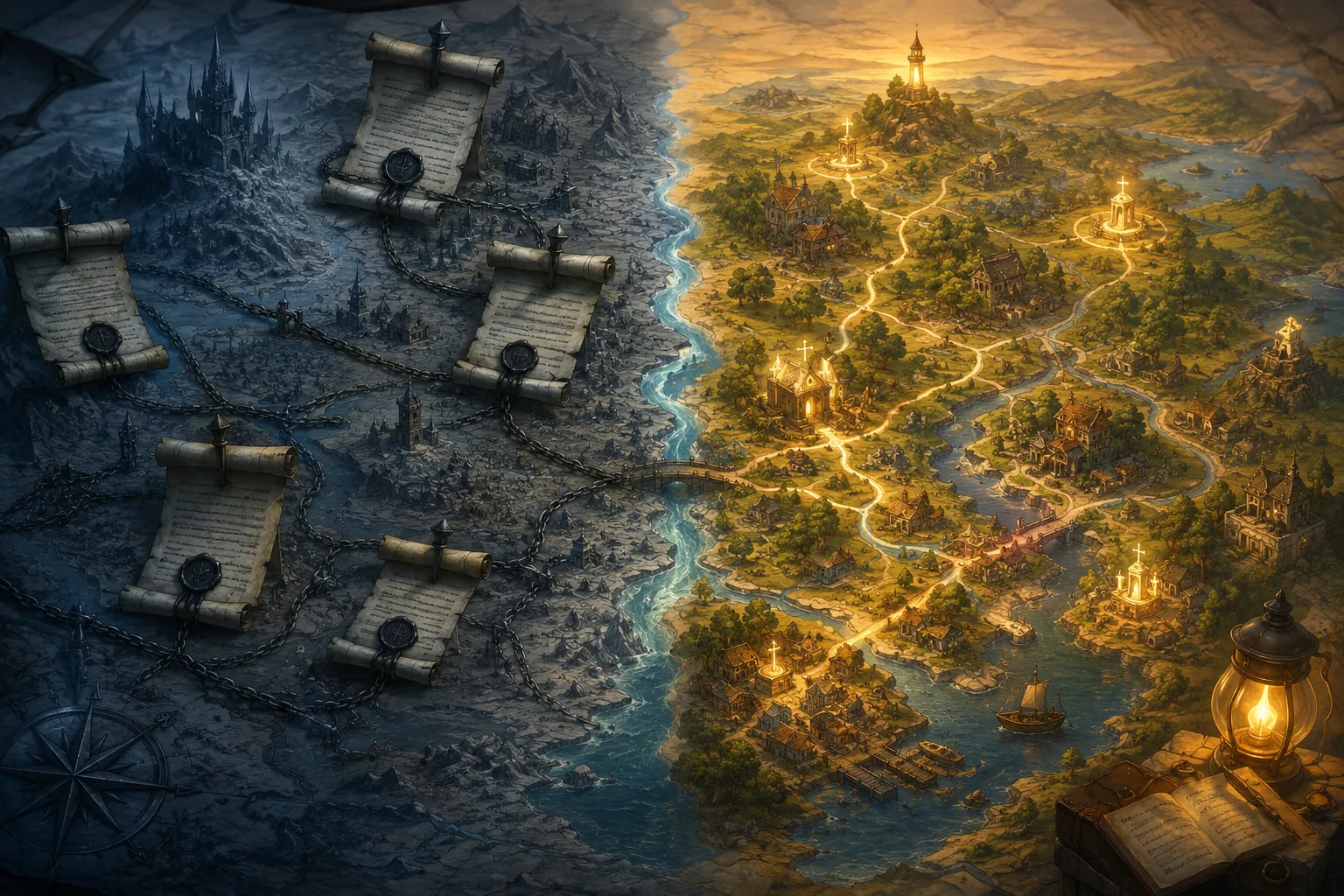
The Sarel Chronicles, Silas Bellhaven’s Maker’s Map trilogy, illustrate this well. In Sarel, silver roads mark answered prayers, certified by the House of Witness. When that institution starts using those roads to justify abandonment, the world’s faith structure isn’t invalidated. It’s being tested. That distinction is everything.
How Do You Weave Faith Into a Fantasy World Without It Feeling Preachy
Faith feels preachy in fiction when a character explains it to another character who exists only to receive the explanation. It feels organic when the world’s own events force characters to reckon with spiritual questions they didn’t choose to ask. [7]
The craft rule is this: show the character’s misbelief about God as the engine of the arc, and let the plot dismantle it. [2] The reader arrives at the truth alongside the protagonist, not ahead of them.
A practical framework for organic faith integration:
- Establish the world’s spiritual laws early, what does the world believe about the divine, and what evidence exists that those beliefs are true or contested?
- Give your protagonist a specific wound or misbelief about grace, justice, or God’s attention, not a generic “I don’t believe,” but a particular, earned doubt
- Let plot events pressure that misbelief, not a mentor correcting it, but consequences revealing it
- Place mercy and justice in genuine tension, situations where the character cannot have both, and must choose
- Let grace arrive after cost, earned grace is the only kind that lands with weight in fiction or in life
Michelle Griep’s guidance on this is sharp: Christian writers are not preachers. The job is to “woo” readers by showing right and wrong through character action and consequence, not by pointing a finger. [7] Sarah Hamaker’s 2026 craft guidance echoes this, let the narrative drive the action, not the message. [12]
What Are the Best Examples of Christian Themes in Fantasy That Work Well
The strongest examples succeed because faith is structural, not decorative. C.S. Lewis’s Narnia works because Aslan’s sacrifice carries actual cosmic weight within the world’s laws, the Deep Magic isn’t a metaphor bolted onto the story; it is the story’s physics. Tolkien’s Middle-earth works differently: there’s no explicit theology, but the world’s moral architecture, the cost of the Ring, the nature of mercy toward Gollum, the grace of the Shire, reflects a deeply Christian understanding of temptation, sacrifice, and hope. [10]
More recent examples include:
- The Kethara Chronicles (Silas Bellhaven), an empire that tries to count and contain every act of mercy, and two women carrying a covenant word the auditors cannot own
- The Map of Unanswered Prayers (Silas Bellhaven), a map-scribe marked by a prayer the official record refused to acknowledge, in a world where the gap between institutional religion and lived faith is the central conflict
- Worlds Collide by Clint Hall (Enclave, July 2026), a recent release demonstrating the category’s continued vitality in traditional publishing
What these share: the faith isn’t explained. It’s inhabited.
How Much Should Religion Play a Role in Epic Fantasy Worldbuilding
Religion should play exactly as much role as it would in a real secondary world, which is to say, a great deal, because pre-modern societies organized everything around their understanding of the divine. The question isn’t how much but how honestly. [5]
Use this decision framework:
| Approach | Best for | Risk |
|---|---|---|
| Explicit allegory | Readers who want clear spiritual parallels | Can feel heavy-handed if the allegory is too obvious |
| Integrated worldview | Broad audiences, including non-Christian readers | Requires more craft to signal clearly to faith readers |
| Background theology | Epic scope, complex political worlds | Faith can disappear into the scenery |
The sweet spot for most Christian epic fantasy is integrated worldview: the world’s spiritual laws are real and consequential, characters hold genuine belief and genuine doubt, and the story’s events test both. [8]
What Are Common Mistakes Writers Make When Adding Faith to Fantasy
The most common mistake is resolving spiritual tension too quickly and too cleanly. A character doubts, encounters a crisis, prays, and receives clear divine confirmation, all within the same chapter. That’s not faith under fire. That’s a diagram of faith. [2]
Other frequent errors:
- The mentor-as-mouthpiece, a wise elder character who exists to explain theology to the protagonist (and the reader)
- Consequence-free grace, characters receive forgiveness without the story acknowledging what their choices actually cost others
- Villain theology, making the antagonist’s worldview a straw man so the protagonist’s faith looks correct by comparison rather than earned
- Spiritual warfare as spectacle, treating demonic opposition as action-movie set pieces rather than as genuine moral and spiritual weight
- Ignoring institutional corruption, real faith traditions have always had to reckon with the gap between institution and conviction; pretending otherwise produces flat worlds [5]
The Sarel Chronicles address this directly: the House of Witness is corrupt, but the Maker-Who-Hears is not. That distinction, between the institution and the faith it was built to serve, is one of the most honest moves available to Christian epic fantasy. [9]
Is Christian Fantasy Only for Christian Readers
No. Christian epic fantasy reaches non-Christian readers whenever the story’s stakes are real and the faith is lived rather than lectured. Tolkien is the obvious proof, millions of readers who hold no Christian belief have found The Lord of the Rings profound because its moral architecture is honest about cost, loss, and the limits of power. [10]
The readers who bounce off Christian fantasy are usually bouncing off the preachiness, not the faith. When a story walks with its reader rather than talking at them, when doubt is honored, consequences are real, and grace arrives after cost, the faith becomes part of the story’s emotional truth rather than a barrier to it. [2]
Christian epic fantasy in 2026 is also finding audiences through Kindle Unlimited, where readers self-select based on story promise rather than genre label. Clean content, real stakes, and honest faith are a specific reader promise, not a restriction.
What’s the Difference Between Allegory and Subtle Faith Integration in Fantasy
Allegory maps story elements directly onto theological concepts: Aslan is Christ, the White Witch is death, the Stone Table is the cross. The reader is meant to recognize the correspondence. Subtle faith integration doesn’t ask for recognition, it builds a world whose moral laws reflect Christian truth without requiring the reader to decode it. [10]
Allegory works best when:
- The story is short enough to sustain the mapping without strain
- The target audience will find the recognition meaningful rather than reductive
- The author is willing to let the allegory be imperfect (Lewis himself said Narnia was “supposal,” not strict allegory)
Subtle integration works best when:
- The world is large and complex enough that no single mapping would hold
- The author wants to reach readers who might resist explicit allegory
- The faith questions are genuinely unresolved within the story, the world asks them, it doesn’t answer them for the reader
Most long-form Christian epic fantasy benefits from subtle integration. Allegory compresses; integration expands.
How Do You Handle Non-Christian Characters in a Faith-Based Fantasy World
Non-Christian characters, or characters who hold different beliefs within the secondary world, are not problems to solve. They’re the story’s most honest pressure points. [9]
A character who genuinely doesn’t believe, or who believes differently, forces the protagonist’s faith to be something more than cultural default. When Elya Renn in The Map of Unanswered Prayers encounters the boy whose prayer the House of Witness refused to record, the question isn’t whether the boy’s faith is correct. The question is what Elya will do with the evidence she’s now carrying.
Practical guidance:
- Give non-believing characters internally coherent reasons for their position, not strawman skepticism
- Let their worldview produce genuine goods alongside its genuine costs
- Avoid the conversion arc as the only available ending for a non-Christian character; sometimes the most honest ending is unresolved
- Let the faith-holding protagonist be genuinely challenged, not merely tested and confirmed [9]
Can You Write Christian Epic Fantasy Without Making It Didactic or Heavy-Handed
Yes, and the structural key is keeping the story’s question open longer than feels comfortable. [2]
Didacticism happens when the author knows the answer before the character does, and the plot exists to deliver that answer. The fix is to genuinely not know, within the story’s logic, whether the character will choose rightly, and to make the cost of choosing wrongly real and lasting.
A step-by-step check for heavy-handedness:
- Find every scene where a character explains a spiritual truth to another character. Ask: does this character need to say this, or is the author saying it through them?
- Find every moment of grace in the story. Ask: what did it cost? If the answer is “nothing,” the scene needs revision.
- Find the antagonist’s best argument. If it’s easy to dismiss, it’s not doing its job.
- Find the protagonist’s lowest moment. If faith rescues them too quickly, the rescue hasn’t been earned.
- Read the final chapter and ask: is the spiritual question answered or inhabited? Inhabited is almost always stronger. [8]

What Worldbuilding Elements Should Reflect Christian Values in Fantasy
Christian values in worldbuilding aren’t a checklist of content restrictions. They’re a set of structural commitments about how the world works. [5]
Elements worth building with intention:
- Justice and mercy in genuine tension, a legal or covenant system that creates real dilemmas, not easy answers
- The weight of record, what gets written down, who controls it, and what it costs to tell the truth once you’re holding it (this runs through every Silas Bellhaven series, from Mercy Crossing to Marat-Sol)
- Sacrifice that costs the giver, not heroic death as spectacle, but choices that diminish the protagonist in ways that matter to the story
- Institutional corruption without institutional abandonment, the temple can be corrupt; the covenant it was built to serve is not
- Ordinary faithfulness, the character who keeps their word in a small thing, when no one is watching, and the story notices
The Kethara Chronicles build this into the world’s political structure: an empire that wants every act of mercy counted and contained. The covenant word Amara and Sela carry cannot be owned by that system, and the story’s conflict flows entirely from that structural fact.
How Do You Balance Adventure and Action with Spiritual Themes
Adventure and spiritual depth are not competing priorities, they’re the same priority expressed at different scales. [8]
A chase scene is also a test of what the character believes about mercy. A battle is also a question about justice. A locked door is also a record that someone needs to tell the truth about. The action carries the spiritual weight when the character’s choices inside the action reflect their inner convictions.
The practical rule: every action sequence should change something in the character’s understanding of the world’s spiritual laws, not just their tactical situation. If a character survives a battle but learns nothing about cost, mercy, or justice, the battle is doing only half its work.
Publishing Options for Christian Epic Fantasy in 2026
In 2026, Christian epic fantasy writers have more viable paths to readers than at any previous point. [6]
Traditional/hybrid CBA publishing:
- Enclave Publishing remains the most active traditional press for Christian speculative fiction (recent release: Worlds Collide by Clint Hall, July 2026)
- Bethany House and Revell occasionally publish fantasy with strong faith elements
- Realm Makers (St. Louis, June 25-27, 2026) is the primary professional conference for faith-driven speculative fiction and connects writers with agents and editors in this space
Direct-to-reader (KDP/KU):
- Kindle Unlimited is the dominant discovery engine for Christian fiction readers, particularly women 35-65 who read across genres
- Series structure matters enormously, readers who trust an author’s handling of faith will follow them across genres, which is the core strategy behind the Silas Bellhaven catalog
- Clean content, real stakes, and consistent faith integration are the reader promise that drives KU borrows and reviews
Community and craft:
- FEFICC 2026 (Brazil, July 16-19) framed all speculative genres, including fantasy, as capable of revealing the Gospel’s beauty, signaling a growing international community for this work
- Story Embers and Realm Makers both offer ongoing craft resources specific to Christian speculative fiction [9]
Conclusion: Building Worlds Where Faith Has Weight
Christian epic fantasy worldbuilding works when it stops trying to deliver a message and starts trying to tell the truth. The difference is smaller than it sounds, and larger than most first drafts manage.
Actionable next steps for writers:
- Start with the world’s spiritual law, not the magic system, not the map. What does this world believe about mercy, justice, and the divine? What evidence exists that those beliefs are real?
- Give your protagonist a specific misbelief, not generic doubt, but a particular wound that the plot will pressure over the full arc
- Let grace arrive after cost, find every moment of redemption in your outline and ask what it cost before it arrived
- Test for preachiness, find every scene where a character explains faith to another character, and ask whether the story could show that truth instead
- Read in the tradition, Lewis, Tolkien, and the growing catalog of contemporary Christian epic fantasy (the Sarel Chronicles, the Kethara Chronicles) offer working models of faith that is inhabited rather than explained
Hope in the dark is the oldest story. It doesn’t need a sermon. It needs a world honest enough to make the darkness real, and faith strong enough to mean something inside it.
Frequently Asked Questions
What makes Christian epic fantasy different from general fantasy with moral themes? Christian epic fantasy grounds its moral architecture in a specifically Christian understanding of grace, redemption, mercy, and justice, not as cultural values but as structural laws of the world. The difference shows up in how sacrifice is weighted, how grace arrives, and whether the world’s spiritual claims are treated as genuinely real within the story.
Does Christian epic fantasy have to include a Christ figure? No. Allegory with a direct Christ figure (like Aslan) is one approach, but most long-form Christian epic fantasy works through integrated worldview rather than mapped allegory. The world reflects Christian truth without requiring a one-to-one correspondence.
How do you write spiritual warfare in fantasy without it becoming campy? Ground it in moral and psychological reality rather than spectacle. Spiritual opposition should pressure the character’s specific misbeliefs and wounds, not just provide an action set piece. The enemy’s power is most frightening when it works through the character’s own choices.
Can non-Christian readers enjoy Christian epic fantasy? Yes, when the story’s stakes are real and the faith is lived rather than lectured. Tolkien’s readership is the clearest evidence. Readers resist preachiness, not faith.
What’s the best way to handle prayer and prophecy in a fantasy world? Treat prayer as genuine communication with uncertain outcomes, not a vending machine for plot solutions. Prophecy works best as promise rather than determinism: the character still chooses, and the prophecy’s fulfillment depends on what they choose.
How explicit should the Christianity be in Christian epic fantasy? This is a craft decision that should be made before building the map. More explicit allegory requires a tighter world with clearer correspondences. Subtle integration allows a larger, more complex world. Neither is superior, they serve different stories and different readers. [37]
What’s the single biggest craft mistake in faith-based fantasy? Cheap grace, redemption that arrives without cost. When a character receives forgiveness or divine help without the story acknowledging what their choices cost others, the faith element loses all weight. Earned grace is the only kind that lands. [2]
Where can Christian epic fantasy writers find community and craft resources in 2026? Realm Makers (St. Louis, June 25-27, 2026) is the primary professional conference. Story Embers offers ongoing craft guidance specifically for Christian speculative fiction writers. The broader KU/KDP community also has active Facebook groups for Christian fiction authors. [9]
References
[1] Writing a Fantasy Novel Group Discussion – https://www.facebook.com/groups/writingafantasynovel/posts/10162530512697998/
[2] Creativity Christian Fiction 101: A Beginner’s Guide to Mastering Faith-Based Storytelling – https://www.laynemcdonald.com/post/creativity-christian-fiction-101-a-beginner-s-guide-to-mastering-faith-based-storytelling
[5] Worldbuilding Christian Fantasy: Writing Religion in Fiction – http://www.therebelchristian.com/writers-block/worldbuilding-christian-fantasy-writing-religion-in-fiction12112019
[6] Christian Fiction Self-Publishing Guide – https://selfpublishing.com/christian-fiction/
[7] Incorporating Faith and Fiction – https://michellegriep.com/blog/incorporating-faith-and-fiction
[8] Weaving Faith Into Fiction Plots – https://successfulchristianselfpublishing.com/weaving-faith-into-fiction-plots/
[9] How to Authentically Write Religious Characters Without Resorting to Stereotypes – https://storyembers.org/how-to-authentically-write-religious-characters-without-resorting-to-stereotypes/
[10] How Christian Fiction Blends Storytelling and Spirituality – https://www.authorjeanwhite.com/how-christian-fiction-blends-storytelling-and-spirituality/