
Last updated: August 9, 2026
Quick Answer: Christian LitRPG is a subgenre that combines the game-mechanic storytelling of LitRPG (characters who gain experience points, level up, and navigate skill systems) with explicitly Christian or broadly faith-rooted themes, grace, repentance, identity, and earned redemption. It’s a small but growing corner of Christian fiction where XP bars and scripture can coexist without either one feeling like a gimmick.
Key Takeaways
- LitRPG is a genre where characters experience game-like systems (stats, levels, skill trees) as real and consequential within the story world.
- Christian LitRPG applies those mechanics to spiritual themes, progression costs something, grace is earned through trial, and identity is tested by the system itself.
- The genre splits into two camps: openly Christian (God, Christ, and Scripture named directly) and broadly Christian (redemption arcs and moral frameworks that reflect Christian values without doctrinal language).
- Readers are primarily adults, not children, the genre’s complexity makes it better suited to teen and adult audiences.
- The genre is expanding in 2026, with new releases like Canthany Rising and growing visibility at events like LitRPG Con 2026.
- Faith integration works best when the game mechanics mirror spiritual truth rather than illustrate it with a caption.
- Common criticisms include shallow theology, gamification of sacred concepts, and inconsistent worldbuilding.
- Christian LitRPG communities exist on Reddit, Facebook, and Discord, small but active.
- Most titles are priced at Kindle Unlimited rates or $2.99,$4.99 for ebooks.
What Is Christian LitRPG and How Does It Work?
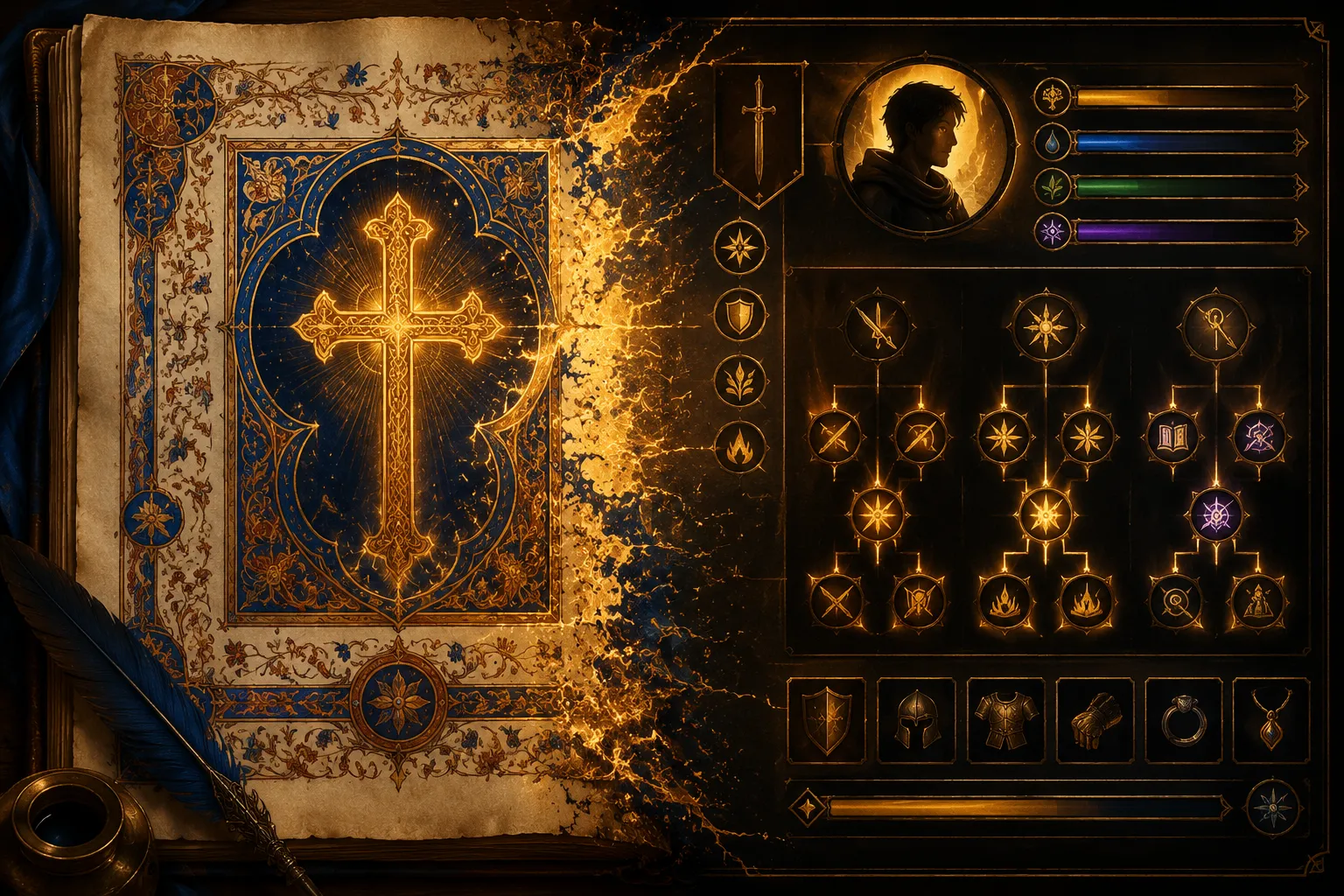
Christian LitRPG is a subgenre that places characters inside game-like systems, experience points, stat screens, skill trees, level thresholds, and uses those mechanics to explore Christian themes of grace, repentance, identity, and spiritual cost. The “game” is not metaphorical; within the story’s world, the system is real and the numbers matter.
Standard LitRPG, which originated in Russian web fiction and expanded rapidly through English-language platforms, requires that characters consciously interact with game mechanics as part of the narrative [3]. Christian LitRPG keeps that structural requirement but asks a harder question underneath it: what does a system that measures your worth actually do to a soul?
How the mechanics typically work:
- A character enters a game world, a system-governed reality, or a divine trial structure
- Stats, skills, and XP accumulate through action and choice, not just combat, but moral decisions
- Progression gates force the character to confront what they’re willing to spend to advance
- Grace, when it appears, is not a cheat code, it arrives after cost, not instead of it
The best Christian LitRPG uses the game system the way a parable uses a story: the surface is familiar, but the weight underneath is the real thing [2].
How Is Faith Integrated Into LitRPG Mechanics?
Faith integrates into LitRPG mechanics most effectively when the game system itself embodies spiritual truth rather than commenting on it. When a character’s Mercy stat rises through sacrifice rather than strategy, or when a Forgiveness skill can only be unlocked after genuine repentance, not just a dialogue choice, the mechanics carry theological weight without a single sermon line.
There are two practical approaches authors use:
1. The system as spiritual mirror The game’s rules reflect divine order. Shortcuts corrupt the character’s build. Earned grace shows up as a stat bonus that couldn’t have been purchased any other way. The theology is structural, not decorative.
2. The character’s faith within the system The protagonist holds Christian belief while navigating a secular or morally ambiguous game world. Their faith is tested by what the system rewards and punishes, and whether they’ll compromise it to level up faster.
The theological essay Finding Christ in the LitRPG argues that the genre’s core tension, a measurable system versus unmeasurable grace, is actually a natural fit for Christian narrative, because Christianity has always been suspicious of merit-based salvation [2]. The game system becomes the Law; grace becomes the thing the system cannot account for.
“Grace is never cheap, never comes from a clean exit, and is not the same thing as reputation.”, Silas Bellhaven brand framework
Christian LitRPG vs. Secular Fantasy RPG: Key Differences
Christian LitRPG and secular LitRPG share the same mechanical vocabulary but differ significantly in what the mechanics mean.
| Element | Secular LitRPG | Christian LitRPG |
|---|---|---|
| Progression goal | Power, survival, dominance | Sanctification, redemption, service |
| Moral framework | Consequentialist (what works) | Covenantal (what’s true) |
| Grace/mercy | Rare stat or random drop | Earned through cost, not luck |
| Death/failure | Respawn or game over | Consequence with meaning |
| Identity | Defined by build/class | Tested and reformed through trial |
Secular LitRPG often treats the game system as neutral or amoral, a set of rules to exploit for survival [3]. Christian LitRPG treats the system as a crucible. The character who games the mechanics for easy wins typically pays a cost the stat sheet doesn’t show [2].
Community discussions on Reddit confirm that religion in LitRPG is often handled poorly in secular entries, either as a corrupt institution or a power source, while Christian LitRPG attempts to treat faith as a genuine moral anchor [4].
Does Christian LitRPG Promote Actual Religious Beliefs?
Yes, openly Christian LitRPG does promote Christian beliefs, that’s the intent. The degree varies by subtype.
- Openly Christian LitRPG (e.g., Canthany Rising by Kenneth Bliss, released June, July 2026) names God, Christ, and Scripture directly within the narrative [10]. These books function as faith-rooted fiction with a game-mechanic delivery system.
- Broadly Christian LitRPG (e.g., The Measured Debt series by Silas Bellhaven) reflects Christian values, earned grace, moral consequence, identity under pressure, without doctrinal language. The theology is structural rather than explicit.
Neither type preaches at the reader. The goal, as Kingdom Pen’s guidance on Christian fantasy worldbuilding frames it, is to let the story’s logic carry the conviction, not to insert a tract into chapter three [6]. Faith shows up as character choice and consequence, not narration.
Who Reads Christian LitRPG and Why?
Christian LitRPG draws from two overlapping audiences: existing LitRPG readers who want content without graphic violence, sexual content, or nihilistic worldviews, and Christian fiction readers who are open to genre fiction that handles faith seriously.
The primary reader profile for Christian-branded LitRPG skews toward adults, many of them Kindle Unlimited subscribers who read widely across clean fantasy, cozy mystery, and thriller. They’re not looking for a Sunday school lesson in game format. They want real stakes, moral weight, and the kind of hope that costs something to reach.
LitRPG as a broader genre has grown significantly on Kindle Unlimited, with the NINC genre spotlight identifying it as one of the platform’s strongest-performing categories [3]. Christian LitRPG is a smaller slice of that, but the 2026 LitRPG Con (July 10-12, 2026) included visible representation from Christian voices in the genre for the first time at that scale, a signal that the subgenre is past its experimental phase.

Best Christian LitRPG Books and Series in 2026
A short, honest list, not ranked by marketing budget, but by what’s actually available and reviewed:
Openly Christian LitRPG:
- Canthany Rising by Kenneth Bliss (2026), Named God and Scripture, adventure-forward structure, the most visible new release in the openly Christian camp [10]
Broadly Christian LitRPG:
- The Measured Debt series by Silas Bellhaven, Three books: The Cost of Being Chosen, The Remembered Route, and The Borrowed Yield. Set at Federated Record, where a collapse investigator named Eamon Kersey discovers the numbers that built his reputation were never fully his. Earned progression, no cheap grace, clean content throughout. Series page
Choose based on what you want:
- Choose Canthany Rising if you want Scripture named directly and an adventure-forward structure
- Choose The Measured Debt if you want faith embedded in consequence and character rather than stated outright
- Check Reddit’s r/litrpg community for ongoing recommendations, the thread on religion in LitRPG surfaces new titles regularly [4]
How Do Game Mechanics Represent Spiritual Growth?
Game mechanics represent spiritual growth most honestly when progression is costly and irreversible,when leveling up requires giving something up, not just accumulating more. That mirrors the Christian understanding of sanctification better than a simple XP bar.
Specific mechanics that map well to spiritual themes:
- Skill decay from sin or compromise, a Mercy skill that atrophies when the character takes shortcuts
- Hidden stats, attributes the system doesn’t display, like Faithfulness or Integrity, that affect outcomes without the character knowing their value
- Locked progression paths, certain abilities only available after specific acts of sacrifice or repentance, not after grinding
- Debt mechanics, borrowed power that must be repaid, reflecting the The Measured Debt series’ core question: what happens when the numbers you built your reputation on weren’t actually yours?
The parallel to theology is direct: the Law (the system) shows you what you owe; grace (the hidden mechanic) covers what you can’t earn [2].
Common Criticisms of the Christian LitRPG Genre
The genre faces legitimate pushback from both sides of its audience.
From Christian readers:
- Gamifying grace trivializes it, reducing repentance to a button press
- Some entries use Christian language as branding without theological substance
- The genre’s roots in secular web fiction can carry worldview assumptions that clash with Christian ethics
From LitRPG readers:
- Faith content can feel inserted rather than integrated
- Openly Christian titles sometimes slow narrative momentum for doctrinal explanation
- The “clean content” constraint occasionally produces stakes that feel muted
The fair critique: The genre is young, and a lot of early entries treat faith as a stat modifier rather than a load-bearing element of the story. The best Christian LitRPG, the kind that earns its genre label, makes the faith structural, not decorative. When the game system itself embodies what the author believes about grace and cost, the theology and the mechanics become the same thing [2][8].
Is Christian LitRPG Appropriate for Young Readers?
Christian LitRPG is generally better suited to teen and adult readers than to children. The genre’s core tension, a merit-based system versus unearnable grace, requires enough theological and emotional maturity to feel the weight of that contrast.
Most titles in the genre are written for adults. The Measured Debt series, for example, deals with institutional corruption, reputational debt, and moral compromise in a workplace-adjacent game setting, content that’s clean but not simple. Canthany Rising has an adventure-forward structure that may read younger, but still engages with genuine spiritual stakes [10].
Practical guidance:
- Ages 14+ can typically engage with broadly Christian LitRPG
- Openly Christian titles with adventure structures may work for ages 12+
- Parents should read a sample chapter first, “clean” means no graphic violence or sexual content, but it doesn’t mean emotionally light
Where to Find Christian LitRPG Communities Online
Christian LitRPG readers and authors gather in a few places, though the community is still small enough that conversations happen across multiple platforms rather than in one central hub.
- Facebook Groups: The LitRPG Books group on Facebook has hosted discussions about faith and religion in the genre [1]
- Reddit: r/litrpg includes periodic threads on religion in LitRPG, with community members recommending titles that handle faith seriously [4]
- Discord: Several LitRPG Discord servers include channels for subgenre discussion; Christian-specific channels are rare but exist within broader clean-fiction communities
- Amazon reviews and Kindle Unlimited lists: Searching “Christian LitRPG” on Amazon surfaces reader reviews that function as informal community discussion
The 2026 LitRPG Con provided the most concentrated in-person gathering of Christian voices in the genre to date, a sign that dedicated community infrastructure may follow.
How Much Do Christian LitRPG Books Cost?
Most Christian LitRPG ebooks are priced between $2.99 and $4.99 per title. Kindle Unlimited subscribers read them at no additional cost beyond their monthly subscription, which is how the majority of LitRPG readers, Christian or otherwise, consume the genre.
- Kindle Unlimited: Most titles are enrolled, making them effectively free for subscribers
- Ebook purchase: $2.99,$4.99 is the standard range for indie-published LitRPG
- Paperback: Where available, typically $9.99,$14.99
- Series bundles: Some authors offer boxed sets at a discount after the series completes
The Measured Debt series is available on Kindle Unlimited. Canthany Rising launched in mid-2026 and follows standard KU pricing conventions [10].
Can You Learn Theology From Christian LitRPG Books?
You can encounter genuine theological ideas in Christian LitRPG, grace, merit, debt, sanctification, identity, but the genre works best as a narrative exploration of those ideas, not a systematic teaching tool. The difference matters.
A well-built Christian LitRPG story will make you feel the problem with merit-based salvation before it names it. That’s what good fiction does with theology: it makes the abstract concrete and the doctrinal personal [2][8]. Dark fantasy and speculative fiction have always carried theological weight, C.S. Lewis understood this, and so did Tolkien.
What you won’t get from the genre: precise doctrinal instruction, denominational clarity, or a substitute for actual Scripture. What you might get: a story that makes you think harder about what grace actually costs, and why a system that measures everything still can’t measure that.
What Makes a Good Christian LitRPG Story?
A good Christian LitRPG story earns its faith the same way it earns its progression: through cost, not convenience.
The marks of a strong entry in the genre:
- The mechanics carry the theology. The game system itself reflects what the author believes about grace, debt, and identity, not just the dialogue.
- Progression costs something real. Leveling up requires sacrifice, not just grinding. Grace shows up after the character has spent something they can’t get back.
- Faith is lived, not stated. Characters doubt, fail, repent, and find mercy in the ordinary moment, not in a dramatic conversion scene.
- Clean content without muted stakes. The story is free of graphic content but not free of genuine danger and moral weight.
- The game world has internal logic. The system’s rules are consistent; the theology doesn’t override the worldbuilding, it informs it.
Authors like Seth Ring, who has discussed the craft of LitRPG worldbuilding in depth [9], point to internal consistency as the foundation everything else rests on. For Christian LitRPG, that consistency has to extend to the faith layer, the theology can’t contradict the mechanics without breaking the reader’s trust.
Conclusion: Where the Genre Is Headed
Christian LitRPG: Gamification Meets Grace, A Genre Deep Dive is not just a useful framing for a content article. It’s the actual question the genre is still working out in 2026: can game mechanics carry the weight of grace without cheapening it?
The answer, based on what’s being published and read right now, is yes, when the mechanics are built to bear it. The genre is past its novelty phase. Canthany Rising signals that openly Christian LitRPG has a readership willing to follow it into explicit faith territory [10]. The Measured Debt series demonstrates that broadly Christian LitRPG can embed theology so deeply into its structure that the game and the grace become inseparable.
If you’re new to the genre, start here:
- Read The Cost of Being Chosen (Book 1 of The Measured Debt) for a broadly Christian entry point with real stakes and no cheap resolution → Amazon link
- Read Canthany Rising for an openly Christian adventure with Scripture named directly [10]
- Join the r/litrpg community and search “religion” or “Christian” for ongoing reader recommendations [4]
The genre is rooted in faith, and the best of it proves that faith under fire, faith that costs something, and hope in the dark are not diminished by a skill tree. Sometimes the stat sheet just shows you what you already knew: grace was never something you could earn.
FAQ
What is the difference between Christian LitRPG and regular LitRPG? Regular LitRPG focuses on game mechanics as a survival or power system. Christian LitRPG uses those same mechanics to explore grace, repentance, and spiritual identity, the system becomes a crucible for faith, not just a power ladder.
Is Christian LitRPG a large genre? No, it’s a small but growing subgenre. As of 2026, there are a handful of established series and a growing number of new releases, with Canthany Rising being the most visible new entry [10].
Can secular LitRPG readers enjoy Christian LitRPG? Yes, if the faith is structural rather than preachy. Readers who want clean content and moral stakes often find Christian LitRPG satisfying regardless of their personal beliefs.
What does “earned grace” mean in a LitRPG context? It means grace arrives after the character has spent something real, not as a reward for grinding, but as something the system cannot account for. The character couldn’t have purchased it; it shows up because of what they were willing to lose.
Are Christian LitRPG books available on Kindle Unlimited? Most are, yes. The Measured Debt series and Canthany Rising are both available through KU, which is how the majority of LitRPG readers access the genre.
Is the genre appropriate for teenagers? Generally yes for ages 14 and up, with adventure-forward titles potentially accessible at 12+. The content is clean, but the themes, debt, compromise, identity under pressure, require some emotional maturity.
Does Christian LitRPG require knowledge of gaming to enjoy? No. The mechanics are explained within the story. Readers who have never played an RPG can follow the system because the narrative treats it as a real-world structure, not assumed background knowledge.
Where is the best place to find new Christian LitRPG releases? Amazon’s Kindle store (search “Christian LitRPG”), the r/litrpg subreddit [4], and the LitRPG Books Facebook group [1] are the most active discovery points as of 2026.
What is The Measured Debt series about? It follows Eamon Kersey, a collapse investigator at Federated Record, whose reputation for surviving every wreck starts to unravel when the position series asks why he’s always the last one standing, and when the numbers he built that reputation on turn out not to be fully his.
Can Christian LitRPG teach theology? It can introduce theological ideas, grace, merit, debt, sanctification, through narrative experience. It’s not a substitute for Scripture or doctrinal study, but it can make abstract concepts feel concrete and personal [2].
References
[1] LitRPG Books Facebook Group Post – https://www.facebook.com/groups/LitRPG.books/posts/8946344022055521/
[2] Finding Christ In The LitRPG – https://www.dappledthings.org/deep-down-things/17469/finding-christ-in-the-litrpg
[3] LitRPG: A Genre Spotlight – https://ninc.com/litrpg-a-genre-spotlight/
[4] Religion In LitRPGs (Reddit) – https://www.reddit.com/r/litrpg/comments/16w4fa4/religion_in_litrpgs/
[6] How To Create Religions As A Christian Fantasy Author – https://kingdompen.org/how-to-create-religions-as-a-christian-fantasy-author/
[8] Dark Fantasy Novels Scream Theology – https://www.christiancentury.org/voices/dark-fantasy-novels-scream-theology
[9] Interview: Seth Ring – https://www.campfirewriting.com/learn/interview-seth-ring
[10] Canthany Rising: A Christian LitRPG Adventure by Kenneth Bliss – http://juliearduini.com/2026/07/07/canthany-rising-a-christian-litrpg-adventure-by-kenneth-bliss/