

Last updated: August 9, 2026
Quick Answer: Faith-based character development means building protagonists whose belief shapes their choices, flaws, and growth from the inside out, not decorating a generic character with religious language. The difference between a protagonist readers believe in and one they put down after three chapters almost always comes down to one thing: whether faith costs the character something real.
Key Takeaways
- Faith must drive choices, not decorate them. Readers recognize a character whose belief only appears during crisis moments, it reads as prop, not conviction.
- Doubt is not the enemy of faith-based fiction. It’s often the engine. A character who never questions is a character who never grows.
- Earned grace means the mercy arrives after the cost, not instead of it. Cheap resolution breaks reader trust faster than any plot hole.
- Preachiness is a structural problem, not just a tone problem. When the story pauses to deliver a message, the character stops being a person and becomes a mouthpiece. [5]
- Flaws must be load-bearing. A protagonist’s weakness should connect directly to what their faith is being tested on, otherwise the flaw is cosmetic.
- Spiritual arcs and emotional arcs should run parallel, not separately. Growth in one should cost something in the other.
- Faith-based characters can appeal to secular readers when the human stakes are clear and the belief is shown through behavior, not announced through narration.
- The “show, don’t sermonize” rule is not optional. Religious writing coaches and craft teachers consistently identify this as the single most common failure point. [2]
- Genre doesn’t change the principles. Whether the setting is a Tennessee church social, a frontier railroad town, or a covenant fantasy highland, the same rules of authentic faith characterization apply.
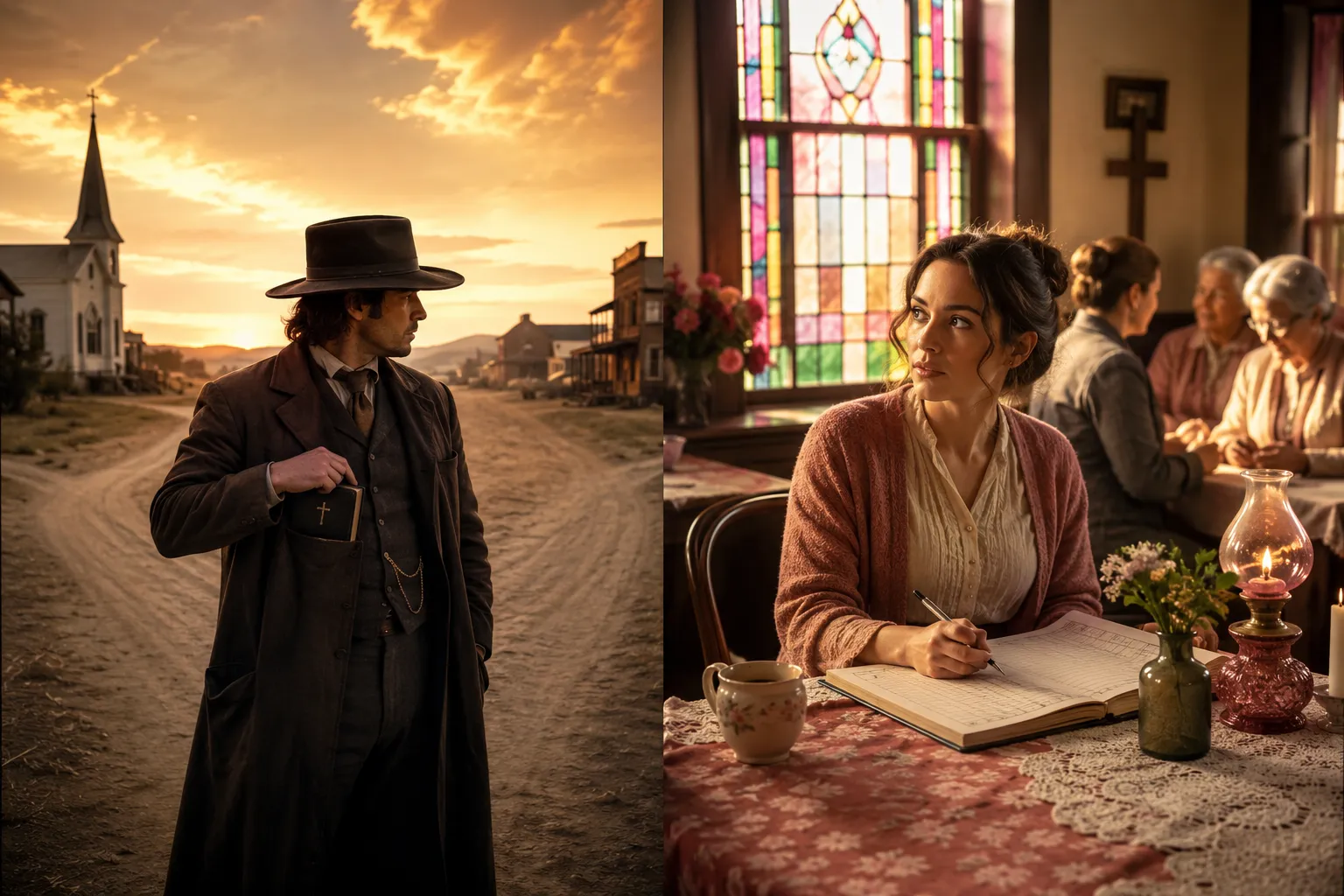
What Makes a Faith-Based Character Feel Authentic to Readers
A faith-based character feels authentic when their belief is woven into how they see the world, not just how they react to crisis. Authenticity comes from specificity: the way a character prays, what they do when prayer doesn’t seem to work, what they’re tempted to compromise and why.
Readers, especially Christian fiction readers who have lived faith themselves, are remarkably good at detecting when a character’s belief is functional versus decorative. Functional faith means the protagonist’s convictions produce friction. They want something, their faith says no, and the story is about what happens next. Decorative faith means the character quotes scripture, attends church, and is otherwise indistinguishable from a secular protagonist with a cross necklace.
Three markers of authentic faith characterization:
- The character’s belief creates at least one significant plot complication (not just comfort)
- The character behaves differently than they would without faith, even when no one is watching
- The character’s spiritual life has texture: habits, doubts, specific convictions, not just “trusts God”
Craft teachers and Christian writing coaches in 2026 are increasingly specific about this: spiritual arcs must be designed with the same intentionality as emotional arcs. [6] A protagonist’s faith should have a beginning state, a point of testing, and a changed state by the end, and that change should cost something visible on the page.
How to Write a Protagonist with Strong Beliefs Without Being Preachy
The simplest rule: let the story carry the message, not the character’s mouth. A protagonist who explains their faith to other characters, especially in moments of conflict, is almost always a sign that the author doesn’t trust the plot to do its job. [2]
Preachiness is a structural problem as much as a tonal one. [5] When a scene stops moving forward so a character can deliver a spiritual lesson, readers feel the author’s hand on their shoulder. That breaks immersion immediately.
Practical ways to keep faith present without moralizing:
- Show the internal cost of a moral choice rather than narrating the principle behind it. A character who lies to protect someone, then lies awake at 2 a.m. staring at the ceiling, communicates conviction without a single sermon.
- Let consequences do the theological work. If a character acts against their faith, the fallout teaches the lesson. The author doesn’t need to add a character who explains what went wrong.
- Use secondary characters as foils, not mouthpieces. A skeptical friend who asks hard questions is far more effective than a wise mentor who provides tidy answers. [9]
- Trust the reader. Christian fiction readers are not reading to be taught what to believe. They’re reading to see their faith reflected honestly in a story that takes it seriously. [8]
“Walking with them, not talking at them”, that distinction is the whole craft. A protagonist who wrestles with belief in real time walks alongside the reader. A protagonist who delivers spiritual conclusions talks at them.
What’s the Difference Between Character-Driven Faith and Plot-Driven Faith in Novels
Character-driven faith means the protagonist’s belief shapes who they are before the story begins, it’s part of their identity, their default assumptions, their blind spots. Plot-driven faith means faith shows up as a response to events, essentially a tool the story uses when it needs a moral moment.
Both can work, but character-driven faith produces more believable protagonists. When a character’s faith is foundational, every scene carries its weight, even quiet scenes where nothing explicitly spiritual happens. The reader senses a consistent inner life.
Plot-driven faith tends to produce the “foxhole conversion” problem: a character who isn’t particularly religious until the stakes get high enough, then suddenly finds God, resolves the crisis, and the faith disappears again. Readers notice this. [10]
Choose character-driven faith if:
- The protagonist’s belief should create conflict across multiple scenes, not just the climax
- The story spans enough time for genuine spiritual growth to be visible
- The genre rewards interiority (psychological thriller, literary mystery, epic fantasy)
Plot-driven faith can work if:
- The story is about someone coming to faith for the first time, then the arc is the point
- The faith moment is earned through genuine cost across the whole narrative, not dropped in at the end
How to Show Spiritual Growth in a Character Arc
Spiritual growth in fiction works the same way emotional growth does: it must be earned through specific events, not declared by the narrator. The character starts somewhere, something happens that their current faith cannot handle, and they either grow or break, and either outcome can be honest.
A working framework for spiritual arc design:
- Establish the starting faith posture. Is the character certain, doubting, performative, private, wounded? Be specific.
- Introduce a test that targets that specific posture. A character who is certain needs to face something their certainty cannot explain. A character who is performative needs to be seen failing in private.
- Let the cost accumulate before the grace arrives. Earned grace means the mercy shows up after the character has paid something real, not as an escape hatch.
- Show the changed posture through behavior, not announcement. The character doesn’t say “I’ve grown.” They make a choice in the final act that they couldn’t have made in the first chapter.
StoryEmbers and similar Christian craft outlets have consistently framed doubt as a catalyst rather than a problem in faith-based fiction. [7] A character who doubts and keeps moving is more compelling, and more honest, than one who never wavers.
Common Mistakes Writers Make with Religious Protagonists
The most common mistake is making the protagonist’s faith their defining trait rather than one dimension of a full person. Faith is part of who the character is, it’s not the whole of them.
Mistakes that strip characters of humanity: [10]
- The Perfect Saint Problem: A protagonist who never sins, never fails, and never doubts isn’t a person, they’re a standard. Readers can’t walk alongside a standard.
- The Sermon Moment: Stopping the plot so the protagonist can explain a theological point to another character. Even if the theology is sound, the scene is dead.
- Cheap grace: Resolving the story’s central moral weight with a quick prayer or a conversion moment that hasn’t been earned by the preceding pages. [8]
- Faith as armor: Using the protagonist’s belief to protect them from genuine consequences. Faith under fire means the fire is real.
- Ignoring the specific tradition. “Christian” covers enormous theological and cultural range. A character from a rural Pentecostal background and one from a mainline Episcopal church will experience faith differently. Specificity reads as honesty.
Should Faith-Based Characters Doubt Their Beliefs in the Story
Yes, and the doubt should be genuine, not resolved too quickly. A protagonist who doubts and finds their way through is far more compelling than one whose faith is never tested. [7]
The key distinction is between doubt as a plot device (the character doubts, gets an answer, moves on) and doubt as a character reality (the character doubts, acts anyway, and the faith that comes out the other side is different from the faith that went in). The second version is what readers remember.
Doubt also creates the conditions for earned grace. If the character never questions, the grace they receive has no weight. The reader hasn’t felt the cost, so the gift doesn’t register.
What doubt should do in a faith-based story:
- Create a genuine decision point where the character must act without certainty
- Connect to the story’s central moral question, not just the character’s inner life
- Cost the character something, relationship, reputation, safety, or clarity
How to Write Faith-Based Characters That Appeal to Secular Readers Too
Faith-based characters appeal to secular readers when the human stakes are clear and the belief is shown through behavior rather than stated through narration. A character who forgives someone who doesn’t deserve it, and shows the internal cost of that forgiveness, communicates something true about mercy that resonates across belief systems.
The principle is simple: write the human experience first, and let the faith be the lens through which the character experiences it. Secular readers don’t need to share the belief to recognize the honesty of the struggle.
What secular readers resist is being positioned as the audience for a lesson. The moment the story’s structure implies “and here’s what you should believe,” the non-believing reader is out. [5]
What crosses the divide:
- Moral complexity that doesn’t resolve cleanly
- Characters whose faith costs them something a secular person would also find costly
- Honest portrayal of doubt, failure, and incomplete answers
How Do You Balance Faith with Flaws in Character Development
The balance is straightforward when the flaws are connected to the faith rather than separate from it. A character’s weakness should intersect with what their belief is being tested on, otherwise the flaw is decorative.
For example: a protagonist whose faith calls them to mercy but whose temperament runs toward judgment. That internal tension produces story. Every scene where they must choose between the two is a scene where both the flaw and the faith are doing real work.
Flaws that work well in faith-based protagonists:
- Pride that masquerades as conviction
- Mercy that shades into enabling
- Obedience that becomes avoidance of personal responsibility
- Certainty that prevents listening
The goal isn’t a balanced character in the sense of equal virtues and vices. The goal is a character whose specific faith and specific flaw are in genuine conflict, because that conflict is what produces the spiritual arc.
How Much Religious Detail Should You Include for Faith-Based Characters
Enough to make the faith feel lived-in, not enough to make non-practitioners feel like outsiders. The rule of thumb: include the details that affect behavior and choice, and leave out the details that only explain theology.
A character who keeps a specific prayer habit, who has a complicated relationship with a particular passage of scripture, who attends a church where they know everyone’s business, that level of detail creates texture. A character who pauses to explain the doctrine of sanctification to another character crosses into catechism.
Useful religious detail includes:
- Specific habits and practices (not just “she prayed”)
- Community and relationship (the church is a place with people, not just a building)
- Points of tension between the character’s faith and their circumstances
- The specific language of their tradition, used naturally
Detail that tends to slow the story:
- Theological explanation delivered through dialogue
- Scripture quotations that stop the scene rather than advancing it
- Backstory about how the character came to faith, front-loaded before the story earns it

What’s the Difference Between Writing for Faith-Based vs. General Audiences
The difference is primarily one of assumed context, not content. Faith-based readers bring a shared vocabulary, a familiarity with the tradition, and often a personal investment in seeing their faith portrayed honestly. General audiences bring none of that assumed context, but they bring the same hunger for honest human stories.
Writing for a faith-based audience means the author can use the tradition’s specific language and imagery without stopping to explain it. The shorthand is available. Writing for a general audience means every faith element must earn its place through emotional logic rather than assumed resonance.
The best faith-based fiction works for both audiences because it doesn’t rely on the shorthand. It shows the faith doing its work in a character’s life in ways that any reader can follow, regardless of their own belief. [6]
How Do You Create Tension When Your Protagonist Has Strong Faith
Strong faith creates tension when it puts the protagonist in direct conflict with what they want, what the world around them demands, or what survival seems to require. Faith is not a tension-reducer in good fiction, it’s a tension-generator.
A protagonist who believes in mercy and justice simultaneously is a protagonist in permanent tension, because mercy and justice rarely point in the same direction. A protagonist who believes God is present and then experiences something that makes that presence impossible to feel, that’s a story.
Sources of tension specific to faith-based protagonists:
- The cost of obedience: Doing the right thing produces real loss, not symbolic loss
- The gap between belief and experience: The character believes something is true, but their circumstances make it feel false
- Community conflict: The protagonist’s faith puts them at odds with the people they love or the institution they belong to
- Moral complexity without clean resolution: The character must choose between two things their faith values, and there’s no option that doesn’t cost something
The Mercy Line series builds this tension structurally: in a railroad town where law and justice don’t always overlap, a character who believes in both is always caught between them. The faith doesn’t resolve the tension, it makes the tension matter.
Examples of Well-Written Faith-Based Protagonists in Literature
Well-written faith-based protagonists share a common quality: their belief is visible in their choices under pressure, not just in their stated convictions.
Classic examples:
- Dostoevsky’s Alyosha Karamazov (The Brothers Karamazov), faith expressed through presence and action, almost never through declaration
- Graham Greene’s whisky priest (The Power and the Glory), faith persisting through failure and self-knowledge, not in spite of them
- C.S. Lewis’s Ransom (The Space Trilogy), belief tested by genuinely alien circumstances, never insulated from cost
In contemporary Christian fiction, the pattern that works is the same: characters who doubt, fail, repent, and find grace in the ordinary moment that suddenly isn’t ordinary anymore. The Mercy House Mysteries follow this pattern, Nora Bell Hartley in Juniper Gap isn’t a saint navigating a mystery; she’s a person whose faith creates as many complications as it resolves.
The common thread across all these examples: the faith is load-bearing. Remove it, and the character collapses. That’s the test.
Conclusion: Faith That Costs Something Is Faith Readers Will Follow
The principles of faith-based character development come down to one conviction: readers believe in protagonists whose faith is real enough to cost them something.
That means building characters whose belief creates friction before it creates comfort. It means letting doubt do its work before grace arrives. It means trusting the story to carry the message rather than stopping the scene to deliver it. And it means giving the protagonist flaws that connect directly to what their faith is being tested on, not decorative imperfections that disappear by chapter three.
Actionable next steps for writers:
- Audit your protagonist’s faith posture. Write one paragraph describing where their belief stands at the story’s opening, specific, not general. If you can’t write it, the character doesn’t have one yet.
- Identify the test. What specific event or pressure will target that posture directly? If the test doesn’t connect to the faith, the spiritual arc won’t land.
- Delay the grace. Find the moment in your outline where mercy or resolution arrives, and push it one scene later. Let the cost accumulate first.
- Read the dialogue aloud. Any line where a character explains their faith to another character is a candidate for cutting or restructuring. If the scene stops to deliver a message, the story has paused.
- Check the flaw connection. Your protagonist’s central weakness should be in direct tension with their central conviction. If they’re not connected, one of them needs to change.
Faith under fire, that’s where the story lives. Not in the certainty, but in what the character does when certainty runs out.
FAQ
Q: Can a faith-based protagonist be the villain or an antihero? A: Yes. A character whose faith is genuine but distorted, who uses sincere belief to justify harm, is one of the most compelling figures in fiction. The faith must still be real, not a disguise.
Q: How do I handle prayer scenes without making them feel like filler? A: Make the prayer cost something or reveal something. A character who prays and doesn’t get an answer, then acts anyway, is more interesting than one whose prayer resolves the scene.
Q: Should every book in a series advance the protagonist’s spiritual arc? A: Each book should show the faith doing real work in that story’s specific circumstances. The arc across a series can be gradual, but each installment needs its own spiritual stakes.
Q: Is it okay to write a faith-based character who belongs to a tradition I don’t personally practice? A: Yes, with research and respect. Specificity is the goal. Vague generic “Christianity” often reads as less honest than a carefully rendered specific tradition the author has studied.
Q: How do I avoid the “perfect saint” problem without making my protagonist unlikeable? A: The key is making the flaw understandable, not making the character sympathetic despite it. Readers can follow a character who does wrong things if they understand why, and if the faith is genuinely in tension with those choices.
Q: What’s the fastest way to check if my faith-based protagonist is preachy? A: Find every scene where the protagonist speaks about their faith to another character. Ask: is this character speaking because the scene requires it, or because the author needs to deliver a point? If it’s the second, cut or restructure. [5]
Q: Do faith-based characters need a conversion arc? A: No. Many of the strongest faith-based protagonists begin the story already believing. The arc is about what that belief costs them and how it changes under pressure, not about acquiring faith from scratch.
Q: How explicit should the faith content be for Kindle Unlimited readers? A: KU readers in the Christian fiction category expect faith to be present and genuine, not background noise. The content should be clean and the faith should be real, but neither should be announced as a selling point inside the prose itself.
Q: Can faith-based character development work in genre fiction like fantasy or thriller? A: Absolutely. Genre setting doesn’t change the principles. Whether the protagonist is a frontier lawman, a covenant-fantasy map-scribe, or a psychological thriller survivor, the same rules apply: faith must be load-bearing, doubt must be honest, and grace must be earned.
Q: How do I write a faith-based character who loses their faith during the story? A: Treat the loss with the same specificity as the faith itself. What specific event or accumulation of events broke the hold? What does the character do in the absence of belief? And, if the story calls for it, what does return look like when it isn’t the same faith that left?
References
[1] Author Interview Bryan Davis – https://australasianchristianwriters.com/author-interview-bryan-davis/
[2] Don’t Preach, Write The Gospel – https://storytellersquad.com/2025/12/23/dont-preach-write-the-gospel/
[5] Preachy Novels – https://kingdompen.org/preachy-novels/
[6] Telling Religious Story Without Preachy Part 2 – https://clearwaterpress.com/oneyearnovel/blog/telling-religious-story-without-preachy-part-2/
[7] Telling Religious Story Without Preachy – https://clearwaterpress.com/oneyearnovel/blog/telling-religious-story-without-preachy/
[8] Christian Stories That Are Not Cheesy – https://christianstorylab.com/p/christian-stories-that-are-not-cheesy
[9] Seven Ways To Preach Without Being Preachy And Teach Without Being Teachy – https://christianpublishers.net/seven-ways-to-preach-without-being-preachy-and-teach-without-being-teachy/
[10] 7 Things Readers Hate In Christian Fiction – https://thechristianlibrarian.substack.com/p/7-things-readers-hate-in-christian