
Last updated: August 10, 2026
Quick Answer: Character arcs in Christian LitRPG work best when a protagonist’s spiritual maturity, their faith under fire, their ethical choices, their reliance on God, grows in direct parallel with their in-game stats, class progression, and loot. The spiritual arc doesn’t sit beside the game mechanics; it runs through them. Grace shows up after cost, not instead of it, and every level gained should ask something of the character’s soul, not just their skill tree.
Key Takeaways
- A strong character arc in LitRPG ties moral and spiritual growth to the same progression system that governs stats and skills, they should feel inseparable, not bolted on.
- Christian LitRPG differs from standard LitRPG in one essential way: the “system” is not the highest authority. God is. That tension is the story.
- Faith arcs earn their weight through costly choices and incremental transformation, not sudden sermon-like revelations. [8]
- The perceived conflict between grace-based theology and merit-based leveling is real, but it’s also the most interesting creative problem in the genre. [6]
- Earned grace, redemption that costs something, is the throughline that separates Christian LitRPG from both secular progression fantasy and preachy faith fiction.
- Integrity and ethical choices can function as hidden stat modifiers, quest gatekeepers, or class-unlock conditions without feeling forced.
- Common writer mistakes include resolving faith questions too cleanly, using scripture as exposition, and treating spiritual growth as a separate storyline from the game plot.
- Readers drawn to Christian LitRPG want their faith represented honestly, not preached at, they want stories that walk with them, not talk at them.
What Is a Character Arc in LitRPG Fiction?
A character arc in LitRPG fiction is the internal transformation a protagonist undergoes across the course of the story, the change in who they are, not just what they can do. In standard LitRPG, that arc is often synonymous with the progression system itself: the character gets stronger, smarter, more capable, and the reader watches the numbers climb.
But numbers climbing is not the same as a person changing. A character arc requires something to be at stake beyond the next level threshold. It requires the protagonist to want something, fear something, and be forced to choose, repeatedly, at increasing cost.
In LitRPG, the arc and the system interact constantly:
- External progression (stats, skills, class upgrades) reflects what the character can do.
- Internal progression (beliefs, values, relationships, faith) reflects who they are becoming.
- The best LitRPG writing makes those two tracks collide. A character who gains a powerful ability they’re not yet wise enough to use responsibly is a character arc waiting to happen.
The numbers on a stat sheet can tell you what a character is capable of. Only the story can tell you what they’re worth.
How Do Christian Values Work in LitRPG Stories?
Christian values function in LitRPG stories when they shape how a protagonist makes decisions inside the game world, not when they’re announced through narration or scripture-dropping. The faith has to be load-bearing, not decorative.
Practically, this means:
- Mercy and justice surface as competing pressures in quest design. Does the character spare the enemy? At what cost?
- Honesty and integrity affect how the character interacts with NPCs, factions, and other players, and what doors open or close as a result.
- Humility runs directly against the genre’s default reward loop, which celebrates power accumulation. A character who refuses to exploit a broken mechanic because it would harm others is living their faith, not preaching it.
- Reliance on God creates a specific narrative tension in a world governed by a “System”, because the System is not God, and the character has to know the difference.
Kenneth Bliss’s Canthany Rising (2026) demonstrates this directly: the story begins with an act of disobedience, eating forbidden fruit, and the entire progression system that follows is built on the consequences of that choice. Sin, fall, and redemption aren’t themes layered over the game mechanics; they are the game mechanics. [9]
Best Examples of Faith-Based Character Development in LitRPG

The clearest examples of faith-based character arcs in LitRPG come from stories where the protagonist’s spiritual state directly affects what they can access in the game world.
Published examples worth studying:
- “Canthany Rising” by Kenneth Bliss (2026): Seven animals eat forbidden fruit in Eden, awaken as humanoids in a new world governed by health points and character levels. The entire arc is structured around the biblical fall and the question of whether redemption can be earned back. [9]
- “Faith Is Earned” (Royal Road): The title itself is the thesis, a LitRPG progression fantasy where divine favor functions as a stat that must be demonstrated through action, not claimed through declaration. [7]
- The Measured Debt series by Silas Bellhaven: Eamon Kersey’s progression at Federated Record is built on a ledger that keeps proving his competence, right up until the moment the record starts asking harder questions than his stats can answer. The series treats earned grace as the only kind that holds. Available at The Cost of Being Chosen.
Community discussions in LitRPG reading groups also point to characters in series like The Ritualist (Dakota Krout) where a protagonist’s Catholic faith shapes how they navigate a game world’s moral landscape, though those aren’t explicitly Christian LitRPG. [6]
How to Balance Spiritual Growth With Game Mechanics in LitRPG
Balancing spiritual growth with game mechanics means treating them as the same system, not parallel systems. When a character’s faith choices have mechanical consequences, and their mechanical choices have spiritual weight, the story stops feeling like a faith lesson stapled to a game.
A practical framework for writers:
- Map spiritual attributes to game attributes. Faith, integrity, mercy, and wisdom can function as stats, but they should be earned through story, not assigned at character creation.
- Let moral choices gate progression. A class upgrade that requires the character to have acted with honesty in three prior encounters is more interesting than one that just requires a stat threshold.
- Use failure as a teaching mechanism, not a punishment. A character who sins, loses a skill, and has to rebuild earns their restoration. That’s earned grace, redemption that costs something.
- Keep the System subordinate to God. The game world’s mechanics can be wrong. They can be corrupted, gamed, or incomplete. A Christian protagonist who trusts God over the System creates genuine narrative tension.
- Show faith through choice, not exposition. A character who chooses the harder, costlier path because it’s right, and doesn’t explain why in dialogue, is doing more theological work than a paragraph of internal monologue. [8]
What Makes a Good Moral Character Arc in Fantasy LitRPG?
A good moral character arc in fantasy LitRPG requires three things: a believable starting point, a cost, and a transformation that couldn’t have happened without the cost. The arc has to be earned.
Checklist for a strong moral arc:
- The character starts with a genuine flaw or blind spot, not cartoonish evil, but a real human failure (pride, fear, self-protection)
- Early choices reflect that flaw in small, believable ways
- The game world applies pressure that exposes the flaw at increasing stakes
- The character has the option to choose differently, and it costs them something real to do so
- The transformation is visible in behavior, not just in internal narration
- Grace arrives after cost, not as a substitute for it
Common mistake: Writers often give characters a single dramatic conversion moment and then treat the arc as complete. Real moral transformation is incremental. It shows up in Tuesday’s small choice before it shows up in the climactic battle. [8]
How Do Stats and Spiritual Attributes Relate in Christian LitRPG?
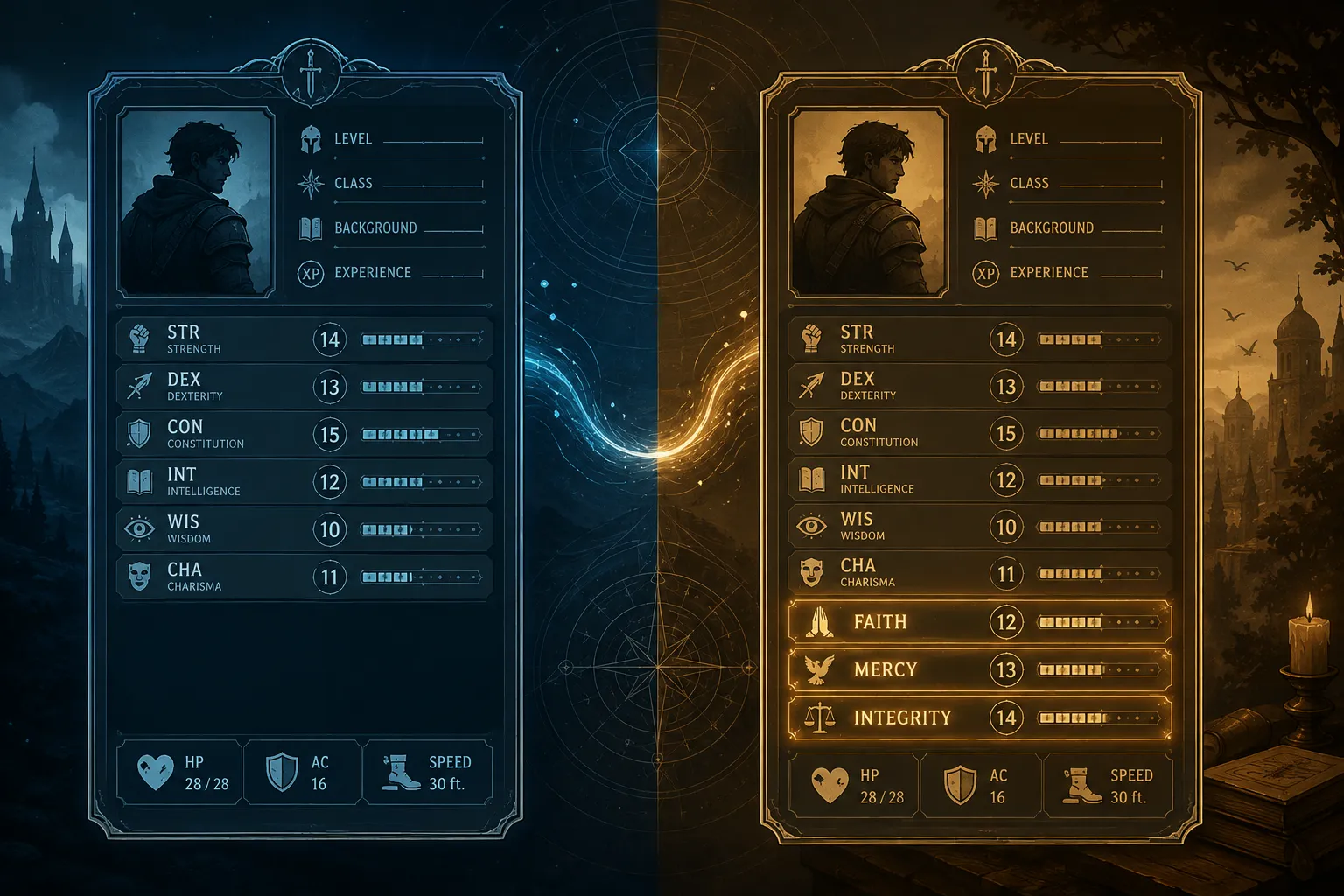
In Christian LitRPG, spiritual attributes and game stats work best when they’re integrated into the same progression framework rather than kept separate. A character’s Wisdom stat might reflect both tactical intelligence and spiritual discernment. A Faith attribute might affect healing ability, resistance to corruption, or access to divine-class skills.
The tension that makes this interesting: in most LitRPG, stats are earned through grinding, repetition, combat, resource accumulation. But spiritual attributes in a Christian framework aren’t earned by grinding. They’re grown through surrender, failure, and costly obedience. That’s a fundamentally different progression logic, and the best Christian LitRPG leans into that difference rather than papering over it.
How the two systems can interact:
| Game Mechanic | Spiritual Parallel | Story Function |
|---|---|---|
| Class unlock | Spiritual calling confirmed | Requires demonstrated integrity, not just stat threshold |
| Skill degradation | Moral failure | Sin has mechanical consequences |
| Healing ability | Mercy extended to others | Scales with how the character has treated NPCs |
| Resistance to corruption | Faith under fire | Tested by the game world’s darkest zones |
| Hidden loot / secret quests | Hope in the dark | Only accessible to characters who acted rightly when no one was watching |
Is Christian LitRPG Different From Regular LitRPG Character Development?
Yes, and the difference is theological, not just tonal. In standard LitRPG, the System is the highest authority in the world. It defines what’s possible, what’s rewarded, and what progress means. A character who masters the System wins.
In Christian LitRPG, the System is not the highest authority. That distinction changes everything. A protagonist who trusts God over the System will sometimes make choices the System penalizes. They’ll refuse power-ups that require moral compromise. They’ll extend mercy when the optimal play is to exploit. And the story has to honor those choices, not by making them cost nothing, but by making the cost worth it.
This is why the community concern about “grace versus merit-based leveling” is actually the genre’s greatest creative asset, not a problem to solve. [6] The friction between grace-based theology and a merit-based progression system is the story. A character who learns that their stats don’t define their worth, that they are chosen before they are strong, is living out something the genre rarely explores.
How to Write a Redemption Arc in a Christian LitRPG Setting
A redemption arc in Christian LitRPG works when the character’s fall is specific, the cost of restoration is real, and the grace that arrives at the end was never cheap. The arc should feel like it was always heading somewhere, not like the author decided to add faith in the third act.
Step-by-step structure:
- Establish what the character values most, power, reputation, survival, approval, and let it be a legitimate desire, not a cartoon flaw.
- Let the game world offer a shortcut that serves that desire at moral cost. The character takes it, or is tempted to.
- Show the consequence, not as punishment from a punishing God, but as the natural weight of a choice that was never free.
- Introduce a moment of honest reckoning, not a sermon, not a vision, but a quiet moment where the character sees clearly what they’ve become.
- Make the path back costly. Restoration requires restitution, honesty, or sacrifice. It doesn’t arrive because the character feels bad.
- Let grace arrive in an ordinary moment, a small act of mercy received, an unexpected door, a character who extends trust they haven’t earned yet.
- Don’t resolve it completely. Redemption in progress is more honest than redemption complete. The character carries what they did. They just don’t carry it alone.
Craft guidance published in 2026 reinforces this: faith arcs should begin in mess and doubt, show belief through costly choices, and avoid sudden revelations that feel unearned. [8]
Who Reads Christian LitRPG, and Why Does Character Arc Matter?
Christian LitRPG readers are a specific audience: they want the genre’s progression mechanics and world-building, but they want faith handled as lived experience rather than lesson. They’re readers who know the difference between a story that walks with them and one that talks at them.
Character arc matters to this audience because they’re not reading for the stat sheets. They’re reading to see something true about what it costs to be faithful in a world that rewards different things. They want:
- Characters who actually doubt, fail, and find their way back
- Faith that shows up in hard choices, not easy declarations
- A story where being chosen doesn’t mean being protected from cost
- Clean content, not sanitized, but honest without being gratuitous
This is the same reader who follows C.S. Lewis from Narnia into the Space Trilogy because the brand promise transfers: this author handles faith with intelligence and imagination. The genre label changes; the promise doesn’t.
LitRPG community discussions confirm that readers actively look for characters whose faith shapes their gameplay decisions, and that the absence of that kind of moral grounding is noticed and named. [6]
Common Mistakes Writers Make With Faith-Based Character Arcs
The most common mistake is treating the faith arc as a separate storyline from the game plot. When spiritual growth happens in quiet reflection scenes while the actual story happens in dungeons and boss fights, the two tracks never integrate, and the faith material starts to feel like interruption.
Other mistakes to avoid:
- Scripture as exposition. A character who quotes chapter and verse to explain their choices is narrating their faith, not living it. Let the choice speak.
- Clean conversion moments. Real transformation is incremental. A single dramatic moment of faith rarely holds unless the story earns it through accumulated small choices. [8]
- Cheap grace. Forgiveness that costs the character nothing teaches the reader nothing. Redemption that costs something is the only kind that lands.
- The System as God. If the game world’s mechanics always validate the right choice, there’s no faith required. Faith under fire means the System sometimes says the wrong thing.
- Moralizing through NPCs. When a side character exists only to deliver spiritual wisdom, readers feel it. Let the wisdom arrive through consequence, not dialogue.
- Resolving doubt too quickly. A character who doubts and then immediately receives a confirming sign hasn’t really doubted. Let the doubt sit. Let the character act faithfully without confirmation.
Conclusion: Writing Characters Who Level Up in Every Way That Matters
Character arcs in Christian LitRPG, leveling up faith and integrity alongside stats and skills, work when they’re built on the same principle that makes any good story work: nothing of value arrives without cost, and the cost is what makes the value real.
The genre offers a genuinely unique creative space. The progression mechanics that define LitRPG can carry spiritual weight without becoming allegory. A Faith attribute that scales with costly obedience is more theologically honest than a sermon. A character who refuses the System’s reward because it would require compromising their integrity is living out something real.
Actionable next steps for writers and readers:
- Writers: Map your protagonist’s spiritual arc to your progression system from the outline stage. Every major level gain should correspond to a spiritual test, not just a stat increase.
- Writers: Read Canthany Rising [9] and the Royal Road story “Faith Is Earned” [7] as working examples of how game mechanics and biblical themes can share the same structure.
- Readers: If you’re looking for Christian fiction where faith is load-bearing and grace is never cheap, the Measured Debt series (The Cost of Being Chosen, The Remembered Route, The Borrowed Yield) is built on exactly that premise.
- Both: Remember that the tension between grace-based theology and merit-based leveling isn’t a problem to solve. It’s the story. Lean into it.
Hope in the dark is only hope if the dark was real. The same is true for every level gained on the way to becoming someone worth the cost of being chosen.
FAQ
What is Christian LitRPG? Christian LitRPG is a subgenre of LitRPG (literary role-playing game fiction) where the story’s progression mechanics, leveling, stats, skills, are integrated with Christian faith themes. The protagonist’s spiritual growth runs parallel to, and often intersects with, their in-game advancement.
Can a character have a strong arc in LitRPG without religious themes? Yes. A moral arc, one built on integrity, sacrifice, and earned transformation, doesn’t require explicit religious content. However, in Christian LitRPG specifically, the faith element is structural, not decorative. Removing it changes the story’s core logic.
How does grace work in a merit-based leveling system? That tension is the genre’s defining creative challenge. Grace in a Christian LitRPG context means the character’s worth isn’t determined by their stats, they are chosen before they are strong. The story earns that truth by first making the character believe the opposite.
What’s the difference between a faith arc and a redemption arc? A faith arc tracks a character’s relationship with God, doubt, trust, failure, and renewed reliance. A redemption arc tracks a character’s moral restoration after a specific failure. They often overlap, but a faith arc can exist without a dramatic fall, while a redemption arc requires one.
Should spiritual attributes be visible stats in Christian LitRPG? They can be, but they work best when they’re earned through story choices rather than assigned at character creation. A Faith stat that grows because the character acted faithfully under pressure is more meaningful than one that starts high and stays there.
How do you avoid making a Christian LitRPG feel preachy? Show faith through choice and consequence, not narration or dialogue. Let the character’s decisions carry the theological weight. Avoid having NPCs deliver spiritual lessons, and resist the urge to resolve doubt with immediate confirmation. [8]
What makes a redemption arc feel earned in LitRPG? The fall has to be specific and believable, the cost of restoration has to be real, and the grace that arrives at the end has to come after, not instead of, the character paying that cost. Cheap grace doesn’t land.
Are there published Christian LitRPG novels available now? Yes. Canthany Rising by Kenneth Bliss (2026) integrates biblical fall-and-redemption themes directly into its game mechanics. [9] The Measured Debt series by Silas Bellhaven approaches LitRPG through the lens of earned progression and costly grace, starting with The Cost of Being Chosen.
Why do readers care about character arcs in Christian LitRPG specifically? Because they’re not reading for the stat sheets. They want to see something true about what it costs to be faithful in a world that rewards different things, and they want that truth delivered through story, not sermon.
Can integrity and ethics change gameplay outcomes in LitRPG? In well-constructed Christian LitRPG, yes. Moral choices can gate class unlocks, affect NPC relationships, open hidden quests, or degrade skills when violated. This is how the story makes faith load-bearing rather than decorative.
References
[2] Weaving Faith Into Fiction Plots – https://successfulchristianselfpublishing.com/weaving-faith-into-fiction-plots/
[3] How To Write A Faith Thread In Your Novel – https://faithfictionandfairytales.wordpress.com/2023/10/16/how-to-write-a-faith-thread-in-your-novel/
[4] Finding Christ In The LitRPG – https://www.dappledthings.org/deep-down-things/17469/finding-christ-in-the-litrpg
[6] Facebook LitRPG Group Discussion – https://www.facebook.com/groups/LitRPG.books/posts/25107643748832291/
[7] Faith Is Earned LitRPG Progression Fantasy Divine – https://www.royalroad.com/fiction/120927/faith-is-earned-litrpg-progression-fantasy-divine
[8] How To Write A Faith Arc Without It Sounding Preachy – https://penandpolish.studio/2026/05/10/how-to-write-a-faith-arc-without-it-sounding-preachy/
[9] Canthany Rising Brings Christian Faith And LitRPG Adventure Together In An Epic New Fantasy By Kenneth Bliss – https://www.christiannewswire.com/canthany-rising-brings-christian-faith-and-litrpg-adventure-together-in-an-epic-new-fantasy-by-kenneth-bliss/