
Last updated: August 13, 2026
Quick Answer: Clean Christian fiction and general clean reads both avoid explicit content, graphic violence, and profanity, but they are not the same thing. Clean Christian fiction treats faith as load-bearing to the story: God is present, characters answer to something beyond themselves, and grace, when it comes, costs something. General clean reads simply filter out content that some readers find objectionable. The absence of heat is not the same as the presence of faith.
Key Takeaways
- “Clean” describes content limits. “Christian” describes a worldview woven into the story’s bones.
- Christian fiction on Kindle Unlimited includes faith as an active story element, not just a setting detail.
- General clean reads can be secular, inspirational, or faith-adjacent, none of those are the same as explicitly Christian.
- You do not need to be a Christian to enjoy clean Christian fiction, but you should expect faith to shape character choices and consequences.
- Inspirational fiction sits between the two: it carries moral weight without necessarily naming God or anchoring to Christian theology.
- Kindle Unlimited carries both categories, and marketing increasingly groups them together, which is useful for discovery but can blur meaningful differences. [1]
- The best clean Christian fiction shows faith through what characters do under pressure, not through narration or scripture-dropping.
- Series starters are the most common KU entry point for both categories, making it easy to sample before committing.
What Makes Christian Fiction Different from Regular Clean Reads
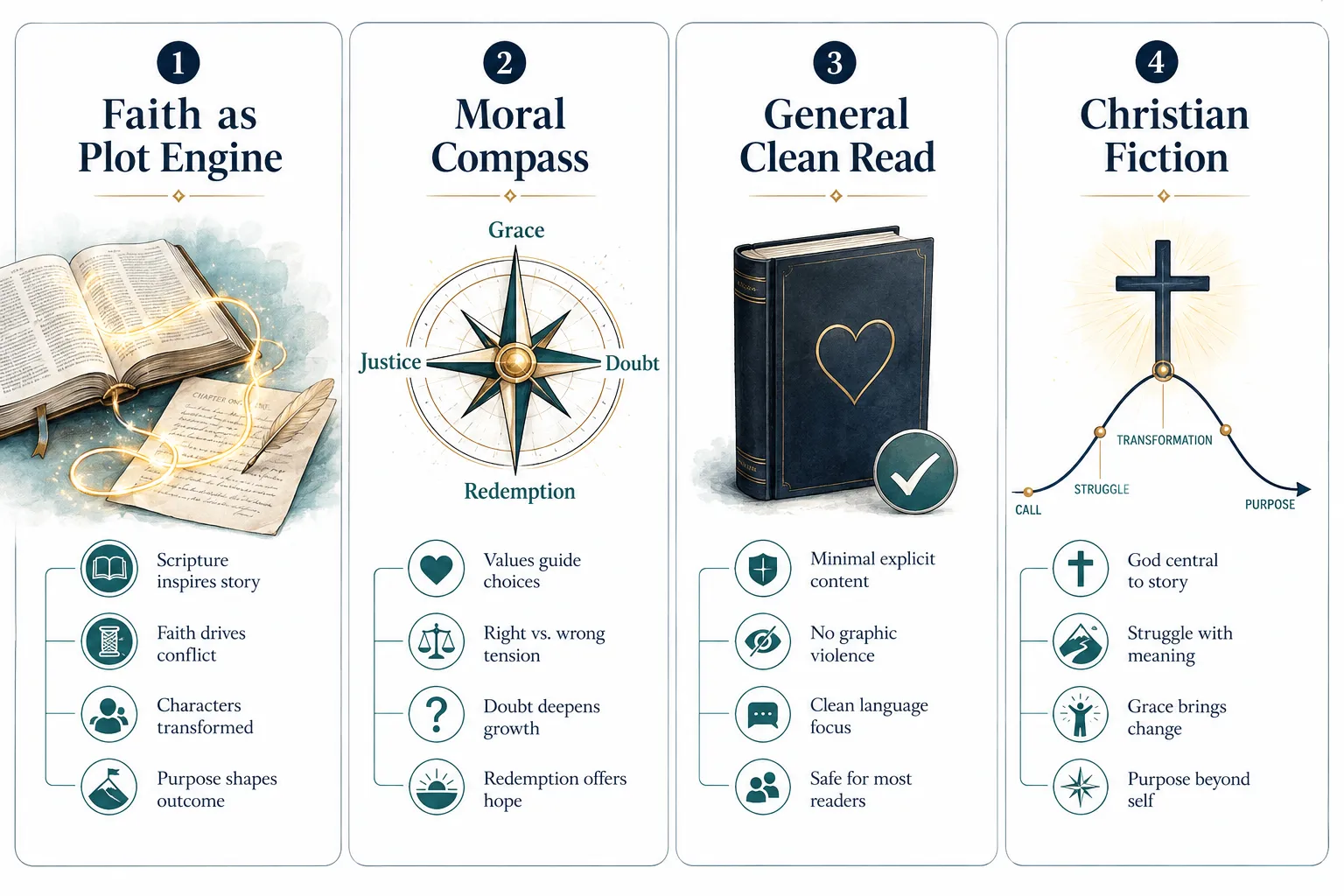
Christian fiction is different from a regular clean read because faith functions as a structural element of the story, not a content filter. In a clean secular romance, two characters fall in love without explicit scenes. In a clean Christian romance, those same characters are also answering to God, their choices, failures, and reconciliations carry theological weight.
The clearest way to see this: a general clean read can be written by an atheist for an atheist audience and still qualify. A Christian fiction novel cannot. The faith has to be real inside the story’s world, not just implied by what’s missing from the page. [4]
Three markers that separate Christian fiction from general clean reads:
- God is present as a character in the narrative logic, characters pray, doubt, receive grace, or resist it, and the story takes those moments seriously.
- Moral consequences are framed in terms of sin, repentance, or redemption, not just cause-and-effect, but spiritual weight.
- Hope is earned through cost, not delivered as a tidy resolution. Cheap grace, the kind that shows up without anyone paying for it, tends to mark formula Christian fiction, not the real thing.
“Walking with them, not talking at them”, that’s the line that separates Christian fiction worth reading from Christian fiction that preaches. The best faith-rooted stories let God show up in the ordinary Tuesday that suddenly isn’t ordinary anymore.
Are All Clean Reads Considered Christian Fiction?
No. Clean reads and Christian fiction overlap, but they are not the same category. A clean read is defined entirely by what it excludes, no explicit sexual content, no graphic violence, no strong language. [2] Christian fiction is defined by what it includes: a faith framework that shapes the story’s moral and spiritual architecture.
A useful way to think about it:
| Category | Content Filter | Faith Present | God Named | Moral Framework |
|---|---|---|---|---|
| General Clean Read | Yes | Sometimes | Rarely | Secular or vague |
| Inspirational Fiction | Yes | Yes | Sometimes | Values-based |
| Clean Christian Fiction | Yes | Yes | Yes | Explicitly Christian |
Most Kindle Unlimited promotions now explicitly separate “Christian” from “Clean/No-Heat” titles while grouping them for audience overlap, because the readers share content preferences but not necessarily worldview expectations. [1]
Christian Fiction vs. Inspirational Fiction: What’s the Difference?
Inspirational fiction carries moral and spiritual themes but does not require explicit Christian theology. Christian fiction does. This is a meaningful distinction for readers who want faith represented honestly rather than softened into general “hope and goodness” messaging.
Inspirational fiction might feature a character who finds meaning, overcomes grief, or acts with courage, all without naming God, referencing Scripture, or anchoring to any specific faith tradition. It’s the difference between a story that feels uplifting and a story where the Resurrection is actually relevant to the plot. [4]
For readers who want the full weight of Christian theology, mercy and justice together, redemption that costs something, faith under fire, inspirational fiction often feels like it stops just short of saying the thing it means.
How Much Religious Content Is in Christian Fiction Books?
The amount varies widely, but in well-crafted clean Christian fiction, faith is present throughout, not as a sermon, but as the lens through which characters see their choices. Readers should expect prayer, scripture references, church community, and moral dilemmas framed in Christian terms. [3]
What well-handled Christian fiction looks like in practice:
- A character’s faith is tested by the plot, not announced in the opening chapter.
- Scripture appears when a character reaches for it naturally, not when the author wants to make a point.
- Doubt is treated as real, not as a problem to be quickly resolved.
- Grace shows up after cost, not instead of it.
What it does not look like: a character stopping mid-scene to deliver a conversion speech, or a villain who exists only to be redeemed in chapter twelve.
Christian Fiction Books Without Heavy Preaching: Do They Exist?
Yes, and they’re increasingly the standard that serious Christian fiction readers seek out. The best faith-rooted stories on Kindle Unlimited show faith through character choice and consequence, not narration. [3]
The distinction readers often describe: they want fiction that walks with them, not fiction that talks at them. A story can be deeply, genuinely Christian without a single passage that reads like a devotional. The faith shows in what a character refuses to do when no one is watching. It shows in the cost of telling the truth. It shows in the mercy that arrives after the hard thing, not instead of it.
Authors building in this space, including Silas Bellhaven’s catalog across cozy mystery, frontier western, psychological thriller, and epic fantasy, treat faith as the load-bearing wall, not the decoration. The Mercy House Mysteries series, for example, sets murder investigations inside a Tennessee church community where faith shapes every character’s motivation, but no one stops the plot to give a Sunday school lesson.
How to Know If a Book Is Actually Christian Fiction
The clearest signals are in the publisher category tags, series descriptions, and the first few pages. Amazon’s browse categories separate “Christian Fiction” from “Clean & Wholesome,” which helps, but marketing copy sometimes blurs the line. [1]
Practical checklist for identifying genuine Christian fiction:
- The Amazon category listing includes “Christian” (not just “Clean & Wholesome” or “Inspirational”)
- The book description mentions faith, God, prayer, or a church community as part of the story
- Reviews reference faith themes, not just “clean content”
- The series description frames moral stakes in spiritual terms
- The author’s bio or brand signals a faith-rooted worldview, not just a content preference
If a book is listed only under “Clean Romance” or “Wholesome Fiction” with no faith-specific language, it’s likely a general clean read, which may be exactly what some readers want, but it’s not the same thing. [6]
Do You Need to Be Religious to Enjoy Clean Christian Fiction?
No. Readers who are not Christian regularly enjoy clean Christian fiction for the same reasons they enjoy any well-crafted story: real stakes, honest characters, and hope that feels earned rather than handed out. [3]
What non-Christian readers should expect: faith will be present and taken seriously. Characters will pray and mean it. Moral questions will be framed in Christian terms. The story won’t pretend those things are neutral. For readers who can engage with that framework as part of the story’s world, the way a reader engages with magic systems in fantasy, Christian fiction offers something general clean reads often don’t: a moral universe with actual weight.

Where it gets harder: if a reader actively resists the theological framing, the faith elements will read as intrusive rather than integral. That’s not a failure of the book, it’s a genuine mismatch between reader and story. The same way a reader who dislikes courtroom procedure probably shouldn’t start with legal thrillers.
Where to Find Christian Fiction on Kindle Unlimited
Kindle Unlimited carries a large and growing catalog of Christian fiction across every major genre. The most reliable discovery paths in 2026:
- Amazon category browse: Kindle Store > Kindle eBooks > Religion & Spirituality > Fiction > Christian Fiction
- Series starters: Most KU-enrolled Christian fiction is structured as series, with book one free or low-cost to encourage continued reading. [5]
- Faith-based KU spotlight lists: Curated lists from Christian book bloggers and reader communities regularly tag KU-eligible titles by genre and faith intensity.
- Author pages: Authors who build a worldview brand (rather than a single-genre brand) often carry multiple series under one identity, making an author page a reliable discovery engine once a reader finds a voice they trust.
The Silas Bellhaven author page on Amazon, for example, covers cozy mystery, frontier western, psychological thriller, covenant fantasy, and LitRPG, all under the same “Rooted in Faith” promise, all enrolled in Kindle Unlimited.
Christian Fiction Romance vs. General Clean Romance
This is where the distinction matters most, because romance is the highest-volume category in both clean and Christian fiction. [9]
General clean romance: No explicit scenes, typically “closed door” or “kisses only.” The relationship arc is the story. Faith may appear as a character trait but doesn’t drive the plot or moral stakes.
Christian romance: The relationship arc is present, but it operates inside a faith framework. Characters wrestle with questions of purity, forgiveness, and covenant. The resolution isn’t just “they get together”, it’s “they get together in a way that honors God and costs them something.”
Some Christian romance series, like the Mercy Line western series, take a further step: a romance-absent content contract, where the story’s emotional weight comes entirely from conscience, justice, and earned grace rather than any romantic arc. That’s a valid choice for readers who want faith-rooted fiction without the romance genre conventions at all.
Most Popular Christian Fiction Genres on Kindle Unlimited
Based on category visibility and reader community activity in 2026, the most active Christian fiction genres on KU are:
- Christian Romance, by far the largest category, spanning contemporary, historical, and frontier settings
- Christian Cozy Mystery, high repeat-read value, strong series loyalty
- Christian Suspense / Psychological Thriller, growing rapidly, especially among readers who want real stakes without graphic content
- Christian Historical Fiction, steady, broad audience
- Christian Epic Fantasy, smaller but deeply engaged readership
- Christian Western, niche but loyal, especially for readers who want masculine-coded faith stories
- Christian LitRPG, emerging category, very small but distinctive
FAQ
Q: Can a book be clean but not Christian? Yes. Clean describes content standards, no explicit scenes, no graphic violence, no strong language. A book can meet all of those standards without any faith content at all. [2]
Q: What does “inspirational fiction” mean on Amazon? Inspirational fiction carries moral or spiritual themes but doesn’t require explicit Christian theology. It often sits between general clean fiction and overtly Christian fiction in both content and tone. [4]
Q: Is Christian fiction always preachy? No, though some is. The best clean Christian fiction shows faith through character choices and consequences, not through narration or sermon-like passages. Readers who have been burned by preachy Christian fiction should look for authors who frame faith as lived experience rather than lesson. [3]
Q: How do I find Christian fiction on Kindle Unlimited without wading through general clean reads? Browse Amazon’s “Christian Fiction” subcategory directly, or use curated KU lists from faith-based book communities. Author pages for worldview-brand authors are also reliable, if you trust the author’s approach to faith, the whole catalog tends to hold. [5]
Q: Do Christian fiction books always have a happy ending? Not always, but they tend toward hope. The distinction is between cheap resolution (everything works out fine) and earned hope (things are hard, but grace shows up, and it costs something). The best clean Christian fiction lands in the second category.
Q: What’s the difference between “faith-based” and “Christian fiction”? “Faith-based” is a broader marketing term that can include any religious tradition. “Christian fiction” specifically anchors to Christian theology, God, grace, sin, redemption. The terms are often used interchangeably in KU marketing, but they’re not identical. [1]
Q: Can Christian fiction include dark themes? Yes. Faith under fire is one of the most honest things Christian fiction can portray. Darkness in a Christian story isn’t a content failure, it’s the condition that makes grace meaningful. The line is between darkness that serves the story’s redemptive arc and gratuitous content that exists for shock value.
Q: Are there Christian fiction options for readers who don’t like romance? Yes. Christian cozy mystery, Christian thriller, Christian fantasy, Christian western, and Christian LitRPG all offer faith-rooted stories where the primary arc isn’t romantic. The Mercy Line western series and The Gathering Light psychological thriller series, for example, carry no romantic content at all.
Conclusion
The distinction between clean Christian fiction and general clean reads isn’t about content ratings, it’s about what the story is for. General clean reads offer a safe reading experience. Clean Christian fiction offers something more specific: a story where God is real, choices carry spiritual weight, and hope in the dark is earned rather than assumed.
For readers who want that, who want fiction that walks with them through doubt and cost and ordinary Tuesdays that turn out to matter, Kindle Unlimited in 2026 carries more options than ever.
Actionable next steps:
- Browse Amazon’s Christian Fiction subcategory directly rather than relying on “Clean & Wholesome” as a proxy.
- Start with a series opener, most KU-enrolled Christian fiction is series-based, and book one is the lowest-risk entry point.
- Check the author’s brand, not just the book description. An author who writes from lived faith tends to handle it consistently across a catalog.
- If you’re new to the genre, Christian cozy mystery is the most accessible entry point, lower stakes, warm setting, faith woven in naturally.
- For readers who want real tension with their faith content, Christian psychological thriller and Christian frontier western offer earned grace without softening the hard things.
Explore the full Silas Bellhaven catalog, cozy mystery, frontier western, psychological thriller, covenant fantasy, and more, at the Amazon author page. All series are enrolled in Kindle Unlimited.
References
[1] Blurred Lines Clean Or Christian Romance – https://www.inspyromance.com/blurred-lines-clean-or-christian-romance/ [2] Understanding Clean Wholesome Heat Levels A Readers Guide – https://www.desertlifemedia.com/blog/understanding-clean-wholesome-heat-levels-a-readers-guide [3] 10 Clean Faith Based Fiction Books Christian Safe Reads – https://www.shelfsafebooks.com/post/10-clean-faith-based-fiction-books-christian-safe-reads [4] Christian Fiction V Clean Read Are You Confused By Vicki Hinze – https://christians-read.com/2013/09/23/christian-fiction-v-clean-read-are-you-confused-by-vicki-hinze/ [5] 23180388 Many Christian Books On Kindle Unlimited And Some Are Free – https://www.goodreads.com/topic/show/23180388-many-christian-books-on-kindle-unlimited-and-some-are-free [6] Clean Romance Reading Guide – https://emmastclair.com/clean-romance-reading-guide/ [9] Saintly Sweet Sensual Smutty A Treatise On The Four Types Of Romance Novels How To Navigate Them As A Christian – https://kellynrothauthor.com/2023/03/29/saintly-sweet-sensual-smutty-a-treatise-on-the-four-types-of-romance-novels-how-to-navigate-them-as-a-christian/