
Last updated: August 14, 2026
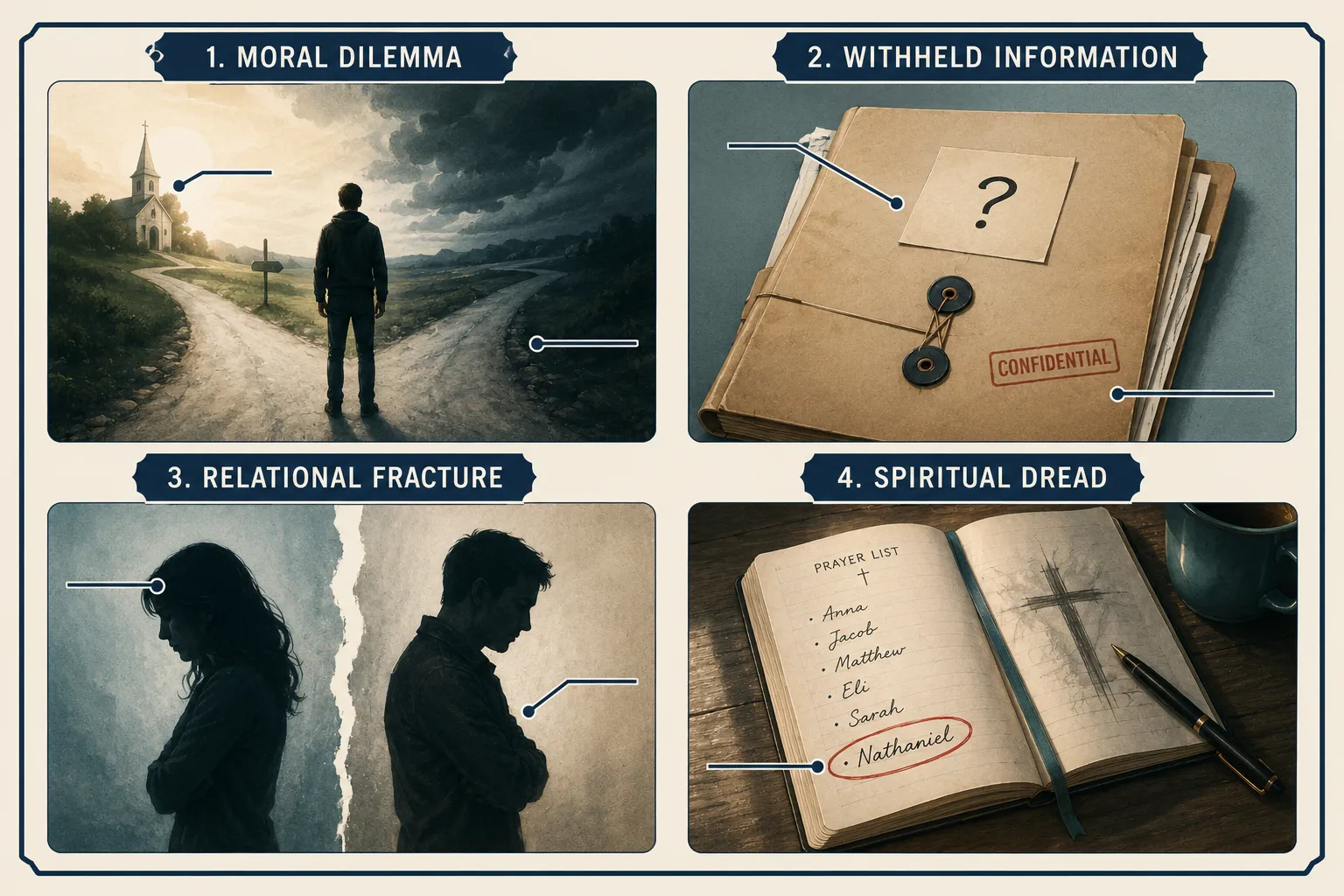
Quick Answer: Non-violent suspense in Christian psychological thrillers builds fear, dread, and narrative tension through moral dilemmas, withheld information, relational fracture, and spiritual stakes, not through graphic violence or explicit content. The reader’s pulse still rises. The pages still turn. The difference is that the threat lives in what a character knows, what she risks losing, and what her faith costs her to hold onto.
Key Takeaways
- Psychological suspense works through internal pressure: secrets, moral weight, and the fear of exposure, not body counts or gore
- Christian readers want real stakes, not sanitized plots; the threat must feel genuine even without graphic content [7]
- Moral dilemmas rooted in faith create tension no action scene can replicate, because the character can’t punch her way out
- Withheld information, unreliable testimony, and the slow erosion of trust are among the most powerful non-violent tools available
- Industry editors confirm growing demand for “clean, faith-centered” suspense that captures traditional puzzle structure [7]
- Shifting the narrative viewpoint away from the violent act and toward the emotional aftermath preserves tension while keeping content clean [6]
- Spiritual warfare, doubt, silence from God, the temptation to lie for a good reason, raises stakes in ways secular thrillers cannot
- Readers in this space want fiction that walks with them, not talks at them; preachy resolution kills tension faster than any content warning
- The “earned grace” structure (cost before mercy) is both a theological conviction and a craft principle, it’s what makes the ending land
- Clean fiction does not mean low-stakes fiction; the Christian psychological thriller at its best makes the reader afraid of the truth, not the blood
What Is Non-Violent Suspense in Fiction?
Non-violent suspense is tension built entirely from psychological, relational, and moral sources rather than physical threat or graphic harm. The reader feels dread, urgency, and fear, but the mechanism is information, not injury.
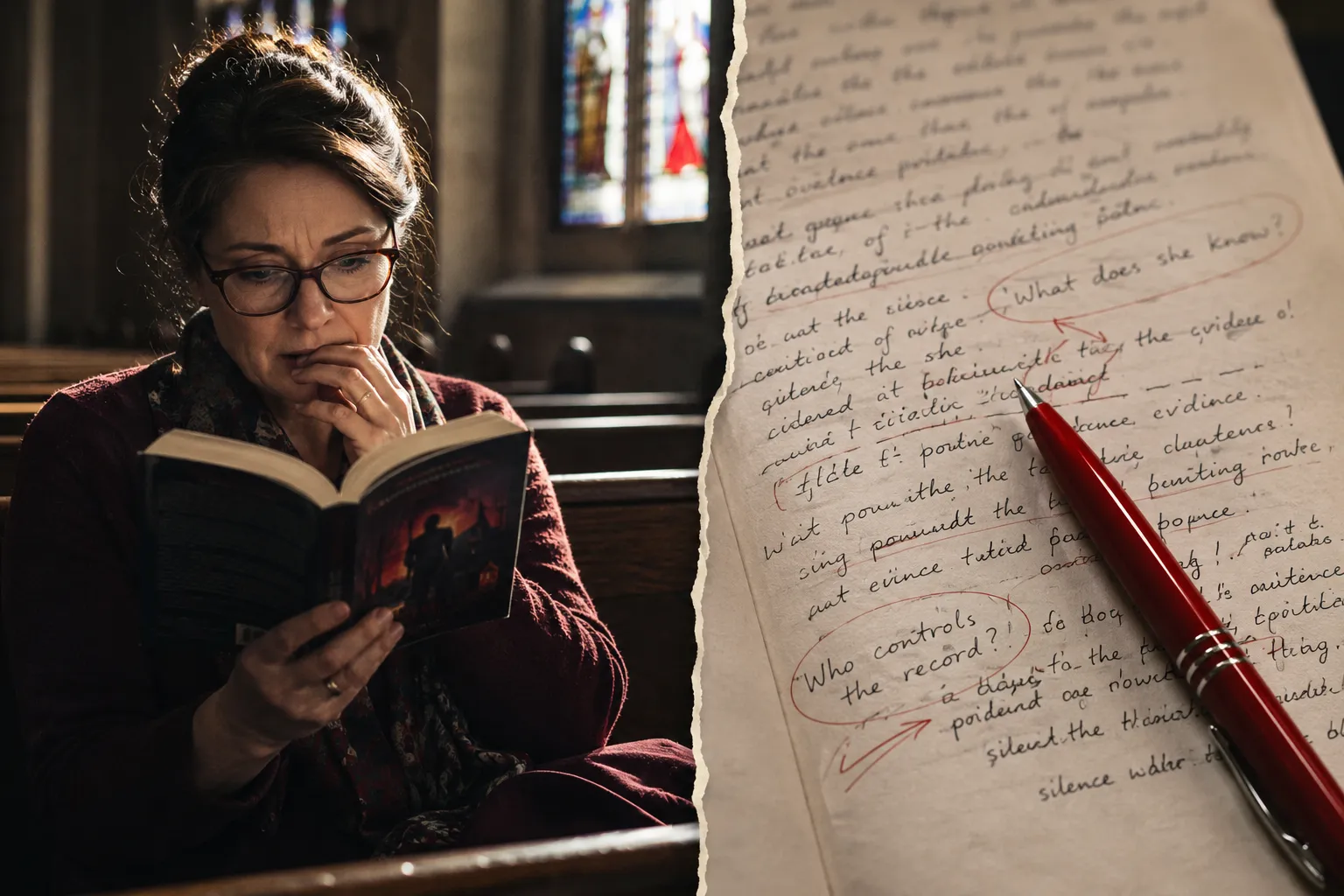
In practice, this means the story’s danger lives in questions: What does she know? Who controls the record? What happens if the truth comes out? A character can be in genuine peril without a single act of physical violence on the page. The threat is exposure, betrayal, spiritual collapse, or the loss of something that cannot be replaced.
For Christian psychological thrillers specifically, non-violent suspense is not a compromise or a content restriction, it’s a craft choice that often produces more dread, because the reader can’t look away from a moral crisis the way she might flinch away from a violent scene.
Can You Write a Thriller Without Graphic Content?
Yes, and the best argument for it is that psychological fear outlasts physical shock. Graphic content produces a spike of adrenaline. Moral dread produces a slow, sustained anxiety that follows the reader out of the book.
The Christian publishing market has recognized this. Industry editors are actively expanding into mystery and suspense titles that deliver “clean, faith-centered” stories with traditional puzzle structure, pointing to reader demand that mirrors the Agatha Christie model, high tension, real danger, no gore required. [7]
The practical proof is in the structure: a woman who discovers her own testimony appearing in someone else’s file (as in When Hannah Sleeps) is in danger the moment she reads that page. No weapon required. The threat is the record itself.
What Makes Psychological Suspense Effective?
Effective psychological suspense depends on three conditions: the reader must understand what the character stands to lose, must believe the threat is real, and must not be able to predict how the character will respond.
The three engines of psychological tension:
- Information asymmetry, the reader knows something the protagonist doesn’t, or the protagonist knows something she can’t safely tell
- Moral cost, every available choice carries a price; there’s no clean exit
- Relational stakes, the threat runs through people the character loves, trusts, or depends on
When all three are active simultaneously, the reader cannot put the book down, not because something violent might happen, but because something true might come out.
The most effective suspense doesn’t ask “will she survive?” It asks “what will she do when she can’t avoid the truth any longer?”
How Do Christian Authors Build Tension Without Gore?
Christian authors build tension without gore by moving the camera away from the act itself and toward its weight. The craft principle is simple: show the aftermath through a character’s emotional and spiritual response, not through physical description of the act. [6]
Practical techniques:
- Redirect the viewpoint. A crime scene matters less as a physical description and more as the moment a character realizes what it means about someone she trusted.
- Use objects as carriers of dread. A sealed envelope, a prayer list with the wrong name on it, a ledger entry that doesn’t match the story she was told, these carry menace without a single act of violence.
- Let silence do work. What a character doesn’t say, doesn’t ask, or refuses to look at creates more unease than explicit confrontation.
- Make the threat institutional. When the danger comes from a system, a retreat’s record-keeping, a false warrant, a testimony that’s been quietly edited, the reader can’t locate a single villain to fear, and that’s more unsettling.
- Withhold resolution. End chapters on an unanswered question, not a cliffhanger action beat.
A 2020 craft panel on writing crime fiction as Christian authors confirmed this approach directly: minimize description, cast crime negatively, and trust that readers engage without needing “gruesome or graphic” detail. [6]
How to Raise Stakes in a Story Without Action Scenes
Raising stakes without action scenes means escalating what the character has to lose rather than what might physically happen to her. The stakes are relational, spiritual, and reputational, and those can be raised much higher than physical danger.
Stake-escalation checklist for non-violent Christian thrillers:
- The protagonist’s faith is not a safety net, it’s being tested by the plot
- Someone she loves is implicated, not just endangered
- The truth, if it comes out, will cost her something she cannot get back
- She has made a choice earlier in the story that now limits her options
- The antagonist has legitimate power, institutional, relational, or spiritual, not just physical force
- Time pressure exists, but it’s a deadline of consequence, not a countdown to violence
- Silence is as dangerous as speaking
The “earned grace” principle applies here directly. Mercy that arrives before cost feels cheap. Stakes that escalate through moral weight, where the character must choose between two things she values, both of them good, produce the kind of tension that makes a reader stay up past midnight. Redemption that costs something is the only kind that satisfies.
Techniques for Building Dread and Fear Psychologically
Dread is the slow accumulation of wrongness, the reader’s growing certainty that something is off before the character can name it. Fear is the moment the character names it. Both can be built entirely through psychological and spiritual means.
Dread-building techniques:
- Repetition with variation. A detail that appears twice, slightly changed, signals that someone is controlling the narrative.
- Unreliable testimony. When the reader can’t fully trust the protagonist’s account of her own past, every scene carries extra weight.
- Spiritual silence. A character who prays and hears nothing is in a specific kind of terror that secular fiction cannot replicate. Faith under fire is not the same as faith abandoned, and the distinction creates enormous narrative tension.
- The too-helpful character. Someone who makes everything easier is more frightening than an obvious antagonist.
- Institutional language used wrongly. When the vocabulary of care, prayer lists, testimonies, restoration language, is being used to control rather than heal, the reader recognizes the wrongness before the protagonist does.
Recent craft commentary reinforces the principle: suspense writers should omit unnecessary violence and show enough to communicate what happened without excessive graphic detail, trusting the reader’s imagination to fill the space. [5]
The Difference Between Violent and Non-Violent Thrillers
The core difference is not content rating, it’s where the threat lives. Violent thrillers locate danger in the body. Non-violent thrillers locate danger in the mind, the record, and the soul.
| Dimension | Violent Thriller | Non-Violent Psychological Thriller |
|---|---|---|
| Primary threat | Physical harm or death | Exposure, betrayal, loss of truth |
| Tension source | Action, chase, confrontation | Information, silence, moral cost |
| Reader response | Adrenaline spike | Sustained dread and moral unease |
| Faith role | Often incidental or absent | Load-bearing, tested by the plot |
| Resolution | Defeat of physical antagonist | Truth reclaimed, grace earned at cost |
Neither model is inherently superior, but for readers who want hope in the dark without graphic content, the non-violent psychological thriller delivers something the violent thriller structurally cannot: a resolution that feels like mercy rather than victory.
What Do Readers Expect from Christian Suspense Novels?
Christian suspense readers, primarily women between 35 and 65, many of them Kindle Unlimited subscribers, want real stakes, honest faith, and a story that doesn’t require them to manage graphic content while reading. They are not asking for easy stories. They are asking for honest ones. [7]
What this audience expects:
- Characters who actually doubt, fail, and have to choose, not protagonists with pre-packaged faith
- Danger that feels genuine, even without violence
- Faith that shows up in decisions and consequences, not in narrated theology
- A resolution where grace is earned, not handed out as a plot convenience
- Clean content that signals trust, the author is not going to ambush them
What they do not want is a story that mistakes clean for soft. A sanitized plot with no real cost is not Christian fiction, it’s a greeting card. The demand, as industry editors have confirmed, is for “clean, faith-centered mysteries” that capture the spirit of traditional puzzle structure, not watered-down versions of it. [7]
Who Reads Non-Violent Christian Thrillers?
The audience for non-violent Christian psychological thrillers is larger and more varied than the traditional “Christian fiction shelf” suggests. Readers include lifelong faith-community members, general-market readers who want clean content without a religious agenda, and lapsed readers returning to fiction that reflects their values.
Market research cited by publishers in 2026 points to “a substantial readership seeking clean and wholesome” stories that extends well beyond the traditional Christian market. [8] Baker Publishing Group’s general-market imprint Haven launched in 2026 specifically to reach readers “of any faith, or none” who want stories without graphic content. [8]
For Christian psychological thrillers specifically, the reader is someone who has experienced institutional faith, church, ministry, retreat, community, and knows that the most dangerous things in those spaces are rarely violent. They are quiet. They are recorded. They are repeated in the language of care.
That reader recognizes the threat immediately. She doesn’t need gore to feel afraid.
Common Mistakes When Writing Clean Thrillers
The most common mistake is confusing “clean” with “consequence-free.” A thriller without graphic content still needs real cost, genuine threat, and a protagonist who cannot escape the truth by choosing nicely.
Mistakes to avoid:
- Resolving moral dilemmas too cleanly. If the character prays and immediately receives clarity, the tension collapses. Faith under fire means the silence lasts long enough to hurt.
- Making the antagonist cartoonishly evil. The most frightening antagonists in non-violent thrillers believe they are doing good. Institutional harm is scarier than personal malice.
- Using faith as a plot shortcut. A scripture verse that solves the problem is not earned grace, it’s a cheat. Let the verse sit in the character’s mind while she still has to make the hard choice.
- Avoiding all darkness. Clean content is not the same as no darkness. Readers in this space want honesty about hard things, not avoidance of them.
- Preaching the theme. The moment the narrative voice explains what the story means, the reader stops feeling it. Trust the image. Trust the choice. Trust the reader.
How Much Tension Is Too Much in Christian Fiction?
Tension is too much when it exists for its own sake rather than serving the story’s moral and spiritual question. The test is not intensity, it’s purpose.
A scene that produces dread in service of a question about truth, mercy, or faithfulness belongs in a Christian psychological thriller regardless of how uncomfortable it makes the reader. A scene that produces dread purely for shock, with no connection to the story’s deeper stakes, does not belong, not because of content rules, but because it’s bad craft.
The practical guideline: every scene of high tension should raise the cost of the character’s central choice. If it doesn’t, it’s not tension, it’s noise.
FAQ
What is the spine question of a good Christian psychological thriller? Who controls the record of someone’s truth, and what does it cost to take it back? That question drives moral dread, relational stakes, and spiritual conflict without requiring a single act of graphic violence.
Can a Christian thriller have a villain who is also a believer? Yes, and it’s often more effective. An antagonist who uses the language of faith to control, silence, or harm is more frightening than an outsider threat, because the protagonist can’t dismiss the vocabulary she shares with them.
How do you handle a crime scene in a non-violent Christian thriller? Show it through the protagonist’s emotional and spiritual response, not through physical description. What she notices, what she refuses to look at, and what it changes in her understanding of someone she trusted, that’s where the scene’s power lives. [6]
Is “clean fiction” the same as “Christian fiction”? Not exactly. Clean fiction avoids graphic violence, explicit content, and coarse language regardless of faith content. Christian fiction specifically handles faith as a load-bearing element of the story. The best Christian psychological thrillers are both, but the faith is what makes the stakes matter, not just the absence of graphic content. [8]
What’s the difference between spiritual warfare in fiction and preaching? Spiritual warfare in fiction shows up as the character’s internal experience, doubt, temptation, the silence of God during a crisis, not as narrated theology. The reader feels the warfare through what the character does under pressure, not through what the narrator explains about it.
How do you end a Christian psychological thriller without a cheap resolution? Grace arrives after cost, not instead of it. The protagonist reaches the truth, but it has taken something from her. The resolution feels like mercy precisely because the reader has watched her pay for it.
What makes The Gathering Light series an example of non-violent suspense? Each book in the series, When Hannah Sleeps, When the Voice Breaks, and When the Prayer List Opens, builds its threat entirely through institutional control of testimony and record. The danger is that someone else is writing the protagonist’s story. No physical violence required; the dread is in the document.
Do Christian thriller readers want romance in their suspense? It varies by series. Some Christian psychological thrillers include romantic threads; others, like The Mercy Line, maintain a romance-absent contract by design. The key is consistency, readers trust authors who signal their content contract clearly and keep it.
Can non-violent suspense sustain a full series? Yes. The key is varying the type of moral and relational threat across books while keeping the spine question consistent. Each new protagonist faces a different institutional or relational danger, but the underlying question, what will you do with the truth once you’re holding it, remains constant.
What role does setting play in non-violent Christian suspense? Setting is not backdrop, it’s pressure. A small town where everyone knows everyone, a retreat where testimonies are recorded and kept, a frontier town where the record is the only law, these settings make silence dangerous and truth costly. The geography of the story should make escape harder, not easier.
Conclusion
Non-violent suspense in Christian psychological thrillers is not a limitation, it’s a discipline that, when practiced well, produces fiction more unsettling and more honest than anything built on shock value. The threat is the record. The danger is the silence. The cost is real, and the grace, when it comes, is earned.
Actionable next steps for readers and writers:
- If you write Christian suspense: Start with the moral dilemma, not the crime. What choice does your protagonist have to make that her faith makes harder, not easier?
- If you read Christian suspense: Look for series where the stakes escalate through what characters know and risk, not through body count. The Gathering Light series is a direct example of this structure in practice.
- If you’re new to the genre: Start with When Hannah Sleeps, it opens on a contradiction (a woman who transcribes other people’s worst nights until her own testimony appears in someone else’s file) and never lets the reader settle.
- If you’re a writer working on craft: Practice the viewpoint redirect, write a scene of discovery from the inside of the character’s spiritual response, not from the outside of the physical event. The dread will follow.
Faith under fire. Hope in the dark. Redemption that costs something. That’s what clean Christian fiction, at its best, has always been.
References
[1] Mysteries on the Rise in Christian Fiction, https://www.publishersweekly.com/pw/by-topic/industry-news/religion/article/100974-mysteries-on-the-rise-in-christian-fiction.html
[5] Christian Fiction New Releases March 2026, https://www.narelleatkins.com/christian-fiction-new-releases-march-2026/
[6] Suspense Panel 2020 Writing Crime Fiction Christian Authors, https://familyfiction.com/suspense-panel-2020-writing-crime-fiction-christian-authors/
[7] Christian Suspense Thrillers, https://christiansuspensenovels.com/christian-suspense-thrillers
[8] The Rise of Christian Fiction Market Trends Regional Dynamics and Future Predictions for 2026, https://www.alibaba.com/product-insights/the-rise-of-christian-fiction-market-trends-regional-dynamics-and-future-predictions-for-2026.html