
Last updated: August 15, 2026
Quick Answer: “Clean” in Christian fiction means more than the absence of profanity or explicit scenes. For most readers, it describes a content contract, no graphic violence, no sexual content, no coarse language, combined with an expectation that faith will be handled with honesty and weight, not as decoration. Clean and Christian are related but not identical categories, and understanding the difference is what separates books that earn loyal readers from books that disappoint them.
Key Takeaways
- “Clean” is a content standard; “Christian” is a worldview standard, a book can be one without being the other [7]
- Readers expect no profanity, no explicit sexual content, and no gratuitous violence, but they do not expect the absence of darkness, conflict, or moral complexity
- Romance in clean Christian fiction can exist; the line is typically drawn at physical intimacy beyond kissing, and at emotional content that glorifies sin without consequence
- Faith under fire, doubt, failure, repentance, and earned grace, is what separates Christian fiction from fiction that is merely clean [4]
- Authors who treat “clean” as a checklist rather than a craft commitment tend to produce flat, unconvincing stories
- The fastest-growing segment of clean fiction is digital and serialized, with audiobooks driving discovery among women 35-65 [2]
- Major publishers now distinguish between “clean but not Christian” and genuinely faith-rooted fiction [2]
- The best clean Christian fiction delivers real stakes, real cost, and mercy that means something because it wasn’t free
What Does “Clean Fiction” Mean, Exactly?
Clean fiction means content that excludes profanity, explicit sexual scenes, and graphic violence. That is the baseline definition most readers and publishers agree on [1]. What it does not mean is fiction without tension, moral complexity, or hard subject matter.
The confusion starts when readers use “clean” as shorthand for “safe”, meaning no surprises, no discomfort, no darkness. That expectation is a misreading of the term, and it leads to real disappointment on both sides of the reader-author relationship.
The working definition most clean fiction readers carry:
- No profanity or crude language
- No explicit sexual content (most draw the line at anything beyond a closed-door kiss)
- No graphic depictions of violence, blood and death can appear, but not in ways designed to shock or disturb for their own sake
- No content that glorifies sin, addiction, or abuse without consequence
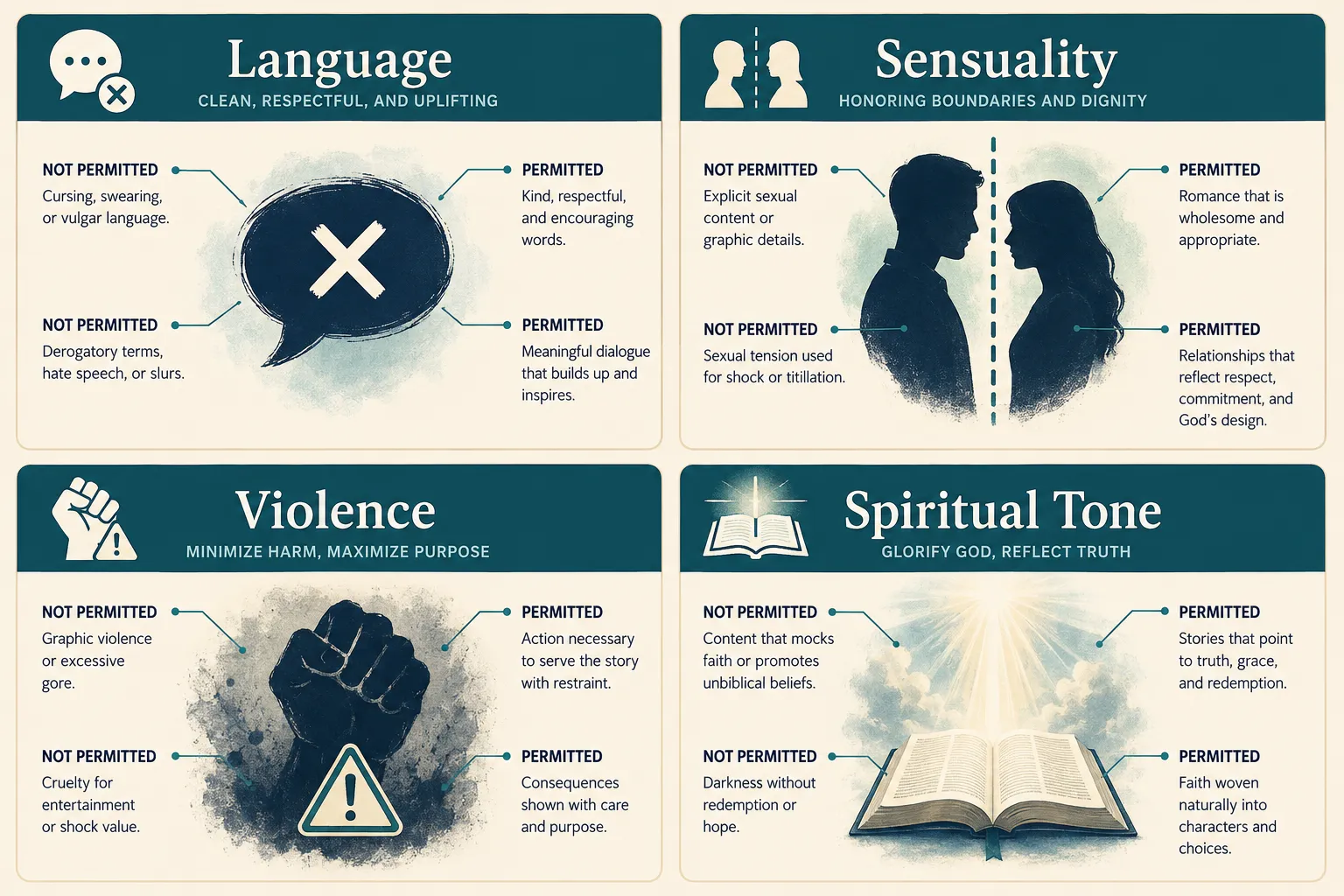
What clean fiction permits, and what good clean Christian fiction actively requires, is honesty about hard things. A character can grieve, doubt, fail, carry shame, or face genuine danger. The difference is in how those elements are handled: with care and consequence, not for shock value.
Clean Christian Fiction vs. “Merely Clean” Books: What’s the Real Difference?
Clean Christian fiction carries faith as a load-bearing element of the story, not as background scenery. A book can be completely clean, no objectionable content whatsoever, and have no meaningful Christian element at all [7].
Author Vicki Hinze drew this distinction clearly: Christian fiction is clean by default, but clean fiction is not Christian by default [7]. A cozy mystery set in a small town with no profanity and no explicit content might be clean. Whether it’s Christian depends on whether faith shapes the characters’ choices, the story’s moral logic, and the outcome.
The practical difference:
| Category | Content Standard | Faith Standard |
|---|---|---|
| Clean fiction | No explicit content | Faith optional or absent |
| Inspirational fiction | No explicit content | Faith present as theme |
| Christian fiction | No explicit content | Faith load-bearing; shapes plot and character arc |
Story Embers editorial put it plainly: cleanness is not next to godliness [4]. A story can be technically spotless and spiritually hollow. The inverse is also possible, a story can handle genuinely dark subject matter and still be deeply, honestly Christian, because it treats that darkness with the weight it deserves and points toward something true.
How Much Romance Is Acceptable in Clean Christian Fiction?
Most clean Christian fiction readers accept romance as a storyline, but draw the line at physical intimacy beyond a kiss. The standard is sometimes called “closed door”, the reader understands that intimacy exists within marriage, but the author does not depict it on the page [10].
Beyond the physical, readers also watch for emotional content that romanticizes sin or presents extramarital desire as aspirational. A character can feel temptation, that’s honest, but the narrative framing matters. Does the story treat that temptation as something to be worked through, or as something to be celebrated?
What most clean Christian romance readers expect:
- Romantic tension and emotional connection: fully acceptable
- A first kiss or brief physical affection: generally acceptable
- Explicit physical intimacy, even within marriage: outside the clean standard for most readers
- Storylines involving adultery or premarital sex presented without moral weight: outside the Christian standard even if described discreetly
Some series, like the Mercy Line westerns from Silas Bellhaven, maintain a romance-absent content contract entirely, no romantic subplot at all. That’s a stricter standard than “clean romance,” and it serves a specific reader who wants faith-driven story without any romantic tension in the mix.
Can Clean Christian Fiction Have Violence or Dark Themes?
Yes, and it probably should. Clean Christian fiction can include violence, death, moral failure, abuse, grief, and psychological darkness. The distinction is between purposeful darkness and gratuitous darkness [4].
Purposeful darkness serves the story’s moral and spiritual logic. A character’s suffering matters because it costs something and changes something. Gratuitous darkness exists for shock or sensation, it doesn’t earn its place in the narrative.
The practical test for violence in clean Christian fiction:
- Does the violence have consequence, emotional, relational, or spiritual?
- Is it described in clinical or restrained terms, rather than graphic detail designed to disturb?
- Does it serve the story’s question, or is it decorative?
A clean Christian psychological thriller can explore manipulation, spiritual abuse, and institutional harm, as The Gathering Light series does, without ever crossing into graphic territory. The darkness is real. The cost is real. The mercy, when it comes, means something because of what preceded it.
What Readers Actually Expect from Clean Christian Books
Readers who seek out clean Christian fiction are not looking for fiction that pretends the world is easy. They are looking for fiction that handles the world honestly and holds something true at the center [9].
The most common reader expectations, drawn from community discussions and reviewer patterns:
- No content surprises, the book delivers what the label promises; no sudden explicit scenes or language that breaks the contract
- Faith that functions, characters whose belief shapes how they act under pressure, not just what they say in church
- Real stakes, something genuinely matters; the plot has weight
- Earned resolution, problems don’t dissolve through convenient coincidence or a tidy conversion moment; grace shows up after cost, not instead of it
- Respect for the reader, the story walks with the reader, not at them; it doesn’t explain its own themes or deliver its moral in dialogue
This last point is where many well-intentioned clean Christian books lose readers. When a character delivers a sermon in the middle of a scene, or when the author steps in to explain what the reader should feel, the story stops working. Faith under fire looks like a character choosing badly, living with it, and finding their way back, not a character reciting the right answer.
How Authors Write Tension Without Explicit Scenes
Tension in fiction comes from uncertainty, not from explicit content. Authors who understand this can write genuinely gripping stories, psychological thrillers, frontier westerns, epic fantasy, while maintaining a clean content standard throughout [5].
Practical craft techniques for tension without explicit content:
- Withhold information strategically, the reader knows something is wrong before the character does, or the character knows something the reader doesn’t
- Use consequence as pressure, the weight of a past choice pressing on the present creates more tension than any scene of violence
- Make the stakes personal, a character’s specific fear, specific loss, or specific loyalty creates more dread than a generic threat
- Let silence carry weight, what characters don’t say, don’t do, or don’t ask is often more unsettling than what they do
- Trust the reader, a closed door is more effective than an open one when the reader’s imagination is engaged
The Mercy House Mysteries series demonstrates this in cozy mystery form: a mislabeled donation box, a note in a hymnal margin, a recipe tin with a family secret inside. The objects carry the weight. The tension comes from what they mean, not from what they show.

The Difference Between Clean Fiction, Inspirational Romance, and Christian Fiction
These three categories overlap but are not interchangeable. Confusing them is one of the most common marketing mistakes in the faith-based fiction space [3].
Clean fiction is defined entirely by content exclusions, no profanity, no explicit content, no graphic violence. Faith is optional. The audience includes readers of any belief or none [8].
Inspirational romance is a publishing category that typically means clean romance with a faith element, usually Protestant Christian, though not always. The faith element is present but may be light; the primary story engine is the romantic relationship.
Christian fiction means faith is structural. It shapes the character’s choices, the story’s moral logic, and the resolution. The story would be fundamentally different, or would not work at all, if the faith element were removed [6].
Author Kellyn Roth has argued for moving the conversation from “clean fiction” to “God-honoring fiction”, a framing that asks not just what the story excludes, but what it affirms and how it handles the weight of belief [6]. That shift matters because it moves the standard from a checklist to a conviction.
Baker Publishing Group’s Haven imprint has taken the opposite approach, launching a line explicitly positioned as “clean but not Christian”, targeting readers who want content standards without faith content [2]. Both approaches are honest. The problem comes when the two are conflated in marketing.
Common Mistakes Authors Make Writing Clean Christian Fiction
The most common mistake is treating “clean” as the goal rather than as the floor. When an author’s primary aim is to avoid objectionable content, the story tends to go flat, because avoiding things is not the same as building something.
Other frequent errors:
- Cheap grace, a character’s faith problem resolves too easily, without the cost that makes grace meaningful
- Sermon dialogue, a character explains the theme aloud, removing the reader’s experience of discovering it
- Sanitized conflict, the story’s antagonist or problem is so mild that the resolution carries no weight
- Assumed faith, characters are described as Christian but never act from that belief when it costs them something
- Inconsistent content contract, the book markets as clean but contains a scene that breaks the standard, destroying reader trust
The cleanness of a story should be invisible, not because the hard things aren’t there, but because they’re handled with enough craft that the reader never feels the author flinching. Comfort earned through honesty about hard things is different from comfort earned by avoiding them.
Is Clean Fiction Only for Religious Readers?
No. Clean fiction has a substantial secular readership, and that market has grown significantly as readers across belief backgrounds seek out fiction without explicit content [8].
Publishers Weekly has reported on Christian novelists deliberately targeting readers “of all faiths or none” through clean fiction positioning [8]. The content standard appeals to readers who are not religious but prefer fiction without graphic content, parents, readers who find explicit material distracting, and readers who simply prefer emotional tension over physical description.
The distinction matters for authors: a book can be clean and broadly accessible, or clean and specifically Christian. Both are valid. The mistake is marketing one as the other.
How to Market Clean Christian Fiction to the Right Audience
The right audience for clean Christian fiction is readers who want real stakes, honest faith, and a content standard they can trust. In 2026, that audience is primarily women 35-65, heavily concentrated in Kindle Unlimited, and active in genre communities around cozy mystery, Christian romance, and faith-based thriller.
Practical marketing signals that attract the right reader:
- Series branding that signals faith as structural, not decorative (series names, cover imagery, back-cover copy)
- Content descriptors that are specific, “no profanity, no explicit content, faith-driven”, rather than vague (“wholesome,” “uplifting”)
- Genre placement that matches the actual story: a psychological thriller marketed as inspirational romance will disappoint both audiences
- Back-matter that speaks to the reader’s actual experience: what they felt, what the story cost, what they’re carrying with them
What clean Christian fiction marketing should never do is lead with the disclaimer. The tone of the cover copy, the series name, and the first page should make the content standard obvious before the reader ever reads a content warning. Rooted in Faith as a brand position does that work, it tells the reader what kind of story they’re holding before they open it.
Can Clean Fiction Still Be Thrilling and Engaging?
Absolutely, and the best clean Christian fiction proves it. Tension, dread, moral complexity, and genuine surprise are craft problems, not content problems. They don’t require explicit material to function [5].
A frontier western can carry the full weight of injustice, danger, and conscience without a single graphic scene. A psychological thriller can be genuinely unsettling, the kind that keeps a reader up past midnight, while maintaining a clean content standard throughout. An epic fantasy can hold covenant, betrayal, and sacrifice at its center without violence that exists for shock.
The reader who picks up a clean Christian thriller is not asking for a story with the edges sanded off. She is asking for a story where the edges are real and the handling is careful. Hope in the dark is not the same as pretending the dark isn’t there.
Conclusion: What “Clean” Really Means, and What Authors Owe Readers
Clean Christian fiction is a promise. Not a checklist, not a marketing category, not a set of content exclusions, a promise that the story will handle hard things with care, that faith will function rather than decorate, and that mercy will mean something because it cost something to reach.
Actionable steps for authors writing in this space:
- Define your content contract clearly, know your line on language, sensuality, and violence before you write, not after
- Ask whether faith is structural, if you removed the faith element, would the story still work? If yes, it may be clean but not Christian
- Earn every resolution, grace that arrives without cost is not grace; it’s convenience
- Let the tone carry the standard, the cleanness of your story should be evident in the sentence-level craft, not announced in a disclaimer
- Write for the reader who wants to be walked with, not talked at, trust her to feel the theme; don’t explain it
Readers who find a clean Christian author they trust follow that author across genres, across series, across years. That trust is built one honest page at a time, not by avoiding the dark, but by holding something true inside it.
FAQ
What is the simplest definition of clean fiction? Clean fiction excludes profanity, explicit sexual content, and graphic violence. It does not require faith content and does not mean the story avoids difficult subject matter [1].
Is all Christian fiction clean? Yes, Christian fiction is clean by default within its publishing standards. But not all clean fiction is Christian; a book can meet the content standard without any faith element [7].
Can a clean Christian novel have a villain who does terrible things? Yes. A villain can be genuinely menacing and their actions can carry real weight. The standard applies to how those actions are depicted, not to whether they exist in the story.
What’s the difference between inspirational romance and Christian romance? Inspirational romance is a publishing category with a light faith element and a romantic primary storyline. Christian romance treats faith as structural, it shapes the characters’ choices and the story’s resolution, not just its setting [10].
Do clean Christian fiction readers want happy endings? Most do, but “happy” is not the same as “easy.” Readers want earned resolution, an ending that cost something and means something. A tidy ending that cost nothing tends to feel hollow [4].
Can a clean Christian thriller be genuinely scary? Yes. Psychological dread, moral danger, and genuine uncertainty create fear without graphic content. The most effective clean thrillers use withheld information and personal stakes rather than explicit scenes.
What does “closed door” mean in romance fiction? Closed door means physical intimacy between characters is implied or acknowledged but not depicted on the page. It is the standard for most clean Christian romance [10].
Is clean fiction growing as a market? Yes. Digital formats, Kindle Unlimited, and audiobooks have all expanded the clean fiction audience. Publishers Weekly has reported on Christian novelists actively targeting readers across belief backgrounds with clean content positioning [8].
What makes faith “load-bearing” in a story? Faith is load-bearing when removing it would change the story’s outcome. If a character’s belief shapes the choice they make at the story’s crisis point, and that choice drives the resolution, faith is structural, not decorative [6].
Should authors label their books as clean in the title or subtitle? It can help with discoverability, particularly in psychological thriller and romance where reader expectations vary widely. The Gathering Light series uses “A Clean Christian Psychological Thriller” as a subtitle for exactly this reason. The label sets the contract before the reader opens the book.
References
[1] What Does Clean Mean – https://jharrisonwrites.com/2014/11/16/what-does-clean-mean/ [2] Redefining Christian Fiction – https://www.publishersweekly.com/pw/by-topic/industry-news/religion/article/91845-redefining-christian-fiction.html [3] The Five Types Of Christian Fiction – https://jakedoberenz.com/the-five-types-of-christian-fiction/ [4] Dear Christian Novelists: Cleanness Is Not Next To Godliness – https://storyembers.org/dear-christian-novelists-cleanness-is-not-next-to-godliness/ [5] Christian Fiction – https://christianediting.co.nz/christian-fiction/ [6] Shifting The Focus: God-Honoring Fiction Vs Clean Fiction – https://kellynrothauthor.com/2023/12/13/shifting-the-focus-god-honoring-fiction-vs-clean-fiction/ [7] Christian Fiction V Clean Read: Are You Confused? By Vicki Hinze – https://christians-read.com/2013/09/23/christian-fiction-v-clean-read-are-you-confused-by-vicki-hinze/ [8] Christian Novelists Seek Readers Of All Faiths Or None – https://www.publishersweekly.com/pw/by-topic/industry-news/religion/article/99493-christian-novelists-seek-readers-of-all-faiths-or-none.html [9] The Unofficial Christian Fiction Guide – https://jennfaulk.com/2018/03/14/the-unofficial-christian-fiction-guide/ [10] Blurred Lines: Clean Or Christian Romance – https://www.inspyromance.com/blurred-lines-clean-or-christian-romance/