
Last updated: August 16, 2026
Quick Answer: Christian western fiction and secular westerns share the same frontier setting and many of the same story beats, but they operate in fundamentally different moral universes. In a Christian western, God is real and active, a character’s choices carry weight before something larger than public opinion. In a secular western, the universe is essentially neutral, and meaning rises or falls on human effort alone. That single difference reshapes everything: the stakes, the cost of grace, and what “justice” actually means by the last page.
Key Takeaways
- The worldview gap is the real difference, not just content standards. Christian westerns assume God is present and interested; secular westerns assume the frontier is morally indifferent.
- Faith functions as plot engine, not decoration. In the best faith-rooted frontier stories, a character’s belief is tested, not announced.
- Clean content is a byproduct of worldview, not a censorship rule. Violence, moral failure, and hard choices still appear, they’re just handled with purpose.
- Earned grace is the genre’s signature move. Redemption that costs nothing means nothing. The best Christian westerns make their characters pay for it.
- The audience is broader than many assume. Readers who want moral clarity and real stakes, not just religious readers, are drawn to faith-rooted frontier stories.
- Secular westerns can be morally rich, but they locate that moral weight in human codes: honor, loyalty, frontier law. Christian westerns locate it in something that outlasts the frontier.
- The subgenre is growing, driven by indie authors and digital platforms expanding the Christian fiction market. [1][7]
- Writing a Christian western badly is easy. The most common mistakes involve using faith as a sermon rather than a story engine.
What Is Christian Western Fiction and How Does It Differ from Regular Westerns?
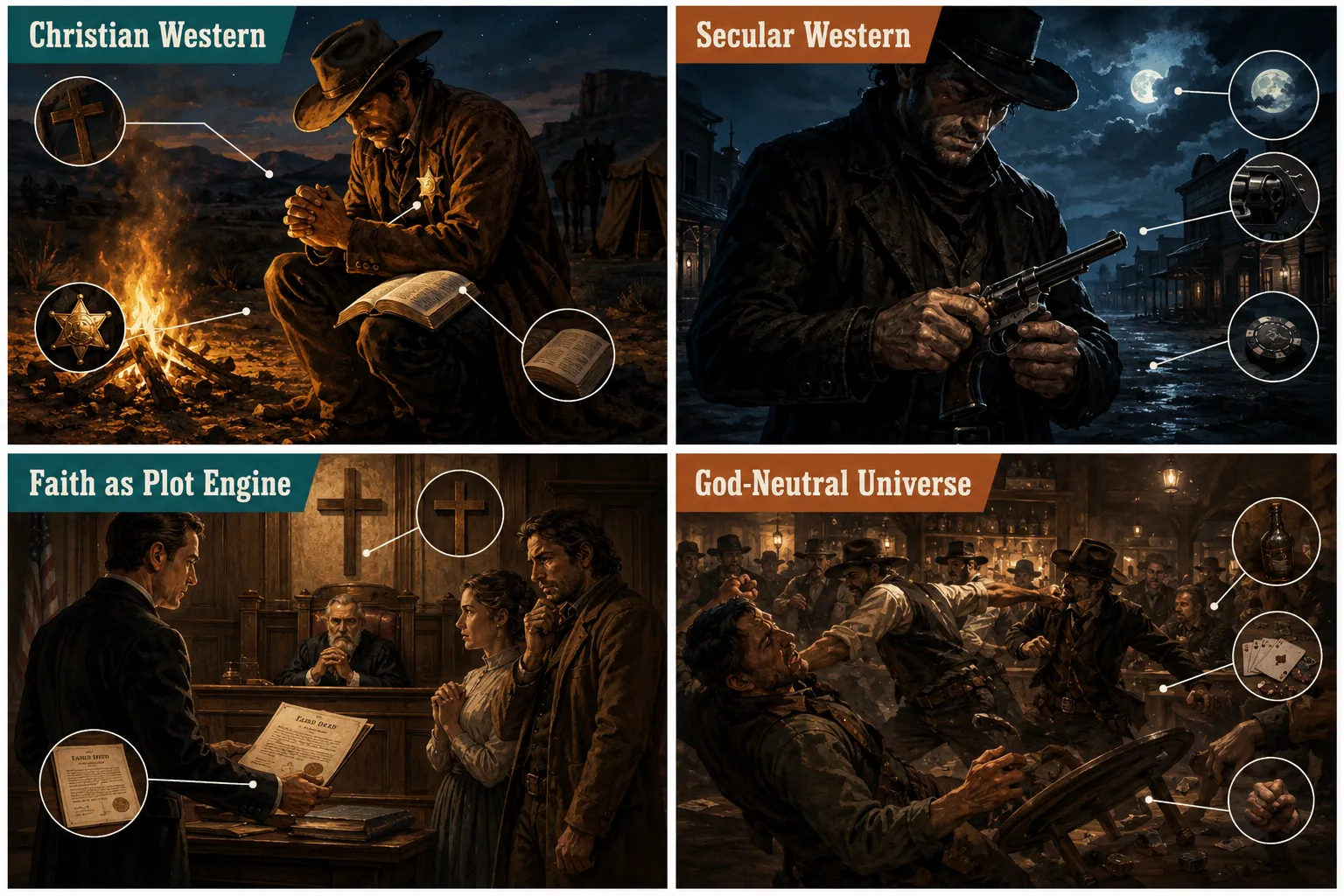
Christian western fiction is frontier storytelling built on the conviction that God is real, present, and morally relevant to the events on the page. That’s the whole distinction, and it’s a larger one than it sounds.
A secular western operates in what might be called a God-neutral universe, the frontier is harsh, human beings make choices, and whatever meaning emerges comes from their effort, relationships, or luck. [The universe doesn’t care; the characters have to make it care.] A Christian western assumes the opposite: that suffering sits inside a larger story of redemption, that human choices carry moral weight before God, and that hope is grounded in something more durable than optimism.
This isn’t about whether a character attends church or quotes scripture. It’s about whether the story’s architecture assumes a moral order that exists independently of human opinion.
In practice, the difference shows up in:
- What the protagonist is ultimately answerable to (community standards vs. a moral order beyond them)
- Whether redemption is available and what it costs
- How the story handles justice when human law fails
- Whether suffering is random or sits inside a larger frame of meaning
How Do Faith Themes Change the Western Frontier Story?
Faith changes the frontier story by giving moral weight to choices that would otherwise be purely pragmatic. When a marshal in a secular western decides not to shoot an unarmed man, that’s character. When a marshal in a Christian western makes the same choice because he answers to something beyond the badge, that’s conscience, and the story can press on that conscience in ways a purely character-driven story cannot.
The frontier is a near-perfect setting for this kind of pressure. Law is thin, distance is real, and no one is watching. That’s exactly the condition that makes faith under fire mean something. The question “what will you do when no one is watching?” lands differently when the answer is “God is watching” rather than “no one is.”
“Where law runs out, a man finds what he answers to.”, The Mercy Line series conscience line
This is why the best faith-rooted frontier stories don’t need to announce their Christianity. The setting does the theological work. Isolation, injustice, and the gap between legal and right create natural pressure on a character’s beliefs, and that pressure is the story.
Do Christian Westerns Have Less Violence and Action Than Secular Westerns?
Not necessarily less action, but violence is handled with more deliberate purpose. Christian westerns don’t avoid conflict; they refuse to treat it as entertainment for its own sake.
A secular western like True Grit or Lonesome Dove can carry graphic violence because the moral frame is human: survival, vengeance, the cost of the frontier. A Christian western can carry the same moral weight with less graphic content because the frame is larger, the cost of violence is spiritual and eternal, not just physical and immediate.
What readers can expect from Christian western content standards:
- Gunfights and physical danger: yes, handled with consequence
- Moral ambiguity and hard choices: yes, often the central engine
- Graphic gore or torture: no
- Profanity: no
- Sexual content: no
- Villains who are genuinely threatening: yes, cheap grace requires no real threat
The result isn’t a softer story. It’s a story where the stakes feel different because the cost of getting it wrong extends beyond the grave.
What Makes a Western Story Christian Versus Just Having Religious Characters?
A religious character in a secular western is set dressing. A Christian western is one where faith is structurally load-bearing, where removing the faith element would collapse the plot, not just change the atmosphere.
The test is simple: Could this story work with the faith elements removed?
- If yes: you have a western with a religious character.
- If no: you have a Christian western.
In a genuinely faith-rooted frontier story, the protagonist’s belief system creates the central conflict. They can’t simply shoot their way to resolution because their conscience won’t allow it. They can’t accept a corrupt legal settlement because they answer to a standard the settlement doesn’t meet. The faith isn’t a personality trait, it’s the engine that drives the plot into territory a secular story wouldn’t reach.
This is what separates earned grace from cheap grace. The character has to choose faith when it costs something. That choice has to be the story’s hinge.
How Do Christian Westerns Handle Morality and Good vs. Evil Differently?
Secular westerns often operate in moral gray, the gunfighter who kills for money but has a code, the lawman who bends rules to get justice, the outlaw who’s more honorable than the sheriff. That ambiguity is part of the genre’s appeal.
Christian westerns don’t flatten that complexity, but they do locate it differently. Good and evil still look complicated on the surface. The difference is that the story assumes a moral order underneath the complexity, one that the characters may violate, ignore, or fight against, but cannot ultimately rewrite.
Comparison: How morality functions in each tradition
| Element | Secular Western | Christian Western |
|---|---|---|
| Moral authority | Human codes, frontier law, personal honor | Divine standard that exists beyond human agreement |
| Redemption | Possible through reputation repair or sacrifice | Available through grace, but grace costs something |
| Justice | What the community enforces or what the hero achieves | Mercy and justice held in tension; not always resolved in this life |
| Suffering | Random, or the result of human cruelty | Sits inside a larger story, not explained away, but not meaningless |
| Hope | Earned by human effort or luck | Grounded in something beyond human optimism |
What Are the Best Christian Western Novels and Authors to Read?
The Christian western subgenre has grown considerably, with both legacy CBA (Christian Booksellers Association) authors and a new wave of indie writers expanding what the genre can do. [3]
Established names in Christian western fiction include:
- Brock and Bodie Thoene, historical frontier fiction with deep theological roots
- Janette Oke, foundational prairie fiction that shaped the modern Christian romance-western hybrid
- Lori Copeland and Virginia Smith, lighter frontier stories with faith woven through community life
For readers who want frontier fiction with harder moral edges and no romance:
- The Mercy Line series by Silas Bellhaven, nine-book Christian frontier western set in the railroad town of Mercy Crossing, built around land claims, labor bonds, and buried records. The conscience line says it plainly: “Where law runs out, a man finds what he answers to.” Starting point: The False Warrant, Book 1.
What to look for when choosing a Christian western:
- Does faith drive the plot or just color the atmosphere?
- Is redemption earned or handed out at the end as a reward?
- Are the villains genuinely threatening, or conveniently weak?
- Does the story trust you to feel the weight of hard choices, or does it explain the moral for you?
Are Christian Westerns Only for Religious Readers, or for Everyone?
Christian westerns are written from a faith perspective, but they’re readable, and often deeply satisfying, for anyone who wants moral clarity, real stakes, and a world where choices mean something.
Readers who aren’t religious but are drawn to stories where good and evil are genuinely distinct, where a character’s integrity is tested rather than celebrated, and where hope is harder to come by than cynicism, those readers often find Christian westerns more satisfying than secular ones, precisely because the moral architecture is load-bearing rather than decorative.
The audience that tends to connect most strongly: readers who are tired of moral relativism as a default setting, who want fiction that feels honest about hard things without wallowing in them, and who want hope in the dark to be earned rather than assumed.
What Time Period Do Most Christian Westerns Take Place In?
Most Christian westerns are set in the post-Civil War American West, roughly 1865 to 1900, the same era that defines the broader western genre. This period works particularly well for faith-rooted stories because it sits at the intersection of rapid legal change and moral uncertainty: territorial law was inconsistent, land claims were disputed, and the gap between what was legal and what was right was wide enough to drive a story through.
Some Christian frontier fiction extends into the early 1900s or reaches back to the 1840s-1860s pioneer and prairie era. A smaller number use the frontier as a secondary-world setting (as in Christian fantasy that borrows frontier tropes) rather than a historical one.
The Mercy Line series, for example, is set in the railroad expansion era of Mercy Crossing, a period when paper records, land surveys, and labor bonds determined who got justice, and where the law’s reach ended well before conscience did.
Common Mistakes People Make When Writing Christian Western Fiction
The most damaging mistake is treating faith as the story’s conclusion rather than its engine. When a character’s faith is the answer that arrives at the end, rather than the thing being tested throughout, the story becomes a sermon with scenery.
Other frequent missteps:
- Cheap grace: Redemption handed to a character who hasn’t paid for it. If the cost isn’t real, the grace isn’t either.
- Villain as cardboard: A story about mercy and justice needs a genuine threat. A villain who’s easily defeated doesn’t test anyone’s faith.
- Scripture as dialogue: Real people in crisis don’t quote chapter and verse at each other. Faith shows up in choice and consequence, not in theological speeches.
- Sanitizing the hard things: Clean content doesn’t mean comfortable content. Avoiding moral difficulty doesn’t make a story Christian, it makes it shallow.
- Resolving too cleanly: Not every injustice gets corrected in this life. Stories that know that feel more honest, and more faithful, than ones that don’t.
Can You Have a Good Western Story Without the Religious Elements?
Absolutely, and the secular western tradition has produced some of the most enduring American literature. Blood Meridian, Lonesome Dove, True Grit: these are serious, morally complex works that don’t require a theological frame to carry weight.
The question isn’t whether secular westerns can be good. They can. The question is what a reader is looking for. If the appeal is moral ambiguity, raw human drama, and a world where meaning is made rather than found, secular westerns deliver that with real power.
If the appeal is a story where the moral order is real and not up for negotiation, where hope in the dark has a ground to stand on, and where redemption that costs something is actually available, that’s what faith-rooted frontier fiction offers, and secular westerns structurally cannot.
Both traditions are doing something true. They’re just answering different questions.
Where Do Christian Westerns Fit in the Broader Western Genre Market?
Christian westerns occupy a distinct and growing corner of both the western genre and the Christian fiction market. Religion book sales rose 7.8% in 2023 [6], and the Christian fiction market has continued expanding through 2025 and into 2026, driven significantly by indie authors and digital platforms. [1][2] Short-form Christian fiction, including frontier and western settings, has seen particular growth through subscription platforms like Kindle Unlimited. [7]
Within Christian retail, fiction remains a minority slice compared to devotionals and Bibles [5], but western and frontier fiction has been explicitly recognized as a growing subgenre. [3] The audience skews toward readers who want clean, honest stories with real stakes, not sanitized ones, and who are underserved by both the secular western market (too much content they want to avoid) and the softer end of Christian fiction (not enough genuine tension).
The market position is real: readers who want faith under fire rather than faith as background decoration are actively looking for this kind of story, and the supply has historically been thin.
What Should I Expect from a Christian Western If I’ve Never Read One Before?
Expect a frontier story that takes its moral stakes seriously, where the protagonist’s choices matter not just to the plot but to something larger than the plot. Expect clean content: no profanity, no graphic violence, no explicit material. Expect faith to show up as lived experience rather than as lesson.
What you won’t get: a story that preaches at you. The best Christian westerns trust the reader to feel the weight of hard choices without having those choices explained. Faith shows up in what a character does when no one is watching, in what they refuse to do when it would be easy, and in what they hold onto when holding on costs them.
If you’re new to the subgenre, a practical starting point:
- For frontier justice with no romance and hard moral edges: The False Warrant (The Mercy Line, Book 1), available here
- For community-based frontier faith with a lighter touch: Janette Oke’s Love Comes Softly series
- For historical frontier fiction with deep theological weight: Brock and Bodie Thoene’s Shiloh Legacy series
How Do Christian Westerns Balance Action and Adventure with Spiritual Themes?
The best ones don’t balance them, they fuse them. The spiritual question is the action question. A land dispute isn’t just a legal problem; it’s a test of whether a man will let a widow lose her orchard because the paperwork says he can. A false warrant isn’t just a plot complication; it’s a test of whether obedience to law and obedience to conscience can survive in the same body.

When faith and action are fused this way, neither suffers. The action has moral weight. The faith has physical consequence. The story moves because both are real.
The mistake is treating them as separate tracks that need to be balanced, cutting away from the chase to have a prayer scene, then cutting back. That’s where the sermon problem starts. Faith under fire means the fire and the faith are in the same scene, pressing on the same character, at the same time.
Conclusion: Why Faith-Rooted Frontier Stories Matter Right Now
The difference between Christian western fiction and secular westerns isn’t really about content restrictions or religious decoration. It’s about the moral universe the story inhabits, and what that universe says about whether grace, justice, and hope are real things or just useful fictions.
Secular westerns have given the world some of its most honest literature about human nature. Christian westerns ask a harder question: what does human nature look like when it’s answerable to something it didn’t invent?
In 2026, with the Christian fiction market growing and the indie frontier expanding the range of what faith-rooted stories can do [1][7], readers have more options than ever. The best of those options, the ones worth your time, are the ones where redemption costs something, where faith is tested rather than announced, and where hope in the dark is earned rather than assumed.
Where to go next:
- Browse The Mercy Line series for Christian frontier western fiction built on earned grace and frontier justice
- Start with The False Warrant if you want a single entry point into faith-rooted frontier fiction with real stakes
- Explore the full Silas Bellhaven catalog for clean Christian fiction across mystery, thriller, fantasy, and western, all rooted in the same conviction: God is real, stories matter, and the two have always belonged together
FAQ
Q: Is Christian western fiction the same as inspirational western fiction? A: They overlap but aren’t identical. “Inspirational” is a broader marketing label that can include secular stories with uplifting themes. Christian western fiction specifically assumes a theistic worldview, God is real and active in the story’s moral architecture.
Q: Do Christian westerns always have a conversion scene? A: No, and the best ones don’t. A dramatic conversion scene can actually undercut the story’s faith work if it arrives as a tidy resolution. Faith in Christian westerns is more often a condition the character is already living in, being tested, than a destination they arrive at.
Q: Can Christian westerns have morally complex villains? A: Yes, and they should. A story about mercy and justice needs genuine threat. A villain who’s easily dismissed doesn’t test anyone’s conscience. The moral complexity of a villain, someone who does wrong for understandable reasons, is what makes the protagonist’s choices meaningful.
Q: Are Christian westerns always set in America? A: Mostly, but not exclusively. Some Christian fantasy borrows frontier tropes (isolated territory, thin law, moral pressure) in secondary-world settings. The frontier condition, where law runs out and conscience is all that’s left, can exist anywhere.
Q: What’s the difference between “clean western” and “Christian western”? A: A clean western avoids graphic content but may not have a theistic worldview. A Christian western is clean because of its worldview, the content standards flow from the moral architecture, not from a separate content policy.
Q: Do Christian westerns include romance? A: Many do, particularly in the CBA (Christian Booksellers Association) tradition. But not all. The Mercy Line series, for example, maintains a romance-absent content contract, the focus is entirely on frontier justice, conscience, and moral cost.
Q: Who is the target reader for Christian western fiction? A: Primarily adults who want moral clarity and real stakes without graphic content, often (but not exclusively) Christian readers, women 35-65, and Kindle Unlimited subscribers who read across faith-based genres.
Q: How long are Christian western novels typically? A: They vary widely. Traditional CBA westerns tend toward standard novel length (70,000-90,000 words). Indie Christian westerns, especially in series format on Kindle Unlimited, often run shorter (40,000-60,000 words per installment) to support rapid series release.
Q: Is the Christian western market growing? A: Yes. The broader Christian fiction market has shown consistent growth [6], and frontier/western settings have been explicitly identified as a growing subgenre within that market. [3] Indie publishing and digital platforms have accelerated this. [7]
Q: What’s the best first Christian western to read if I’m skeptical about the faith content? A: Look for one where faith is structural rather than decorative, where the protagonist’s belief creates the central conflict rather than resolving it. The False Warrant by Silas Bellhaven is a good entry point for readers who want moral weight without preaching.
References
[1] The Rise Of Christian Fiction Market Trends Regional Dynamics And Future Predictions For 2026 – https://www.alibaba.com/product-insights/the-rise-of-christian-fiction-market-trends-regional-dynamics-and-future-predictions-for-2026.html
[2] Christian Fiction 14 7 Yearly Surge Dramatic Market Expansion Data – https://www.firmenpresse.de/pressrelease734029/christian-fiction-14-7-yearly-surge-dramatic-market-expansion-data.html
[3] 95660 Christian Fiction Embraces A Classic Genre The Western – https://www.publishersweekly.com/pw/by-topic/industry-news/religion/article/95660-christian-fiction-embraces-a-classic-genre-the-western.html
[5] 97044 Sales Dip At Christian Retailers But Bibles And Devotionals See A Small Bump – https://www.publishersweekly.com/pw/by-topic/industry-news/religion/article/97044-sales-dip-at-christian-retailers-but-bibles-and-devotionals-see-a-small-bump.html
[6] 94679 Aap Preliminary Report Puts Religion Book Sales Up 7 8 In 2023 – https://www.publishersweekly.com/pw/by-topic/industry-news/religion/article/94679-aap-preliminary-report-puts-religion-book-sales-up-7-8-in-2023.html
[7] Marketersmedia 2026 2 18 Christshare Highlights Rise Of Short Form Christian Fiction – https://markets.financialcontent.com/wral/article/marketersmedia-2026-2-18-christshare-highlights-rise-of-short-form-christian-fiction