
Last updated: August 17, 2026
Quick Answer: Clean Christian fiction for Kindle Unlimited authors means holding a firm content contract, no profanity, no graphic violence, no explicit content, while still delivering real stakes, emotional complexity, and forward momentum that keeps readers turning pages. The mistake most authors make is confusing “clean” with “safe.” Readers who pick up clean Christian fiction on KU aren’t asking for stories without danger or heartache. They’re asking for stories where faith is load-bearing, not decorative, and where the cost of grace is shown, not just stated.
Key Takeaways
- Clean does not mean tension-free. Psychological pressure, moral dilemmas, and unresolved grief are all fully available to clean Christian fiction authors.
- The Christian fiction market is growing. Religion trade sales rose in 2025, and digital formats, especially KU, are leading that expansion. [6]
- Short-form and indie Christian fiction are both surging in 2026, with Kindle Unlimited functioning as a primary discovery channel for new authors. [8]
- The core reader demographic is women aged 35-65, but the genre has meaningful male readership in western, thriller, and fantasy subgenres.
- Romantic tension in clean fiction is built through withheld information, proximity, moral stakes, and emotional honesty, not physical description.
- The most common author mistake is resolving tension too early with a spiritual epiphany that functions as a plot shortcut.
- Earned grace, mercy that arrives after real cost, is the single craft principle that separates forgettable clean fiction from the kind readers recommend.
- Tropes work best when they carry genuine spiritual weight: the secret past, the reluctant protector, the crisis of faith that doesn’t resolve cleanly.
- Marketing clean Christian fiction on KU requires category precision, series structure, and cover signals that communicate content contract before the reader opens the book.
What Is Clean Christian Fiction and How Is It Different from Regular Fiction
Clean Christian fiction is fiction that excludes profanity, graphic violence, and explicit sexual content while centering faith as a genuine, active element of the story, not a backdrop. It differs from secular “clean romance” or “sweet romance” in one specific way: the faith isn’t optional. God, prayer, doubt, and moral reckoning are woven into the plot itself, not added as flavor.
Publishers Weekly defines clean fiction broadly as wholesome, faith-informed storytelling without coarse language or eroticism [7], but Christian fiction narrows that further: the spiritual dimension has to do actual narrative work. A character’s prayer life should affect their choices. A crisis of faith should cost something before it resolves, if it resolves at all.
The practical content contract for clean Christian fiction on KU typically includes:
- No profanity or crude language
- No graphic depictions of violence (consequences of violence can be shown; gore is not)
- No explicit sexual content; physical intimacy closes the door at kissing or emotional nearness
- Faith handled as lived experience, doubt, repentance, and grace all present, none of them tidy
Is Clean Fiction the Same as Inspirational Romance
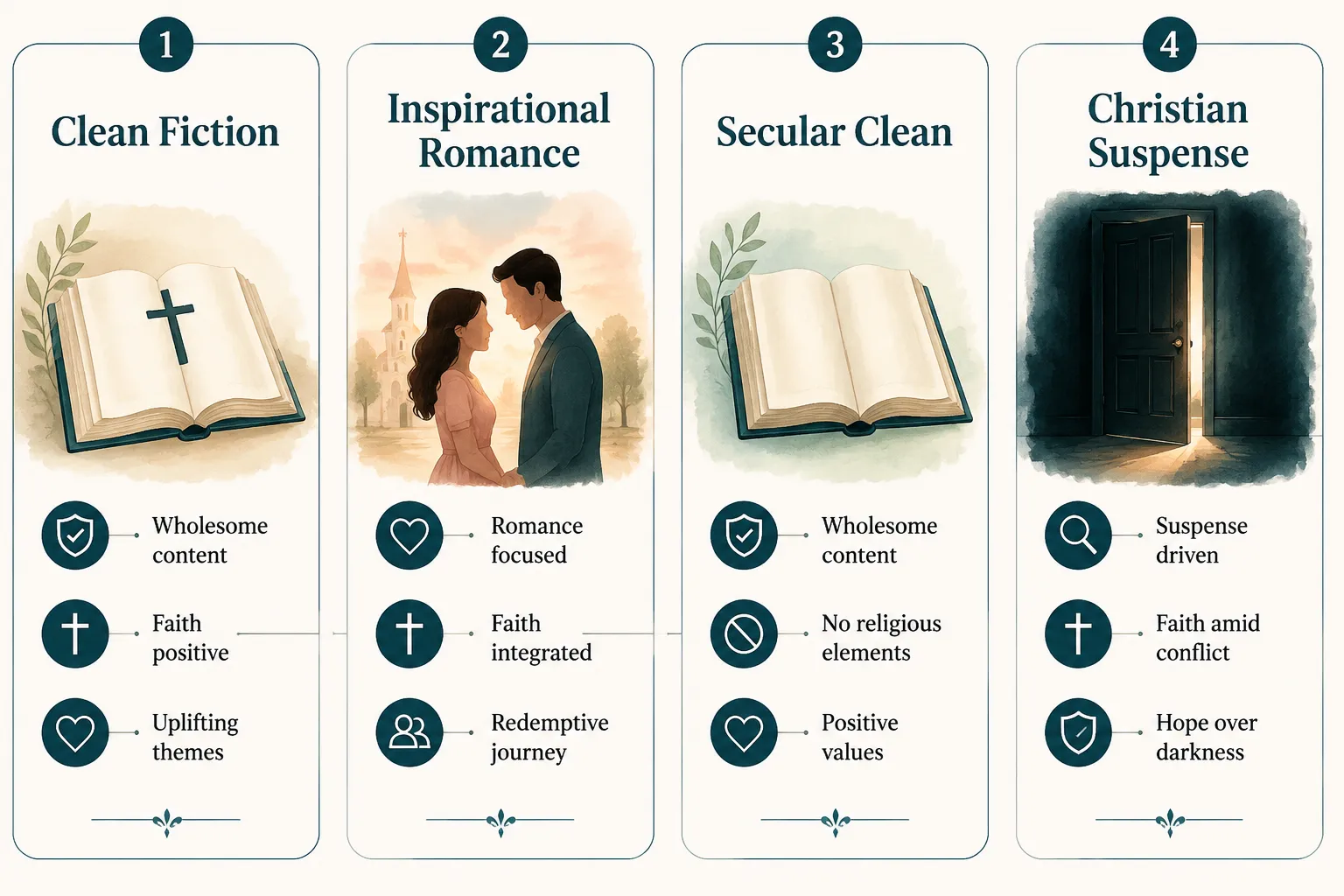
No, and the distinction matters for both readers and authors. Inspirational romance is a specific subgenre with its own Bookscan category and publishing conventions. Clean fiction is a content descriptor. The two overlap significantly, but they’re not identical.
Inspirational romance typically features a faith arc alongside the romantic arc, often with a conversion or recommitment moment. Clean fiction may or may not include romance at all, and the faith element can be more ambient, present in character worldview without driving a conversion plot.
Choose “inspirational romance” as your category if: your book has a central romantic arc, a faith journey tied to that arc, and a happily-ever-after or happy-for-now ending.
Choose “clean Christian fiction” as your broader descriptor if: your book is a mystery, thriller, western, or fantasy where faith is central but romance is secondary or absent.
Industry editors note crossover potential when faith is “light-touch” and the romance is emotionally engaging [7], but readers in the Christian KU space are often specifically seeking the deeper faith integration, not the lighter version. Know which reader you’re writing for before you set your categories.
What Do Christian Fiction Readers Actually Want in a Book
Christian fiction readers, primarily women 35-65 on Kindle Unlimited, want stories that walk with them, not talk at them. They’re not looking for a sermon with a plot attached. They want characters who actually doubt, fail, and find grace in the middle of an ordinary Tuesday that suddenly isn’t ordinary anymore.
What they consistently respond to:
- Moral complexity without moral relativism. Right and wrong exist in the story’s world, but the path between them is hard.
- Faith under fire. Belief tested by real circumstances, not confirmed by easy providence.
- Earned redemption. Grace that arrives after cost, not instead of it.
- Emotional honesty. Grief, anger, and spiritual dryness treated as real, not rushed past.
- Hope in the dark. Not saccharine optimism, genuine light that has to be found, not assumed.
Christian reading trends in 2026 show devotional fiction and romantic suspense dominating the category [3], which tells authors something specific: readers want emotional intimacy and spiritual depth together, not separately.
“Walking with them, not talking at them” is the standard. The moment a character delivers a speech that sounds like a Sunday school lesson, the reader feels the author’s hand on the page, and they put the book down.
How Do You Write Tension in a Story Without Explicit Content
Tension in clean Christian fiction comes from stakes, not sensation. The most durable tension in any story is moral and relational, and neither of those requires explicit content to function.
Techniques that work across genres:
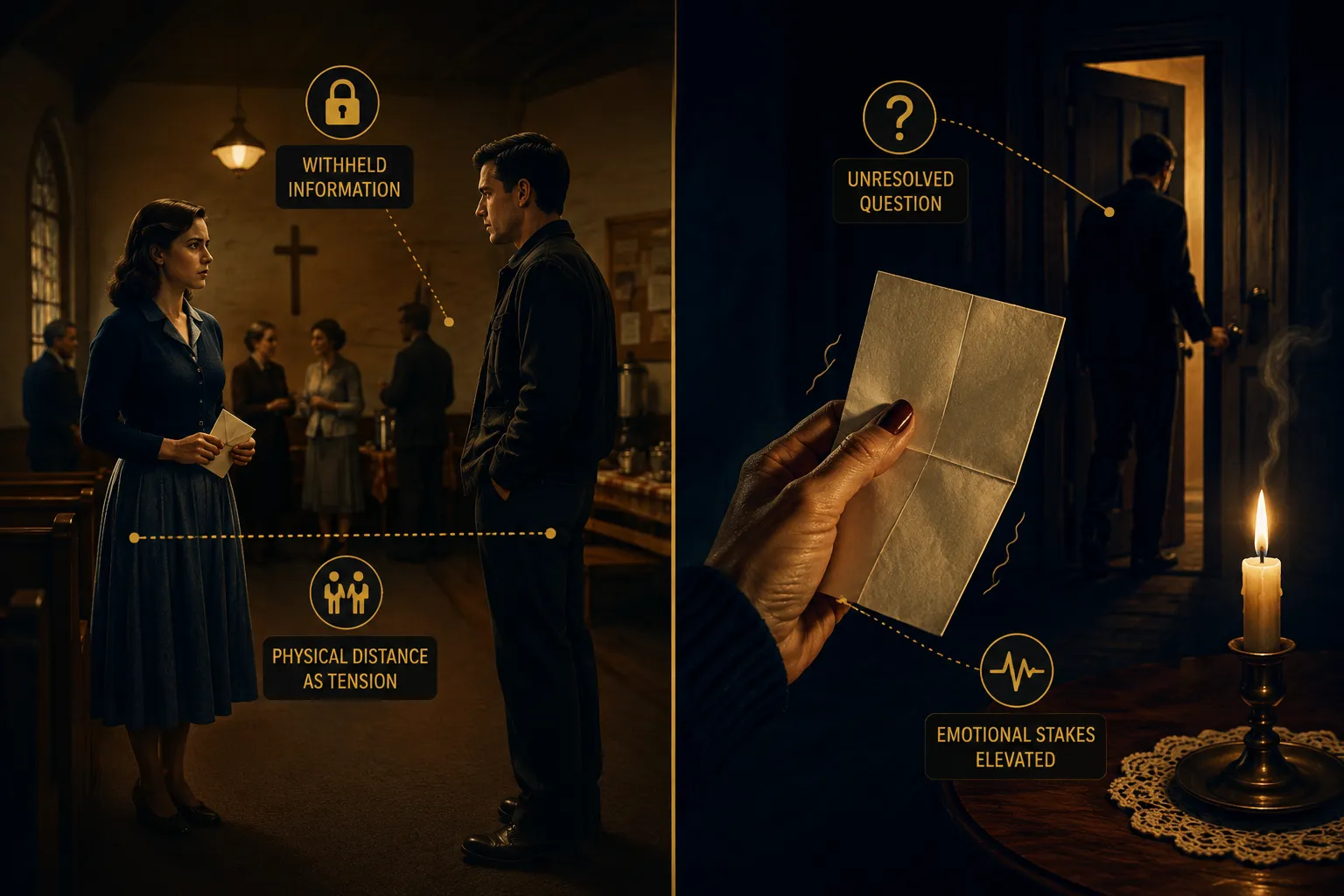
- Withheld information. The reader and the character both know something is wrong, but neither knows the full shape of it yet. This is the engine of psychological thrillers and cozy mysteries alike.
- Competing loyalties. A character owes something to two people who want opposite things. Faith complicates this further, what God seems to be asking may conflict with what justice seems to require.
- Proximity and restraint. In clean romance, the tension lives in what doesn’t happen. Two characters alone in a room, aware of each other, choosing not to act, that’s more charged than a scene that crosses the line.
- Consequence that arrives slowly. A lie told in chapter two should still be paying interest in chapter twelve.
- The unanswered prayer. One of the most honest and tension-sustaining moves in Christian fiction: a character prays, and the silence is the answer they have to live with.
Christian librarians and craft writers distinguish between “clean” and “sanitized” for exactly this reason [9]. Sanitized fiction removes difficulty. Clean fiction keeps the difficulty and removes the gratuitous.
How Do You Handle Romantic Scenes in Clean Fiction Without Being Boring
Romantic tension in clean Christian fiction is built through emotional honesty and restraint, not through what’s described physically. The “close the door” convention, ending a scene before explicit content begins, only fails when the author closes the door too early and leaves no emotional residue.
The craft principle: the scene should end at the moment of highest emotional charge, not the moment before physical escalation. Those are different moments.
Practical techniques:
- Use the senses that aren’t touch. A voice that changes. The way someone’s name sounds in a quiet room. The smell of rain on wool. These carry intimacy without crossing content lines.
- Let misunderstanding do the work. Clean romance’s most reliable engine is two people who want the same thing and believe, incorrectly, that the other person doesn’t.
- Raise the external stakes at the moment of emotional vulnerability. A character who is about to say something true gets interrupted by something dangerous. The reader carries both threads forward.
- Let faith complicate the feeling. A character who believes marriage is sacred will experience attraction differently than a secular character would. That difference is tension.
Craft advice from Christian romance writers consistently points to emotional complexity as the replacement for physical description [9], and readers confirm it. The scenes they remember aren’t the ones that went furthest. They’re the ones that cost the characters something.
What Tropes Work Best in Clean Christian Fiction
The tropes that work best in clean Christian fiction are the ones that carry genuine spiritual weight, where the trope’s emotional logic and the faith theme’s emotional logic are the same thing.
High-performing tropes by subgenre:
| Subgenre | Trope | Why It Works |
|---|---|---|
| Cozy Mystery | Reluctant investigator with a conscience | Forces moral reckoning alongside the puzzle |
| Frontier Western | False accusation / wrongful record | Justice and mercy in direct conflict |
| Psychological Thriller | Unreliable testimony / hidden record | Raises questions about truth and who controls it |
| Epic Fantasy | Covenant broken and restored | Maps directly onto redemption theology |
| Inspirational Romance | Second-chance love after failure | Grace requires acknowledging what was lost |
The secret past, the character who carries guilt for something they did or failed to do, and the community that must decide whether to extend trust, these all function as clean, high-tension frameworks because the spiritual stakes and the plot stakes are identical.
Common Mistakes Authors Make Writing Clean Fiction on Kindle Unlimited
The most damaging mistake is using a spiritual epiphany as a plot shortcut. When a character’s crisis resolves because they prayed and felt peace, without anything in the external plot changing, readers feel cheated, not spiritually, but narratively. Grace is real, but it doesn’t make the problem disappear. It gives the character the strength to face it.
Other common errors:
- Preaching through dialogue. A character who explains the theme to another character is the author losing confidence in the story.
- Sanitizing conflict until it has no teeth. If the antagonist isn’t genuinely threatening, the protagonist’s courage means nothing.
- Resolving doubt too quickly. A character who questions God and finds peace in the same chapter hasn’t really questioned anything.
- Signaling faith through props. A character who carries a Bible, quotes scripture, and attends church can still be spiritually hollow on the page. Faith shows in choices under pressure, not in religious activity.
- Miscategorizing on KU. Putting a faith-heavy novel in a secular romance category, or a lightly-faith novel in Christian fiction, creates reader mismatch, and mismatch generates negative reviews that damage discoverability.
Do Clean Romance Novels and Christian Fiction Sell Well on Kindle Unlimited
Yes, and the data for 2026 supports it clearly. Christian fiction as a category saw a 14.7% yearly surge in market expansion [5], and religion trade sales were up in 2025 even as other categories were mixed [6]. Kindle Unlimited functions as a primary discovery mechanism for this growth, particularly for indie authors publishing series.
Short-form Christian fiction is rising sharply in 2026 [8], which suggests KU readers are sampling new authors through novellas and shorter works before committing to full series. This is a structural opportunity: a well-crafted entry-point book at a lower page count can build series read-through faster than a single long novel.
Can you make money writing clean fiction on Amazon Kindle Unlimited? Yes, with the right structure:
- Series over standalones. KU rewards read-through. A 10-book cozy mystery series earns more per subscriber than a single novel.
- Consistent release cadence. The algorithm rewards authors who publish regularly within a category.
- Cover signals that communicate content contract. Readers need to know from the cover and subtitle that the book is clean and faith-based before they click.
- Category precision. Amazon’s Christian fiction categories [10] are actively curated and have strong July 2026 activity [1], meaning correct categorization directly affects visibility.
What Age Group Reads Clean Christian Fiction, and Do Male Readers Engage
The primary demographic for clean Christian fiction on KU is women aged 35-65. This group drives the cozy mystery and inspirational romance subgenres most directly, and they are the most active KU subscribers in the faith-based fiction space.
Male readership is real but genre-specific. Christian western, frontier fiction, psychological thriller, and Christian fantasy all have meaningful male audiences. The Mercy Line series, for example, operates on a romance-absent content contract with masculine-only leads, a deliberate choice that signals to male readers that the series is built for them without excluding female readers who enjoy frontier fiction.
For authors targeting male readers in clean Christian fiction:
- Lead with justice, moral reckoning, and external conflict rather than relationship arcs
- Keep the faith integration tied to conscience and action, not emotional processing
- Choose settings and genres where male protagonists are conventional: westerns, thrillers, military, frontier
How Long Should a Clean Christian Novel Be for Kindle Unlimited
For KU specifically, length strategy depends on subgenre and series position.
- Cozy mysteries: 50,000-70,000 words is standard. Readers expect a complete puzzle and a satisfying resolution within that range.
- Inspirational romance: 60,000-80,000 words. The dual arc (romance + faith) needs room to breathe.
- Psychological thriller: 70,000-90,000 words. Longer builds more dread.
- Epic fantasy: 90,000-120,000 words for book one; series can expand from there.
- Short-form / novellas: 20,000-35,000 words. Rising sharply in 2026 [8] as entry-point reads.
KU pays per page read (KENP), so longer books earn more per full read-through, but only if the pacing holds. A 90,000-word novel with 20,000 words of slow middle earns less than a tight 65,000-word novel that readers finish in two sittings.
How Do You Market Clean Fiction Books on Kindle Unlimited
Marketing clean Christian fiction on KU starts with category and cover, not ads. If the cover doesn’t signal the content contract, no ad budget fixes the mismatch.
Core marketing principles:
- Cover communicates genre and faith-level before the title does. Cozy mystery covers should look like cozy mysteries. Christian thriller covers should feel tense, not pastoral.
- Subtitle carries the content signal. “A Clean Christian Psychological Thriller” in the subtitle tells the right reader they’re in the right place, and tells the wrong reader to keep scrolling. Both outcomes are good.
- Series page on Amazon functions as a catalog. Readers who finish book one should land on a page that shows them books two through ten exist.
- Back matter matters. The end of every book should point to the next one, the series page, and the author’s reader community.
- ARC readers and Christian book communities, including active KU curation lists [1], are word-of-mouth accelerants that no ad spend replaces.
What Should You Avoid Writing in Clean Christian Fiction
Beyond the content contract basics (no profanity, no graphic violence, no explicit content), there are craft-level things that undermine clean Christian fiction specifically:
- Cheap grace, mercy that costs the character nothing and changes nothing
- Villain-as-strawman, an antagonist who exists only to be wrong, not to be genuinely threatening
- Scripture as punctuation, dropping a verse at the end of a chapter to signal spiritual content without earning it
- The clean-exit resolution, a plot that wraps up too neatly because the author was uncomfortable with unresolved pain
- Faith as personality trait rather than tested conviction, a character described as devout who never has their faith actually tested by the plot
The standard worth holding: if removing all the faith content from your manuscript leaves the plot completely intact, the faith wasn’t load-bearing. It was decoration. Clean Christian fiction for Kindle Unlimited readers works when the faith is structural, when the story couldn’t happen the same way without it.
Conclusion: Holding the Line Without Losing the Story
The tension between clean content and genuine stakes is real, but it’s not unsolvable. Authors who write clean Christian fiction for Kindle Unlimited successfully are the ones who understand that the content contract is a floor, not a ceiling. It tells you what to leave out. It says nothing about how much pressure, moral weight, or emotional honesty you’re allowed to put in.
Actionable next steps for authors:
- Audit your manuscript for cheap grace. Find every moment where a spiritual resolution substitutes for a plot resolution, and ask whether the character actually paid a cost.
- Check your category placement against Amazon’s active Christian fiction categories [10] and current KU curation lists [1] to make sure your cover and subtitle are sending the right signal.
- Build series structure from book one. KU rewards read-through, and clean Christian fiction readers are loyal series readers when the first book earns their trust.
- Let faith show in choices, not speeches. Every scene where a character acts against their own interest because of what they believe is worth ten scenes where a character talks about what they believe.
- Read the market. Christian reading trends in 2026 point toward devotional fiction and romantic suspense as the dominant modes [3] [9], but the white space is in the genres that carry faith honestly without being shelved exclusively in the church gift shop: thriller, fantasy, western, and psychological suspense.
Redemption that costs something. Hope in the dark. Mercy and justice in the same story, refusing to let either one win cleanly. That’s what clean Christian fiction for Kindle Unlimited readers is actually asking for, and it’s more than enough to build a body of work on.
FAQ
Q: Can clean Christian fiction include a villain who does genuinely evil things? A: Yes. Clean content limits how evil acts are depicted, not whether they exist. A villain can threaten, deceive, manipulate, and cause real harm, the restriction is on graphic depiction, not on moral weight.
Q: Does every clean Christian fiction book need a conversion scene? A: No. Many of the strongest books in the genre feature characters whose faith is already established and being tested, not characters coming to faith for the first time. Conversion is one story; sustained belief under pressure is another, and often more interesting.
Q: How explicit can a kiss scene be in clean Christian fiction? A: A kiss can be described with emotional specificity, what it means, what it costs, what changes after it, without physical detail. The line is usually drawn at anything that reads as prelude to sexual content. Emotional intensity is not the same as explicit content.
Q: Is Kindle Unlimited a good platform for Christian fiction specifically? A: Yes. KU’s subscription model suits the reading habits of the core Christian fiction demographic, who read frequently and in volume. Series structure performs especially well because KU pays per page read, rewarding authors whose readers finish books and continue the series. [1]
Q: Can a clean Christian fiction book have a sad ending? A: Yes, and some of the most honest books in the genre do. Hope in the dark doesn’t require a happy ending. It requires that something true was found, even if everything else was lost.
Q: Do I need to include scripture references in clean Christian fiction? A: No. Scripture can appear naturally when a character would genuinely reach for it, but it should never be dropped in to signal spiritual content. The faith should be visible in the character’s choices before it’s ever visible in a verse reference.
Q: How do I avoid the “preachy” label from readers? A: Let characters be wrong about spiritual things and face real consequences. Let the antagonist have a point. Let the protagonist’s faith fail to solve the immediate problem. Preachiness happens when the author’s conclusion is visible before the character earns it.
Q: What’s the difference between “clean” and “wholesome” in fiction? A: Clean refers to content exclusions (no profanity, no explicit content, no graphic violence). Wholesome implies an additional tonal quality, warmth, community, comfort. Clean Christian fiction can be dark in tone while remaining clean in content. Not all clean fiction is wholesome, and not all wholesome fiction is clean.
Q: Should I use “clean” in my book’s subtitle on Amazon? A: Yes, if your target reader is specifically seeking clean content. “A Clean Christian Psychological Thriller” in the subtitle filters for the right reader and filters out the wrong one, both outcomes protect your review profile.
Q: How important is series length for KU income in Christian fiction? A: Very important. A 10-book series with strong read-through earns significantly more per subscriber than a standalone, because KU income is cumulative across page reads. The Christian fiction reader who finishes book one and finds nine more waiting is the most valuable reader in the ecosystem.
References
[1] Christian Books On Kindle Unlimited – https://reviews.oneclearwinner.com/product/christian-books-on-kindle-unlimited/
[3] Christian Reading Trends 2026 Devotional Fiction Dominance Revealed – https://www.firmenpresse.de/pressrelease735411/christian-reading-trends-2026-devotional-fiction-dominance-revealed.html
[5] Christian Fiction 14 7 Yearly Surge Dramatic Market Expansion Data – https://www.firmenpresse.de/pressrelease734029/christian-fiction-14-7-yearly-surge-dramatic-market-expansion-data.html
[6] 99667 Trade Sales Were Mixed In 2025 Religion Sales Up – https://www.publishersweekly.com/pw/by-topic/industry-news/financial-reporting/article/99667-trade-sales-were-mixed-in-2025-religion-sales-up.html
[7] 99493 Christian Novelists Seek Readers Of All Faiths Or None – https://www.publishersweekly.com/pw/by-topic/industry-news/religion/article/99493-christian-novelists-seek-readers-of-all-faiths-or-none.html
[8] Marketersmedia 2026 2 18 Christshare Highlights Rise Of Short Form Christian Fiction – https://markets.chroniclejournal.com/chroniclejournal/article/marketersmedia-2026-2-18-christshare-highlights-rise-of-short-form-christian-fiction
[9] Marketersmedia 2026 4 17 Christshare Releases Report On Christian Reading Trends In 2026 – https://markets.financialcontent.com/lightport.lightport8/article/marketersmedia-2026-4-17-christshare-releases-report-on-christian-reading-trends-in-2026
[10] Contemporary Christian Fiction – https://www.amazon.com/Contemporary-Christian-Fiction/b?ie=UTF8&node=7588745011