
Last updated: August 18, 2026
Quick Answer: A Christian psychological thriller builds suspense not through graphic violence or shock, but through the weight of moral choice, spiritual deception, and the cost of grace. Authors in this subgenre use guilt, temptation, hidden sin, and faith under fire as the primary engines of tension, giving readers stakes that cut deeper than physical danger because they reach into the soul. The result is clean Christian fiction that earns its hope rather than announcing it.
Key Takeaways
- Christian psychological thrillers distinguish themselves by making internal moral and spiritual conflict the source of suspense, not external action alone.
- Guilt, temptation, and spiritual deception function as plot mechanics, they create pressure, raise stakes, and force character choices that drive the story forward.
- Faith doubt is not a weakness in these stories; it is the engine of the plot when handled with honesty.
- Readers want characters who wrestle with institutions, systems, and their own conscience, not characters who receive tidy theological answers [9].
- The biggest craft mistake is resolving spiritual tension too early, which collapses the suspense before the reader has earned the relief.
- Redemption that costs something is what separates a compelling Christian thriller from a morality play.
- Moral ambiguity is not incompatible with Christian fiction, it is what makes the eventual clarity meaningful.
- Clean Christian fiction can carry real stakes. The absence of graphic content does not require the absence of genuine danger.
- Authors who balance faith and plot treat theology as load-bearing structure, not decoration [9].
- The subgenre is growing, with 2026 releases and reader demand signaling a market that wants authenticity over formula [9].
What Is a Christian Psychological Thriller, and How Is It Different from Regular Thrillers?
A Christian psychological thriller is a suspense novel in which the central conflict operates on a spiritual and moral level, not just a physical one. The danger is real, but the deepest threat is to the character’s soul, conscience, or faith, and the resolution requires more than survival.
Where a standard psychological thriller asks who can be trusted, a Christian psychological thriller asks what is worth trusting at all. The protagonist is not just in danger of being harmed; they are in danger of losing their moral footing, their faith, or their understanding of who God is in the middle of a crisis.
Key distinctions:
- The antagonist often operates through deception, manipulation, or the corruption of something sacred, a community, a testimony, a record of truth.
- The protagonist’s internal world, doubt, guilt, spiritual conviction, carries as much narrative weight as external plot events.
- Resolution requires moral and spiritual reckoning, not just escape or justice.
- Clean content standards mean tension comes from psychological and spiritual pressure, not graphic imagery.
This is the framework behind The Gathering Light series, books like When Hannah Sleeps and When the Prayer List Opens, where the threat is not a weapon but the weaponization of someone’s own testimony against them.
How Do Authors Use Moral Conflict to Create Suspense in Christian Fiction?
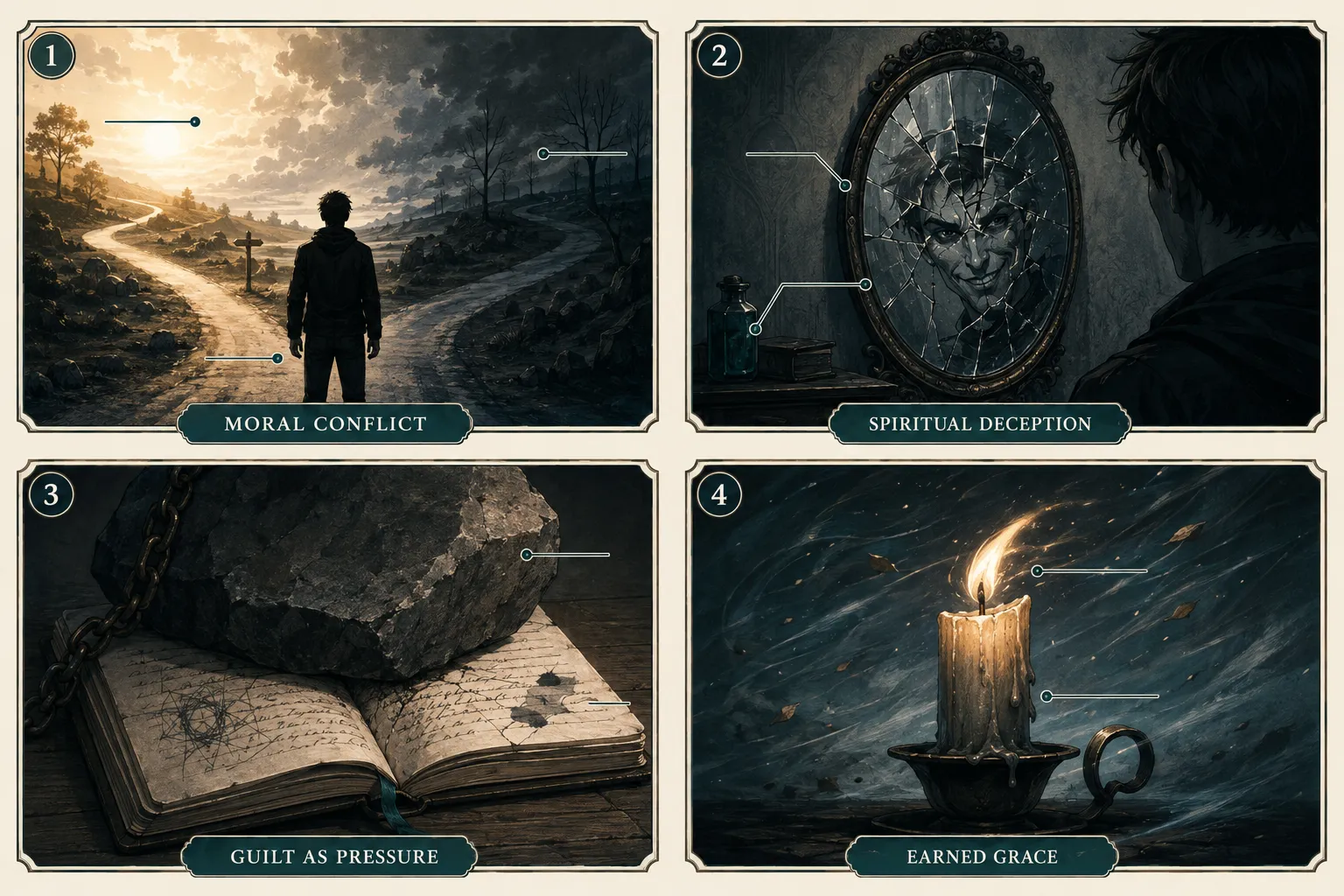
Moral conflict creates suspense in Christian psychological thrillers by forcing characters into situations where every available choice carries a cost. The reader feels the tension not because they fear physical harm, but because they understand what the character stands to lose, relationally, spiritually, vocationally, by choosing wrong [9].
The craft principle is this: suspense lives in the gap between what a character knows is right and what they are being pressured to do. The wider that gap, and the longer the character stands in it, the higher the tension climbs.
Practical techniques authors use:
- The compromised record. A character holds information that could protect someone or destroy them. Choosing what to do with it is the moral engine of the plot.
- The loyalty trap. A character must choose between protecting a person they love and telling a truth that will hurt them.
- The slow reveal of complicity. The protagonist gradually discovers they have participated, even innocently, in something harmful. Guilt becomes a pressure source that compounds with every new discovery.
- The false grace offer. An antagonist offers a way out that looks like mercy but requires the protagonist to betray something true. Accepting it would end the external danger but cost the character their integrity.
These mechanics work without a single scene of graphic violence. The weight is moral, and that weight is what keeps readers turning pages.
How Do Spiritual Warfare Themes Build Tension in Psychological Thrillers?
Spiritual warfare in Christian fiction creates tension by making the invisible conflict visible through its effects on characters and events. The reader doesn’t need to see angels and demons on the page, they need to feel the pressure of a battle being fought through human choices, deceptions, and moments of inexplicable clarity or darkness.
K.P. Smith’s Angelic Dominion of Light uses escalating suspense and emotional depth to make readers feel the reality of unseen conflict, demonstrating how external danger can mirror internal spiritual testing [5]. The technique is not to explain the warfare but to show its fingerprints.
How this builds tension specifically:
- A character who should be trustworthy keeps steering others away from truth, and the protagonist can’t quite name why.
- Moments of prayer or conviction arrive at the worst possible time, demanding action the character doesn’t feel ready for.
- The antagonist’s methods feel spiritually familiar, they use the language of faith, the structures of community, the appearance of grace, which makes them harder to resist and more disturbing to recognize.
The suspense in spiritual warfare isn’t about supernatural spectacle. It’s about discernment under pressure, the terrifying possibility that something that looks holy might not be, and the cost of figuring that out in time.
What Makes a Character’s Internal Moral Struggle Compelling in Christian Fiction?
A character’s internal moral struggle becomes compelling when the reader can feel the genuine cost of both choices, and when the character’s faith is part of the problem, not just the solution.
Suspense writer Will Marler describes this as writing characters who encounter faith at the moment they are “desperate, broken, and out of options” [2]. That’s the condition that makes internal struggle real: not a philosophical debate, but a person at the end of their resources, choosing what to hold onto.
What makes the struggle work:
- The character has something genuine to lose by doing the right thing, not just comfort, but relationships, reputation, or safety.
- Their faith is tested, not confirmed. They don’t receive a clear sign; they have to act on conviction without certainty.
- The struggle is specific, not abstract. It’s not “should I be honest”, it’s “should I tell Pastor Harmon what I found in that file, knowing it will destroy the ministry he built.”
- The reader understands the temptation. The wrong choice has to be genuinely appealing, not obviously evil.
Faith under fire is only gripping when the fire is real. Characters who face no genuine cost in their spiritual choices produce no genuine tension.
How Can Faith Doubt and Questioning Drive a Thriller Plot Forward?
Faith doubt drives plot when it creates decision paralysis at critical moments, causes the protagonist to misread a situation, or opens them to manipulation by someone who offers false certainty. Doubt is not the enemy of the story, it is one of its best tools.

When a character isn’t sure whether God is present or whether they can trust their own spiritual instincts, they become vulnerable in ways that external threats alone can’t produce. That vulnerability is where a skilled antagonist, or a well-constructed situation, can apply the most pressure.
Craft applications:
- A protagonist who doubts their own discernment will hesitate to act on a correct instinct, giving the threat time to deepen.
- A character who has lost confidence in prayer may isolate themselves precisely when community would protect them.
- Doubt can be weaponized by an antagonist who recognizes it and offers a counterfeit certainty, a false comfort that leads the protagonist further from truth.
The key is that doubt must eventually cost something and then be answered, not with a tidy resolution, but with a hard-won, specific act of trust that the reader has watched the character earn. That’s the difference between hope in the dark and cheap reassurance.
What Are Common Mistakes Authors Make Writing Christian Psychological Thrillers?
The most damaging mistake is resolving spiritual tension before the reader has fully felt it. When grace arrives too early, before the character has genuinely struggled, genuinely failed, or genuinely faced the cost, it reads as formula, not faith.
Other common mistakes:
- Scripture as a shortcut. Dropping a verse into a tense scene to signal resolution without earning it through plot. Readers feel the shortcut.
- The villain who is only evil. A one-dimensional antagonist removes moral ambiguity and makes the protagonist’s choices too easy. The most unsettling antagonists in Christian thrillers believe they are doing good.
- Preaching through the protagonist. When a character’s internal monologue shifts from doubt and fear to doctrinal explanation, the suspense evaporates. Faith shows through choice and consequence, not narration.
- Treating clean content as low stakes. The absence of graphic content doesn’t mean the absence of danger. Authors who confuse “clean” with “safe” produce stories without real tension.
- Resolving doubt with conversion. A dramatic conversion moment at the climax is not a substitute for a character arc. Readers want to see faith worked through, not announced.
The market is moving decisively away from books that treat theology as decoration [9]. Readers want the friction named, not smoothed over.
How Do You Balance Religious Messaging with Actual Suspense and Plot?
The balance is achieved by making faith load-bearing rather than decorative, meaning the spiritual content is what creates the stakes, not what interrupts them. When the religious element is structural, it doesn’t compete with the plot; it is the plot.
A character’s conviction that bearing false witness is wrong doesn’t slow the thriller down, it is the reason the thriller exists. Their faith is what makes the choice hard, what makes the antagonist’s manipulation effective, and what makes the eventual truth-telling costly and meaningful.
Practical balance principles:
- Let faith show through what a character refuses to do, not through what they say about God.
- Use community structures (churches, prayer groups, ministries) as settings where trust and betrayal carry extra weight, not as safe spaces, but as places where deception is especially damaging.
- Keep the spiritual stakes tied to the plot stakes. If a character’s faith crisis has no effect on the external plot, cut it or deepen it.
- Avoid the “faith chapter”, a section where plot pauses for spiritual reflection. Weave conviction into action.
The goal is fiction that walks with the reader, not talks at them. Faith that lives in the story’s bones doesn’t need to announce itself.
Are Christian Psychological Thrillers Only for Religious Readers?
No. Christian psychological thrillers with strong moral and spiritual conflict at their center are accessible to any reader who values stories about conscience, integrity, and the cost of truth. The faith framework provides the stakes and the moral architecture, but the human experience of guilt, doubt, temptation, and the desire for redemption is not exclusive to believers.
That said, the subgenre is primarily written for and marketed to readers who want their faith represented honestly in fiction, particularly women 35-65 who read on Kindle Unlimited and want clean Christian fiction with real stakes [8]. These readers are not looking for a theological lecture; they want characters who doubt, serve, fail, and find grace in the middle of an ordinary Tuesday that suddenly isn’t ordinary anymore.
Who this subgenre serves best:
- Readers who want suspense without graphic content
- Readers who want faith treated as lived experience, not background noise
- Readers who find moral and spiritual stakes more gripping than physical danger alone
- General readers who appreciate psychological complexity and character-driven plots
What Techniques Do Successful Authors Use to Keep Readers Guessing About Characters’ Motivations?
The most effective technique in Christian psychological thrillers is spiritual ambiguity, making it genuinely unclear whether a character’s motives are holy or self-serving, and letting that uncertainty drive the reader’s suspicion.
Because Christian communities operate on trust, shared language, and assumed good faith, a character who uses that language and structure for harmful ends is deeply unsettling. The reader can’t be sure whether the pastor who keeps redirecting the investigation is protecting the congregation or protecting himself.
Specific techniques:
- Give every character a theologically coherent justification for their actions, including the antagonist.
- Use the language of grace and mercy as potential cover for manipulation, let the reader wonder if a character is offering genuine forgiveness or buying silence.
- Delay the revelation of a character’s full history. What looks like spiritual maturity may be the result of something the character has never confessed.
- Let the protagonist’s own biases, toward trusting authority, toward believing the best, work against them.
This is the spine question running through The Gathering Light: who controls the record of someone’s truth, and what happens when the system designed to protect testimony turns it into a tool of control.
How Do You Write a Christian Thriller That Doesn’t Feel Preachy, and What Role Does Redemption Play in Building Tension?
A Christian thriller avoids feeling preachy when faith is demonstrated through consequence rather than stated through dialogue. The moment a character explains what they believe in a way that feels directed at the reader rather than at the situation, the story has stepped out of fiction and into sermon.
Redemption builds tension rather than releasing it when it is deferred, partial, and costly. The reader should feel the weight of what the character has done, and what it will take to make it right, long before any resolution arrives. Redemption that costs something is what makes grace feel real rather than formulaic.
How to keep redemption tension-building:
- Let the character face genuine consequences for their choices before grace enters the picture.
- Make the act of repentance or truth-telling require the character to give up something they value, safety, reputation, a relationship.
- Don’t let grace cancel consequences. A character can be forgiven and still face the damage their choices caused. That tension is where the most honest Christian fiction lives.
- Avoid the clean exit. Mercy is not the same thing as reputation restored.
Earned grace, grace that arrives after cost, not instead of it, is what separates a Christian psychological thriller from a morality play.
How Do You Use Moral Ambiguity to Make a Christian Thriller More Suspenseful?
Moral ambiguity in a Christian thriller creates suspense by forcing the reader to hold competing interpretations of the same character or event, and by making the protagonist’s faith the lens through which that ambiguity is processed, imperfectly.
The ambiguity is not relativism. The story still has a moral center. But the path to clarity is obscured, and the protagonist’s spiritual convictions both help and hinder their ability to see clearly. That tension, between what faith teaches and what the evidence suggests, is where the best Christian psychological thrillers operate.
Practical applications:
- A character who has done real harm may also have done real good. The protagonist has to hold both truths simultaneously.
- The “right” choice may be unclear not because the moral framework is absent, but because the facts are incomplete.
- Let the protagonist be wrong about someone they trusted, and let that wrongness cost them, not as punishment, but as consequence.
Moral ambiguity handled this way doesn’t undermine faith. It tests it, which is exactly what a thriller is supposed to do.
Conclusion: Writing Suspense That Earns Its Hope
The Christian psychological thriller is one of the most demanding forms in clean Christian fiction, not because it requires graphic content, but because it requires genuine honesty about the weight of moral choice. Guilt, temptation, spiritual deception, and the slow cost of grace are not decorations on a thriller plot. They are the plot.
Actionable next steps for writers and readers:
- Writers: Identify your protagonist’s specific moral vulnerability, the conviction that will be tested, before you build the external plot around it.
- Writers: Let your antagonist believe they are right. The most unsettling villains in Christian fiction have a theology.
- Writers: Defer grace. Let the character earn the hope before it arrives.
- Readers: If you want Christian psychological thrillers that treat faith as load-bearing structure, start with When Hannah Sleeps, the first book in The Gathering Light series, and follow the question of who controls the record of someone’s truth through all three books.
- Both: Look for stories where faith shows up in what a character refuses to do, not in what they say about God. That’s where the real tension lives.
The subgenre is growing because readers are done with books that smooth over the hard things [9]. They want hope in the dark, not because the dark was never real, but because the light arrived anyway, and it cost something. That’s the promise of faith-rooted fiction done right. Rooted in Faith, honest about the cost, and never in a hurry to hand out cheap grace.
Frequently Asked Questions
What is the difference between a Christian thriller and a Christian psychological thriller? A Christian thriller typically centers on external danger, crime, conspiracy, physical threat, with faith as a character element. A Christian psychological thriller places the primary conflict inside the protagonist’s mind, conscience, and spiritual life. The external plot exists to pressure the internal one.
Can a Christian psychological thriller have an unreliable narrator? Yes, and it can be especially effective. A narrator whose faith has been manipulated or whose spiritual discernment has been compromised creates a layer of uncertainty that serves the genre well, as long as the story ultimately holds to a moral center.
Do Christian psychological thrillers have to end with redemption? They don’t have to end with complete restoration, but they should end with honest reckoning. Redemption that costs something is more satisfying, and more theologically honest, than a tidy resolution. The character should be changed, not just rescued.
What makes spiritual deception scarier than physical danger in fiction? Physical danger threatens the body. Spiritual deception threatens the character’s ability to tell truth from lie, good from evil, genuine grace from its counterfeit. That threat is harder to escape because it operates from inside the character’s own framework.
Is moral ambiguity appropriate in Christian fiction? Yes. Moral ambiguity is not the same as moral relativism. A story can have a clear moral center while still presenting situations where the right choice is genuinely difficult to discern. That difficulty is what makes the eventual clarity meaningful.
How do you write faith doubt without making the character seem weak? Doubt is a sign of engagement, not absence. A character who doubts is a character who takes their faith seriously enough to be troubled when the evidence is hard. Write doubt as active wrestling, not passive drift, and let it cost the character something before it resolves.
What’s the best length for a Christian psychological thriller? Most in the subgenre run 70,000-90,000 words. Long enough to build genuine psychological pressure and let moral consequences unfold, short enough to maintain the tight pacing the genre requires.
Are Christian psychological thrillers appropriate for teens? It depends on the specific book. Clean content standards (no graphic violence, language, or explicit content) make many appropriate, but the psychological and spiritual complexity is generally aimed at adult readers. Parents should preview before recommending to younger teens.
How is spiritual warfare portrayed without feeling supernatural-horror adjacent? By keeping the warfare’s effects human and relational. The battle shows up in deception, manipulation, isolation, and the corruption of trust, not in supernatural spectacle. The reader feels the spiritual dimension through its consequences, not through explicit supernatural events.
What’s the single most important craft principle for this subgenre? Let grace arrive after cost, not instead of it. Every other technique follows from that one.
References
[1] Luanaehrlich – https://allauthor.com/interview/luanaehrlich/
[2] Author Interview And A Giveaway Will Marler Desperate Souls – https://readingismysuperpower.org/2026/02/12/author-interview-and-a-giveaway-will-marler-desperate-souls/
[3] New Christian Suspense Books – https://christiansuspensenovels.com/new-christian-suspense-books
[4] goodreads – https://goodreads.com/book/show/250650647
[5] Award Winning Author K P Smith Releases Angelic Dominion – https://www.openpr.com/news/4572831/award-winning-author-k-p-smith-releases-angelic-dominion
[6] Christian Reading Trends 2026 Devotional Fiction Dominance Revealed – https://www.firmenpresse.de/pressrelease735411/christian-reading-trends-2026-devotional-fiction-dominance-revealed.html
[7] 50 Best Christian Mystery Books 2026 Ultimate Reading Guide – https://thebookdecoder.com/50-best-christian-mystery-books-2026-ultimate-reading-guide/
[8] Christian Suspense Thrillers – https://christiansuspensenovels.com/christian-suspense-thrillers
[9] 2026 Best Selling Christian Fiction Books Market Trends Top Genre Insights – https://www.alibaba.com/product-insights/2026-best-selling-christian-fiction-books-market-trends-top-genre-insights.html
[10] news.marketersmedia – https://news.marketersmedia.com/christshare-highlights-growth-of-serialized-christian-fiction-content/89189939