Last updated: August 19, 2026
Quick Answer: From small-town sheriff to reluctant outlaw is one of the most compelling moral arcs in Christian western fiction because it forces a character, and the reader, to ask what obedience actually means when the law itself is corrupt. Christian westerns handle this by grounding moral ambiguity in faith, not abandoning it: the character’s conscience, shaped by belief, becomes the true north when the badge no longer can be. These stories work best when the cost of that choice is real and the grace that follows is earned, not handed out.
Key Takeaways
- Christian western fiction differs from secular westerns by treating faith as a load-bearing story element, not a backdrop or decoration.
- Moral gray areas, vigilante justice, false warrants, loyalty versus righteousness, are common in the genre precisely because Scripture itself is full of them.
- A reluctant outlaw is not an antihero; the distinction lies in motivation, conscience, and the weight the character carries for every wrong choice made for right reasons.
- The best Christian western characters break the law only after genuine moral reckoning, and the narrative holds them accountable.
- Clean Christian fiction can portray moral complexity without graphic content; the tension lives in conscience and consequence, not in explicit violence.
- Series like Silas Bellhaven’s The Mercy Line and Jim Head’s Circuit Rider Mysteries (2026) show the subgenre actively expanding with morally layered protagonists.
- The primary readership skews toward women 35-65 on Kindle Unlimited who want faith handled honestly, not preached.
- Common author mistakes include resolving moral tension too quickly or using faith as a shortcut to avoid hard consequences.
What Is Christian Western Fiction and How Does It Differ from Regular Westerns
Christian western fiction is frontier storytelling where faith functions as a structural element of the plot, shaping character decisions, driving conflict, and informing what justice and mercy actually look like on the ground. It is not a western with Bible verses dropped in. The difference is load-bearing: in a secular western, the hero’s moral code is personal and often self-defined. In a Christian western, the protagonist answers to something outside himself, and that accountability is the engine of the story.
Regular westerns often celebrate individual will, the lone gunfighter who makes his own law. Christian westerns complicate that by asking what a man owes to God, to community, and to truth when those obligations pull in different directions. The frontier setting is not just atmosphere; it is a pressure cooker for exactly those questions.
What sets Christian westerns apart:
- Faith is tested by plot events, not stated in narration
- Justice and mercy are treated as distinct and sometimes competing obligations
- Characters face consequences that are spiritually as well as physically real
- The moral resolution points toward grace, but grace costs something first
Why Christian Westerns Explore Moral Gray Areas Instead of Clear Good vs. Evil
The genre leans into moral complexity because the source material, Scripture itself, is full of it. Critics of Christian fiction have long noted that many conservative readers tolerate moral ambiguity in the Bible (David, Rahab, the prophets) but resist it in novels [1]. That tension is productive. It means Christian western authors are working in a space where the genre’s most honest instincts push against reader expectations, and the best books navigate that honestly.
Mike Duran’s “Moral Artist Principle” captures the core debate: biblical narrative does not always provide clean moral resolution, yet Christian fiction is often pressured to [32]. The frontier setting amplifies this because historical western life was genuinely ambiguous, land claims were disputed, warrants were fabricated, and law enforcement was sometimes indistinguishable from organized crime.
“Mercy is never cheap, and the ordinary Tuesday can turn out to matter more than anyone expected.”, Silas Bellhaven
A story that pretends otherwise is not more Christian. It is less honest. The moral gray area is where faith under fire actually gets tested.
What Makes a Character a Reluctant Outlaw in Fiction
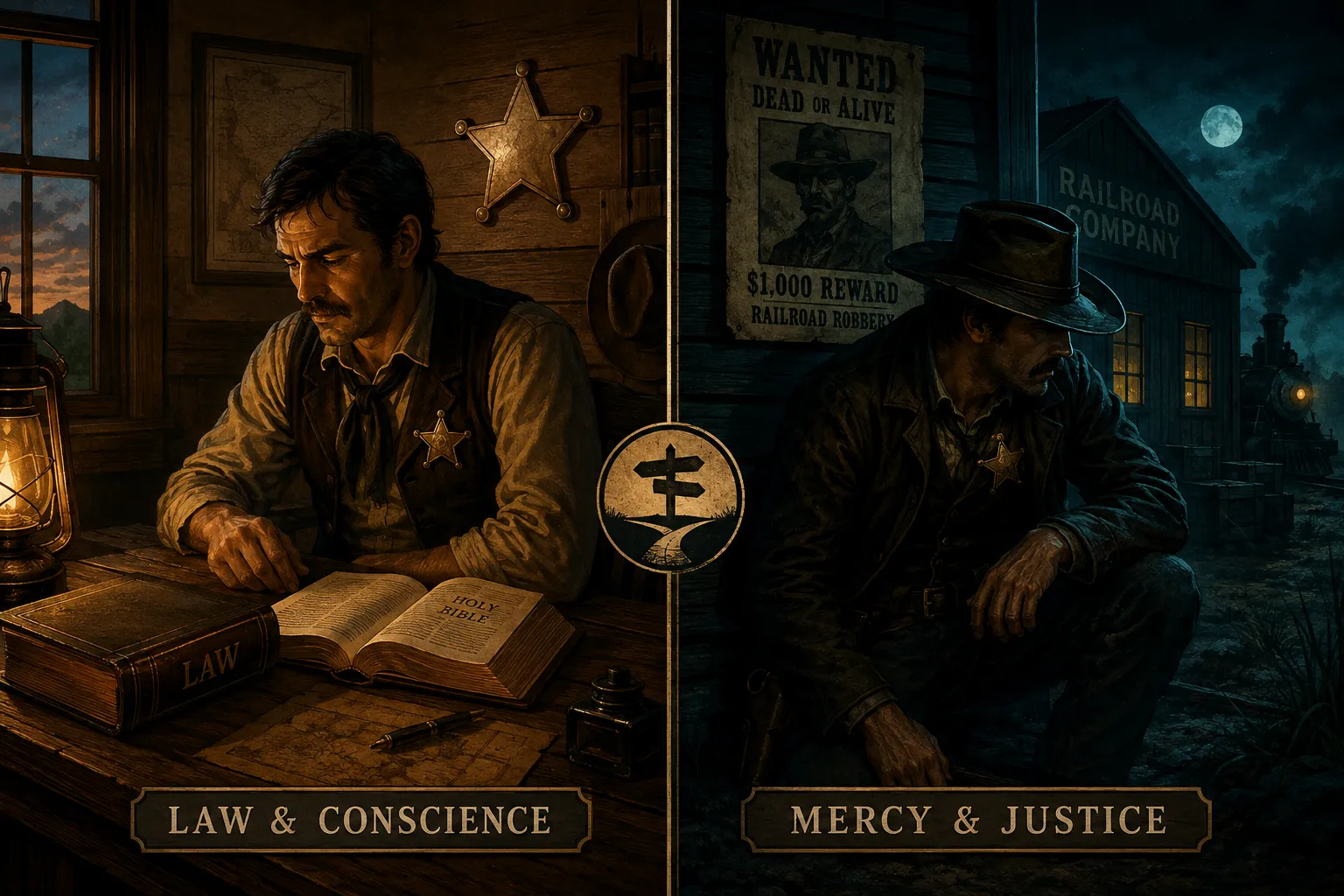
A reluctant outlaw is a character who crosses a legal or social boundary not from ambition, self-interest, or rebellion, but because their conscience, shaped by a moral framework they genuinely hold, leaves them no other path. The reluctance is the point. They do not want to break the law. They want the law to be worth keeping.
Reluctant outlaw vs. antihero, the key distinctions:
| Reluctant Outlaw | Antihero | |
|---|---|---|
| Motivation | Conscience and moral obligation | Self-interest or survival |
| Relationship to law | Grieves breaking it | Indifferent or contemptuous |
| Faith dimension | Answers to a higher authority | Defines own moral code |
| Narrative weight | Carries guilt; seeks accountability | Often avoids accountability |
| Resolution | Seeks restoration or justice | May remain unresolved |
In Christian western fiction, the reluctant outlaw is almost always someone who held a position of lawful authority, a sheriff, a marshal, a land agent, before the system they served proved corrupt. The arc from small-town sheriff to reluctant outlaw is specifically about what happens when the badge and the conscience stop pointing the same direction.
Silas Bellhaven’s The False Warrant (The Mercy Line, Book 1) puts this question directly: a territorial seal does not make a custody lawful, and Caleb must decide what obedience is worth. That is the reluctant outlaw question in its cleanest form.
How Christian Values Complicate a Sheriff’s Decision to Become an Outlaw
This is the moral center of the from-small-town-sheriff-to-reluctant-outlaw arc, and it is more complicated than it looks. Christian ethics do not simply endorse breaking unjust laws, Romans 13 is in the canon alongside Exodus 1 (the midwives who defied Pharaoh). A believing character carries both of those texts in his chest when he has to decide.
The specific complications a Christian sheriff faces:
- Submission to authority, faith traditions generally counsel obedience to governing structures, which makes defiance costly in a way secular westerns do not require
- Pride vs. conscience, the character must honestly examine whether his resistance is righteous or simply self-righteous
- Mercy toward the corrupt, a Christian protagonist cannot simply destroy the villain; he must reckon with what mercy looks like toward someone who has done real harm
- Accountability, breaking the law for good reasons does not erase the act; the character must be willing to answer for it
These complications are what make the arc rich rather than simple. The faith does not make the choice easier. It makes the weight of it heavier and the grace of surviving it more real.
Christian Western Novels Where the Hero Breaks the Law for Good Reasons
Several recent titles show how the subgenre is handling this arc in 2026.
Silas Bellhaven’s The Mercy Line series is built on exactly this tension. The series conscience line, “Where law runs out, a man finds what he answers to”, is the reluctant outlaw question stated as a premise. Book 1, The False Warrant, opens with a custody order that carries a legitimate seal but lacks legitimate authority. Book 4, The Living Record, places protagonist Jonah between lawful paper and a deadly road, with no clean exit. Each book in the series holds its protagonist accountable for the choices made, and grace shows up after cost, not instead of it.
Jim Head’s Blood on the Sawdust Trail (Circuit Rider Mysteries, Book 1, launched July 2026) is set in Redemption, Colorado in 1887 and frames its central conflict as justice and mercy colliding, with themes of greed, forgiveness, and truth running through frontier detective storytelling [30]. The title and setting signal exactly the kind of moral gray area this subgenre does best.
C. Lowry’s Wrangler Range (February 2026) builds its premise around a new sheriff facing the “thin line between lawman and gunslinger”, a direct engagement with the reluctant outlaw question from the law-enforcement side [19].
How Do Authors Balance Faith Themes with Outlaw Protagonists in Westerns
The balance works when faith shapes the character’s internal experience of moral failure rather than providing a clean exit from it. The mistake is using faith as a resolution device, the character prays, receives clarity, and acts decisively. That is not how faith under fire actually works, and readers feel the falseness of it.
What works:
- Faith shows up as doubt, as prayer that goes unanswered in the moment, as the character holding a conviction they cannot fully justify
- The moral choice is made before the character has certainty, not after
- Consequences are real and proportionate, grace does not erase them
- Other characters hold the protagonist accountable, including people of faith
What does not work:
- A conversion moment that resolves the plot tension
- Scripture quoted as a solution rather than a question
- The outlaw arc treated as a detour from faith rather than an expression of it
The best clean Christian fiction in this space treats the outlaw arc as the place where faith gets proven, not the place where it gets suspended.

Are Christian Westerns Popular and Who Reads Them
Christian fiction as a category has shown consistent market growth, with Kindle Unlimited providing a significant distribution channel for series-based clean fiction [7]. The western subgenre specifically sustains multi-book arcs, the Burning Dress Ranch line, The Mercy Line, and the Circuit Rider Mysteries all launched or expanded in 2026 [16] [30], which suggests readers are returning to these worlds rather than sampling and moving on.
The core readership for Christian western fiction overlaps substantially with the broader clean Christian fiction audience: primarily women 35-65, Kindle Unlimited subscribers, readers who want real stakes handled within a faith framework. That demographic is not looking for sanitized stories. They want stories that are honest about hard things without being gratuitous about them, which is exactly what the moral gray area western offers.
The subgenre also draws readers who came to Christian fiction through other genres (cozy mystery, historical romance) and found the frontier setting offered something the other genres did not: a context where the stakes of moral failure are immediate and physical, not just social.
Common Mistakes Authors Make Writing Moral Ambiguity in Christian Westerns
The most common failure is resolving moral tension too quickly. A character faces a genuine dilemma, obey a corrupt law or protect an innocent person, and within a chapter, a prayer or a mentor figure arrives to clarify the right answer. The tension evaporates before it has done its work.
Other frequent mistakes:
- Moralizing through secondary characters, a preacher or elder delivers the thematic point in dialogue, removing the need for the reader to sit with the question
- Consequence-free grace, the protagonist makes a morally costly choice and suffers no real loss; faith is used to skip the accountability
- Collapsing the outlaw arc into a conversion arc, the character’s moral struggle becomes primarily about their spiritual state rather than the concrete injustice they face
- Avoiding the hard question, the law turns out not to be corrupt after all, or the dilemma resolves through a plot convenience that lets the character keep their hands clean
Caleb Woodbridge’s argument that Christian fiction can and should explore a fallen world where justice is not always immediate and consequences are uneven [44] is the corrective here. The story does not need to deliver a tidy verdict. It needs to point honestly toward mercy and grace without pretending the road there was straight.
Can a Christian Character Still Do Morally Questionable Things in a Western
Yes, and the genre is most honest when it says so plainly. A character rooted in faith is not a character who never fails morally. They are a character for whom moral failure carries real weight, who does not rationalize it away, and who seeks accountability rather than avoidance.
The distinction that matters is between moral failure with consequence and moral failure as entertainment. Clean Christian fiction holds the line on the latter. A character can lie to protect an innocent person, break a corrupt law, or use force in a situation where every option is bad, and the story can treat all of that honestly, without the narrative endorsing it as cost-free or glorifying the transgression.
This is what earned grace means in practice: the character does something they cannot fully justify, they carry it, and the grace that eventually comes is proportionate to the cost. That is more theologically honest than a story where the believing character never has to make a genuinely hard choice.
How Real Western History and Christian Theology Clash in This Genre
Frontier history was not clean, and Christian western authors who engage it honestly will find genuine tension between the historical record and the theological ideals their characters hold. Land dispossession, labor exploitation, and the corruption of territorial courts were real features of the American West, not invented dramatic conveniences.
That history creates productive friction with Christian theology in several specific ways:
- Justice delayed, the historical West often delivered no justice at all, which challenges the narrative expectation that righteousness will be vindicated
- Complicity, churches and Christian institutions were sometimes complicit in frontier injustice, which means a believing protagonist cannot simply align with the church as a moral authority
- The record, land claims, warrants, and labor bonds were the instruments of both justice and oppression, which is why so many Christian westerns (including The Mercy Line) center on documents and records as objects of moral weight
The Gospel Coalition’s argument for fiction that resists flattening spiritual reality while acknowledging genuine moral cross-pressure [39] applies directly here. The best Christian westerns do not resolve the historical tension. They hold it open long enough for faith to mean something real inside it.
FAQ
What is a moral gray area in Christian western fiction? A moral gray area is a situation where a character must choose between two obligations that both carry genuine weight, obeying the law versus protecting an innocent person, for example, with no option that is fully clean. Christian westerns use these situations to test faith under real pressure.
Is the reluctant outlaw a common character type in Christian westerns? Yes. The arc from lawman to outlaw (or near-outlaw) is one of the genre’s most recurring structures because it puts the question of conscience versus authority in the sharpest possible terms. The character’s faith makes the choice harder, not easier.
Can Christian western fiction be dark or serious? It can be serious and deal honestly with hard subjects. Clean Christian fiction avoids graphic violence, explicit content, and gratuitous darkness, but that is not the same as avoiding difficult moral territory. The darkness in these stories lives in conscience and consequence, not in content.
Who reads Christian western fiction? Primarily women 35-65, many on Kindle Unlimited, who want faith handled honestly inside a story with real stakes. The readership overlaps with Christian cozy mystery and historical fiction audiences.
What makes a Christian western different from a faith-adjacent western? In a faith-adjacent western, a character’s belief is part of their background. In a Christian western, faith is load-bearing, it directly shapes the decisions that drive the plot and the moral framework through which consequences are understood.
How do Christian western authors handle violence? Clean Christian fiction keeps violence consequential but not graphic. A character may use force, face death, or witness injustice, but the narrative does not linger on physical detail for its own sake. The weight of violence is moral and emotional, not visual.
Is Silas Bellhaven’s The Mercy Line a good example of this genre? Yes. The Mercy Line is built on the conscience question, “Where law runs out, a man finds what he answers to”, and each book places its protagonist between a lawful document and a morally unjust outcome. The series holds characters accountable and treats grace as something earned through cost.
What is the difference between earned grace and cheap grace in this context? Cheap grace resolves moral tension without requiring the character to bear real consequence. Earned grace comes after the character has genuinely paid a cost, loss, accountability, grief, and the mercy that follows is proportionate to what it took to get there.
Are there new Christian western releases in 2026? Yes. Jim Head’s Blood on the Sawdust Trail (Circuit Rider Mysteries) launched in July 2026, and multiple titles in the Burning Dress Ranch line released in spring 2026. The subgenre is actively expanding [16] [30].
What is the biggest mistake readers make when approaching this genre? Expecting the faith element to guarantee a tidy resolution. Christian western fiction at its best does not promise that righteousness wins quickly or cleanly. It promises that the character’s faith will be tested, proven, and sometimes broken open, and that grace will show up on the other side of that, not instead of it.
Conclusion
The arc from small-town sheriff to reluctant outlaw is not a detour from Christian western fiction’s faith commitments. It is where those commitments get tested most honestly. When a character who believes in justice, accountability, and mercy discovers that the law he serves has become an instrument of injustice, his faith does not give him an easy answer. It gives him a harder question, and the story lives in how he carries it.
If you want to read Christian westerns that take this seriously:
- Start with The False Warrant (The Mercy Line, Book 1) for a clean, conscience-driven frontier story where a lawful document and a lawful act are not the same thing.
- Explore the full Mercy Line series for a linked-protagonist structure where each book asks the same question from a different angle.
- Watch for Jim Head’s Circuit Rider Mysteries if you want frontier detective storytelling with justice and mercy in direct collision.
The genre is growing because readers want stories that walk with them through hard moral territory, not stories that talk at them about what the right answer was supposed to be all along. Rooted in faith, honest about cost, and clear that mercy is never cheap: that is what this subgenre does when it is doing its best work.
References
[7] Christian Fiction Keeps Its Allure – https://www.publishersweekly.com/pw/by-topic/industry-news/religion/article/73661-christian-fiction-keeps-its-allure.html
[16] CKN Christian Publishing new releases – https://www.alibaba.com/product-insights/the-rise-of-christian-fiction-market-trends-regional-dynamics-and-future-predictions-for-2026.html
[30] Blood on the Sawdust Trail launch – EIN Presswire (Jim Head, Circuit Rider Mysteries, July 2026)
[32] Mike Duran, Moral Artist Principle discussion – referenced in Christian fiction criticism
[39] The Gospel Coalition, Christian fiction and spiritual reality – referenced in Christian fiction criticism
[44] Caleb Woodbridge, Christian fiction and fallen-world storytelling – referenced in Christian fiction criticism
[1] Can A Christian Author Write For The General Market – https://christianpublishers.net/can-a-christian-author-write-for-the-general-market/