
Last updated: August 20, 2026
Quick Answer: The best Christian epic fantasy worlds on Kindle Unlimited are built around faith-integrated magic systems, covenant bonds, prophecy mechanics, and spiritual warfare frameworks, that make theology load-bearing inside the story rather than decorative. These aren’t allegories with thin plots. They’re secondary worlds where the rules of power, mercy, and consequence grow directly from a Christian understanding of how the universe works. Readers who love deep worldbuilding will find that the faith element adds structural depth, not Sunday school interruptions.
Key Takeaways
- Faith-integrated magic means the rules of magic in a story reflect theological realities, covenant, consequence, grace, not just Christian symbols sprinkled on top of a secular system.
- Kindle Unlimited is the primary discovery engine for Christian epic fantasy in 2026, with new series surfacing regularly in Amazon’s new-release charts [1][5].
- The best series avoid allegory, they build original secondary worlds where Christian truth shows up through how the world works, not through thinly veiled stand-ins for biblical figures.
- You don’t need to be religious to enjoy faith-based fantasy; the best titles read as honest explorations of justice, mercy, and earned redemption that any thoughtful reader can engage.
- “Clean” and “theologically rich” are not the same thing, the most satisfying Christian fantasy is both, but many titles are one without the other.
- Silas Bellhaven’s Sarel Chronicles and Kethara Chronicles are KU-available series built specifically for deep worldbuilding fans who want faith woven into the world’s architecture.
- Earned grace is the hallmark of the best Christian fantasy magic systems, power costs something, mercy arrives after cost, and cheap resolution is treated as a plot failure.
- Christian fantasy is a growing market segment, with analysts tracking significant year-over-year expansion in faith-based speculative fiction [3][6].
What Makes a Fantasy Magic System Christian or Faith-Based
A magic system is Christian or faith-based when its internal logic reflects a theological worldview, not when it uses Christian vocabulary. The difference matters enormously for readers who care about worldbuilding depth.
Secular fantasy magic tends to be transactional: learn the rules, apply the power, get the result. Faith-integrated magic systems work differently. They treat power as something that flows from a relationship, with a creator, a covenant, a living moral order, rather than something a character simply masters through study or willpower.
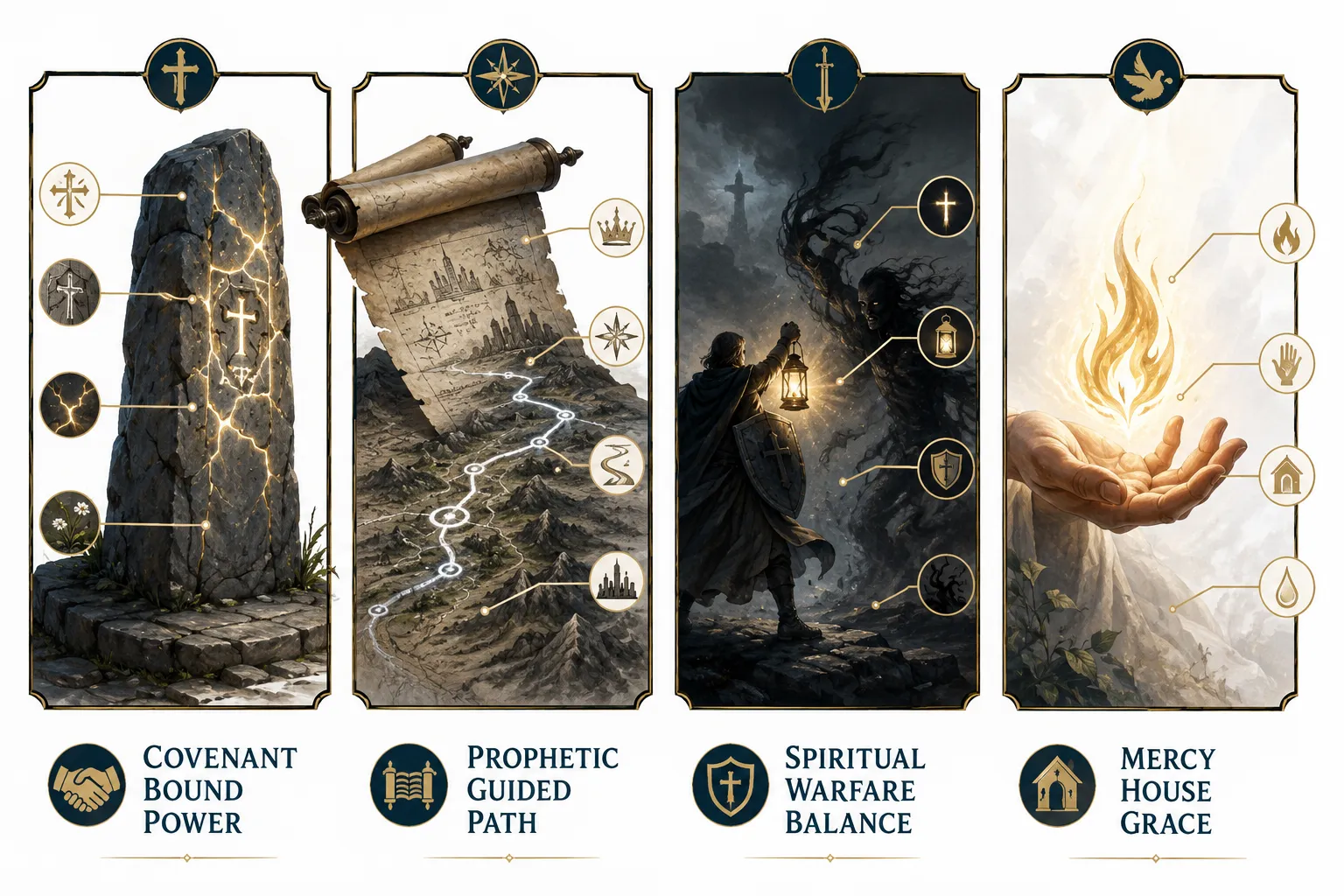
Key markers of a genuinely faith-integrated system:
- Covenant mechanics, power is granted through binding promises, and breaking those promises has real consequences inside the world’s rules
- Prophetic structure, the world has a direction, and characters can align with or resist it, but not ignore it
- Spiritual warfare, opposition isn’t just physical or political; there are forces that actively work against mercy and truth
- Earned grace, restoration is possible, but it follows cost, not instead of it
- Moral consequence baked into the physics, the world itself responds to faithfulness and betrayal
“Faith isn’t a backdrop, it’s load-bearing. Every story stands on the conviction that belief and event are woven from the same thread.”, Silas Bellhaven
The distinction between a magic system that uses Christian symbols and one that uses Christian structure is the difference between decoration and architecture.
Best Christian Fantasy Books on Kindle Unlimited Right Now
Kindle Unlimited hosts a growing catalog of Christian epic fantasy, and the titles worth your time share one quality: the faith element shapes the world’s rules, not just the characters’ dialogue [2][4].
Silas Bellhaven’s Sarel Chronicles (KU-available) is built around one of the more original faith-integrated magic concepts in the genre. In the world of Sarel, the Maker-Who-Hears has answered prayers across history, and those answered prayers are physically recorded as silver roads on the Great Map, certified and kept by the House of Witness. The magic isn’t spellcasting; it’s discernment. The question the trilogy asks is whether a prayer that goes unrecorded by human institutions still counts to the Maker.
- The Map of Unanswered Prayers, View on Amazon
- The Roads That Lied: Where the Map Ends, View on Amazon
- Beyond the Maker’s Map, View on Amazon
The Kethara Chronicles (also KU-available) takes a different angle: an empire that wants every act of mercy counted, contained, and bureaucratically managed. The covenant magic in Marat-Sol operates through witness-stones and memory-cords, physical objects that carry testimony. The spiritual warfare here is institutional, which makes it feel uncomfortably contemporary.
- The Stone That Remembered, View on Amazon
- The Cord That Loosened, View on Amazon
- The Name That Returned, View on Amazon
Beyond Silas Bellhaven’s catalog, Amazon’s new-release charts for Christian fiction regularly surface indie and small-press epic fantasy series built on similar frameworks [1][5]. The Christian fiction market has been expanding at a notable pace, with speculative and fantasy titles gaining meaningful share within that growth [3][6].
How Do Authors Integrate Theology into Fantasy Worldbuilding
Theology gets integrated into fantasy worldbuilding when it shapes the world’s physics, the rules of what is possible, what is forbidden, and what costs something, rather than appearing only in a character’s private beliefs.
The most effective approach, used by authors like Silas Bellhaven, is to ask: if this theological truth is real, what would the world look like? Then build the world from that answer outward.
Practical integration methods:
- Covenant as contract, Build binding agreements into the world’s power structure. Covenants that are honored open access to something; covenants broken close it or exact a price.
- Prayer as world-record, Treat answered and unanswered prayer as something the world itself tracks, even when human institutions fail to.
- Mercy as structural force, Make mercy not just a character virtue but something the world’s rules reward and protect, even when it’s costly.
- Spiritual opposition as plot engine, Give the antagonist forces a theological logic, not just a power motive. The best Christian fantasy villains aren’t evil because they want power; they’re evil because they want to replace the covenant with something they control.
- Redemption that costs something, Ensure that restoration follows genuine cost, not a dramatic moment of emotional resolution.
Scholars and theological essayists have long argued that fantasy is one of the most powerful vehicles for Christian truth-telling precisely because it can make invisible realities visible through world-rules rather than argument.
Christian Epic Fantasy vs. Secular Fantasy: What’s the Difference
The core difference isn’t content warnings or the presence of prayer scenes. It’s whether the universe in the story has a moral architecture that reflects a Christian understanding of reality.
| Feature | Christian Epic Fantasy | Secular Epic Fantasy |
|---|---|---|
| Source of power | Relational (covenant, calling, grace) | Neutral or self-generated |
| Moral consequence | Built into world physics | Socially constructed |
| Redemption arc | Costs something real | Often free or earned by heroism alone |
| Spiritual opposition | Theologically motivated | Power or survival motivated |
| Hope | Grounded in something outside the self | Earned through character will |
Secular fantasy can be morally serious and beautifully written. The difference is that Christian epic fantasy operates in a universe where mercy and justice are real forces, not just human preferences. That changes how magic systems work, how consequences land, and what the ending means.
Are There Christian Fantasy Worlds with Complex Magic Systems
Yes, and this is where the genre has matured most significantly in recent years. Early Christian fantasy often kept magic minimal or symbolic to avoid controversy. The current generation of authors, particularly those publishing through KU, are building systems with genuine structural complexity.
The Sarel Chronicles’ “cartographic prayer” system, where the Maker’s responses to prayer become navigable geography, is a strong example. The rules are internally consistent, they create genuine plot stakes, and they’re theologically grounded without being allegorical.
Complex faith-integrated systems tend to share these qualities:
- Internal consistency, the rules don’t bend to make the plot convenient
- Cost and consequence, using the system’s power always involves something given up or risked
- Theological coherence, the system reflects a real theological position, not just vague “light vs. dark” spirituality
- Discovery through story, the reader learns the rules the way the character does, through experience and consequence
Do I Need to Be Religious to Enjoy Faith-Based Fantasy
No. The best faith-based fantasy reads as honest storytelling about justice, mercy, and what it costs to tell the truth, questions that resonate with any thoughtful reader regardless of belief.
What faith-based fantasy offers non-religious readers is a universe with moral weight. The stakes feel real because the world’s rules treat faithfulness and betrayal as consequential, not just emotionally significant. That’s a different reading experience from secular fantasy where morality is negotiable.
Choose faith-based fantasy if you:
- Want magic systems with genuine moral consequence
- Prefer redemption arcs that cost something real
- Are drawn to worlds where the stakes include more than physical survival
- Appreciate clean content without graphic violence or explicit material
It may not be the right fit if you:
- Find any theological framing distracting regardless of how it’s handled
- Prefer magic systems rooted in purely naturalistic or scientific frameworks
Christian Fantasy Books That Don’t Feel Preachy
The best Christian fantasy doesn’t feel preachy because faith shows up through character choice and world consequence, not through narration or dialogue that explains what the reader should believe.
Silas Bellhaven’s stated approach, “walking with them, not talking at them”, is the clearest articulation of this. Characters in the Sarel Chronicles don’t stop the plot to deliver theological summaries. The theology is structural: it’s in what the world rewards, what it costs, and what holds when everything else breaks.
Signs a Christian fantasy is not preachy:
- Characters doubt, fail, and find grace through plot events, not monologues
- Antagonists have genuine theological logic, not cartoon villainy
- The “faith moment” comes after cost, not as a shortcut around it
- Scripture or prayer appears as lived experience, not as inserted lesson
Signs it probably is preachy:
- Characters explain their beliefs to each other in ways no real person would
- Conversion scenes resolve plot tension that should have been earned differently
- The villain exists to be corrected rather than to genuinely threaten

What’s the Difference Between Christian Allegory and Christian Fantasy
Christian allegory uses fantasy elements to represent specific theological realities, characters, events, or objects that stand for something in Christian doctrine. The most famous example is Narnia, where Aslan’s sacrifice and resurrection map directly onto the Passion.
Christian fantasy builds secondary worlds where Christian theological truth is structurally true without requiring a one-to-one correspondence. The world operates according to Christian principles, covenant, mercy, spiritual opposition, earned grace, but the story isn’t a code to be decoded.
The practical difference for readers:
- Allegory rewards recognition (“Aslan is Christ”)
- Christian fantasy rewards immersion (“this world has real moral weight”)
The Sarel Chronicles and Kethara Chronicles are Christian fantasy, not allegory. The Maker-Who-Hears is not a stand-in for a specific theological figure, the world is built to reflect what a universe governed by that kind of God would actually look like, with all the complications that implies.
Many readers who find allegory too tidy prefer Christian fantasy precisely because it doesn’t resolve neatly. Hope in the dark is still hope, but the dark gets to be genuinely dark first.
Common Mistakes in Writing Christian Fantasy Worldbuilding
The most common failure is treating faith as a character trait rather than a world-building principle. When only the protagonist is Christian and the world itself is morally neutral, the faith element floats on top of the story rather than supporting it.
Other frequent mistakes:
- Cheap grace, restoration that arrives without genuine cost undermines both the theology and the story
- Villain as strawman, antagonists who exist only to be theologically wrong rather than genuinely threatening
- Magic as prayer substitute, treating supernatural power as interchangeable with Christian spiritual practice without examining the difference
- Allegory creep, starting with original worldbuilding and then slowly mapping every element onto a biblical parallel until the world loses its own logic
- Faith as the solution, using a character’s belief as a plot device that resolves tension rather than as something tested and proven through the plot
The strongest Christian fantasy worldbuilding treats faith the way good fiction treats any truth: it earns it through what happens, not through what the narrator says about it.
How Much Religious Content Is in Christian Fantasy Novels
This varies significantly across the genre, and understanding the range helps readers find the right fit [8].
Light integration: Faith appears in character values and occasional prayer; the world’s rules are largely secular. These read more like “clean fantasy with a Christian protagonist.”
Moderate integration: The world has a creator-figure and a moral architecture, but the theological content stays in the background. Most mainstream Christian fantasy publishers operate here.
Deep integration: The magic system, world history, and plot stakes are explicitly shaped by theological realities, covenant, spiritual warfare, prophecy, earned grace. The Sarel Chronicles and Kethara Chronicles operate here.
For deep worldbuilding fans, the third category is where the most interesting work is happening. The faith element isn’t decoration; it’s the reason the world works the way it does.
Kindle Unlimited Christian Fantasy Series Worth Reading
Kindle Unlimited remains the central discovery tool for Christian fantasy readers who want to explore backlists and new series without per-book cost [2][9]. The platform’s subscription model is particularly well-suited to series readers, and Christian epic fantasy tends to publish in trilogies or longer runs.
Silas Bellhaven’s KU catalog for epic fantasy fans:
- The Sarel Chronicles (series page: Amazon), Start with The Map of Unanswered Prayers for the cartographic prayer system and Elya Renn’s arc from disgraced map-scribe to something the Great Map was never built to hold.
- The Kethara Chronicles (series page: Amazon), Start with The Stone That Remembered for covenant magic, witness-stones, and an empire trying to bureaucratize mercy.
Beyond these, Amazon’s Christian fiction new-release charts and KU-eligible fiction filters [2][4] surface additional series regularly. Curated recommendation lists and reader communities have also begun positioning Christian fantasy alongside other faith-friendly genres for discovery [9][10].
A Note on Kindle Unlimited Christian Fantasy and Diverse Characters
Readers sometimes ask whether KU Christian fantasy includes LGBTQ characters. This varies by author and publisher. Silas Bellhaven’s catalog maintains a traditional Christian sexual ethic, the content contract is clean fiction rooted in lived belief, which includes how relationships are portrayed. Readers looking for Christian fantasy that affirms LGBTQ relationships will find that most titles in the explicitly Christian epic fantasy category do not include those portrayals, reflecting the theological commitments of the authors and publishers in that space. That’s worth knowing before you start a series.
Conclusion: Where to Start with Faith-Integrated Epic Fantasy on KU
The best Christian epic fantasy worlds on Kindle Unlimited aren’t asking readers to accept a theology lesson wrapped in a plot. They’re asking a harder question: what would a world look like if mercy and justice were real forces, if covenant had weight, if grace arrived after cost rather than instead of it?
That question produces better worldbuilding, not just more wholesome content.
Actionable next steps:
- Start with the Sarel Chronicles if you want a magic system built around the gap between what institutions record and what the Maker actually hears. Begin with The Map of Unanswered Prayers.
- Start with the Kethara Chronicles if you want covenant magic and spiritual warfare in a world where an empire is trying to own the definition of mercy. Begin with The Stone That Remembered.
- Use KU’s Christian fiction filter [2] to browse new releases and find series that match your preferred integration depth.
- Look for earned grace, not cheap resolution, that’s the single clearest signal that a Christian fantasy series is doing the theological and narrative work well.
Faith under fire, hope in the dark, redemption that costs something, these aren’t just marketing phrases. In the best Christian epic fantasy, they’re the rules the world runs on.
Frequently Asked Questions
What is a faith-integrated magic system? A faith-integrated magic system is one where the rules of supernatural power in a fantasy world reflect theological realities, covenant, grace, spiritual opposition, rather than being morally neutral. Power flows from relationship and faithfulness, not just skill or study.
Are the Sarel Chronicles and Kethara Chronicles on Kindle Unlimited? Yes. Both series by Silas Bellhaven are available on Kindle Unlimited. The Sarel Chronicles series page is at amazon.com/dp/B0H3PF4XLN and the Kethara Chronicles at amazon.com/dp/B0H3YN7CQW.
Is Christian epic fantasy the same as Christian allegory? No. Allegory maps fantasy elements onto specific theological figures or events (Aslan as Christ). Christian fantasy builds worlds where Christian truth is structurally real without requiring a one-to-one correspondence. The distinction matters for readers who want immersive worldbuilding rather than a code to decode.
Do Christian fantasy books on KU have graphic content? Most titles in the explicitly Christian epic fantasy category are clean, no graphic violence, no explicit sexual content, no profanity. This is part of the content contract readers expect from the genre.
Can non-Christians enjoy Christian epic fantasy? Yes, particularly titles where the faith element is structural rather than devotional. Readers who value moral consequence, earned redemption, and worlds with genuine stakes often find Christian fantasy satisfying regardless of personal belief.
What’s the difference between “clean fantasy” and “Christian fantasy”? Clean fantasy avoids graphic content but may have no theological framework. Christian fantasy has both clean content and a world built on Christian theological principles. The best titles are theologically rich, not just content-filtered.
Where does Christian epic fantasy appear on Amazon? The Christian fiction category on Amazon (node 6190467011) includes KU-eligible fantasy titles [2][4]. New releases in Christian epic fantasy also surface regularly in Amazon’s new-release charts [1][5].
How do I know if a Christian fantasy series is preachy? Look at how faith moments function in the plot. If belief resolves tension that should have been earned through story events, or if characters explain theology to each other in ways no real person would, the series is likely preachy. If faith shows up through consequence and choice, it probably isn’t.
Is the Christian fantasy market growing? Yes. Industry analysis points to significant growth in Christian fiction broadly, with speculative and fantasy titles gaining share within that expansion [3][6].
What should I read first in Silas Bellhaven’s fantasy catalog? For deep worldbuilding fans, start with The Map of Unanswered Prayers (Sarel Chronicles, Book 1). For readers drawn to covenant magic and institutional spiritual warfare, start with The Stone That Remembered (Kethara Chronicles, Book 1).
References
[1] Amazon New Releases in Christian Fiction – https://www.amazon.com/gp/new-releases/books/7259433011
[2] Christian Fiction Kindle Unlimited Eligible – https://www.amazon.com/Christian-Fiction-Kindle-Unlimited-Eligible/s?rh=n:6190467011,p_n_feature_nineteen_browse-bin:9045887011
[3] Christian Fiction 14.7% Yearly Surge: Dramatic Market Expansion Data – https://www.firmenpresse.de/pressrelease734029/christian-fiction-14-7-yearly-surge-dramatic-market-expansion-data.html
[4] Religion, Spirituality, Christian & Bibles Fiction eBooks – Kindle – https://www.amazon.com/Religion-Spirituality-Christian-Bibles-Fiction-eBooks-Kindle/b?ie=UTF8&node=6190467011
[5] Amazon New Releases in Christian eBooks – https://www.amazon.com/gp/new-releases/digital-text/6190468011
[6] The Rise of Christian Fiction: Market Trends, Regional Dynamics and Future Predictions for 2026 – https://www.alibaba.com/product-insights/the-rise-of-christian-fiction-market-trends-regional-dynamics-and-future-predictions-for-2026.html
[8] ACFW Workshop: Fiction by the Numbers – https://member.acfw.com/ezine/article/workshop_12_fiction_by_the_numbers/
[9] New Arrivals on Kindle Unlimited: Romance, Epic Fantasy & More – https://geminook.com/new-arrivals-on-kindle-unlimited-romance-epic-fantasy-more/
[10] Fantasy Books from Christian Publishers: A Booklist – https://redeemedreader.com/fantasy-books-from-christian-publishers-a-booklist/