
Last updated: August 21, 2026
Quick Answer: Faith in fiction without preaching means letting spiritual themes emerge through what characters do, choose, and pay for, not through what they say about God. Christian authors keep story first by treating faith as load-bearing structure rather than decoration, so readers experience conviction through plot and consequence rather than dialogue that sounds like a Sunday school lesson. The result is fiction that walks with readers instead of talking at them.
Key Takeaways
- Preachiness is a structural problem, not just a tone problem, it usually comes from a character acting as a mouthpiece rather than a person with real stakes
- Faith should be load-bearing, meaning the story cannot function without it, not bolted on as a moral at the end
- Earned grace is more powerful than cheap grace, redemption that costs something lands harder than a tidy conversion scene
- Doubt and struggle are not threats to Christian fiction; they are the engine of authentic spiritual arcs
- Non-Christian readers can and do enjoy well-crafted Christian fiction when story comes first
- “Inspirational fiction” and “Christian fiction” are not the same category, the distinction matters for both craft and marketing
- The most common craft mistake is giving a character a theological speech no real person would deliver in that moment
- Show faith through choice and consequence, not narration, scripture-dropping, or convenient conversion
- Genre does not limit spiritual depth, cozy mystery, western, fantasy, and thriller can all carry genuine faith themes
- Clean content and compelling stakes are not opposites, the best Christian fiction proves this on every page
What Does It Mean to Write Faith-Based Fiction Without Being Preachy?
Writing faith-based fiction without being preachy means keeping theology invisible behind story. The moment a character stops acting like a person and starts functioning as a delivery system for doctrine, the fiction breaks, and readers feel it before they can name it [2].
The craft term for this failure is “Mouthpiece Syndrome”: a character says what the author believes rather than what that character, in that situation, would actually say [3]. The fix is not to remove faith from the story. The fix is to make faith the reason characters act, not the speech they give about acting.
“Walking with them, not talking at them”, this is the whole contract between a Christian author and a reader who came for a story, not a sermon.
Faith in fiction without preaching means:
- Characters doubt, serve, fail, and repent, in that order, not skipping steps
- Spiritual turning points cost something before grace arrives
- Scripture, if it appears, belongs to the scene, a character reads a verse because the story put them in a room with a Bible, not because the author needed a theme statement
- The reader draws the conclusion; the author trusts them to
How Do Christian Authors Balance Religious Themes With Compelling Storytelling?
The balance comes from treating faith as the story’s spine, not its wallpaper. When a character’s belief system directly shapes what they risk, what they refuse, and what they lose, the religious theme and the plot become the same thing [8].
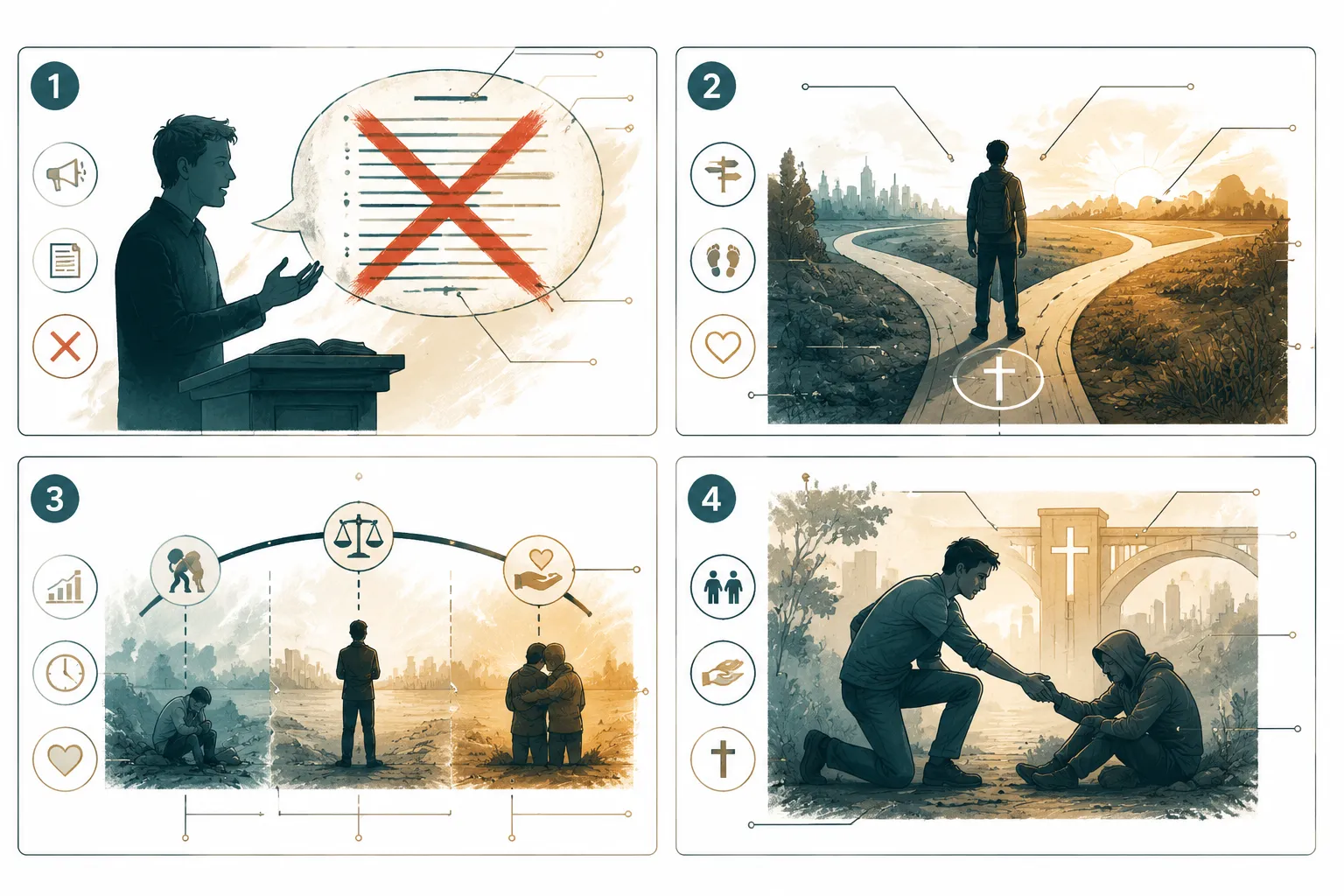
Consider the structure of a frontier western where a man must decide whether to honor a warrant he knows is false. His faith is not in the background, it is the exact reason the decision is hard. The law says one thing. His conscience, shaped by belief, says another. That tension is the story. No sermon required [5].
Practical techniques for balance:
- Anchor spiritual stakes to physical stakes, a character’s crisis of faith should coincide with a crisis in the plot, not arrive separately
- Let the “misbelief about God” drive the arc, what a character gets wrong about faith is more interesting than what they get right
- Use setting as spiritual texture, a church social, a hymnal with margin notes, a frontier town where law runs out all carry faith without announcing it
- Resist the “Willing Recipient” trap, do not write a secondary character who exists only to receive the protagonist’s spiritual wisdom [6]
- Let mercy and justice conflict, the most honest Christian fiction holds both without resolving the tension cheaply
What Is the Difference Between Inspirational Fiction and Christian Fiction?
Inspirational fiction is the broader category: stories with uplifting themes, moral clarity, and hope, but without necessarily naming God, Christ, or Scripture. Christian fiction is more specific: faith in Jesus Christ is present as a real force in the story world, not just as background culture [9].
The distinction matters for craft and for readers:
| Category | Faith Presence | Typical Reader Expectation | Example Tone |
|---|---|---|---|
| Inspirational Fiction | Implied, general spirituality | Hope, moral clarity, clean content | Hallmark-adjacent warmth |
| Christian Fiction | Named, specific, load-bearing | Faith tested and proven through plot | Earned grace, real cost |
| “Christ-lite” | Background culture only | Characters attend church; faith rarely tested | Cozy, low-stakes spiritual texture |
Audience segmentation research in 2026 consistently shows that readers who want “hardcore Christian” fiction, faith under fire, not faith as wallpaper, are a distinct and loyal segment. They will leave a book that promises Christian fiction and delivers only inspirational comfort.
How Do You Write About Faith Without Alienating Non-Religious Readers?
Non-religious readers are not alienated by faith, they are alienated by lectures. A character who genuinely wrestles with belief, pays a real price for it, and does not receive a tidy answer is interesting to any reader, regardless of their own convictions [3].
The practical rule: write the spiritual experience before writing the spiritual explanation. A character who prays in desperation because there is no other option left is more compelling than a character who explains why prayer matters. The experience carries the reader; the explanation stops them.
What keeps non-religious readers engaged:
- Moral complexity, faith that is tested, not assumed
- Consequences that feel real, grace that costs something before it arrives
- Characters who doubt without being punished by the narrative for doubting
- Story questions that matter to everyone, what do you do when the record is wrong? What does justice cost when mercy is the only door left?
Common Mistakes Christian Authors Make When Weaving Theology Into Novels
These are the structural failures that turn a story into a sermon [2][7]:
- The Mouthpiece Character: A protagonist who delivers theological speeches no real person would give in that moment
- The Convenient Conversion: A character accepts faith at the climax because the plot needs a resolution, not because the story earned it
- The Willing Recipient: A secondary character exists only to receive spiritual wisdom from the hero, no agency, no resistance, no cost
- Scripture as Wallpaper: Bible verses appear as chapter epigraphs or dialogue filler without connecting to what the scene is actually doing
- Punishment Theology: Characters who doubt or sin are immediately punished; characters who believe are immediately rewarded, this is not honest about how faith works
- The Clean Exit: A character’s faith resolves their problem without them having to pay anything, this is cheap grace, and readers recognize it even if they cannot name it
Redemption that costs something lands harder than a tidy conversion scene. That is not a craft preference, it is a theological truth that the best Christian fiction has always understood.
Techniques for Showing Faith Through Character Actions Instead of Dialogue
Faith in fiction without preaching is almost entirely a showing problem. The solution lives in scene construction, not in finding better theological language [10].
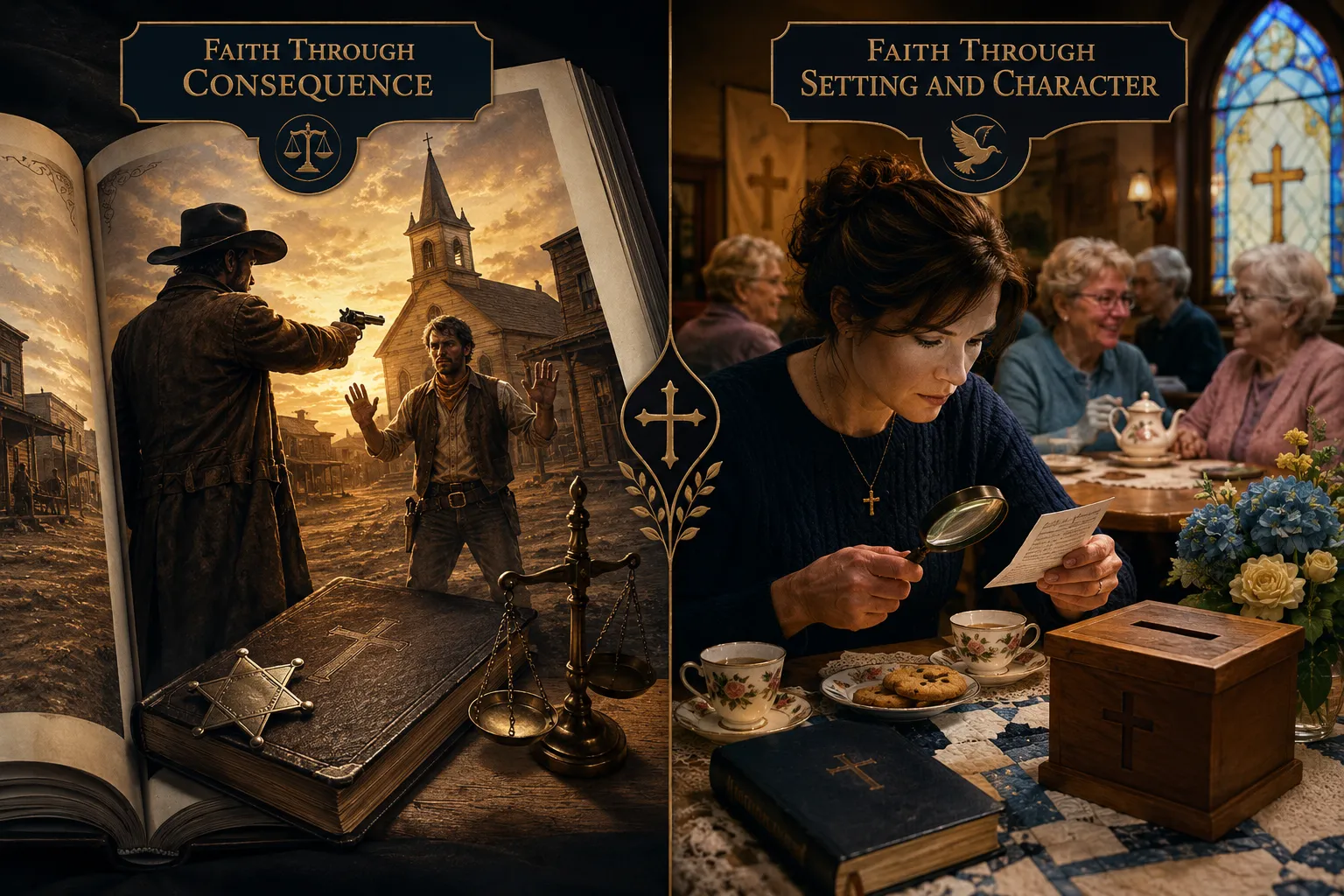
Concrete techniques:
- The choice under pressure, put a character in a situation where their faith costs them something tangible: a relationship, a reputation, a legal standing. What they choose is the sermon.
- The object as witness, a hymnal with margin notes, a donation box, a family Bible, a survey ledger all carry spiritual weight without a character explaining it
- Silence and restraint, a character who doesn’t take revenge when they could, who doesn’t lie when it would be easy, demonstrates faith more clearly than a speech about forgiveness
- The prayer that isn’t answered cleanly, show a character praying and then show them having to act anyway, in the dark, without confirmation
- Secondary characters who push back, a skeptic who asks hard questions forces the protagonist to live their faith rather than explain it
- Consequence as grace, let the story’s resolution feel like mercy, without a character announcing that it is
In The False Warrant (The Mercy Line), Caleb’s decision about whether to honor a warrant he knows is corrupt is not accompanied by a speech about obedience to God. The decision itself, and what it costs him, carries the entire spiritual weight of the book.
What Makes a Spiritual Theme Feel Organic Versus Forced in a Story?
A spiritual theme feels organic when it cannot be removed without the story collapsing. It feels forced when it could be lifted out and the plot would still work fine [8].
Organic spiritual themes:
- Grow from the story’s central question, what will you do with the truth once you’re holding it?
- Are embedded in the genre’s natural tensions (justice vs. mercy in a western; hidden records in a mystery; covenant vs. empire in fantasy)
- Create plot consequences, a character’s faith decision changes what happens next
Forced spiritual themes:
- Arrive in monologue form, separate from the plot’s momentum
- Resolve conflict without cost
- Could be replaced by any other motivation without changing the story
The test: if you removed every explicit reference to God from the manuscript, would the story still be about the same thing? In the best Christian fiction, the answer is no, because the faith is the story’s architecture, not its decoration.
Is Christian Fiction Only for Christian Readers?
No. Christian fiction written with real craft, honest doubt, earned grace, genuine cost, reaches readers well beyond the church. C.S. Lewis is the clearest example: readers who found him through Narnia followed him across wildly different genres because the promise transferred. The brand was not “Christian books.” The promise was “this author handles faith with intelligence and imagination.” [5]
Who reads well-crafted Christian fiction in 2026:
- Christian readers who want their faith represented honestly, not preached at
- Secular readers drawn by genre (mystery, thriller, fantasy, western) who stay for the moral depth
- Readers who have left the church but still carry spiritual questions
- Readers who want clean content with real stakes, not sanitized, but not gratuitous
The caveat: fiction that leads with its Christian label and delivers a sermon will lose secular readers immediately. Fiction that leads with a compelling story and earns its spiritual themes will hold almost anyone.
How Much Religious Content Should Be in a Christian Novel?
There is no correct percentage, but there is a correct test: every moment of explicit faith content should be doing story work at the same time [9].
A useful framework:
- High-faith integration: Every plot decision connects to a spiritual question. The faith is structural. (Example: covenant fantasy where the entire world-system reflects theological reality)
- Mid-faith integration: Faith shapes character motivation and appears in key scenes, but the genre plot carries its own weight. (Example: cozy mystery where the protagonist’s church community is central but the mystery drives the page-turning)
- Low-faith integration: Faith is part of the character’s identity and surfaces at turning points, but the genre story is primary. (Example: a thriller where the protagonist’s belief informs their choices without dominating scenes)
None of these is wrong. The mistake is mismatching the level with the reader’s expectation, promising deep Christian content and delivering surface-level faith, or burying a sermon in a genre story that readers picked up for the plot.
How Do Successful Christian Authors Avoid Heavy-Handed Messaging?
Successful Christian authors treat theology the way a good architect treats load-bearing walls: essential, invisible, and not something you point at and explain to guests [2][6].
What they do differently:
- They trust the reader to feel the theme without being told what it is
- They write characters who are wrong about God in interesting ways, and let the story correct them through event, not lecture
- They close scenes with something unresolved rather than a tidy summary
- They let mercy and justice stay in tension longer than is comfortable
- They write hope in the dark, comfort earned through honesty about hard things, not by avoiding them
The phrase that anchors this entire approach: faith tested and proven through the plot, never delivered as a sermon.
FAQ
Can a Christian novel include characters who don’t believe in God? Yes, and it usually makes the story stronger. A skeptic who pushes back forces the believing protagonist to live their faith rather than explain it. Resistance creates the friction that makes spiritual themes feel real.
Does clean content mean low stakes? No. Clean content means no graphic violence, no explicit sexual content, no profanity, not no danger, no moral complexity, or no genuine cost. The best clean Christian fiction has real stakes on every page.
What is “earned grace” in fiction? Earned grace means redemption arrives after cost, not instead of it. A character receives mercy only after the story has made clear what that mercy is forgiving and what it required of everyone involved.
Should Christian fiction always end hopefully? Hope is not the same as a happy ending. A story can end with loss and still carry genuine hope, the kind that has looked at the dark honestly and chosen to believe anyway. That is more powerful than a tidy resolution.
How do I write doubt without making my protagonist seem faithless? Doubt in a character is not the absence of faith, it is faith under fire. Write the doubt honestly, let it cost something, and let the character act anyway. That is more theologically honest than a character who never questions.
What genres work best for Christian fiction without preaching? All of them. Mystery, thriller, western, fantasy, and LitRPG all carry spiritual themes naturally because they are built on questions of justice, conscience, and what a person answers to when no one is watching.
Is there a market for Christian fiction that isn’t cozy or romance? Yes, and it is growing. In 2026, Christian psychological thriller, frontier western, and covenant fantasy are all active categories with readers who specifically want faith represented honestly in high-stakes stories.
How do I know if my Christian fiction is too preachy? Read every scene where a character talks about faith. Ask: would a real person say this, in this moment, to this other person? If the answer is no, if the speech exists to deliver a message rather than to reveal character, it is too preachy.
Conclusion
Faith in fiction without preaching is not a compromise between story and belief. It is the recognition that the two have always belonged together, that a story built on earned redemption, honest doubt, and grace that costs something is more faithful to the gospel than a novel that delivers doctrine on schedule.
The practical path forward for Christian authors:
- Audit your dialogue, find every speech about faith and ask whether it belongs to the character or to you
- Test your spiritual themes, remove them mentally and see if the story still works; if it does, they are not load-bearing yet
- Write the cost before the grace, let readers feel what mercy is forgiving before they receive it
- Trust your readers, they came for a story, and if the faith is real, they will find it
For readers looking for Christian fiction that walks with them rather than talks at them, across cozy mystery, frontier western, covenant fantasy, psychological thriller, and LitRPG, the Silas Bellhaven catalog is built on exactly this promise. Browse the full collection at the Silas Bellhaven Amazon author page, or start with A Donation to Die For (The Mercy House Mysteries) or The False Warrant (The Mercy Line), both are first-in-series and both put faith under fire from the first chapter.
Rooted in Faith. Hope in the dark. Redemption that costs something.
References
[1] Watch – https://www.youtube.com/watch?v=PMEV4hBmyxk [2] Don’t Preach, Write the Gospel – https://storytellersquad.com/2025/12/23/dont-preach-write-the-gospel/ [3] Telling Religious Story Without Preachy – https://clearwaterpress.com/oneyearnovel/blog/telling-religious-story-without-preachy/ [4] Watch – https://www.youtube.com/watch?v=rqWrgDMQ_Xc [5] Creativity Christian Fiction 101: A Beginner’s Guide to Mastering Faith-Based Storytelling – https://www.laynemcdonald.com/post/creativity-christian-fiction-101-a-beginner-s-guide-to-mastering-faith-based-storytelling [6] Telling Religious Story Without Preachy Part 2 – https://clearwaterpress.com/oneyearnovel/blog/telling-religious-story-without-preachy-part-2/ [7] Episode 12: Faith in Fiction, How to Weave Christianity Into Your Story Without Preaching – https://kathleenguire4.podbean.com/e/episode-12-faith-in-fiction-%E2%80%93-how-to-weave-christianity-into-your-story-without-preaching-%F0%9F%8E%99%EF%B8%8F/ [8] The Ultimate Guide to Writing Soul-Stirring Christian Fiction – https://www.laynemcdonald.com/post/the-ultimate-guide-to-writing-soul-stirring-christian-fiction-everything-you-need-to-succeed [9] Believable Christian Fiction – https://christianediting.co.nz/believable-christian-fiction/ [10] Seven Ways to Preach Without Being Preachy and Teach Without Being Teachy – https://christianpublishers.net/seven-ways-to-preach-without-being-preachy-and-teach-without-being-teachy/