Last updated: August 21, 2026
Quick Answer: Christian LitRPG and Progression Fantasy Explained, at its core, is a subgenre where game-mechanic storytelling (leveling systems, stat screens, dungeon crawls) is built on a foundation of faith, moral consequence, and earned redemption rather than raw power accumulation. These books differ from mainstream dungeon crawls primarily in how they treat character growth: progression costs something spiritually and morally, not just in hit points. As of mid-2026, the subgenre remains a small but growing corner of a very active market.
Key Takeaways
- LitRPG is fiction that incorporates video-game mechanics, stat screens, experience points, leveling, into the narrative itself. Progression fantasy is the broader category where a character grows in power over time, with or without explicit game-system UI.
- Christian LitRPG applies those mechanics through a faith lens: moral choices carry spiritual weight, grace is earned through cost, and redemption arcs replace power-fantasy wish fulfillment.
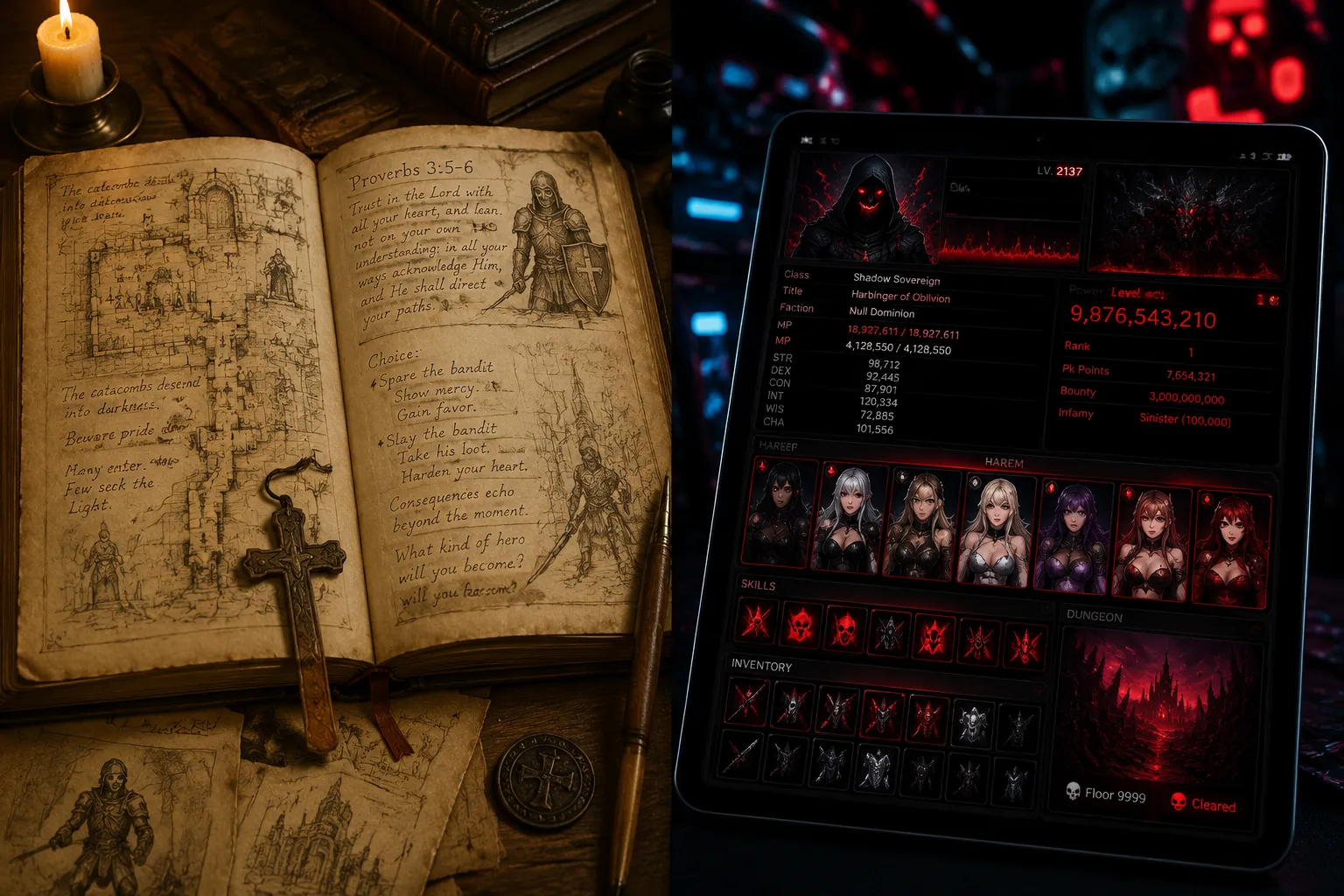
- Mainstream LitRPG frequently features grimdark violence, harem subplots, or amoral power accumulation. Christian titles hold a clean content standard, no graphic violence, no explicit content, no profanity.
- As of August 2026, LitRPG Radar lists 376 upcoming LitRPG and progression fantasy releases, but virtually none are categorized as explicitly Christian or faith-based, showing how rare these titles still are. [8]
- Christian LitRPG does not require Bible knowledge to enjoy. Faith shows up through character choice and consequence, not scripture recitation.
- Non-Christians can and do read these books, the moral stakes and redemption arcs are human stories, not denominational ones.
- The Measured Debt series by Silas Bellhaven is one of the few explicitly Christian LitRPG series currently available, built around the principle of earned grace and the cost of being chosen.
- Traditional Christian publishers have largely overlooked game-based narrative structures as of mid-2026, leaving the space open for indie and self-published authors. [9]
What Is Christian LitRPG and How Does It Differ From Regular Fantasy
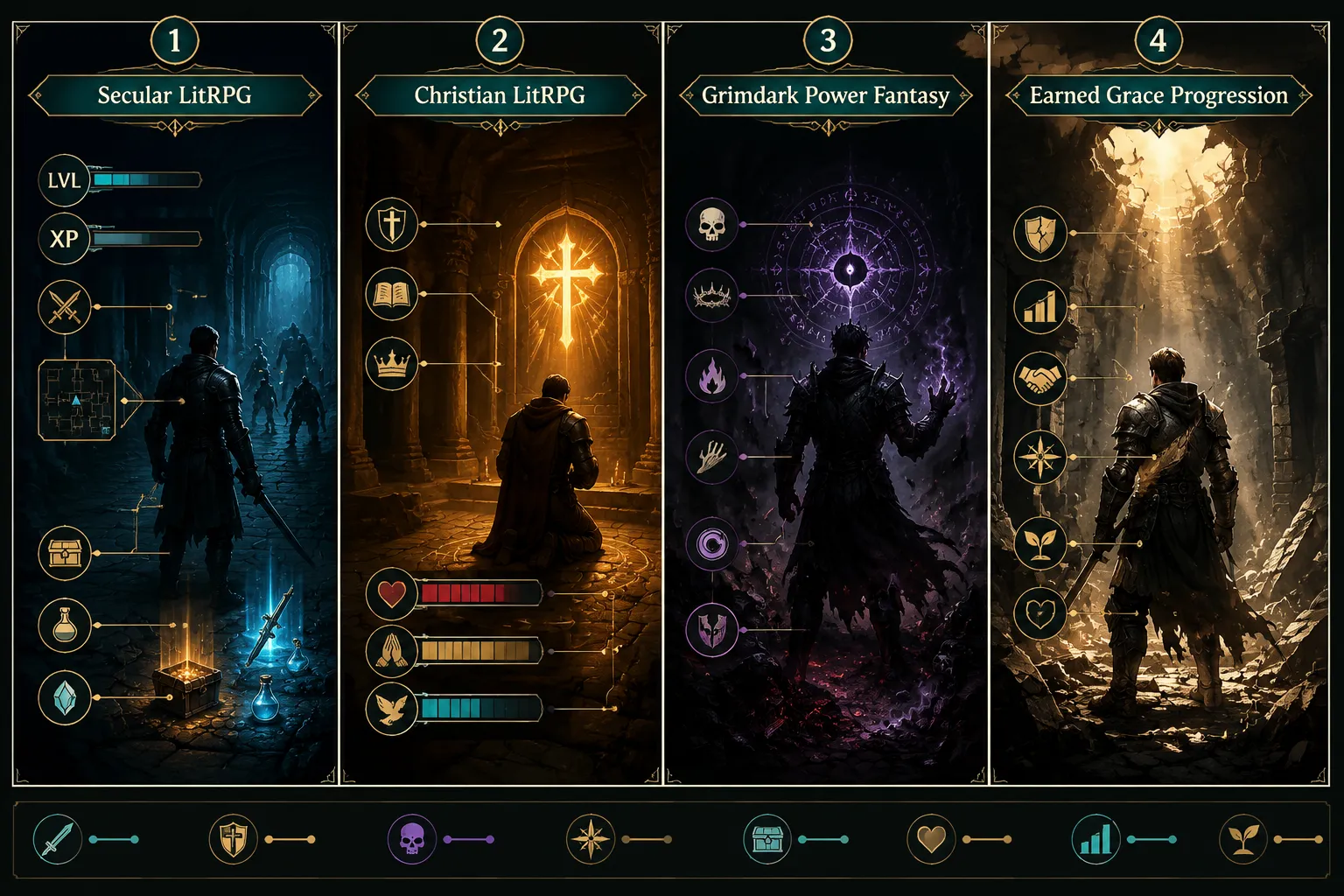
Christian LitRPG is fiction that uses the structural language of role-playing games, experience points, leveling systems, class assignments, dungeon runs, while grounding every mechanic in a theologically honest worldview. Regular fantasy (even Christian fantasy) doesn’t necessarily use game-system mechanics. LitRPG makes those mechanics visible on the page, often as literal stat screens or system notifications that characters can read and respond to.
The difference from regular Christian fantasy like The Kethara Chronicles or The Sarel Chronicles is structural: in standard fantasy, a character grows through trials and relationship. In LitRPG, that growth is quantified, and in Christian LitRPG, the question the numbers keep asking is a moral one. What did that level cost you? What did you spend to get here, and was it yours to spend?
What makes it distinctly Christian:
- Power gained through sacrifice and repentance, not just combat efficiency
- Moral choice systems where the “right” option isn’t always the strongest one
- A divine presence (explicit or structural) that doesn’t hand out rewards without cost
- Redemption arcs that require something real to be given up, not just a stat reset
What Makes Progression Fantasy Different From Traditional Fantasy Novels
Progression fantasy is the parent category that LitRPG lives inside. A character starts weak, grows stronger through deliberate effort, and the reader watches that growth happen in measurable stages. Traditional fantasy novels can include growth, but it’s rarely the structural engine of the story.
In progression fantasy, the growth is the plot. Every arc exists to push the protagonist to the next threshold. In Christian progression fantasy, that threshold isn’t just a power ceiling, it’s a moral and spiritual one. The character doesn’t just become stronger; they become more accountable for what they do with that strength.
Progression fantasy vs. traditional fantasy, at a glance:
| Feature | Traditional Fantasy | Progression Fantasy |
|---|---|---|
| Core engine | Plot-driven quest | Character growth arc |
| Power system | Often fixed or vague | Explicit, measurable |
| Stakes | External (save the world) | Internal + external |
| Christian version | Covenant, calling, sacrifice | Earned grace, moral leveling |
How Do Faith-Based Game Worlds Handle Magic and Spiritual Systems Differently
In mainstream LitRPG, magic is usually a resource, mana points to spend, spells to acquire, power tiers to climb. In faith-based game worlds, the spiritual system carries moral weight. Using power carelessly has consequences that go beyond losing hit points.
Christian LitRPG tends to frame its spiritual systems around covenant rather than transaction. You don’t just spend mana; you act within or against a moral order that the world itself reflects. This is the structural difference between a power fantasy and a faith story: one asks “how strong can I get?” and the other asks “what am I answerable to?”
Common spiritual system approaches in Christian LitRPG:
- Covenant mechanics, abilities tied to promises kept or broken
- Mercy/justice balance, choices that affect alignment in ways that matter to the divine structure of the world
- Debt and yield systems, like The Measured Debt series, where Eamon Kersey’s record-keeping reveals that the numbers he built his reputation on were never fully his
- Faith under fire, moments where the “optimal” game choice conflicts with the right one
How Do Dungeon Crawls Work in Faith-Based Progression Fantasy
Dungeon crawls in mainstream LitRPG are usually about loot, combat efficiency, and power scaling. In faith-based progression fantasy, the dungeon is a crucible, a place where a character’s moral commitments get tested under pressure, not just their combat stats.
The dungeon isn’t just a location. It’s a situation that strips away social performance and forces a character to act from what they actually believe. That’s what makes it useful for Christian storytelling: the dungeon removes all the easy exits.
In The Cost of Being Chosen (The Measured Debt, Book 1), Eamon Kersey’s name keeps clearing every collapse at Federated Record, until the position series starts asking why he’s always the one left standing. The dungeon-equivalent isn’t a cave full of monsters; it’s a record that won’t stop telling the truth. The cost of being chosen isn’t glory. It’s accountability.
Are Christian LitRPG Books Appropriate for All Ages and Faith Backgrounds
Most Christian LitRPG titles, including The Measured Debt series, hold a clean content standard: no graphic violence, no explicit content, no profanity. This makes them broadly appropriate for teen readers and up, though the thematic weight, moral debt, earned grace, the cost of choices, tends to resonate most with adult readers.
Content standards in Christian LitRPG (what you typically won’t find):
- Harem subplots or romantic explicit content
- Grimdark torture or gore
- Profanity or crude humor
- Amoral power accumulation presented as aspirational
Who it’s written for: Primarily adult readers (35-65 is the core Christian fiction demographic) who want genre fiction that handles faith honestly, not as a disclaimer, but as the actual load-bearing structure of the story.
Readers of other faith backgrounds, or no faith background, can engage with these books. The moral stakes are human stakes. The question of what you owe for what you’ve been given is not a denominational question.
Can Non-Christians Enjoy Christian LitRPG Books
Yes, and this is worth saying plainly. Christian LitRPG is not a Bible study with stat screens. The faith shows up through character choice and consequence, not through narration that explains what the reader should believe.
A reader who has never set foot in a church can follow Eamon Kersey through Federated Record and feel the weight of a record that won’t let him off the hook. The story doesn’t require theological agreement. It requires the reader to care whether the character does the right thing when it costs them something, and that’s a human story, not a sectarian one.
Choose Christian LitRPG if you want:
- Progression fantasy without harem tropes or grimdark nihilism
- Characters who face genuine moral consequence, not just tactical consequence
- Clean content that doesn’t require content warnings
- Redemption arcs where something real is at stake
It may not be the right fit if you want:
- Power fantasy with minimal moral friction
- Explicit content or graphic combat
- Secular worldbuilding with no spiritual dimension
What’s the Difference Between Christian LitRPG and Inspirational Fiction
Inspirational fiction is a broad publishing category that includes any story with uplifting, faith-adjacent themes, it doesn’t require explicit Christianity and often avoids denominational specificity. Christian LitRPG is a genre-specific form with a distinct structural identity: game mechanics, progression systems, and a theologically grounded worldview working together.
The practical difference:
- Inspirational fiction might feature a character who finds hope through hardship. Christian LitRPG features a character whose stat sheet reflects the moral cost of their choices.
- Inspirational fiction can be vaguely spiritual. Christian LitRPG, done well, is rooted in faith, not as decoration, but as the reason the world works the way it does.
The phrase that captures the Silas Bellhaven approach: walking with them, not talking at them. The faith isn’t announced. It’s structural.
Do Christian Progression Fantasy Books Require Knowledge of the Bible
No. Christian progression fantasy doesn’t require Bible literacy to follow or enjoy. The faith elements show up as worldview, the way the world is ordered, the way moral choices have weight, the way grace costs something, rather than as scriptural reference.
A reader who knows Psalm 23 and a reader who has never opened a Bible will both understand what it means when a character is held accountable for a record they thought was closed.
Best Christian LitRPG and Progression Fantasy Series to Start With
As of 2026, explicitly Christian LitRPG titles are rare. The LitRPG market is extremely active, LitRPG Radar’s release calendar shows 376 upcoming titles, but faith-based entries remain a small fraction of that output. [8] Traditional Christian publishers have largely not moved into game-based narrative structures. [9]
Where to start:
- The Measured Debt by Silas Bellhaven, The most direct entry point for Christian LitRPG. Three books: The Cost of Being Chosen, The Remembered Route, and The Borrowed Yield. Eamon Kersey’s progression is built on a ledger that keeps proving what he owes. Series page
- The Kethara Chronicles / The Sarel Chronicles, Not LitRPG in the strict sense, but Christian progression fantasy with earned power systems and covenant mechanics. Good bridge reading for readers new to the genre.
- Broader progression fantasy with moral themes, Aethon Books’ 2026 lineup includes titles like Penitent by C.B. Titus, which foregrounds penance and moral struggle, though without explicit Christian framing. [1]
How Do Character Leveling Systems Work in Christian LitRPG
In secular LitRPG, leveling is transactional: kill enemies, gain XP, spend points on stats. In Christian LitRPG, leveling is covenantal. Growth is tied to moral fidelity, not just combat output.
What this looks like in practice:
- A character might gain a new ability after choosing the harder right over the easier wrong
- Stat increases might come with increased accountability, more power means more of the record is yours to answer for
- “Grinding” (the secular LitRPG habit of repetitive combat for XP) is replaced by trials that test character, not just efficiency
- Debt mechanics can run in reverse, a character who borrowed strength they didn’t earn may find the yield comes due
In The Measured Debt, the numbers Eamon built his reputation on were never fully his, and the debt against them eventually comes due. That’s the Christian leveling system in its clearest form: earned grace, not free stats.
Common Mistakes New Christian LitRPG Authors Make
The biggest mistake is treating the faith as a filter rather than a foundation. Removing the harem subplot and adding a prayer scene doesn’t make a book Christian LitRPG, it makes secular LitRPG with Christian decorations.
Mistakes to avoid:
- Cheap grace, Letting characters level up through repentance without the repentance costing anything real. Grace that doesn’t cost something isn’t grace; it’s a cheat code.
- Scripture-dropping, Having characters quote Bible verses instead of living the moral weight of the situation. Faith under fire shows in choices, not citations.
- Avoiding the hard thing, Christian fiction that sidesteps genuine moral darkness isn’t honest about what faith is for. Hope in the dark is only meaningful if the dark is real.
- Mechanical faith, Building a “faith stat” that works like mana, without grounding it in actual moral consequence.
- Preaching through the narrator, The story should walk with the reader, not lecture them. If the narrative voice is explaining what the theme means, the theme isn’t working yet.
Where Can I Find Christian LitRPG Recommendations and Communities
As of 2026, dedicated Christian LitRPG communities are sparse. The genre is new enough that most readers find titles through broader Christian fiction spaces rather than genre-specific hubs.
Places to look:
- Amazon Kindle Unlimited, Search “Christian LitRPG” or “Christian progression fantasy.” The Measured Debt series is available on KU.
- Goodreads, The 2026 new releases thread tracks Christian speculative fiction, though LitRPG-specific Christian titles are rarely highlighted. [7]
- Christian fiction blogs, Sites tracking Christian speculative releases (like those covering July 2026 Christian fiction) occasionally surface genre-adjacent titles, though mainstream Christian houses haven’t moved into LitRPG yet. [6][9]
- GameLit.org, The broader GameLit community at gamelit.org covers LitRPG and progression fantasy generally, though faith-based titles are not a dedicated category. [3]
- Silas Bellhaven’s author page, Amazon author page for the only current multi-book Christian LitRPG catalog.
Are There Christian LitRPG Games or Just Books
As of 2026, Christian LitRPG exists almost entirely as a literary form, books and audiobooks. There are no widely distributed video games marketed specifically as Christian LitRPG, though some Christian game developers have produced RPGs with faith themes (these predate the LitRPG literary genre and don’t use the same structural mechanics).
The literary form is where the genre lives right now. The game-mechanic language in Christian LitRPG books is borrowed from video game culture and applied to prose fiction, it’s not a game you play, it’s a story that uses game structure to ask moral questions.
Conclusion: Why This Subgenre Matters, and Where to Go Next
The LitRPG market is producing hundreds of new titles every few months. [8] Almost none of them are asking the question that Christian LitRPG asks: what does the record say you owe?
That’s the gap, and it’s also the opportunity. Readers who love progression fantasy but are exhausted by grimdark nihilism and harem tropes have nowhere obvious to go. Christian LitRPG and Progression Fantasy Explained is, in part, an explanation of why that gap exists and what fills it: fiction where the leveling system is moral, the dungeon is a crucible, and the grace that shows up at the end cost something real to reach.
Actionable next steps:
- Start with The Measured Debt, The Cost of Being Chosen is Book 1. It’s available on Kindle Unlimited. Amazon link
- If you’re new to Christian fantasy broadly, The Kethara Chronicles or The Sarel Chronicles offer covenant-based progression without the game-mechanic structure, good orientation reading.
- If you’re a writer considering this subgenre, the single most important commitment is this: let the faith be load-bearing, not decorative. Build the world so that moral choices have structural consequences, and let the grace arrive after the cost, not instead of it.
- Browse the full Silas Bellhaven catalog at the Amazon author page for clean Christian fiction across mystery, thriller, western, fantasy, and LitRPG.
Rooted in faith. Earned grace. Hope in the dark, but only because the dark was real first.
FAQ
What is Christian LitRPG in simple terms? It’s fiction that uses role-playing game mechanics (leveling, stat screens, dungeon runs) inside a story grounded in Christian faith. Characters grow in power, but that growth is tied to moral and spiritual accountability, not just combat wins.
Is Christian LitRPG the same as Christian fantasy? No. Christian fantasy is a broad category covering any fantasy with Christian themes. Christian LitRPG specifically uses game-system mechanics as a structural element of the narrative, stat screens, experience points, class systems, while grounding those mechanics in a faith worldview.
Does Christian LitRPG have graphic violence or explicit content? No. Clean content is a defining characteristic of the subgenre. No graphic violence, no explicit sexual content, no profanity. The stakes are moral and spiritual, not shock-based.
Do I need to be a Christian to enjoy these books? No. The faith shows up through character choices and consequences, not through theological instruction. Readers of any background can engage with the moral weight of the stories.
What’s the best Christian LitRPG series available right now? The Measured Debt by Silas Bellhaven, three books starting with The Cost of Being Chosen, is the most developed Christian LitRPG series currently available on Kindle Unlimited.
How is earned grace different from cheap grace in Christian LitRPG? Cheap grace is when a character’s faith solves their problems without cost. Earned grace means the redemption arrives after something real has been paid, a relationship, a reputation, a belief the character held too tightly. The cost is what makes the grace meaningful.
Is Christian LitRPG appropriate for teenagers? Generally yes, for older teens. The content is clean, but the thematic weight, moral debt, accountability, the cost of choices, is adult in its emotional register.
Why are there so few Christian LitRPG books? Traditional Christian publishers haven’t moved into game-based narrative structures, and the broader LitRPG market skews toward secular power fantasy. As of mid-2026, the subgenre is almost entirely indie and self-published. [8][9]
What makes a dungeon crawl ‘Christian’ in these books? The dungeon functions as a moral crucible rather than a loot-delivery system. Characters face choices where the spiritually right option isn’t the tactically optimal one, and the consequences of those choices carry weight beyond the immediate encounter.
Can Christian LitRPG include moral ambiguity? Yes, and it should. Faith under fire means the character faces genuine darkness and genuine temptation. A story that avoids moral complexity isn’t honest about what faith is actually for. The hope has to be earned against something real.
Are there Christian LitRPG audiobooks? Some titles in the subgenre are available in audio format. Check the individual Amazon listings for audiobook availability, as production varies by title.
What’s the difference between progression fantasy and LitRPG? LitRPG is a subset of progression fantasy. All LitRPG is progression fantasy, but not all progression fantasy is LitRPG. LitRPG specifically includes visible game-system mechanics (stat screens, XP, system notifications) as part of the narrative. Progression fantasy is the broader category where a character grows measurably stronger over the course of the story.
References
[1] July 2026 Litrpg Progression Fantasy Releases – https://aethonbooks.com/2026/06/12/july-2026-litrpg-progression-fantasy-releases/
[3] gamelit – https://gamelit.org/
[6] July 2026 New Releases In Christian Fiction – https://sarahhamakerfiction.com/2026/07/08/july-2026-new-releases-in-christian-fiction/
[7] 23303438 2026 New Releases – https://www.goodreads.com/topic/show/23303438-2026—new-releases
[8] Release Calendar – https://www.litrpgradar.com/release-calendar
[9] Christian Fiction New Releases July 2026 – https://www.narelleatkins.com/christian-fiction-new-releases-july-2026/