
Last updated: August 22, 2026
Quick Answer: Kindle Unlimited fundamentally shifted how Christian fiction reaches readers by replacing the gatekeeping model with a subscription-based discovery engine. For indie authors writing clean, faith-rooted stories across cozy mystery, western, thriller, fantasy, and LitRPG, KU offers catalog-compounding income, niche audience concentration, and series economics that traditional publishing rarely extends to genre-crossing voices. The opportunity is real, but it rewards specific strategies, not just enrollment.
Key Takeaways
- KU pays per page read, not per download, series depth and bingeable writing directly drive income
- The July 2026 KDP Select Global Fund reached $67.6 million, with per-page rates hovering between $0.0042 and $0.0050 through mid-2026
- Christian fiction readers are among the most loyal KU subscribers, concentrated in cozy mystery, inspirational romance, Amish, historical, and suspense subgenres [10]
- KU enrollment requires 90-day digital exclusivity on Amazon, the biggest strategic trade-off for indie authors
- Series economics favor KU: Book 1 drives discovery, later books monetize through accumulated page reads
- Clean content standards are a feature in KU’s Christian fiction categories, not a constraint, they pre-qualify readers before they download
- Algorithm changes affect Christian fiction authors the same as all KDP authors, ranking, also-boughts, and category placement shift with read-through rates
- Wide distribution (non-exclusive) suits authors building library reach or diversifying platforms; KU suits authors building Amazon-first catalog depth
- New indie authors in faith-based genres benefit most from KU when they treat it as a subscription funnel, not a one-book experiment
- The ACFW professional ecosystem (conference scheduled August 27-30, 2026 in Memphis) continues to support both traditional and indie Christian fiction authors
What Is Kindle Unlimited and How Does It Work for Authors
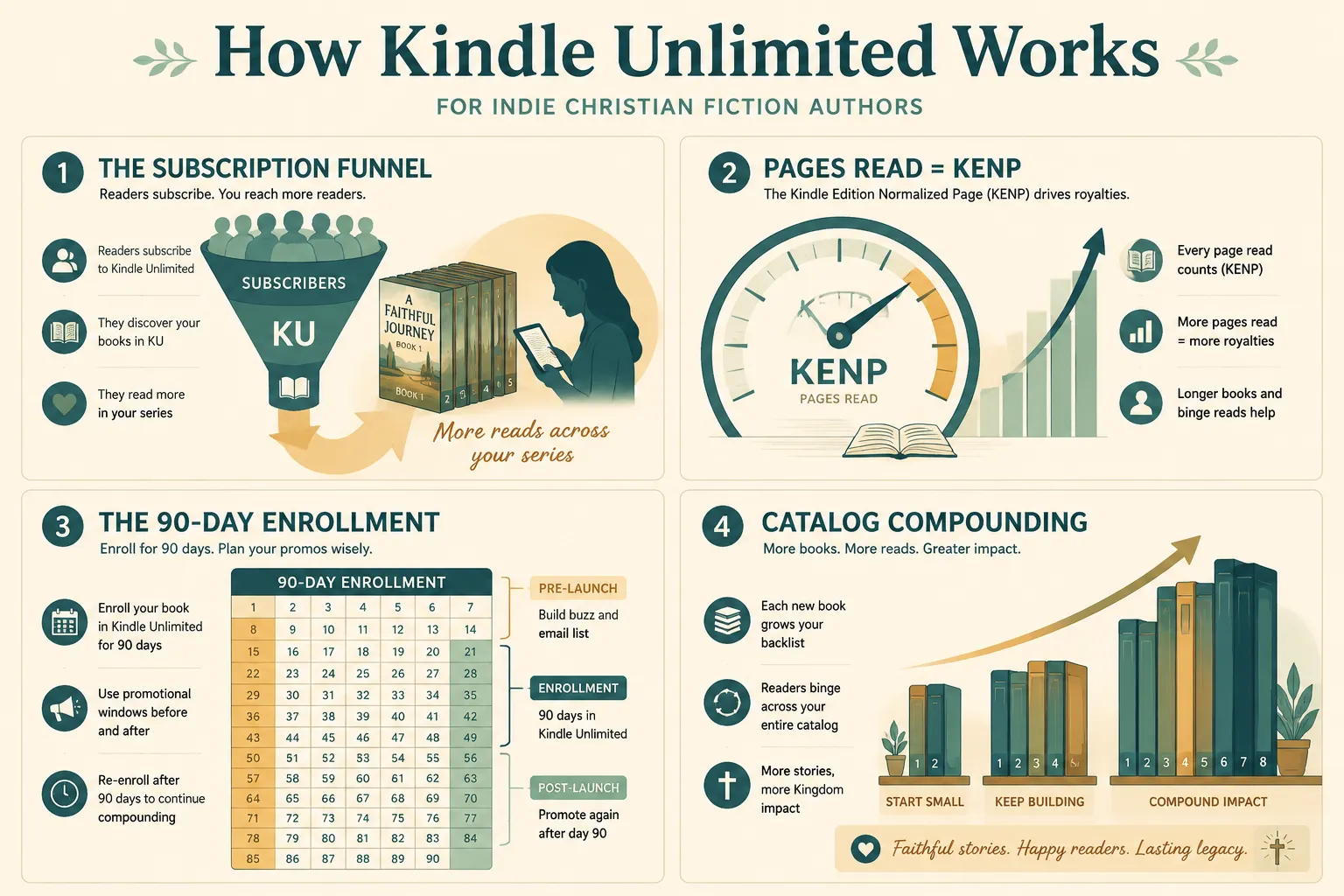
Kindle Unlimited is Amazon’s e-book subscription service. Readers pay a monthly fee for unlimited access to enrolled titles; authors earn from the KDP Select Global Fund based on how many pages their books are actually read, not how many times they’re downloaded.
Amazon’s KDP documentation confirms the core mechanics:
- Authors enroll titles in KDP Select for 90-day periods
- Each enrolled title becomes available to KU subscribers
- Earnings come from a share of the monthly KDP Select Global Fund, proportional to KENP (Kindle Edition Normalized Pages) read
- The fund size is announced monthly and is not a fixed rate
- Amazon caps KENP earnings at 3,000 pages per title per customer
- KU is available across 10 marketplaces, including the U.S., U.K., Germany, France, Brazil, Canada, India, and Australia
The July 2026 Global Fund was reported at $67.6 million, with a per-page payout of approximately $0.004221. Through spring 2026, rates ranged from roughly $0.00482 in April to $0.00488 in May, variable month to month, but stable enough for authors with deep catalogs to forecast income with reasonable confidence.
What this means for Christian fiction authors specifically: A 300-page cozy mystery generating 10,000 KENP reads in a month earns roughly $42,$49 at current rates. A 10-book series where readers binge all 10 books earns proportionally, which is why catalog depth matters far more than any single title’s performance.
How Much Money Can Christian Fiction Authors Make on Kindle Unlimited
Income from KU varies widely and depends on catalog size, series read-through, and monthly page-read volume, not on a fixed per-book royalty. There is no guaranteed income floor.
Realistic benchmarks (based on 2026 rate environment):
| Catalog Size | Avg. Monthly KENP | Est. Monthly Earnings |
|---|---|---|
| 1-3 books | 5,000-20,000 | $21,$100 |
| 5-10 books | 30,000-100,000 | $126,$488 |
| 10-20 books | 100,000-400,000 | $420,$1,952 |
| 20+ books (series depth) | 400,000-1M+ | $1,680,$4,880+ |
Estimates based on $0.0042,$0.00488 per KENP range reported through mid-2026. Actual earnings depend on read-through rates, category visibility, and monthly fund fluctuations.
The authors seeing meaningful income from KU in Christian fiction are almost always running series, not standalone titles. When a reader finishes A Donation to Die For and immediately opens The Christmas Room Clue, every page of that second book earns. That compounding effect is the real economic argument for KU, and it’s why clean, faith-rooted series with strong hooks at chapter ends outperform single titles by a wide margin [10].
Common mistake: Enrolling one book, watching page reads stay low, and concluding KU doesn’t work. KU is a catalog business. One book is a test, not a strategy.
Kindle Unlimited vs. Traditional Publishing for Christian Fiction
For most indie authors writing clean, faith-rooted fiction, KU offers faster market access and better economics on niche subgenres than traditional publishing, but it trades away platform diversification and library reach.
Traditional Christian publishing (through houses like Revell, Bethany House, or Tyndale) offers:
- Editorial support, cover design, and marketing infrastructure
- Physical bookstore and library distribution
- Brand credibility with certain reader segments
- Advance payments (though often modest for debut authors)
KU and indie publishing offer:
- Speed, a title can be live within days of completion
- Royalty rates, 70% on e-book sales plus KU page-read income, versus traditional royalties typically in the 10-15% range on net
- Genre flexibility, traditional publishers are cautious about Christian LitRPG, Christian psychological thriller, or multi-genre pen names; KU has no such gatekeeping
- Series control, an indie author can publish 10 books in a year; traditional timelines rarely allow more than one or two
Choose KU if: Your primary audience is Amazon-first, you’re building a series, and your subgenre is underserved by traditional publishers (Christian western, Christian fantasy, Christian LitRPG).
Choose wide distribution if: You want library placement through services like OverDrive, you’re building a platform across multiple storefronts, or you have an existing audience outside Amazon.
What Genres Sell Best in Christian Fiction on Kindle Unlimited
Christian cozy mystery, inspirational romance, Amish fiction, and Christian suspense consistently show the strongest KU reader concentration. Fantasy and thriller are growing, particularly among readers who want faith handled honestly rather than decoratively.
The subgenres with the deepest KU reader bases as of 2026 [2][10]:
- Christian cozy mystery, high series loyalty, frequent re-reads, strong word-of-mouth in reader communities
- Clean Christian romance, the largest volume category; readers binge aggressively and leave reviews [6]
- Amish fiction, dedicated niche with consistent demand
- Christian historical fiction, steady performer, especially Civil War and frontier settings
- Christian suspense/psychological thriller, growing; readers want real stakes without graphic content
- Christian fantasy and epic fantasy, smaller but passionate audience; underserved by traditional publishing
- Christian western, niche but loyal; frontier justice themes resonate with readers who want moral weight without preachiness
The categories with the least KU traction currently: Christian literary fiction, Christian poetry, and standalone devotional-adjacent novels without series structure.
Edge case: Christian LitRPG is genuinely new territory. The audience exists, it’s drawn from both Christian fantasy readers and secular LitRPG readers who want clean content, but it requires patient catalog-building because the category isn’t yet well-defined in Amazon’s browse nodes.
How KU Algorithm Changes Affect Christian Fiction Authors on KDP
Amazon’s KDP algorithm rewards read-through rate, page-read volume, and category relevance, not just downloads or reviews. When Amazon adjusts how it weights these signals, Christian fiction authors feel it in their also-bought placements, category rankings, and new-release visibility.
Key algorithm factors that affect Christian fiction KU authors:
- Read-through rate: If readers consistently finish Book 1 and start Book 2, Amazon’s algorithm treats that as a quality signal and surfaces the series more broadly
- Category placement: Choosing the right BISAC categories and Amazon browse nodes determines which readers find a title; misplaced categories mean low conversion even with good writing
- Velocity in the first 30 days: New releases that generate strong early page reads get algorithmic momentum; weak launches are hard to recover from without advertising
- Review recency: Amazon weights recent reviews more heavily than old ones, a 10-book series needs ongoing review accumulation, not just strong reviews on Book 1
Common mistake: Choosing broad categories (like “Christian Fiction”) instead of specific subcategories (like “Christian Mystery & Suspense” or “Christian Fantasy”). Broad categories mean competing against every Christian title on the platform; specific categories mean competing for a concentrated, already-interested audience [2].
Best Practices for Indie Publishing Christian Fiction on Kindle Unlimited
The authors building sustainable KU income in clean, faith-rooted genres share a few consistent practices, none of them complicated, but all of them requiring patience.
Series structure first:
- Plan series at 5-10 books minimum before publishing Book 1
- End each book with a resolved central conflict but an unresolved relational or spiritual thread that pulls readers forward
- Keep word count consistent across the series (see the next section for specifics)
Cover and category discipline:
- Covers must signal genre immediately, a reader browsing Christian cozy mystery should recognize the subgenre within two seconds
- Use all available category slots and select the most specific subcategories available [10]
Promotional tools within KDP Select:
- Kindle Countdown Deals: Price Book 1 at $0.99 for a limited window to drive new series entry
- Free Book Promotion: Five free days per 90-day enrollment period; useful for list-building and also-bought seeding
Back matter:
- Every book should end with a direct link to Book 2 (or the series page) before the acknowledgments
- A short author note that sounds like a person, not a press release, builds the reader relationship that drives series loyalty
How Long Should Christian Fiction Books Be for Kindle Unlimited Earnings
For KU income optimization, longer books earn more per title, but only if readers actually finish them. The sweet spot for most Christian fiction subgenres is 60,000-90,000 words.
Subgenre word count benchmarks:
- Christian cozy mystery: 55,000-75,000 words (shorter reads suit the binge pattern)
- Christian romance: 60,000-85,000 words
- Christian suspense/thriller: 70,000-90,000 words
- Christian epic fantasy: 90,000-120,000 words (readers expect longer; drop-off is lower)
- Christian western: 55,000-75,000 words
- Christian LitRPG: 80,000-110,000 words
A 300-page book (approximately 75,000 words) at the $0.0042 rate generates roughly $1.26 per full read-through. That sounds small, until 500 readers binge a 10-book series in the same month.
The drop-off problem: Books over 100,000 words in cozy mystery or romance see measurable drop-off before the final chapters. If readers don’t finish, those unread pages earn nothing. Pacing and chapter-end hooks matter as much as word count.
Can You Publish on Kindle Unlimited and Other Platforms at the Same Time
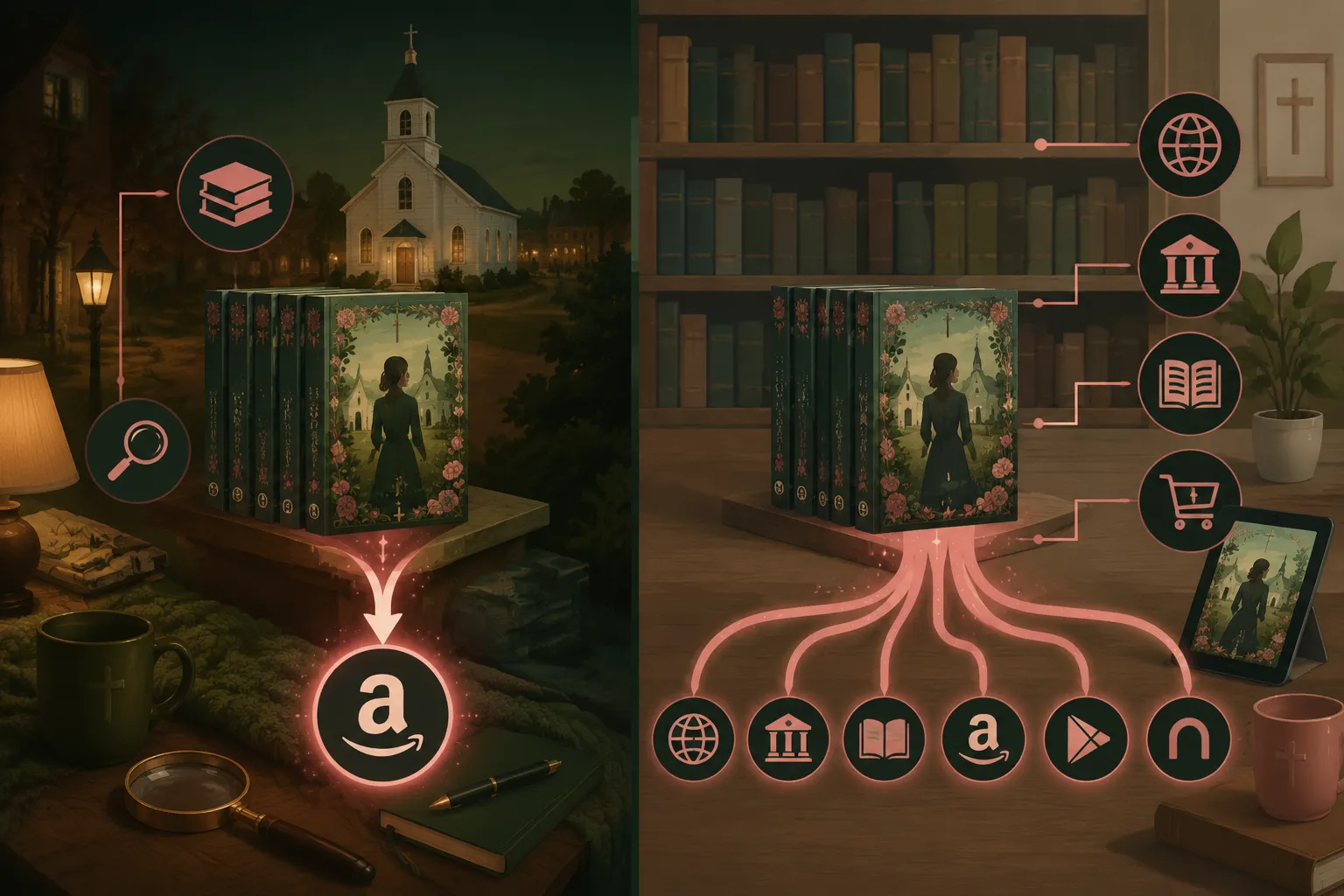
No, KDP Select enrollment requires digital exclusivity for the enrolled title during each 90-day period. An author cannot simultaneously sell the same e-book on Apple Books, Kobo, Barnes & Noble, or Google Play while it’s enrolled in KU.
What exclusivity does and doesn’t cover:
- It covers the digital e-book format only
- Print editions (paperback, hardcover) can be sold anywhere simultaneously
- Audiobooks are not affected by KDP Select enrollment
- A different title by the same author can be published wide while another title is in KU
The strategic question is whether the KU income and Amazon visibility outweigh the lost revenue from other platforms. For most new indie Christian fiction authors with small audiences, the answer is yes, Amazon is where Christian fiction readers concentrate, and KU’s discovery engine is more powerful than starting from zero on five platforms simultaneously.
When to go wide instead: Authors with existing audiences on other platforms, authors who prioritize library placement, or authors whose readers have explicitly told them they prefer Kobo or Apple Books.
How to Market Christian Fiction Books on Kindle Unlimited
KU marketing works differently from direct sales marketing, the goal is page reads, not purchases, so the conversion metric is a reader starting and finishing the book, not just clicking buy.
Effective marketing channels for Christian fiction KU authors:
- Amazon Ads (Sponsored Products): Target competitor authors and series in the same subgenre; bid on Christian cozy mystery, Christian suspense, and clean fiction keywords
- BookBub Featured Deals: High-cost but high-volume; most effective for Book 1 of a series with 5+ books already published
- Facebook reader groups: Christian fiction reader communities on Facebook are active and recommendation-driven; authentic participation (not spam) builds real audience [5]
- Newsletter swaps with other Christian fiction authors: Cross-promotion to already-qualified readers is more efficient than cold advertising
- ACFW community: The American Christian Fiction Writers organization (conference August 27-30, 2026, Memphis) connects indie and traditional authors with readers and industry contacts [3]
What doesn’t work well: Generic social media posting without community context. A post about a new Christian western on a general Twitter/X feed reaches almost no one. Targeted placement in front of readers who already read the genre is the only marketing that consistently converts to page reads.
Is Kindle Unlimited Worth It for New Christian Fiction Authors
For new indie authors in clean, faith-rooted genres, KU is worth enrolling, with one condition: the author must be committed to building a series, not testing the market with a single book.
KU is worth it for new Christian fiction authors when:
- They’re writing a series of 5+ planned books
- Their subgenre has strong KU reader concentration (cozy mystery, romance, suspense, fantasy)
- They don’t have an existing audience on other platforms
- They’re willing to treat the first 12-18 months as catalog-building, not immediate income
KU is not the right fit when:
- The author has one standalone novel and no series plans
- The author’s readers are primarily on non-Amazon platforms
- The author wants library distribution as a primary goal
The honest reality: KU doesn’t make weak books successful, and it doesn’t make strong books successful overnight. What it does is create a discovery and monetization structure where a well-written, properly categorized series in a faith-rooted genre can find its readers without a traditional publishing contract or a marketing budget that most new authors don’t have.
What Percentage of Christian Fiction Readers Use Kindle Unlimited
A precise industry-wide figure isn’t publicly available, but the evidence from Amazon’s own category pages and reader communities points to high KU penetration among Christian fiction readers, particularly in cozy mystery, romance, and suspense [10].
Several observable signals support this:
- Amazon’s Christian Fiction Kindle Unlimited Eligible category shows thousands of enrolled titles with strong review counts, indicating active readership [10]
- Reddit’s cozy mystery communities frequently surface Christian KU recommendations, with readers explicitly noting they read primarily through KU [5]
- Clean Christian romance KU promotions (like those running through early 2026) attract reader engagement that suggests subscription reading is the dominant mode for this audience [6]
- Amazon’s Christian Living and Christian Fiction KU-eligible browse nodes show consistent reader activity [8][9]
The reader profile most likely to be a KU subscriber in Christian fiction: women 35-65, reading 3-8 books per month, primarily in cozy mystery, inspirational romance, or Christian suspense. For this reader, KU is the economically rational choice, and that means authors writing for this audience are writing for a subscriber base, not a purchase-by-purchase market.
Conclusion: What This Means for Authors Writing Rooted-in-Faith Stories
How Kindle Unlimited changed Christian fiction publishing comes down to one shift: it moved the question from “will a publisher accept this?” to “will readers read this?” For indie authors writing clean Christian fiction, cozy mystery set in small Tennessee towns, frontier westerns where law runs out and conscience doesn’t, covenant fantasy where grace costs something real, psychological thrillers where the record itself becomes the weapon, that shift opened doors that traditional gatekeeping kept closed.
The economics reward series depth, clean category targeting, and writing that earns its readers’ trust one chapter at a time. Faith under fire, mercy and justice held in tension, hope in the dark that doesn’t arrive cheaply, these aren’t marketing angles. They’re what the best Christian fiction has always been built on. KU didn’t change that. It just made it possible for the right readers to find it.
Actionable next steps for Christian fiction indie authors in 2026:
- Plan your series before publishing Book 1, minimum 5 books, ideally 10
- Enroll in KDP Select for the first 90-day period and use Kindle Countdown Deals on Book 1
- Choose specific subcategories, not broad “Christian Fiction”, target the niche your book actually belongs to [2][10]
- Write to the read-through: end each chapter with something unresolved, and end each book with a thread that pulls toward the next
- Build back matter that sounds human, a genuine author note and a direct link to the next book
- Track KENP monthly, not just sales, page reads tell you whether readers are finishing, which is the only metric that matters for series health
- Connect with the ACFW community for both craft development and reader-facing promotion [3]
The readers are there. They’re looking for stories that walk with them, not talk at them. The platform exists to connect the two. The only question left is whether the writing earns that trust, and that part has always been on the author.
Explore the Silas Bellhaven catalog, Christian cozy mystery, frontier western, covenant fantasy, psychological thriller, and LitRPG, all rooted in faith and built for Kindle Unlimited readers: Silas Bellhaven on Amazon
FAQ
What is KENP and how does it affect my KU earnings? KENP stands for Kindle Edition Normalized Pages, Amazon’s standardized page count for KU titles. Your earnings are calculated by multiplying your total KENP read in a month by the current per-page rate (approximately $0.0042,$0.0050 in 2026). Longer books with high read-through rates earn more.
Can I set my own price for a KU book? Yes. KU enrollment doesn’t change your list price. Readers with KU subscriptions can read it for free as part of their subscription; readers without KU can still purchase it at your set price.
How often does Amazon pay KU earnings? Amazon pays KDP royalties (including KU page-read earnings) approximately 60 days after the end of the month in which they were earned.
Does enrolling in KDP Select hurt my chances with traditional publishers? KDP Select only restricts digital e-book distribution during the 90-day enrollment period. It doesn’t affect print rights, audio rights, or your ability to query traditional publishers. Most traditional publishers focus on print rights anyway.
What happens if I want to leave KU after enrolling? You can opt out of KDP Select renewal before the end of each 90-day period. Your title will be removed from KU at the end of that period, and you can then distribute it on other platforms. You cannot exit mid-enrollment period.
Do Christian fiction readers actually leave reviews on KU books? Yes, and at higher rates than many other genres. Christian fiction communities are review-active, particularly in cozy mystery and romance. Readers who find a series through KU and finish it are among the most likely to leave a review and recommend to friends.
Is there a minimum book length for KU enrollment? Amazon doesn’t set a hard minimum word count for KU enrollment, but very short works (under 10,000 words) earn very little per read-through and are generally not worth the exclusivity trade-off.
How do I know if my Christian fiction book is performing well on KU? Track your KENP read count in your KDP dashboard. A healthy series shows increasing KENP month over month as more readers discover Book 1 and read through the catalog. Flat or declining KENP after the first month usually signals a category placement or cover signal problem, not a writing problem.
Can a Christian fiction series mix KU and wide titles? Yes, individual titles within a series can have different distribution strategies, but it creates reader friction. If Book 1 is in KU and Book 3 is wide, a KU subscriber who wants to binge the series hits a wall. Most authors choose one strategy per series for consistency.
What’s the biggest mistake new Christian fiction authors make with KU? Enrolling a single standalone book, seeing low page reads after 30 days, and concluding KU doesn’t work. KU is a catalog business. The discovery and compounding economics only activate when there are multiple books for readers to move through.
References
[1] Contemporary Christian Fiction – https://www.amazon.com/Contemporary-Christian-Fiction/b?ie=UTF8&node=7588745011
[2] Religion Spirituality Christian Bibles Fiction Ebooks Kindle – https://www.amazon.com/Religion-Spirituality-Christian-Bibles-Fiction-eBooks-Kindle/b?ie=UTF8&node=6190467011
[3] June 2026 Acfw New Releases – https://www.sandraardoin.com/june-2026-acfw-new-releases/
[5] Christian Kindle Unlimited Recommendations – https://www.reddit.com/r/CozyMystery/comments/15jyto1/christian_kindle_unlimited_recommendations/
[6] Clean Christian Romance Kindle Unlimited Promo Discover Your Next Wholesome Read 2 – https://sophietoovey.com/2026/03/01/clean-christian-romance-kindle-unlimited-promo-discover-your-next-wholesome-read-2/
[8] Christian Living Kindle Unlimited Eligible – https://www.amazon.com/Christian-Living-Kindle-Unlimited-Eligible/s?rh=n:158327011,p_n_feature_nineteen_browse-bin:9045887011
[9] Christian Fiction Kindle Unlimited – https://top5best.com/christian-fiction-kindle-unlimited
[10] Christian Fiction Kindle Unlimited Eligible – https://www.amazon.com/Christian-Fiction-Kindle-Unlimited-Eligible/s?rh=n:6190467011,p_n_feature_nineteen_browse-bin:9045887011