

Last updated: August 24, 2026
Quick Answer: Christian psychological thrillers use unreliable perception, distorted memory, deceptive narrators, fractured reality, by grounding hope not in what the protagonist can see clearly, but in what God’s promise holds regardless of perception. The protagonist’s confusion becomes the dramatic engine; faith becomes the fixed point that survives it. Done well, this approach produces stories that are more honest about suffering, not less hopeful about grace.
Key Takeaways
- Unreliable perception is a craft tool, not a theological problem, it creates stakes, not despair
- Hope in Christian fiction is grounded in God’s promise, not the protagonist’s ability to perceive correctly
- The difference between a Christian thriller and a secular one is often the source of the resolution, not the presence of darkness
- Twist endings are fully compatible with Christian fiction when the twist reveals truth rather than negating it
- Despair and presumption are both theological errors, good Christian thrillers avoid both
- The protagonist can be confused, deceived, and wrong without the story losing its redemptive throughline
- Readers root for an unreliable protagonist when they sense the character’s moral core even through the fog
- Clean Christian fiction can carry genuine psychological tension without graphic content
- Ambiguity in plot is not the same as ambiguity in worldview
- The best Christian psychological thrillers treat doubt as a condition to be walked through, not a verdict to be handed down
What Is an Unreliable Narrator in Psychological Thrillers?
An unreliable narrator is a storytelling device in which the character telling the story, or through whose perspective the story is filtered, cannot be fully trusted to report events accurately. This unreliability can stem from trauma, deception, mental illness, manipulation by others, or simple human self-deception.
In psychological thrillers, this device creates the genre’s signature tension: the reader suspects something is wrong before the protagonist does, or realizes the protagonist has been misreading events entirely. The reveal, when perception finally corrects itself, is the emotional payoff.
Three common forms of unreliable perception in thrillers:
- Memory gaps, the protagonist cannot access or accurately reconstruct what happened
- Manipulation by others, a controlling figure is deliberately shaping what the protagonist believes
- Self-deception, the protagonist refuses to see what the evidence plainly shows
None of these are inherently anti-Christian. In fact, Scripture itself takes human self-deception seriously (Jeremiah 17:9). The craft question isn’t whether to use unreliable perception, it’s how to use it without leaving the reader in a story that ends in nihilism.
How Christian Psychological Thrillers Use Unreliable Perception Without Undermining Hope
Christian psychological thrillers preserve hope by separating two things that secular thrillers often conflate: what the protagonist can perceive and what is actually true. When those two things diverge, the story gains tension. When they finally converge, or when the protagonist chooses faithfully despite the gap, the story gains meaning.
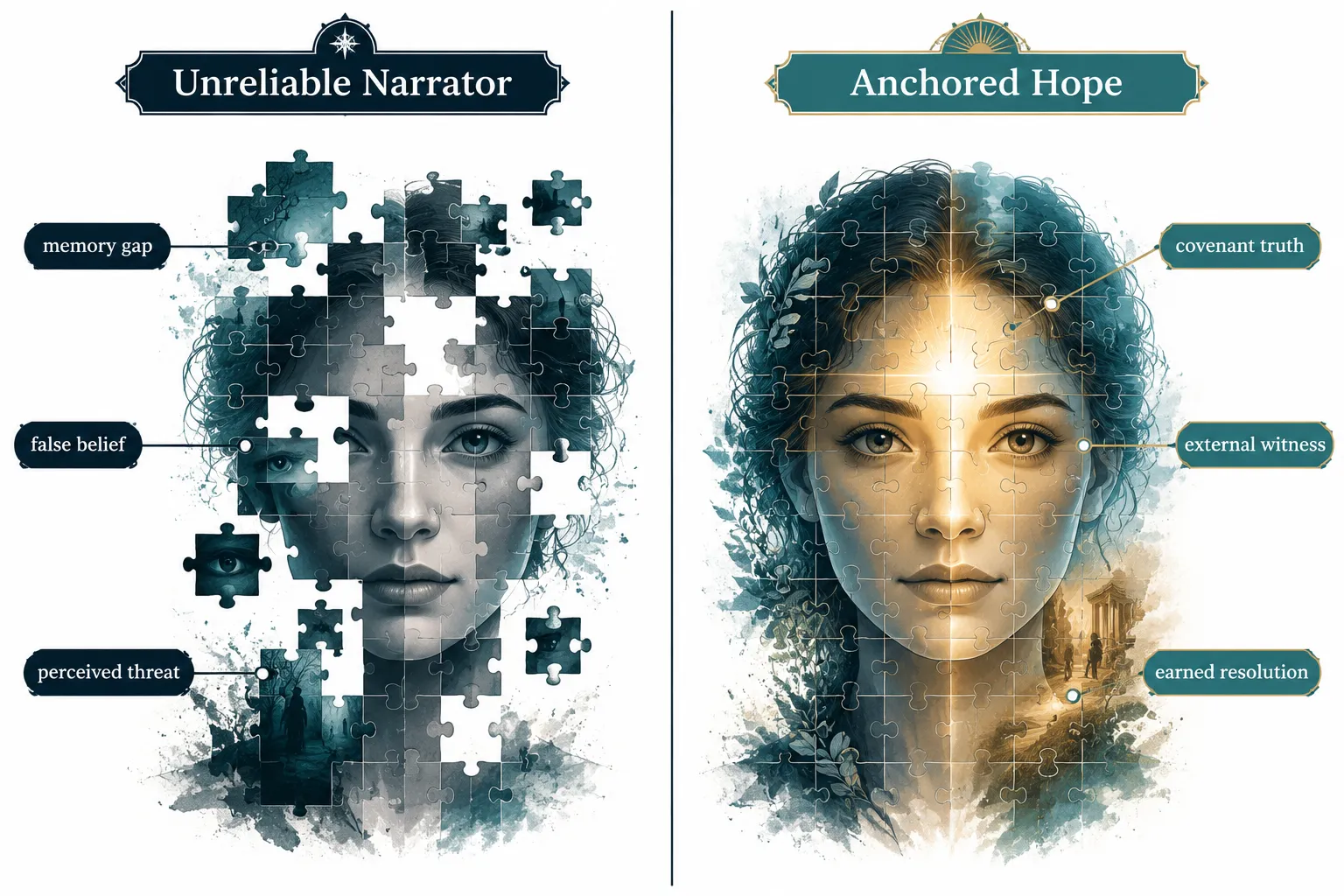
Theologically, this maps onto a well-developed understanding of hope as grounded in God’s promise rather than human perception [8]. The protagonist’s confusion is not evidence that God is absent, it’s evidence that the story is honest about the human condition. Hope, in this framework, is not optimism about what can be seen. It’s trust in what holds even when sight fails.
This is why the genre works for faith-rooted fiction. The darkness is real. The fog is real. And the light at the end is not a trick of the plot, it’s earned, at cost, by a character who chose faithfully when nothing was clear.
What this looks like in practice:
- The protagonist is deceived or confused, but a secondary character, a letter, a prayer, or a piece of physical evidence carries the truth forward independently
- The twist reveals not that everything was meaningless, but that the protagonist was being protected or led without knowing it
- Resolution comes through confession, testimony, or the surfacing of a record, not through the protagonist’s unaided perception correcting itself
How Do Christian Authors Balance Doubt and Faith in Thrillers?
Christian authors balance doubt and faith by treating doubt as a condition the character moves through, not a conclusion the story arrives at. Doubt is the fuel for the thriller’s tension; faith is what the character reaches for when the fuel runs out.
The key is that faith in these stories shows up through choice and consequence, not narration. A character doesn’t explain their faith, they act on it under pressure, fail, repent, and act again. The reader sees faith proven through the plot, not delivered as a sermon.
“Walking with them, not talking at them”, that’s the line that separates earned faith from performed piety in fiction.
Theologically, this reflects the understanding that despair is a sin against hope, and presumption is its mirror [8]. A story that resolves too easily (presumption) is as false as one that resolves in nihilism (despair). The honest Christian thriller lives in the space between, where the character genuinely doesn’t know, genuinely struggles, and finds grace not because the path was easy but because they didn’t stop walking it.
Examples of Christian Psychological Thrillers with Unreliable Characters
The Gathering Light series by Silas Bellhaven offers a sustained example of how Christian psychological thrillers use unreliable perception without undermining hope. Each book in the series places a new protagonist inside a system, Gathering Light Restoration Retreat, that controls the language used to describe trauma and testimony.
- When Hannah Sleeps, Hannah Garrick has transcribed other women’s testimonies for years, until her own words start appearing in someone else’s file. Her perception of what is real, what she said, and what was done to her becomes the central question. View on Amazon
- When the Voice Breaks, Caris Weller built her career on careful language, until the retreat’s system begins speaking for her. View on Amazon
- When the Prayer List Opens, Taryn Vickers finds her own name on the retreat’s prayer list, written in the hand of a woman who was supposed to be safe. View on Amazon
In each book, the spine question is the same: who controls the record of someone’s truth? The unreliable perception isn’t accidental, it’s manufactured by a system that weaponizes the language of healing. The hope in each story comes not from the protagonist seeing clearly from the start, but from the moment when the truth can no longer be contained by the system holding it [9].
Readers looking for comparable titles in the broader Christian suspense space will find active reading communities tracking the genre [10].
Can You Have a Twist Ending in Christian Fiction Without Losing the Message?
Yes, a twist ending is fully compatible with Christian fiction, provided the twist reveals truth rather than negating it. The test is simple: does the twist leave the reader with a clearer picture of what was actually happening, or does it collapse the story into meaninglessness?
Twist endings that work in Christian fiction:
- The protagonist was being protected by someone they suspected
- The antagonist’s motive was rooted in a wound that now demands mercy, not just judgment
- The record that seemed to condemn the protagonist actually exonerates them, and the truth was there all along
Twist endings that undermine Christian fiction:
- Everything the protagonist believed was false, including the possibility of redemption
- The resolution requires the reader to conclude that suffering had no meaning
- The “twist” is that God or faith was the deception
The theological principle here is what some scholars describe as “proleptic hope”, the conviction that evil is not the final word, that the ending written into the story’s structure is redemptive even when the middle chapters are dark [3]. A twist can deepen that structure. It cannot contradict it and still be honest Christian fiction.
What’s the Difference Between Unreliable Perception and Losing Faith?
Unreliable perception is a cognitive condition, the character cannot accurately read what is happening around them. Losing faith is a spiritual condition, the character concludes that God is absent, indifferent, or false.
These two things can coexist in a story, but they are not the same thing, and conflating them is one of the most common mistakes in Christian thriller writing.
A protagonist can be completely wrong about who is threatening them, what is real, and what happened in the past, and still be holding onto faith. In fact, that combination produces the genre’s most powerful moments: the character who prays in the dark not because they can see clearly, but because they have nothing else to hold.
The distinction in practice:
| Unreliable Perception | Loss of Faith |
|---|---|
| “I don’t know what’s real” | “I don’t know if God is real” |
| Cognitive fog, can be resolved by truth | Spiritual crisis, requires encounter, not information |
| Creates thriller tension | Creates a different kind of story |
| Compatible with a hopeful ending | Requires a conversion arc to resolve redemptively |
The best Christian psychological thrillers use unreliable perception to test faith, not replace it. The fog clears. The faith that survived the fog is the story’s actual subject.
Common Mistakes Christian Thriller Writers Make with Ambiguous Plots
Ambiguity is a legitimate tool in psychological thrillers. But Christian thriller writers make specific mistakes when handling it that either flatten the story or undercut its faith content.

The most common mistakes:
Resolving ambiguity with a sermon. When the fog clears, a character explains the theological meaning of what just happened. This kills the earned quality of the resolution. Trust the image; don’t explain it.
Using ambiguity to avoid cost. Grace that arrives without the protagonist paying anything for it is cheap grace, and readers feel it. The ambiguity should increase the cost, not provide an escape from it.
Confusing the reader’s disorientation with the protagonist’s. The reader should always sense that someone in the story knows the truth, even if the protagonist doesn’t. Without that, the story tips into nihilism.
Making the faith element the source of the deception. If the retreat, the church, or the prayer group is purely predatory with no honest counterweight, the story argues against faith rather than testing it.
Resolving too quickly. Psychological tension requires time to build. A twist that arrives before the reader has been genuinely disoriented doesn’t land.
Forgetting that hope is interpretive, not just emotional. Hope in Christian fiction is a lens through which events are read, not just a feeling the protagonist has at the end [4]. It should shape how scenes are written, not just how they conclude.
How Do Christian Thrillers Maintain Hope When the Protagonist Is Confused or Deceived?
Christian thrillers maintain hope under confusion by building structural anchors into the story that the protagonist cannot see but the reader can sense. These anchors carry the story’s redemptive promise even when the protagonist is at their most disoriented.
Structural anchors that preserve hope:
- A secondary character who holds the truth and is moving toward the protagonist
- A physical object, a letter, a ledger, a recorded testimony, that carries accurate information
- The protagonist’s moral choices, which remain consistent even when their perception is wrong
- Narrative pacing that signals the story is moving toward something, not simply accumulating darkness
Theologically, this reflects the understanding that hope is grounded in God’s promise, not in human perception [8]. The character doesn’t need to see clearly for the story to be moving toward light. The reader trusts the author’s worldview even when the protagonist cannot trust their own eyes.
This is the difference between hope in the dark and a story that is simply dark. One is a genre. The other is a worldview.
Does Christian Fiction Require a Clear Resolution, or Can It Be Ambiguous?
Christian fiction can carry genuine ambiguity in its plot without abandoning its worldview. What it cannot carry is ambiguity about whether grace, truth, and mercy are real.
Plot ambiguity, leaving some questions unanswered, some wounds not fully healed, some relationships still in process, is honest. Life doesn’t resolve cleanly, and fiction that pretends otherwise loses the trust of readers who know better.
Worldview ambiguity, leaving the reader genuinely uncertain whether redemption is possible or whether the story’s God is good, is a different matter. That’s not tension. That’s a different kind of story.
A useful rule for Christian thriller writers: The ending doesn’t have to be happy. It has to be honest about what holds. A protagonist who survives damaged, who carries scars, who doesn’t get everything back, that’s a legitimate Christian ending. A protagonist who survives with no sense that anything was worth the cost, that tips toward despair, which theological tradition treats as its own kind of error [8].
Who Reads Christian Psychological Thrillers vs. Regular Thrillers?
Christian psychological thriller readers are largely women between 35 and 65 who read on Kindle Unlimited and want genuine suspense with clean content and faith handled as lived experience rather than lesson. They are not looking for stories that avoid hard things, they are looking for stories that handle hard things without graphic content, without nihilism, and without treating faith as a naive prop.
Regular thriller readers often prioritize escalating shock value, graphic violence, or moral ambiguity as an end in itself. Christian thriller readers want the same psychological tension, the same sense that something is deeply wrong and the protagonist may not survive it, but they want the story’s underlying worldview to hold.
The overlap is larger than publishers once assumed [1]. Readers who find clean Christian psychological thrillers that deliver genuine tension tend to be intensely loyal, because the combination is genuinely rare.
How Do Christian Themes Work in a Story Where Nothing Is What It Seems?
Christian themes work in disorienting stories by functioning as the fixed point rather than another layer of uncertainty. When everything else is unreliable, the narrator, the setting, the relationships, the story’s theological convictions remain stable. That stability is what makes the darkness bearable rather than nihilistic.
In practice, this means:
- Mercy and justice remain real categories even when the plot obscures who deserves which
- Earned grace shows up after cost, not as a shortcut around it
- Faith under fire is demonstrated through small, concrete choices, not dramatic declarations
- The story’s God is consistent even when the protagonist’s perception of God is not
The theological concept of hope as an “interpretive virtue under epistemic pressure” [4] captures this well: hope doesn’t require clear sight. It requires trust in what holds when sight fails. That’s exactly the condition a psychological thriller puts its protagonist in, and exactly the condition Christian faith was designed to address.
How to Write a Protagonist Readers Can’t Trust but Still Root For
Readers root for an unreliable protagonist when they can sense the character’s moral core even through the perceptual fog. The protagonist can be wrong about facts, wrong about people, wrong about what happened, but they cannot be wrong about what they want to do right.
Craft techniques that build reader loyalty for unreliable protagonists:
- Show the protagonist making a morally costly choice early, before the unreliability is established
- Let the reader see the character’s fear without letting the character see it clearly themselves
- Give the protagonist a consistent value, honesty, protection of the vulnerable, refusal to lie, that they hold even when everything else is uncertain
- Allow the protagonist to be wrong and to pay for being wrong, without punishing them beyond what the story needs
The protagonist of a Christian psychological thriller doesn’t need to be virtuous. They need to be reaching, toward truth, toward grace, toward something worth the cost of the story. That reaching is what readers follow, even when they can’t trust what the protagonist sees.
FAQ
Q: Can a Christian psychological thriller have an unreliable narrator who is also a person of faith? A: Yes, in fact, that combination is the genre’s most powerful version. A protagonist whose faith is genuine but whose perception is compromised creates a story about the difference between what we can see and what holds regardless of sight.
Q: Does using an unreliable narrator mean the story has no moral center? A: No. The moral center of a story is carried by its structure and worldview, not by its narrator’s reliability. An unreliable narrator can exist inside a story with a clear, faith-rooted moral center.
Q: Is it dishonest to write a Christian thriller where the church or a Christian institution is the source of harm? A: Not if the story distinguishes between the institution’s failure and the faith itself. The Gathering Light series does exactly this, the retreat weaponizes the language of healing, but the story’s hope comes from truth surfacing despite the system, not from faith being false.
Q: How dark is too dark for clean Christian fiction? A: The line is not about how serious the subject matter is, it’s about graphic content (explicit violence, sexual content, profanity) and about whether the story’s darkness serves a redemptive purpose or is an end in itself.
Q: Can a Christian psychological thriller end without full resolution? A: Yes. Partial resolution, wounds that are real, healing that is incomplete, is honest. What the ending cannot do is leave the reader with the sense that nothing was worth the cost.
Q: What makes a twist ending feel earned in Christian fiction? A: The twist reveals something that was true all along, rather than retroactively making the story meaningless. It deepens the reader’s understanding of what the protagonist was actually moving through.
Q: How do you signal hope in a story that is genuinely dark? A: Through structural anchors, secondary characters who hold the truth, objects that carry accurate information, the protagonist’s moral choices remaining consistent, rather than through tone alone.
Q: Is psychological thriller compatible with the “clean fiction” standard? A: Yes. Psychological tension does not require graphic content. The most effective psychological thrillers work through implication, dread, and the gap between what is known and what is suspected, none of which require explicit material.
Q: How is hope different from a happy ending in Christian fiction? A: Hope is a conviction about what holds, that grace is real, that truth surfaces, that mercy outlasts the damage. A happy ending is a plot outcome. The two can coexist, but hope doesn’t require the happy ending to be real.
Q: What’s the biggest mistake new Christian thriller writers make? A: Explaining the faith content instead of dramatizing it. Grace shown through character choice and consequence is powerful. Grace explained by a narrator or a secondary character in dialogue is a sermon.
Q: Can Christian psychological thrillers appeal to readers who aren’t Christian? A: Yes. Readers who want clean, psychologically complex fiction with genuine stakes and a coherent worldview will find these stories satisfying regardless of their own faith background.
Q: How does the Gathering Light series handle unreliable perception specifically? A: Each book places a protagonist inside an institution that controls the language of testimony, making the protagonist’s own record of events suspect. The hope in each story comes from the moment when truth can no longer be contained by the system that distorted it.
Conclusion
How Christian psychological thrillers use unreliable perception without undermining hope comes down to one conviction: hope is not a function of clear sight. It’s a function of what holds when sight fails.
The fog is real. The manipulation is real. The gaps in memory and the distortions of trauma are real. A story that pretends otherwise isn’t honest, and readers who’ve lived through hard things know the difference. But the God who holds the record of what actually happened, who keeps the testimony that no system can fully suppress, that’s the fixed point the story can move toward even when the protagonist can’t see it yet.
For writers working in this space, the practical steps are these:
- Build structural anchors, let truth exist in the story independently of the protagonist’s perception
- Show faith through choice, not narration, let the character reach for what’s right even in the fog
- Let the cost be real, earned grace only means something if the earning was genuine
- Trust the image, don’t explain the theme; let the story carry it
- Hold the worldview steady, ambiguity in plot is fine; ambiguity about whether grace is real is a different story
Readers who want hope in the dark, not cheap comfort, not nihilism, but faith under fire that proves itself through the plot, are waiting for exactly these stories. The genre has room for more of them.
Related Reading:
- The Gathering Light series, When Hannah Sleeps
- When the Voice Breaks
- When the Prayer List Opens
- Browse all Silas Bellhaven titles
References
[2] Koontz – https://www.nobts.edu/about/institutional-effectiveness1/LemkeSW-files/Koontz.html
[3] Viewcontent – https://scholar.csl.edu/cgi/viewcontent.cgi?article=1107&context=phd
[4] journal.stbi.ac.id – https://www.journal.stbi.ac.id/index.php/PSC/article/download/216/80
[8] Hope – https://www.saet.ac.uk/Christianity/Hope.pdf
[9] Christian Psychological Thrillers – https://christianbooks.today/collections/christian-psychological-thrillers
[10] 40558.the Best Christian Mystery Suspense – https://www.goodreads.com/list/show/40558.The_best_Christian_mystery_suspense
[1] 22983272 2025 Mystery Suspense Thriller – https://www.goodreads.com/topic/show/22983272-2025—mystery-suspense-thriller