Last updated: August 25, 2026
Quick Answer: Christian cozy mystery tropes readers actually love, small communities, secrets, and spiritual growth, work because they combine the genre’s natural comfort with faith that earns its place in the story. The small town isn’t just scenery; it’s a moral ecosystem where everyone’s history is visible and secrets carry real weight. Spiritual growth isn’t a sermon dropped into chapter three; it’s what happens to a character after the truth costs them something.
Key Takeaways
- Small-town settings create the accountability and intimacy that make both the mystery and the faith feel credible
- Secrets in Christian cozies tend to be relational and historical, buried in quilts, family Bibles, recipe tins, not graphic or violent
- Spiritual growth works best when it’s a consequence of the plot, not a parallel track running beside it
- Amateur sleuths in faith-based cozies work because community access replaces official authority
- The difference between Christian and secular cozies isn’t content restrictions, it’s that faith functions as a structural element, not decoration
- Publishers including Harlequin Love Inspired and Bethany House are actively expanding into Christian mystery in 2026, signaling real market momentum [2]
- Readers don’t need to be religious to enjoy Christian cozies, but they do need to be comfortable with faith as part of a character’s interior life
- The best series in this subgenre treat doubt and failure honestly, cheap grace is its own kind of dishonesty
- Romance is usually present but light; the emotional core is community, conscience, and resolution
- Strong female protagonists dominate the subgenre, and the best ones are flawed, observant, and morally serious without being preachy
What Makes a Good Christian Cozy Mystery
A good Christian cozy mystery delivers a fair-play puzzle, a believable community, and a faith thread that’s woven into the story’s cause-and-effect rather than announced. Rachelle Gardner, president of Gardner Literary Agency, has noted that mystery is actually a natural fit for Christian themes because the genre is structurally built around truth, justice, and forgiveness, the same questions faith has always asked [2].
What separates a good one from a forgettable one comes down to three things:
- The mystery has to be real. A puzzle that resolves too easily, or where the spiritual lesson arrives before the clues do, loses the reader’s trust.
- The faith has to cost something. Grace that shows up without consequence isn’t grace, it’s a shortcut. The best Christian cozies make their characters earn the comfort they find.
- The community has to breathe. Recurring characters need texture, history, and the capacity to surprise. A town that exists only to frame the crime is a backdrop, not a setting.
The tropes readers actually love in Christian cozy mysteries, small communities, secrets, and spiritual growth, all serve these three requirements when they’re handled well.
Why Do Readers Love Small-Town Settings in Cozy Mysteries
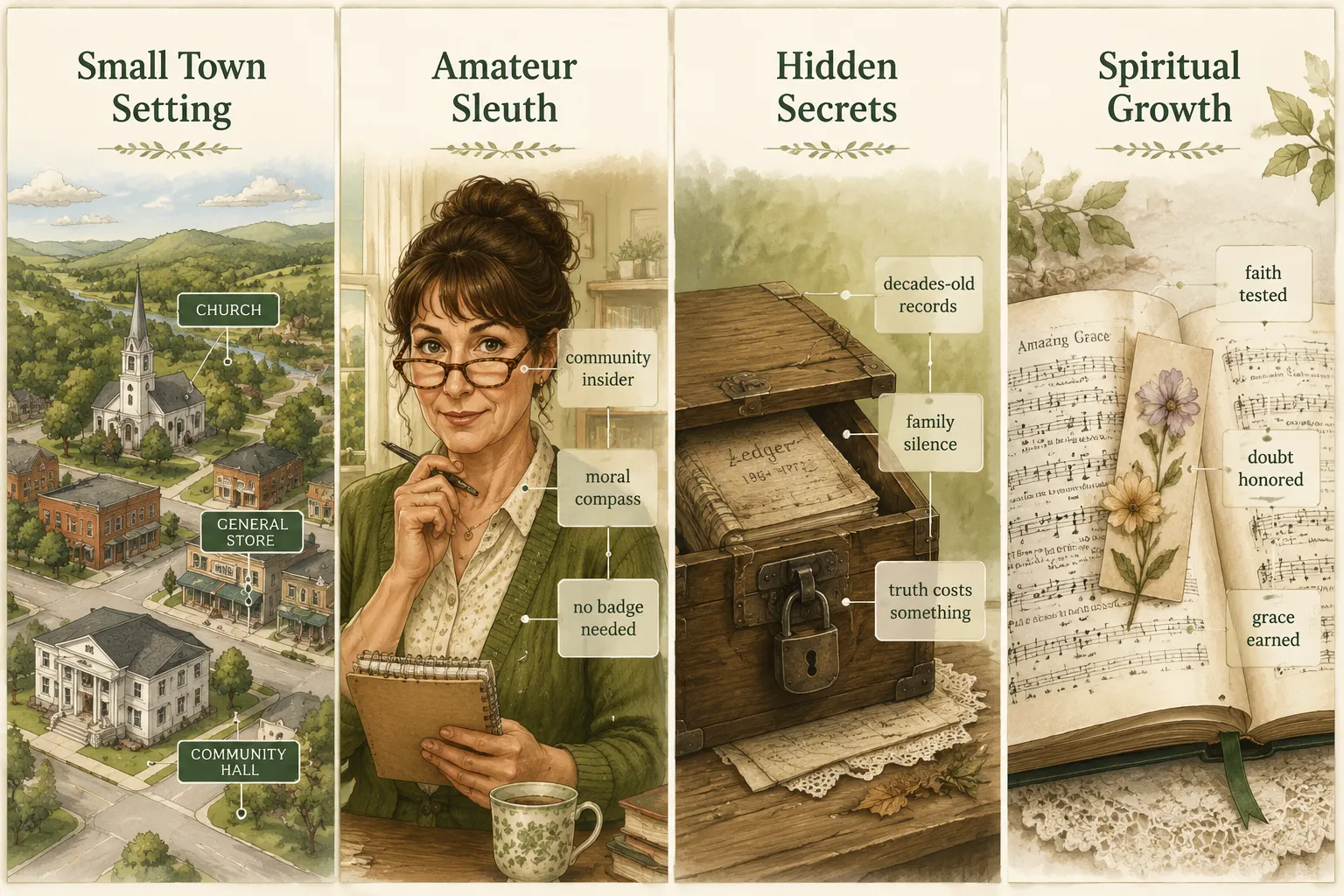
Small-town settings work in cozy mysteries because proximity creates stakes. When everyone knows everyone, a secret isn’t just a plot device, it’s a liability that touches real relationships. This is doubly true in Christian cozies, where the community often centers on a church, and the church is where reputation, mercy, and accountability all share the same pew.
The structural advantages of small-town settings include:
- Limited suspect pools that make fair-play mystery possible without requiring a detective’s badge
- Shared history that gives secrets generational weight, a ledger from thirty years ago still matters because the people it names are still in the room
- Community rituals (church socials, quilting circles, seed swaps, donation drives) that create natural gathering points where information moves and motives surface
- Moral visibility, in a small town, what you do is observed, and what you’ve done is remembered
A January 2026 analysis of cozy mystery tropes confirmed that small towns, recurring characters, and high emotional stakes remain the genre’s most durable elements [1]. Christian cozies inherit all of that and add one more layer: the community isn’t just social, it’s accountable to something larger than itself.
“In Juniper Gap, Tennessee, Nora Bell Hartley keeps finding bodies where she meant to find donations, and secrets the church socials never sing about.”, Mercy House Mysteries series description
How Do Secrets Drive the Plot in Christian Mysteries
Secrets in Christian cozy mysteries work differently than in secular thrillers. The secrets tend to be relational and historical rather than criminal and graphic, a hidden ledger, a family Bible with the wrong name in the genealogy, a recipe tin that holds more than recipes.
This matters because the secret’s function in a Christian cozy isn’t just to conceal a killer. It’s to reveal what a community has agreed to forget, and to force characters to decide whether they’ll keep agreeing. That’s where the spiritual stakes live.
Common secret structures in faith-based cozies:
- Records that outlive their keepers, a document, a tape, a margin note that someone tried to bury but couldn’t
- Family silence, a truth that multiple people know but no one has said aloud, often for reasons that seemed merciful at the time
- Institutional cover, a church, a charity, or a community organization that protected someone it shouldn’t have
- Misidentified grace, a secret kept out of what looked like forgiveness but was actually fear
The best secrets in Christian cozies don’t just explain the murder. They explain the community, why it is the way it is, and what it will cost to be honest now.
What’s the Difference Between Christian Cozy Mysteries and Regular Cozy Mysteries
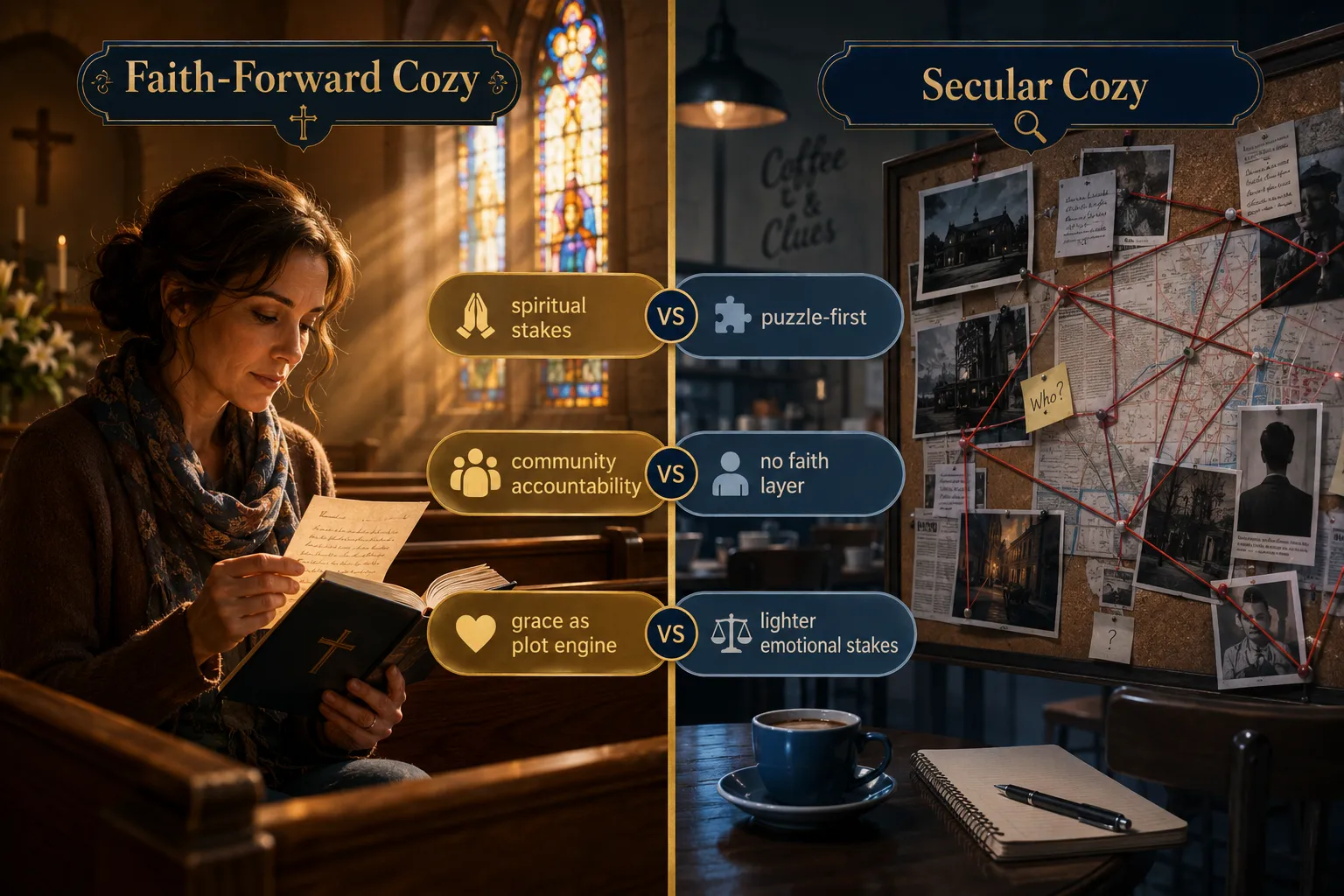
The difference isn’t primarily about content restrictions, though Christian cozies do maintain clean content standards. The real difference is structural: in a Christian cozy, faith functions as a load-bearing element of the story, not a label applied after the fact.
In a secular cozy, the amateur sleuth solves the puzzle and order is restored. In a Christian cozy, the amateur sleuth solves the puzzle and is changed by what the truth required of her.
Key structural differences:
| Element | Secular Cozy | Christian Cozy |
|---|---|---|
| Sleuth’s motivation | Curiosity, justice | Conscience, community duty |
| Community function | Social texture | Moral accountability |
| Resolution feel | Order restored | Grace earned |
| Interior life | Emotional, relational | Includes faith, doubt, prayer |
| Stakes | Who did it | What truth costs |
Shana Asaro of Harlequin Love Inspired describes the current demand as readers wanting the feel of Agatha Christie-style traditional mysteries, puzzle-first, low graphic content, but with faith handled as lived experience rather than lesson [2]. That’s the target: Christie’s craft, with a conscience that answers to something.
How Does Spiritual Growth Fit Into Mystery Plots
Spiritual growth fits into mystery plots when it’s a consequence of what the character discovers, not a scheduled stop on the way to the ending. The mystery forces a choice, tell the truth or protect someone, act on faith or wait for certainty, and the character’s response to that choice is where growth happens.
This is the trope readers actually love: not a character who arrives at the mystery already spiritually sorted, but one whose faith is tested by what she finds and who she has to confront.
Spiritual growth in Christian cozies tends to look like:
- Doubt that gets honest, a character who stops performing certainty and admits what she doesn’t know
- Forgiveness that costs something, not cheap absolution, but the hard work of releasing someone who hurt people she loved
- Conviction under pressure, choosing to tell the truth when the easier path is silence
- Community restored, a fractured relationship or a broken trust that gets mended, imperfectly, because someone chose honesty
What it should never look like: a conversion scene that solves the emotional problem, a scripture quote that arrives like a verdict, or a faith moment that comes before the character has earned it.
Common Tropes in Faith-Based Cozy Mysteries, and Why They Work
The tropes readers actually love in Christian cozy mysteries are the same ones that have always made the genre work, with a faith layer that deepens rather than softens them.
The most durable tropes:
- The amateur sleuth with community access, a church volunteer, a thrift shop manager, a quilting circle regular who hears everything because she’s trusted everywhere
- The object that holds the secret, a family Bible, a hymnal margin note, a recipe tin, a flood box, a seed packet, ordinary items that turn out to be evidence
- The community that protects its own, and the moment when one person decides protection has become complicity
- The recurring cast, a pastor, a deputy, a nosy neighbor, a grieving widow, who accumulate history across books and make the town feel lived-in
- The low-stakes violence, death is present but not graphic; the horror is relational and moral, not physical
- The resolution that restores, not just the crime solved, but something broken in the community acknowledged and, at least partially, healed
These tropes appear consistently across the genre because they serve the reader’s actual need: comfort that’s been earned, not handed over [1].
Best Christian Cozy Mystery Series to Start With, and What to Expect
The best place to start depends on what the reader wants from the faith layer and how much they enjoy ensemble community dynamics versus a single strong protagonist.
For readers new to the subgenre:
- Mercy House Mysteries (Silas Bellhaven), Set in Juniper Gap, Tennessee, with protagonist Nora Bell Hartley. Ten books built around church donations, community events, and secrets hidden in ordinary objects. Faith is present as lived experience, doubt, conscience, and earned grace, never as sermon. Browse the series
- Dana Mentink’s Murder Most Fowl Mysteries, Launching September 2026 from Harlequin Love Inspired, beginning with Murders in the Marquee, described as clean and faith-centered with traditional mystery structure [2]
- Heather Day Gilbert’s All the Suspects on Campus, Planned for January 2027, Christie-style whodunit moving into traditional Christian distribution [2]
- Naomi Stephens’s Don’t Upstage the Body, Published June 2026 by Bethany House, notable as a trade-published Christian mystery from a house historically focused on romance [2]
Choose a series based on:
- Ensemble community feel → Mercy House Mysteries
- Christie-style puzzle structure → Murder Most Fowl Mysteries or All the Suspects on Campus
- Lighter, more comedic tone → Look for indie releases like Penny Frost McGinnis’s One Rotten Apple [11]
Do You Need to Be Religious to Enjoy Christian Cozy Mysteries
No, but you need to be comfortable with faith as part of a character’s interior life. Christian cozy mysteries don’t require theological agreement from the reader; they require tolerance for a protagonist who prays, doubts, and makes choices shaped by conscience rather than convenience.
Readers who enjoy character-driven mysteries with strong moral stakes often find Christian cozies satisfying precisely because the faith layer gives the protagonist’s choices more weight. The question isn’t “do you believe what she believes?” It’s “do you find it interesting to watch someone try to live by what they believe when it’s hard?”
Readers who struggle with the subgenre are usually frustrated by one of two things: faith that feels preachy (the author talking at the reader through the character) or faith that feels decorative (a cross on the cover, nothing inside). Neither is a feature of the genre, both are execution failures.
How Much Romance Should Be in a Christian Cozy Mystery
Romance in Christian cozies is typically present but light, a subplot or a slow-burn thread across a series rather than the emotional center of any single book. The primary relationship in a well-built Christian cozy is between the protagonist and her community, not between the protagonist and a love interest.
This matters structurally: if the romantic tension resolves the book’s emotional arc, the mystery becomes a backdrop for the romance. The genre works better when the mystery resolves the emotional arc, and the romance is one of the things the protagonist is trying to protect or figure out while she’s doing it.
Some series maintain a romance-absent contract entirely, particularly those with masculine leads or those focused on conscience and justice over community warmth. The Mercy Line western series, for example, holds that line deliberately: where law runs out, a man finds what he answers to, and that question doesn’t need a love interest to feel urgent.
What Are People Getting Wrong About Writing Christian Mysteries
The most common mistake in Christian mystery writing is treating faith as content rather than structure. A character who quotes scripture, attends church, and prays before meals isn’t a faith-forward protagonist, she’s a character with religious habits. Faith becomes structural when it drives decisions that cost something.
Literary agent Rachelle Gardner has pointed out that Christian fiction historically developed around romance and romantic suspense, leaving mystery underdeveloped, partly because the genre hadn’t yet figured out how to integrate faith naturally while still delivering a fair-play puzzle [2]. That gap is closing, but the failure mode is still common.
What writers get wrong:
- Faith as reward, the character’s belief is confirmed by the mystery’s resolution, rather than tested by it
- Community as set dressing, recurring characters who don’t change or carry consequences across books
- Secrets without weight, a hidden truth that, once revealed, doesn’t actually cost the community anything
- Grace without cost, forgiveness that arrives before the character has genuinely reckoned with what happened
The standard worth holding: faith under fire, not faith on display. The ordinary Tuesday that turns out to matter more than anyone expected, that’s where the best Christian cozy mysteries live.
Christian Cozy Mystery With Strong Female Protagonists, What to Look For
Strong female protagonists in Christian cozies work when their faith and their investigative instincts come from the same place: a refusal to look away from what’s true. The best ones aren’t strong because they’re fearless, they’re strong because they keep going after they’re afraid.
What distinguishes a well-built protagonist in this subgenre:
- Community insider status that gives her access without requiring a badge or a license
- Moral seriousness that isn’t the same as moral certainty, she doubts, she makes mistakes, she has to apologize
- A specific skill or role (quilting circle organizer, thrift shop manager, church secretary) that explains why she keeps finding herself at the center of things
- A faith that’s worked-through, not a performed piety, but a lived conviction that shows up in how she treats people, not in what she says about God
The amateur sleuth model fits Christian cozies particularly well because community trust replaces institutional authority. She doesn’t need a warrant. She needs people to tell her things, and they do because she’s earned it.
FAQ
What are the most popular Christian cozy mystery tropes? Small-town settings, amateur sleuths with community access, secrets hidden in ordinary objects (Bibles, quilts, recipe tins), recurring ensemble casts, and spiritual growth earned through the cost of truth-telling. These tropes appear consistently because they serve the reader’s need for comfort that feels real rather than convenient.
Is Christian cozy mystery a growing genre? Yes. In 2026, Harlequin Love Inspired is actively expanding into mystery, Bethany House published a trade Christian mystery, and platform-level data from ChristShare shows clean fiction and cozy mysteries are a meaningful and growing reader segment [2][4]. Literary agent Cynthia Ruchti notes it’s still unclear whether this is a lasting trend, but publisher investment suggests real confidence [2].
What makes Christian cozy mysteries different from inspirational romance? The emotional center is different. In inspirational romance, the relationship arc drives the book. In Christian cozy mystery, the puzzle and the community drive the book, with faith shaping how the protagonist handles what she discovers. Romance may be present, but it’s a subplot.
Can men enjoy Christian cozy mysteries? Yes, though the primary audience is women 35-65. Readers who enjoy character-driven mysteries with moral stakes and a strong sense of place tend to find the subgenre satisfying regardless of gender. Series with masculine leads (like frontier Christian westerns) serve male readers who want faith-rooted fiction with different structural priorities.
How graphic is the violence in Christian cozy mysteries? Not graphic at all. Death is present, it’s a mystery, but the horror is relational and moral rather than physical. The genre’s contract with readers is low-stakes violence with high emotional stakes: what matters isn’t how the person died, but what the truth about their death reveals about the community.
What’s the best first book to try in Christian cozy mystery? A Donation to Die For (Mercy House Mysteries, Book 1) is a strong entry point, it establishes the Juniper Gap community, introduces Nora Bell Hartley, and embeds faith as lived experience from the first chapter without announcing it. View on Amazon
Do Christian cozy mysteries have to be set in the American South? No, though the American South is a common setting because small-town church culture is culturally legible there. The structural requirements, a close community, shared history, visible accountability, can be met in any setting where people know each other’s business and have to live with the consequences of what they do.
How long are Christian cozy mystery series typically? Series vary widely. Some run three to five books; others, like the Mercy House Mysteries, run ten or more. Longer series benefit from accumulated community history, recurring characters who carry consequences across books make the town feel real in a way a standalone can’t replicate.
Conclusion
The tropes readers actually love in Christian cozy mysteries, small communities, secrets, and spiritual growth, aren’t comfort mechanisms designed to avoid difficulty. They’re the architecture of stories that take both faith and honesty seriously at the same time. The small town makes accountability visible. The secret makes the cost of truth concrete. The spiritual growth happens because the character had to choose, and choosing changed her.
In 2026, publishers are paying attention. Harlequin Love Inspired, Bethany House, and a growing field of independent authors are all producing work that treats Christian cozy mystery as a real genre with real craft requirements, not a niche afterthought [2].
If you’re ready to find a series that walks with you rather than talks at you:
- Start with A Donation to Die For for a full Juniper Gap introduction
- Browse the complete Mercy House Mysteries series for ten books of earned grace and small-town secrets
- Explore the full Silas Bellhaven catalog for faith-rooted fiction across mystery, western, fantasy, and thriller
The ordinary Tuesday can turn out to matter more than anyone expected. That’s the promise the best Christian cozies keep.
References
[1] The Coziest Mystery Tropes Readers Secretly Love And Why We Cant Get Enough Of Them – https://tonyakappes.com/2026/01/25/the-coziest-mystery-tropes-readers-secretly-love-and-why-we-cant-get-enough-of-them/
[2] Mysteries On The Rise In Christian Fiction – https://www.publishersweekly.com/pw/by-topic/industry-news/religion/article/100974-mysteries-on-the-rise-in-christian-fiction.html
[4] ChristShare Highlights Clean Fiction as Cozy Mysteries Gain Interest – https://news.marketersmedia.com/christshare-highlights-clean-fiction-as-cozy-mysteries-gain-interest/89191539
[11] One Rotten Apple, Penny Frost McGinnis Christian Cozy Release – https://tonyakappes.com/2026/01/25/the-coziest-mystery-tropes-readers-secretly-love-and-why-we-cant-get-enough-of-them/