
Last updated: August 26, 2026
Quick Answer: Christian authors build suspense in psychological thrillers by grounding tension in moral stakes, relational conflict, and withheld truth rather than graphic violence or shock content. The suspense is real, it just comes from a character’s conscience, not from a body count. When faith is load-bearing in the story, the question of what a person will do when no one is watching carries more weight than any graphic scene could.
Key Takeaways
- Suspense without darkness means tension rooted in moral jeopardy, relational stakes, and information the reader doesn’t yet have, not in gore or explicit content
- The most effective Christian psychological thrillers use internal conflict as the primary engine of dread
- Withheld truth, unreliable perspective, and the cost of silence are craft tools that work entirely within clean-content boundaries
- Faith under pressure, not faith as a tidy answer, is what makes Christian thrillers feel honest rather than sanitized
- Readers of clean Christian fiction want real stakes, not protected characters; they want earned grace, not cheap resolution
- Common mistakes include resolving tension too early with a faith moment, or avoiding conflict so thoroughly the story loses its pulse
- The difference between secular and Christian thriller approaches is not intensity, it’s the moral framework inside which that intensity operates
- Authors like Christy Barritt and Steven James demonstrate that psychological complexity and clean content are not in conflict [8][12]
- The Christian suspense market is actively growing in 2026, with new discovery platforms and library curation lists reflecting sustained reader demand [7][4]
What Does Suspense Without Darkness Mean in Christian Fiction
Suspense without darkness does not mean suspense without weight. It means the source of dread is moral, relational, or spiritual rather than graphic or sensational.
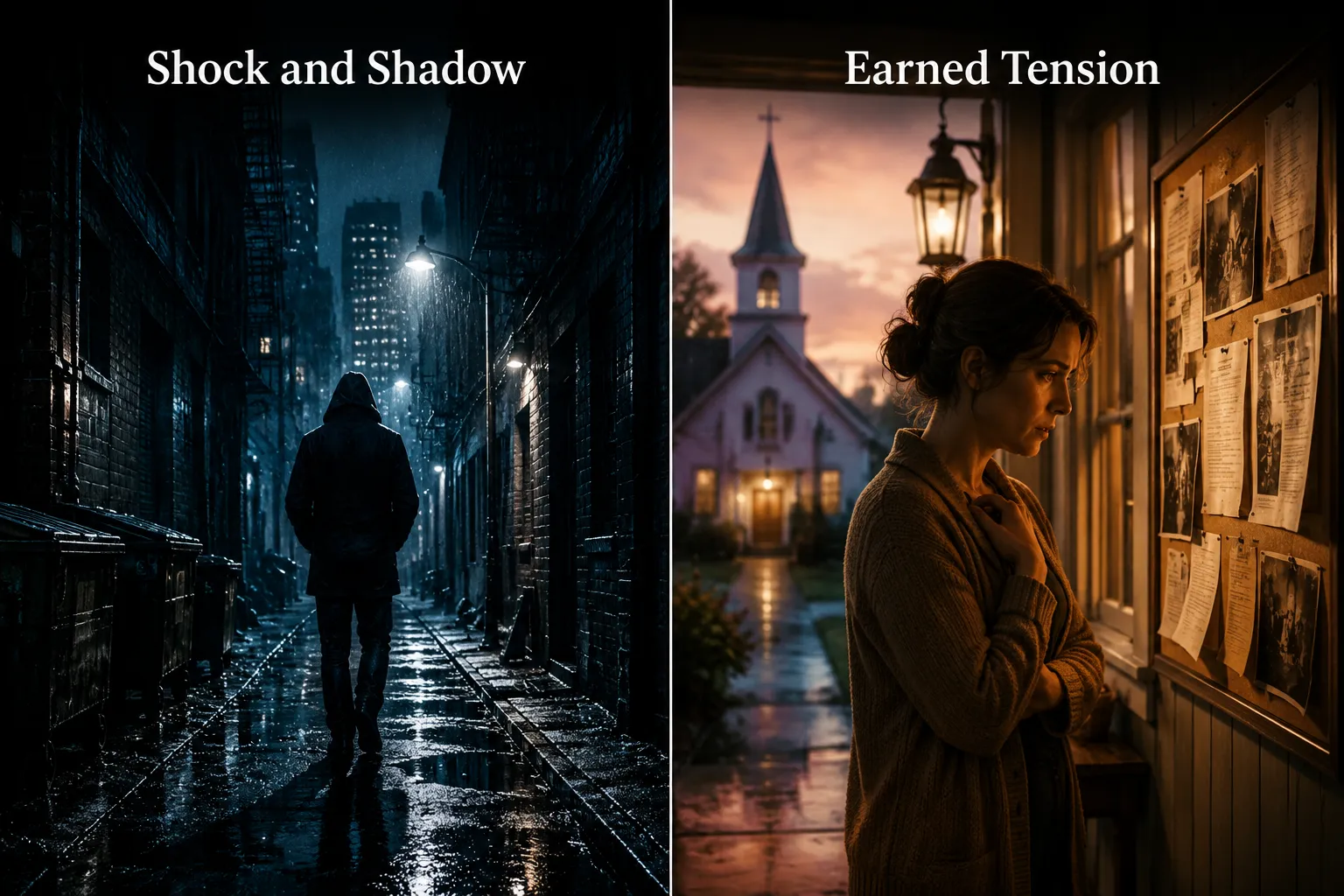
In secular psychological thrillers, tension often comes from visceral threat, violence described in detail, explicit trauma, or shock imagery. Christian authors working in the same genre reach for different tools: the letter that hasn’t been opened yet, the conversation that keeps getting postponed, the character who knows something she hasn’t decided whether to say. The darkness is still there in the sense that the story takes hard things seriously. What’s absent is the gratuitous rendering of that darkness for shock value.
The site Christian Suspense Novels describes this approach directly: tension comes from “masterful plotting and emotional stakes, not cheap shocks.” [7] That’s not a lower standard. It’s a different craft discipline, and in many ways a harder one.
The suspense isn’t softer. The source of it is different.
How Christian Authors Create Tension Without Graphic Content
Christian authors create tension by controlling information, time, and moral cost, three levers that work entirely within clean-content limits.
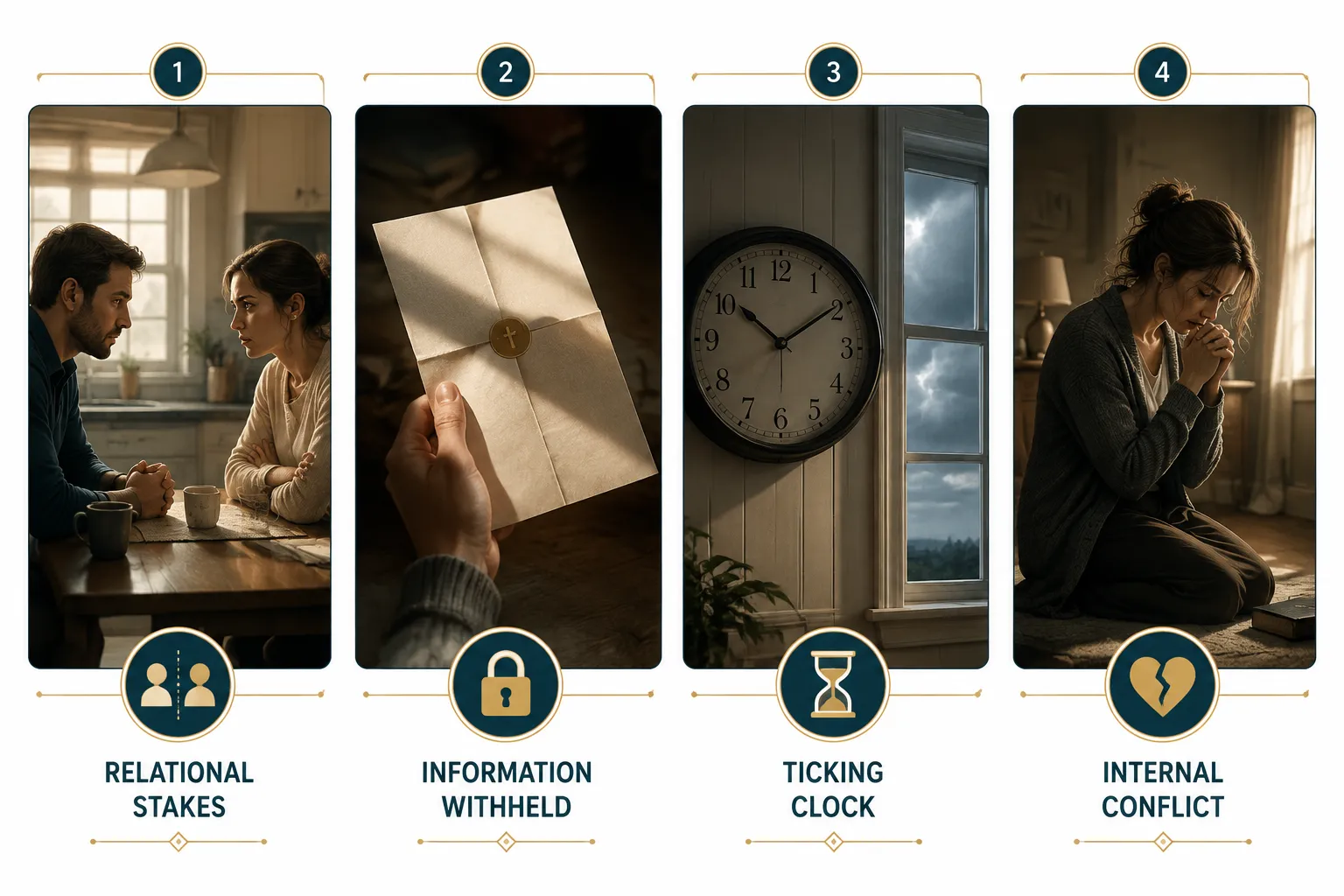
Information control is the most powerful. When a reader knows something the protagonist doesn’t, or suspects something the protagonist refuses to see, the gap between those two positions generates dread. No violence required. The reader’s imagination, working inside a moral framework, does the heavy lifting.
Time pressure works the same way it does in any thriller. A decision that must be made before Sunday’s service. A file that will be archived, and effectively buried, by end of week. A conversation that can only happen before someone leaves town. The clock doesn’t need blood to feel urgent.
Moral cost is where Christian fiction has a specific advantage. When a character’s choice carries spiritual weight, when staying silent is not just strategically risky but ethically wrong, the stakes are higher than physical danger. A character who could speak the truth and doesn’t is in a kind of peril that resonates deeply with readers whose faith tells them that truth-telling matters.
Key techniques that work within clean-content boundaries:
- Unreliable perspective, the narrator believes something the reader is slowly learning to doubt
- Withheld testimony, a character holds information that could change everything and hasn’t decided what to do with it
- Structural irony, the reader sees the shape of what’s coming before the character does
- Relational fracture, trust between two characters breaks slowly, and the reader watches it happen
- The cost of silence, not speaking becomes its own form of action with its own consequences
The Difference Between Secular and Christian Thriller Writing Approaches
The difference is not intensity, it’s the moral architecture the story is built on.
Secular psychological thrillers often operate in a morally neutral or morally ambiguous space. The question is whether the protagonist survives or wins. In a Christian psychological thriller, the deeper question is what the protagonist will become. Survival matters, but so does the state of the soul at the end.
This changes how plot twists land. In a secular thriller, a revelation is satisfying because it resolves the mystery. In a Christian thriller, a revelation is satisfying because it costs someone something, and what they do with that cost reveals who they are. Earned grace shows up after that cost, not instead of it.
Christy Barritt, one of the most widely read authors in the genre, has spoken about this directly: the goal is to show that God’s peace is possible even in dangerous circumstances, not by removing the danger, but by showing faith operating inside it. [8] That’s a fundamentally different structural promise than a secular thriller makes.
Can You Write a Page-Turner Without Violence or Dark Themes
Yes, and the evidence is a growing catalog of titles that prove it. [2][4]
The assumption that page-turning pace requires graphic content is a genre convention, not a craft law. What actually drives a reader to turn the page is unresolved tension, a question that hasn’t been answered, a situation that hasn’t stabilized, a character whose choice is still in the balance. None of those conditions require graphic content to exist.
Authors highlighted in 2026 curated lists, including Jason B. Rash’s Triple Threat and Michael Garrett’s Over the Edge, are cited specifically as examples of “high-stakes suspense with no graphic gore or casual immorality” that still deliver breathless pacing. [2] The clean content isn’t a limitation on the tension. It redirects where the tension lives.
Choose this approach if:
- Your readers want to stay up past midnight but not feel unsettled in the morning
- Your story’s central question is moral or spiritual, not just physical
- You want the faith element to be load-bearing, not decorative
How to Build Psychological Suspense Through Character Conflict Instead of Gore
Psychological suspense lives in the gap between what a character knows and what they’re willing to do about it.
The most durable source of dread in any psychological thriller is a character who is compromised, not necessarily by evil, but by fear, loyalty, past failure, or the weight of a secret they’ve been carrying too long. That compromise doesn’t require graphic backstory. It requires specificity. The reader needs to feel the exact shape of what the character is protecting and what it would cost them to let it go.
Practical steps for building psychological tension without graphic content:
- Establish what the character cannot afford to lose, reputation, a relationship, a belief about themselves
- Put that thing in jeopardy through information, not violence, someone else knows, or is about to find out
- Make silence feel like a choice, the character is actively deciding not to speak, not just passively uninformed
- Let the reader see the cost accumulating, small compromises that build toward a larger one
- Delay the confrontation, every scene that could resolve the tension but doesn’t increases the pressure
- Ground the faith element in the conflict, the character’s belief system is part of what makes the choice hard, not a shortcut out of it
The Gathering Light series (When Hannah Sleeps, When the Voice Breaks, When the Prayer List Opens) operates exactly this way. The spine question, who controls the record of someone’s truth?, generates psychological dread through institutional power and withheld testimony, not through violence. Hannah Garrick’s terror comes from finding her own words in someone else’s file. That’s a clean image with a genuinely disturbing implication.
What Makes a Christian Thriller Engaging for Readers
Christian thriller readers, primarily women between 35 and 65, many reading on Kindle Unlimited, want real stakes, not protected characters. [4] They’ve read enough sanitized fiction to recognize when a story is avoiding conflict rather than handling it honestly.
What they’re actually looking for:
- Characters who doubt and struggle, not characters who have faith as a superpower
- Tension that doesn’t resolve too early, a prayer in chapter three shouldn’t dissolve the problem by chapter five
- Faith that costs something, grace that arrives after the character has paid a real price
- A story that walks with them, not one that talks at them about what they should believe
- Clean content that comes from conviction, not avoidance, the story isn’t clean because it’s afraid of hard things; it’s clean because it doesn’t need shock to be honest
Library systems are actively curating these titles to meet this demand. Sno-Isle Libraries’ 2026 Christian Mystery/Suspense/Thriller staff list includes authors like Steven James, whose novels are noted for intense, complex villain psychology while remaining appropriate for Christian readers, a combination that signals librarians understand the audience isn’t asking for easy stories. [12]
Common Mistakes Christian Authors Make When Trying to Add Suspense
The most common mistake is resolving tension with a faith moment before the tension has fully developed. A character faces a hard situation, prays, and receives clarity, and the story’s engine stalls. Grace is real, but in fiction it has to be earned through the plot, not delivered as a shortcut out of it.
Other frequent missteps:
- Telegraphing the villain too early through obvious moral contrast, so the reader never genuinely doubts
- Protecting the protagonist from real consequences, if nothing can truly go wrong, there’s no suspense
- Using faith as narration rather than showing it through choice and consequence
- Avoiding moral ambiguity entirely, clean fiction doesn’t mean every secondary character is either good or bad
- Resolving relational conflict too quickly, forgiveness is a theme worth exploring, but instant reconciliation deflates tension
- Explaining the theme instead of trusting the story to carry it
The panel discussion on writing crime fiction as Christian authors touches on this directly: the challenge is maintaining authentic faith without letting it become a mechanism that removes narrative risk. [10]
Is Christian Fiction Suspenseful or Does It Feel Too Clean
When it’s done well, it’s genuinely suspenseful. When it’s done poorly, it feels like the story is protecting itself, and readers notice immediately.
The “too clean” critique usually points to one of two problems: either the author avoided conflict to keep the content comfortable, or the faith element was used to resolve tension rather than complicate it. Neither is a genre problem. Both are craft problems.
The 2026 push from discovery platforms like Christian Suspense Novels specifically addresses this by vetting titles for “strong biblical themes, redemption arcs, hope-filled messages, and zero explicit content”, the emphasis being that all four of those things can coexist. [7] Hope-filled doesn’t mean conflict-free. Redemption requires something to be redeemed from.
New Christian suspense authors highlighted in 2026 are “consciously preserving clean suspense while modernizing psychological depth and settings”, a signal that the genre is actively working to close the gap between clean content and genuine tension. [4]
How Do You Create Fear and Tension in a Moral Framework
Fear in a moral framework comes from the possibility of moral failure, which is, for many readers, more frightening than physical danger.
A character who might lie to protect someone she loves. A protagonist who has been holding a truth that could destroy an innocent person’s reputation. A woman who realizes the institution she trusted has been using her own words against her. These are not horror scenarios. They’re moral ones, and they carry real dread precisely because the reader understands the weight of the choice.
The moral framework doesn’t limit fear. It focuses it. The question isn’t “will she survive?” It’s “will she tell the truth?” And for readers whose faith tells them that truth-telling is not optional, that question has teeth.
Christian Thriller Examples That Prove Suspense Doesn’t Need Darkness
Several titles in 2026 serve as concrete proof that clean content and genuine suspense are compatible:
- When Hannah Sleeps (The Gathering Light, Book 1), Hannah Garrick’s testimony appears in someone else’s file. The dread is institutional and psychological, with no graphic content required.
- Triple Threat by Jason B. Rash, cited as high-stakes suspense with “no graphic gore or casual immorality” [2]
- Over the Edge by Michael Garrett, described as “breathless tension” that is spiritually uplifting [2]
- Works by Christy Barritt, who has built a substantial readership on the premise that God’s peace and genuine danger can occupy the same story [8]
- Works by Steven James, curated by library systems for their intense villain psychology within a value-conscious framework [12]
These aren’t outliers. They represent a growing body of work that answers the “too clean” critique with craft rather than argument.
Techniques for Plot Twists in Faith-Based Psychological Fiction
A plot twist in faith-based fiction works best when it reframes the moral question, not just the factual one.
The most effective twists in Christian psychological thrillers don’t just reveal who did something, they reveal what the protagonist has been wrong about in a way that implicates her own choices. The twist lands harder because it carries moral weight.
Techniques that work within a faith framework:
- The record that proves something different, a document, a testimony, a prayer list that reveals a truth the protagonist has been avoiding
- The trusted person who wasn’t, betrayal that comes from inside a community of faith hits harder because the trust was built on shared belief
- The protagonist’s own complicity, the twist reveals that the character has been part of the problem, which demands a response that costs something
- The mercy that complicates justice, a revelation that makes the right thing harder to do, not easier
Who Reads Christian Psychological Thrillers and What Do They Want
The core audience for Christian psychological thrillers is primarily women between 35 and 65, many of them Kindle Unlimited subscribers who read across multiple clean fiction subgenres. [4] They are not a niche audience looking for watered-down secular fiction. They are readers with specific, sophisticated expectations.
They want:
- Faith represented honestly, doubted, tested, and worked through, not performed
- Real consequences, characters who make bad choices and live with them
- Clean content that comes from the author’s conviction, not from avoidance
- Earned resolution, hope that arrives after the story has paid for it
- Stories that walk with them, not stories that instruct them
This audience has grown significantly enough that library systems are actively updating their curation lists and new discovery platforms launched in 2026 specifically to serve them. [7][12] The demand is real, and it’s for something specific: hope in the dark, not a story that pretends the dark isn’t there.
How Long Does It Take to Write a Christian Suspense Novel
There’s no fixed timeline, but Christian psychological thrillers typically run between 60,000 and 90,000 words. For a working author writing consistently, a first draft at that length takes roughly three to six months. Revision, particularly the work of calibrating tension without graphic content, often takes as long as the draft itself.
The craft challenge specific to this subgenre, building genuine suspense inside clean-content limits, requires more structural planning than a thriller that can rely on visceral shock. The moral stakes need to be established early, the information withheld carefully, and the faith element woven into the conflict rather than applied to it from outside. That kind of architecture takes time to build well.
Conclusion: Craft That Earns the Light
The question at the center of every Christian psychological thriller is not whether darkness exists. It does. The question is what the story does with it, and whether the light that comes at the end was earned by the plot or just delivered by the genre’s expectations.
Actionable next steps for authors:
- Audit your tension sources, list every scene that generates dread and identify whether it comes from moral stakes, withheld information, or relational fracture. If it comes primarily from graphic content, look for the moral version of the same threat.
- Delay your faith resolutions, find every moment where a prayer or a scripture resolves narrative tension and ask whether the story has paid for that resolution yet.
- Ground your protagonist’s fear in something she could lose spiritually or morally, not just physically.
- Read the genre you’re writing, titles like When Hannah Sleeps and the work of Christy Barritt demonstrate the craft in practice. [8]
- Trust your readers, they came for real stakes and earned grace. Give them both.
Clean Christian fiction doesn’t protect readers from hard things. It handles hard things honestly, inside a framework where mercy and justice both matter, and where the ordinary Tuesday can turn out to be the one that changes everything.
FAQ
What is a Christian psychological thriller? A Christian psychological thriller is a suspense novel that uses psychological tension, unreliable narrators, withheld truth, moral jeopardy, as its primary engine, while keeping content clean and faith as a genuine element of the story rather than a backdrop.
Can Christian thrillers be as suspenseful as secular ones? Yes. The intensity of suspense depends on the quality of the stakes and the skill of the author, not on graphic content. Moral and spiritual jeopardy can carry as much dread as physical threat, often more, for readers whose faith makes those stakes feel real.
What makes a Christian thriller feel “too clean”? A thriller feels too clean when the author uses faith as a mechanism to resolve tension rather than complicate it, or when the story avoids genuine conflict to keep the content comfortable. The problem is craft, not genre.
Who are some well-known Christian psychological thriller authors? Christy Barritt and Steven James are two of the most widely recognized names in the genre. Both demonstrate that psychological complexity and clean content can coexist. [8][12]
What is “earned grace” in Christian fiction? Earned grace means that mercy and redemption arrive after the story has paid a real cost, the character has faced genuine consequences, made hard choices, and the grace that follows means something because of what preceded it.
How do Christian authors handle villain psychology without graphic content? By focusing on motivation, rationalization, and the moral logic of the antagonist rather than on graphic depictions of their actions. The most unsettling villains in Christian fiction are frightening because their reasoning is coherent, not because their violence is described in detail.
Is there a market for Christian psychological thrillers in 2026? Yes, and it’s growing. New discovery platforms and library curation lists launched in 2026 specifically to serve readers looking for clean suspense with strong faith themes. [7][12]
What’s the difference between a Christian cozy mystery and a Christian psychological thriller? Cozy mysteries prioritize community, warmth, and puzzle-solving with low threat levels. Psychological thrillers prioritize internal tension, moral jeopardy, and psychological dread. Both can be clean and faith-rooted, but the emotional register is significantly different.
Do Christian psychological thrillers need a conversion arc? No. A conversion arc can be one kind of faith story, but it’s not the only one. Characters can be believers whose faith is tested, deepened, or complicated without converting. Forced conversion arcs often feel like genre obligation rather than honest storytelling.
What role does setting play in Christian psychological thrillers? Setting grounds the moral stakes in something specific. A retreat center, a small church community, a tight-knit neighborhood, these settings make the cost of betrayal and the weight of truth-telling feel concrete rather than abstract.
References
[2] Christian Suspense Thrillers – https://christiansuspensenovels.com/christian-suspense-thrillers
[4] New Christian Suspense Authors – https://christiansuspensenovels.com/new-christian-suspense-authors
[7] christiansuspensenovels – https://christiansuspensenovels.com/
[8] Suspense Interview Christy Barritt Wonders Gods Peace Times Danger – https://familyfiction.com/suspense-interview-christy-barritt-wonders-gods-peace-times-danger/
[10] Suspense Panel Writing Crime Fiction Christian Authors – https://familyfiction.com/suspense-panel-writing-crime-fiction-christian-authors/
[12] Christian Mystery Novels For The Whole Family Reading List 4741064 – http://prsync.com/wordsmith-world/christian-mystery-novels-for-the-whole-family–reading-list-4741064/