Last updated: August 27, 2026
Quick Answer: Non-romance Christian epic fantasy for Kindle Unlimited readers who want adventure and faith, not spicy subplots is a growing subgenre of clean speculative fiction where spiritual stakes, world-building, and quest-driven plots carry the story, with no romantic tension used as a primary driver. These books exist, they’re available on KU, and they’re built for readers who want faith handled as something lived and tested, not preached or paired with a love interest.
Key Takeaways
- Christian epic fantasy places faith at the structural center of the story, not as decoration, but as the force that shapes character choice and consequence.
- Non-romance in this context means the plot’s engine is quest, covenant, spiritual conflict, or moral reckoning, not a relationship arc.
- Kindle Unlimited carries a meaningful selection of faith-forward fantasy series, including titles from authors like Silas Bellhaven.
- The Christian speculative fiction community is growing, Realm Makers 2026 drew nearly 350 in-person writers, signaling strong professional support for the genre. [6]
- Faith content works best in fantasy when it shows up through character cost, not narration or scripture-dropping.
- Earned grace, mercy that arrives after real consequence, is the hallmark of the best Christian epic fantasy, not cheap resolution.
- KU readers can filter for clean content using Amazon’s category tags and community recommendations.
- Christian epic fantasy is not exclusively for religious readers; anyone drawn to moral weight and meaningful consequence will find it compelling.
- Series tend to reward readers more than standalones in this subgenre, because faith arcs need room to breathe.
- Preachy fantasy fails not because it includes faith, but because it resolves tension too easily.
What Is Christian Epic Fantasy and How Is It Different from Regular Fantasy
Christian epic fantasy is secondary-world or speculative fiction where the theological framework, covenant, redemption, divine presence, moral accountability, is load-bearing rather than decorative. It differs from standard epic fantasy in that the spiritual dimension isn’t background lore; it’s the ground the story stands on.
In regular epic fantasy, a character might pray to unnamed gods as world-flavor. In Christian epic fantasy, the question of whether God hears, and what it costs to keep believing when the answer feels absent, is often the central tension. The difference isn’t tone or vocabulary. It’s whether faith is structural or ornamental.
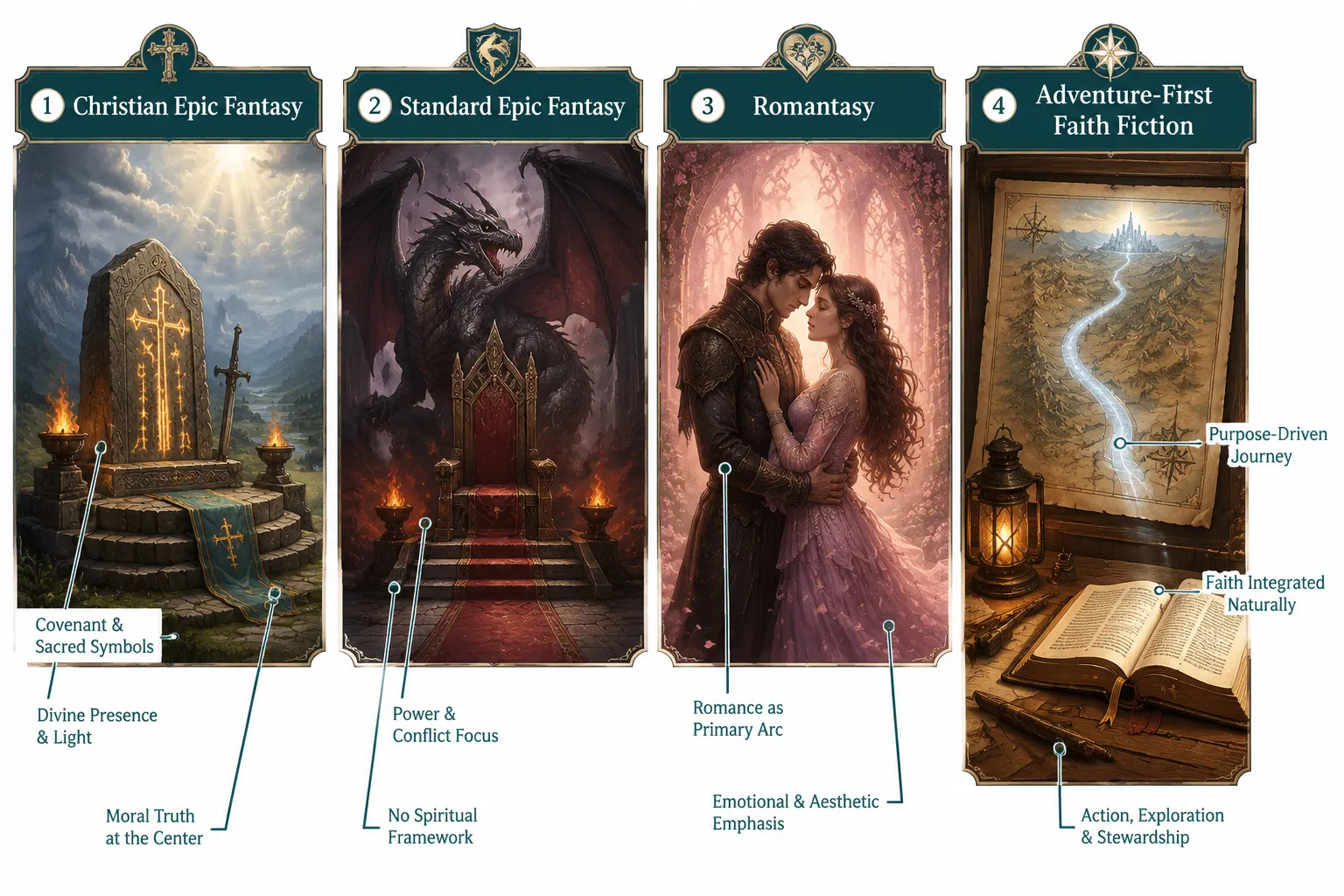
Three markers that distinguish Christian epic fantasy:
- Covenant over contract. Relationships between characters and the divine carry weight and obligation, not just transactional prayer.
- Moral consequence. Characters bear the cost of their choices. Grace arrives, but it doesn’t erase the ledger, it settles it.
- Hope in the dark. The genre doesn’t avoid suffering; it insists that suffering is not the final word.
“Faith isn’t a backdrop, it’s load-bearing. Every story stands on the conviction that belief and event are woven from the same thread.”, Silas Bellhaven
Epic Fantasy with Strong Faith Themes but No Romance Subplot
This is the specific gap many KU readers describe: they want the scale and stakes of epic fantasy, but every series they find either buries the faith content under genre formula or wraps it around a romance arc. Non-romance Christian epic fantasy for Kindle Unlimited readers who want adventure and faith, not spicy subplots fills that gap by making the quest, spiritual, physical, moral, the story’s spine.
What adventure-first faith fantasy looks like in practice:
- The protagonist’s primary conflict is with a system, a power, a covenant broken, or a truth that needs carrying, not with a love interest.
- Relationships exist and matter, but they’re forged through shared mission and tested loyalty, not romantic tension.
- The spiritual arc mirrors the plot arc: faith is tested when the quest gets hardest, not resolved in a quiet moment between characters.
Silas Bellhaven’s Sarel Chronicles is a clear example. In The Map of Unanswered Prayers, map-scribe Elya Renn discovers a black road on her skin during the Great Map’s unveiling, a road belonging to a boy the House of Witness refused to record. The story’s engine is whether the Maker-Who-Hears is present in the prayers the institution decided not to count. Romance doesn’t drive that question. Faithfulness does.
The Kethara Chronicles works similarly: Amara and Sela carry a covenant word through an empire that wants every act of mercy counted and contained. The conflict is between institutional control and genuine mercy, a spiritual and political stakes question, not a romantic one.
How to Find Fantasy Books Without Spicy Content on Kindle Unlimited
Finding clean fantasy on KU takes a few deliberate steps, because Amazon’s browse categories mix content levels freely.
Practical filtering methods:
- Search by category tag. Use Amazon’s “Christian Fantasy” or “Christian Futuristic Fiction” categories, these filter toward faith-based content that typically carries a clean content standard.
- Check the product description. Authors writing for Christian audiences usually signal content level in the blurb or in a content note. Words like “clean,” “faith-based,” or “covenant” are reliable markers.
- Look at the author’s catalog. Authors building a consistent Christian fiction brand, like Silas Bellhaven, maintain the same content standard across every title. One clean book usually means the whole catalog is clean.
- Use community resources. YouTube channels dedicated to Christian and clean fiction releases (active through mid-2026) regularly highlight new KU fantasy titles and explicitly flag content levels. [22]
- Check Realm Makers award finalists. The Realm Awards recognize Christian speculative fiction annually, and finalists are reliably clean and faith-forward. [5]
Choose this approach if: You’ve been burned by a “clean” label that turned out to mean “less explicit than average.” The Christian fiction category on Amazon is the most reliable filter because it carries a community expectation, not just a marketing claim.
Christian Fantasy Authors Who Focus on Adventure Over Relationships
The best adventure-first Christian fantasy authors build their faith themes into the world’s structure, into the systems of power, the geography, the cost of loyalty, rather than into a central relationship.
Authors and series worth knowing in 2026:
- Silas Bellhaven (The Sarel Chronicles, The Kethara Chronicles), covenant-based secondary-world fantasy where spiritual stakes drive plot. Both series are KU-available and romance-absent.
- Isaac Johnson (The War Against The End of Days, Aug 2026), a 461-page apocalyptic epic reimagining the Book of Revelation, categorized under Christian Fantasy and included in Kindle Unlimited. [17]
- The Realm Makers community (14th annual conference, June 2026, St. Louis) is the professional hub for Christian speculative fiction writers, and its award finalists each year surface new adventure-focused voices. [6]
What to look for in an author’s positioning:
- A stated romance-absent or clean content contract
- Series described around covenant, quest, or spiritual conflict rather than relationship arcs
- Secondary-world building that treats faith as structural, not decorative
Is Christian Fantasy Only for Religious Readers, or for Everyone
Christian epic fantasy is not exclusively for religious readers. Anyone drawn to stories with moral weight, real consequence, and hope that costs something will find the genre compelling, regardless of personal belief.
The distinction is between didactic Christian fiction (written to instruct or convert) and conviction-rooted Christian fiction (written from genuine belief, where faith shapes the world but doesn’t lecture the reader). The best Christian epic fantasy falls into the second category. It doesn’t require the reader to share the author’s theology, it requires the reader to care about characters who do.
C.S. Lewis’s The Chronicles of Narnia is the clearest historical example: millions of readers who don’t share Lewis’s Christian faith have found the books meaningful because the spiritual architecture produces genuine story tension, not sermons.
Choose Christian epic fantasy if you want:
- Stories where moral choices carry real weight
- A world where mercy and justice are in actual conflict, not just stated as values
- Hope that arrives after cost, not instead of it
What Makes a Good Christian Epic Fantasy Story
A good Christian epic fantasy story earns its grace. That’s the simplest standard, and it’s harder to meet than it sounds.
The markers of strong Christian epic fantasy:
- Faith under fire. The protagonist’s belief is tested by the plot, not confirmed by it. Doubt is present and honest.
- Earned progression. Characters grow through consequence, not through revelation scenes that resolve everything cleanly.
- World-building with theological weight. The world’s systems, its laws, its institutions, its geography, reflect the story’s spiritual questions. In the Sarel Chronicles, the House of Witness is both a political institution and a theological problem: what happens when the record of answered prayers is controlled by people who decide which prayers count?
- Mercy and justice in real tension. The best Christian fantasy doesn’t let either value win cheaply. Justice without mercy becomes cruelty; mercy without justice becomes sentimentality.
- Clean content that doesn’t feel sanitized. Hard things happen. Loss is real. The story doesn’t avoid darkness, it insists that darkness isn’t the end.
Common mistake: Confusing “Christian” with “safe.” The best Christian epic fantasy is honest about suffering, failure, and the silence of God in hard seasons. What it doesn’t do is wallow in darkness for shock value or resolve tension with a tidy conversion moment.
Christian Fantasy Series vs. Standalone: Which Should You Read First
For non-romance Christian epic fantasy specifically, series are usually the better starting point, because faith arcs need room to develop across multiple books. A character’s spiritual journey from doubt to tested belief to earned grace rarely fits cleanly in a single volume.
When to start with a series:
- You want to watch a faith arc develop over time
- You prefer world-building that deepens with each book
- You’re a KU subscriber, series give you more reading hours per subscription
When a standalone works:
- You want to test an author’s voice before committing to a series
- You’re reading between longer series and want something complete
For Silas Bellhaven’s catalog, The Map of Unanswered Prayers (Book 1 of the Sarel Chronicles) and The Stone That Remembered (Book 1 of the Kethara Chronicles) both function as strong entry points. Each opens a complete story arc while setting up the larger series question.
Common Tropes in Christian Fantasy That Annoy Readers, and How Good Books Avoid Them
Non-romance Christian epic fantasy for Kindle Unlimited readers who want adventure and faith, not spicy subplots still has to navigate a set of genre tropes that frustrate readers even when the content is clean.
Tropes that undermine the genre:
| Trope | Why It Fails | What Works Instead |
|---|---|---|
| The conversion climax | Resolves spiritual tension too neatly | Faith tested and proven through plot, not declared at the end |
| Scripture-dropping | Feels like a sermon interrupting the story | Let faith show through character choice, not quotation |
| Villain as pure evil | Removes moral complexity | Antagonists with coherent, even sympathetic, wrong beliefs |
| Cheap grace | Mercy arrives without cost | Redemption that costs something real |
| The chosen-one shortcut | Removes earned progression | Protagonists who grow through failure and consequence |
The Kethara Chronicles avoids the conversion climax by making the covenant question structural: Amara and Sela aren’t on a journey toward belief, they’re carrying belief through a world that wants to contain and commodify it. The spiritual tension is institutional and political, not internal and melodramatic.
How Much Faith Content Is Too Much in Fantasy Novels
Faith content crosses into “too much” when it stops serving the story and starts instructing the reader. The line isn’t about quantity, it’s about function.
Faith content that serves the story:
- A character’s prayer reflects their specific fear or hope in that moment
- A theological question is embedded in the world’s conflict, not explained by a character
- Spiritual doubt creates plot tension rather than being resolved by a convenient answer
Faith content that overwhelms the story:
- A character explains their theology to another character who exists only to receive the explanation
- The narrative pauses to affirm a doctrinal point
- Every crisis resolves through a spiritual epiphany rather than through action and consequence
Christianity Today’s 2025 coverage of evangelical fantasy’s growth noted that the genre’s strongest titles integrate faith as lived experience rather than lesson, a distinction that separates books readers return to from books they finish once. [3]
Christian Epic Fantasy for Adults vs. Young Adult: What’s the Difference
Adult Christian epic fantasy handles spiritual complexity with more ambiguity and cost. Young adult Christian fantasy tends toward clearer moral frameworks and protagonists who are discovering faith for the first time.
Adult Christian epic fantasy:
- Protagonists carrying established belief through circumstances that test it
- Institutional and systemic spiritual conflict, not just personal
- Grace arrives after real consequence, not as a coming-of-age revelation
- Darker stakes, longer arcs, more morally complex antagonists
Young adult Christian fantasy:
- Protagonists encountering faith questions for the first time
- More clearly defined good-versus-evil structures
- Shorter arcs, faster resolution, more accessible entry points
Silas Bellhaven’s fantasy catalog is written for adult readers, specifically women 35-65 who want faith represented honestly, with real stakes and earned outcomes. The Sarel Chronicles and Kethara Chronicles both assume a reader who has carried belief through hard seasons, not one discovering it for the first time.
Fantasy Books with Biblical Themes but Not Preachy, and Where to Find KU Recommendations
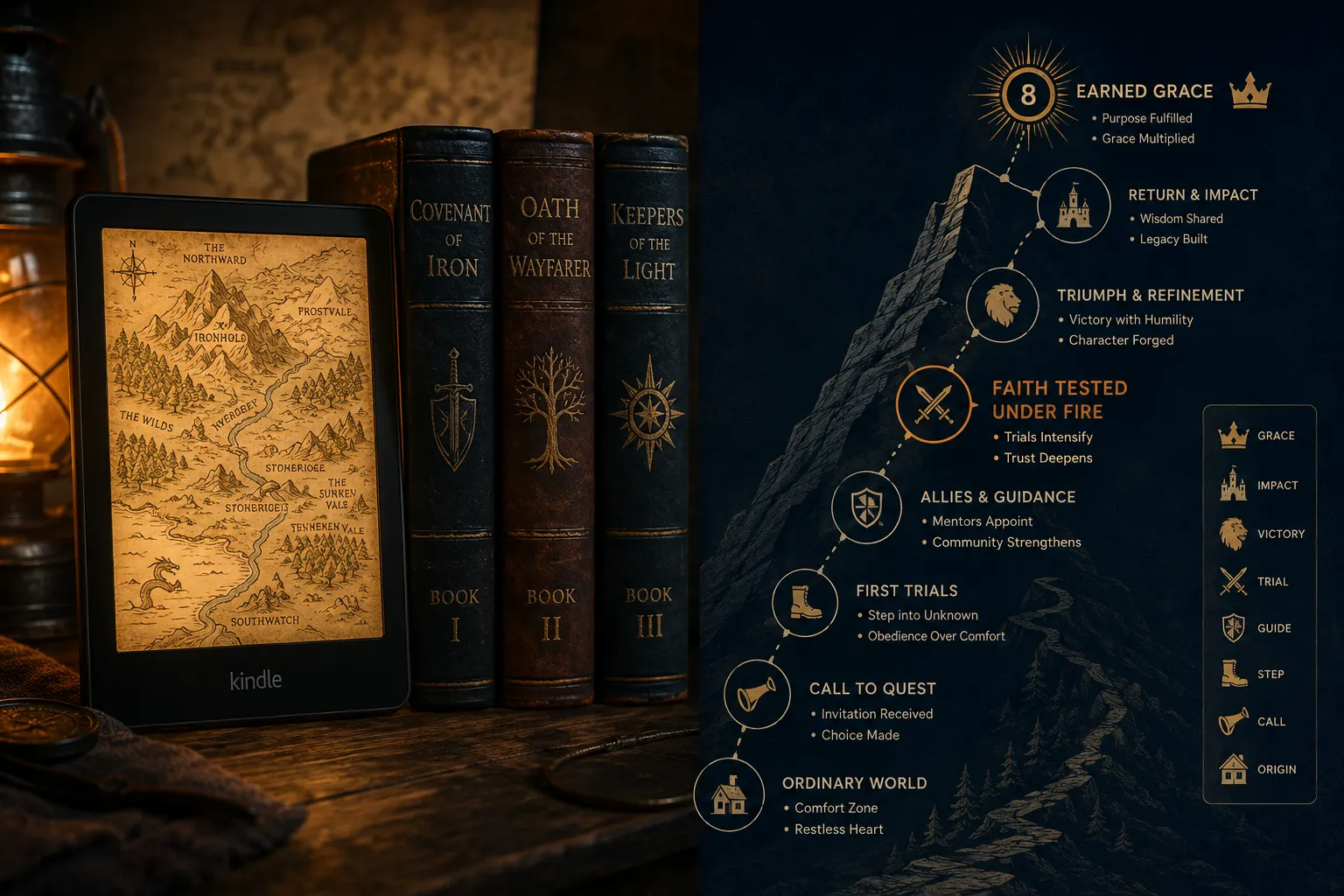
Fantasy with biblical themes but no preachiness works when the theological architecture is structural, when the world’s design reflects the spiritual question without a character ever needing to name it.
What “biblical themes without preachiness” looks like:
- Covenant and betrayal as world-building foundations (not as sermon topics)
- Redemption arcs that require real cost, not just repentance
- Mercy and justice in genuine conflict, with no easy resolution
- The silence of God as a plot condition, not a theological problem to be solved mid-chapter
Where to find KU Christian fantasy recommendations in 2026:
- Realm Makers award finalists, published annually, reliably clean and faith-forward [5]
- YouTube channels dedicated to Christian and clean fiction releases, active through mid-2026 [22]
- Amazon’s Christian Fantasy category, browse new releases filtered by KU availability
- Silas Bellhaven’s catalog, The Sarel Chronicles and The Kethara Chronicles are both KU-available and built on adventure-first, romance-absent faith arcs
- The Realm Makers Expo (launched July 2025, 500+ attendees) specifically connects faith-based speculative authors with readers, creating a growing discoverability pipeline for non-romance titles [14]
Conclusion: Where to Start
The market for non-romance Christian epic fantasy for Kindle Unlimited readers who want adventure and faith, not spicy subplots is real, growing, and better-served in 2026 than it was even two years ago. The Realm Makers community is expanding. New apocalyptic and covenant-based titles are entering KU. And authors building romance-absent, faith-forward catalogs are making it easier to find exactly what this reader has been looking for.
Actionable next steps:
- Start with a series opener. The Map of Unanswered Prayers (Sarel Chronicles, Book 1) or The Stone That Remembered (Kethara Chronicles, Book 1) are both strong entry points, KU-available, adventure-driven, and built on faith that costs something.
- Browse the Realm Awards finalists list for additional vetted Christian speculative titles. [5]
- Follow Christian and clean fiction YouTube channels for new KU releases flagged by content level. [22]
- Check Silas Bellhaven’s full catalog at Amazon, every series maintains a clean content standard, and the fantasy titles specifically carry romance-absent arcs.
Faith under fire, mercy and justice in real tension, hope in the dark, that’s what this genre does when it’s working. The books exist. The subscription covers them. The only step left is the first page.
FAQ
What is non-romance Christian epic fantasy? It’s secondary-world or speculative fantasy where faith is structurally central and the plot’s primary engine is quest, covenant, or spiritual conflict, not a romantic relationship arc. Clean content is standard.
Is Christian epic fantasy available on Kindle Unlimited? Yes. Multiple series are KU-available, including Silas Bellhaven’s Sarel Chronicles and Kethara Chronicles, as well as newer apocalyptic titles like The War Against The End of Days (2026).
Do I have to be Christian to enjoy Christian epic fantasy? No. Readers drawn to moral weight, real consequence, and hope that costs something will find the genre compelling regardless of personal belief. The best titles don’t lecture, they build worlds where faith is structural.
How is Christian epic fantasy different from romantasy? Romantasy centers a romantic relationship as the primary plot driver. Christian epic fantasy centers spiritual stakes, quest, and covenant. Some Christian fantasy includes romance as a secondary element; non-romance Christian epic fantasy removes it from the engine entirely.
What’s the best Christian epic fantasy series for KU readers new to the genre? The Sarel Chronicles by Silas Bellhaven is a strong starting point, adventure-driven, faith-forward, romance-absent, and KU-available. Begin with The Map of Unanswered Prayers.
How do I filter for clean fantasy on Amazon? Browse the “Christian Fantasy” category on Amazon and filter by Kindle Unlimited availability. Authors with consistent Christian fiction catalogs maintain clean content standards across all titles.
What makes Christian fantasy feel preachy, and how do I avoid it? Preachiness happens when a character explains theology rather than living it. Look for books where faith shows up through choice and consequence, not through dialogue that exists to deliver a doctrinal point.
Are there Christian fantasy awards I can use to find quality titles? Yes. The Realm Awards (Realm Makers) recognize Christian speculative fiction annually. The 2024 finalists list is publicly available and a reliable source for vetted, faith-forward titles. [5]
Is Christian epic fantasy only for women? The core KU audience for this subgenre skews toward women 35-65, but the genre’s adventure-first titles, particularly those with masculine leads or quest-driven plots, have broad appeal. The Mercy Line western series by Silas Bellhaven, for example, carries masculine-only leads with a romance-absent contract.
Where is the Christian speculative fiction community most active? Realm Makers is the primary professional hub, drawing nearly 350 in-person writers at its 2026 conference in St. Louis, plus online participants. [6] The Expo arm (launched 2025) specifically connects authors with readers. [14]
References
[1] Strong Attendance At 2024 Realm Makers Conference – https://www.publishersweekly.com/pw/by-topic/industry-news/religion/article/95664-strong-attendance-at-2024-realm-makers-conference.html
[3] Evangelical Fantasy Christian Speculative Fiction Growth – https://www.christianitytoday.com/2025/01/evangelical-fantasy-christian-speculative-fiction-growth/
[5] 2024 Realm Awards Finalists – https://www.realmmakers.com/2024/05/14/2024-realm-awards-finalists/
[6] Christian Speculative Authors Gather For Craft Community Cosplay – https://www.publishersweekly.com/pw/by-topic/industry-news/religion/article/100746-christian-speculative-authors-gather-for-craft-community-cosplay.html