
Last updated: August 27, 2026
Quick Answer: The 2026 Christian fantasy boom marks a genuine shift in faith-based fiction, away from Narnia-style allegory and toward original epic worlds where faith is load-bearing, not decorative. New series are reaching readers well beyond the traditional Christian market because they treat belief as something characters live through, not something authors lecture about. The growth is measurable, the catalog is expanding fast, and the best of it works for secular fantasy readers too.
Key Takeaways
- Christian fantasy entries in major award categories grew 38% between 2018 and 2023, and 2026 is tracking higher [5]
- The 2026 Realm Makers conference (St. Louis, June 24-27) established speculative fiction as a formal track, signaling institutional recognition of the genre’s momentum
- “Hopepunk” positioning is driving mainstream crossover, faith-rooted stories that offer genuine hope without sanitizing the hard parts
- The biggest commercial breakthrough is happening in adult epic fantasy and LitRPG, not just YA
- Indie publishing is outpacing traditional houses in Christian fantasy output and experimentation [5]
- The most successful series avoid allegory and build original covenant worlds where faith is structural, not symbolic
- Clean Christian fantasy is finding secular audiences because the storytelling quality has risen, not because the faith content has been softened
- Authors like Silas Bellhaven (The Sarel Chronicles, The Kethara Chronicles) represent the new model: original secondary worlds, earned grace, no sermons
What Is Christian Fantasy and How Is It Different from Regular Fantasy
Christian fantasy is speculative fiction in which faith, specifically a theistic, usually Christ-influenced worldview, shapes the world’s logic, the characters’ moral choices, and the story’s resolution. It differs from secular fantasy not by avoiding darkness but by answering it differently: grace shows up, but it costs something first.
The key distinction isn’t content restrictions. It’s that the spiritual dimension of the world is real and active, not metaphorical backdrop. A character’s prayer matters to the plot. Covenant, mercy, and justice aren’t just themes, they’re structural forces in the story’s world.
What separates it from “inspirational” fiction:
- Inspirational fiction often features faith as personal comfort; Christian fantasy builds faith into the world’s architecture
- The conflict is external and cosmological, not just internal and emotional
- Secondary worlds (not just our world with Christian characters) are common and growing
Christian Fantasy vs. Narnia Retellings, What’s the Difference
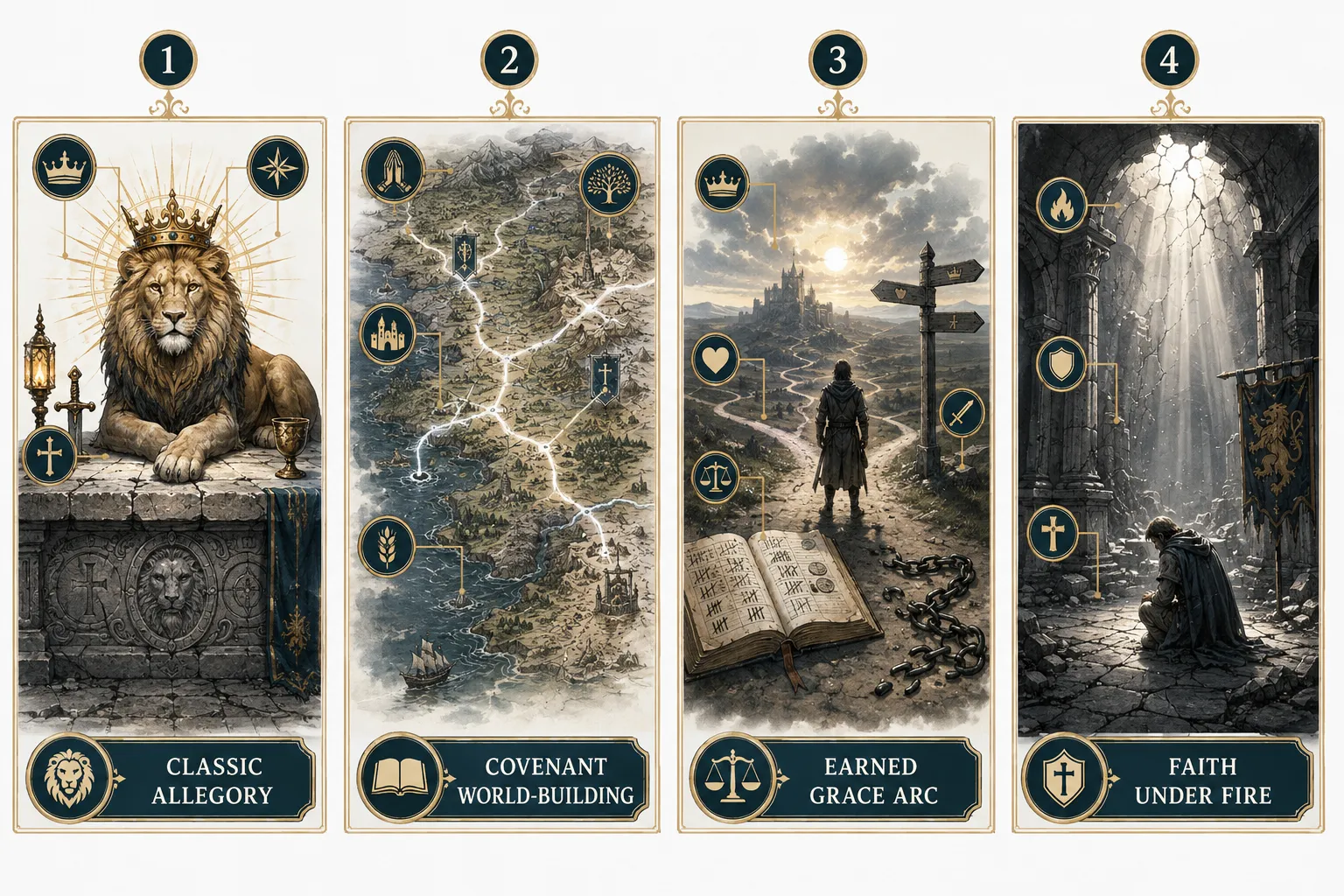
Narnia retellings map Christian theology onto recognizable symbols, a lion who dies and rises, a white witch who represents evil, children who stand in for humanity. The allegory is the point. New-wave Christian fantasy builds original theological worlds where the faith logic is embedded in the world’s rules, not decoded from symbols.
The 2026 Christian fantasy boom is specifically about this departure. Readers and authors are tired of “spot the allegory”, they want worlds where covenant, sacrifice, and mercy are as concrete as gravity.
The practical difference:
| Narnia-Style Allegory | New-Wave Christian Fantasy |
|---|---|
| Recognizable Christ-figure | Original deity/covenant structure |
| Symbolic evil (White Witch) | Morally complex antagonists with real motives |
| Children as protagonists | Adult leads with adult stakes |
| Allegory decoded by reader | Faith embedded in world-logic |
| Single-novel or short series | Multi-book epic series with earned arcs |
Series like The Sarel Chronicles (Silas Bellhaven), where silver roads mark answered prayers and a disgraced map-scribe discovers what the official record has been hiding, are built on original covenant theology, not Narnian mapping. The faith isn’t a code. It’s the world.
Why Are Faith-Based Fantasy Books Becoming More Popular in 2026
Three forces are converging in 2026. First, the broader fantasy market has been hungry for stories with moral weight, not grimdark nihilism, not sanitized escapism, but what some marketers are calling “hopepunk”: hard situations, genuine hope, earned outcomes. Christian fantasy fits that space naturally [5].
Second, Kindle Unlimited and indie publishing have removed the gatekeeping that once kept Christian fantasy in a narrow lane. Authors can build original worlds without a traditional publisher deciding whether the faith content is “too much” or “not enough” [5].
Third, the Realm Makers conference ecosystem, now with a fan-facing Expo (June 26-27, 2026) alongside the author conference, has created a visible community hub that signals the genre’s maturity. When speculative fiction gets its own formal track at a major Christian fiction conference, that’s not a trend. That’s infrastructure.
“Speculative and epic fantasy is having a really nice, long moment.”, Scott Minor, Realm Makers
Christy Award speculative entries were up 38% between 2018 and 2023 [5], and 2026 recommendation lists show the category expanding further, with readers actively seeking series that aren’t just repackaged Narnia [1].
Best Christian Fantasy Books and Series Coming Out in 2026
The 2026 Christian fantasy boom is most visible in series-format epic fantasy and covenant world-building. Readers searching for what’s new are finding a genuine range, not a single style.
Series worth knowing in 2026:
- The Kethara Chronicles (Silas Bellhaven), Covenant fantasy set in the highlands of Marat-Sol, where an empire wants every act of mercy counted and contained. The Stone That Remembered, The Cord That Loosened, and The Name That Returned form a complete trilogy. Browse the series
- The Sarel Chronicles (Silas Bellhaven), Epic fantasy built around a map of answered prayers and one scribe who finds the unanswered ones. The trilogy (The Map of Unanswered Prayers, The Roads That Lied, Beyond the Maker’s Map) is complete and available now. Browse the series
- The Measured Debt (Silas Bellhaven), Christian LitRPG with genuine earned-progression mechanics and a protagonist whose record keeps clearing until it doesn’t. Browse the series
Goodreads’ most-anticipated Christian fiction lists for 2026 show speculative and fantasy titles claiming more slots than in any previous year [1], and bestseller tracking confirms the category is outperforming historical baselines [2][6].
Christian Fantasy Authors Breaking Through the Mainstream
The mainstream breakthrough in 2026 isn’t coming from a single breakout author, it’s coming from a structural shift. Indie Christian fantasy authors are building multi-series catalogs under a single brand identity, and readers are following the brand across genres the way C.S. Lewis readers followed him from Narnia into the Space Trilogy and Mere Christianity.
What the breakout authors have in common:
- Original secondary worlds (not Earth with angels)
- Multi-book series with genuine arc progression
- Adult protagonists with adult moral weight
- Faith that shows up in character choice, not narration
- Clean content that doesn’t feel like a disclaimer, it’s just the tone
The Silas Bellhaven catalog is a working example of this model: Christian western, cozy mystery, epic fantasy, psychological thriller, and LitRPG under one identity, held together by the promise that faith gets handled with intelligence and honesty. Readers who find one series follow the brand into the others [7].
How Do You Write Christian Fantasy Without Being Preachy
The answer is structural, not stylistic. Preachiness happens when faith is delivered as information, a character explains what they believe, or the narrator signals the moral. Non-preachy Christian fantasy shows faith through consequence: what a character chooses when it costs them, what mercy looks like when it arrives late, what prayer does when the answer isn’t what was asked for.
The practical rules:
- Show faith through choice, not speech. A character who prays before a dangerous decision and then lives with the outcome is more convincing than one who quotes scripture at the villain.
- Let grace arrive after cost. Cheap grace, forgiveness that doesn’t require anything, reads as wish fulfillment. Earned grace reads as theology.
- Trust the world’s logic. If your covenant world is built correctly, the faith content is implicit in how the world works. You don’t need to explain it.
- Let doubt stay unresolved. Characters who wrestle with faith and don’t get clean answers feel true. Characters who convert dramatically in chapter twelve feel like a sermon’s illustration.
The brand phrase “walking with them, not talking at them” captures the whole principle. The story walks alongside the reader’s own questions. It doesn’t hand them answers.
Where to Find Christian Fantasy Books That Aren’t Just Narnia Copies
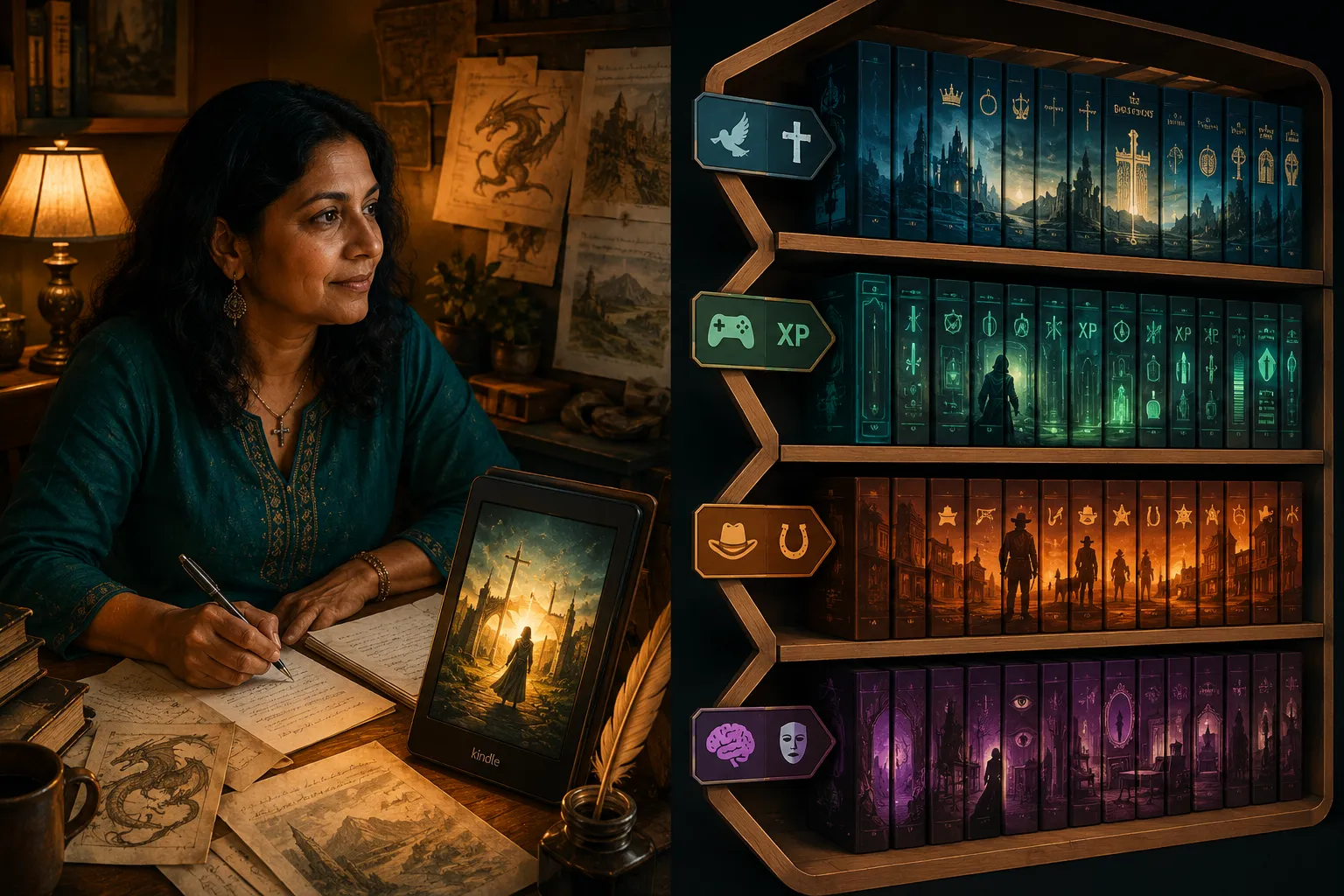
The best places to find original Christian fantasy in 2026 are Kindle Unlimited, the Realm Makers community, and curated recommendation lists that specifically filter for secondary-world and covenant fantasy, not just “Christian fiction with fantasy elements.”
Practical starting points:
- Amazon’s Christian Fantasy category, filter by series length and look for multi-book epic series with original world names in the description
- Goodreads’ Most Anticipated Christian Fiction 2026 list [1], the speculative section is the fastest-growing segment
- Realm Makers Expo (June 26-27, 2026), fan-facing event specifically for Christian speculative fiction readers
- Cherry Picks Reviews [8], curated Christian fantasy reviews with quality filtering
- Silas Bellhaven’s catalog, The Sarel Chronicles and The Kethara Chronicles are both complete trilogies, original worlds, no allegory decoding required
Choose based on what you want:
- For covenant world-building: The Kethara Chronicles
- For map-and-prophecy epic fantasy: The Sarel Chronicles
- For progression fantasy with faith stakes: The Measured Debt (LitRPG)
Christian Fantasy for Adults vs. Young Adult, Which Is Growing Faster
Adult Christian fantasy is growing faster in 2026. YA Christian fantasy has historically dominated the category because of the Narnia legacy, children’s and young adult allegory was the established template. But the current wave is explicitly adult in its stakes, its moral complexity, and its target reader [5].
Market analysis points to a scarcity of quality YA Christian fantasy as an opportunity, but the commercial momentum right now is in adult epic series with Kindle Unlimited distribution [5]. Women 35-65 are the primary audience, and they want stories with real weight, not sanitized coming-of-age allegory.
The adult shift also explains why the best new series feature adult protagonists navigating institutional corruption, covenant betrayal, and the cost of mercy, not children discovering magical worlds.
Common Mistakes in Christian Fantasy Storytelling
The mistakes that sink Christian fantasy are almost always the same ones, and they’re all variations of the same error: treating faith as content to be delivered rather than reality to be lived.
The most common failures:
- The conversion climax. A dramatic salvation moment at the story’s peak feels like the story was always just a vehicle for that moment. It collapses the narrative into a tract.
- The villain who exists to be wrong about God. Antagonists who are purely ideological, straw atheists or evil pagans, aren’t characters. They’re arguments.
- Grace without cost. When forgiveness arrives without the character having genuinely lost something, it reads as cheap and false. Redemption that costs something is the whole point.
- Scripture-dropping. Quoting scripture in dialogue or narration as a way to signal the book’s faith content is the written equivalent of a sermon illustration. It stops the story.
- World-building that’s just Earth plus angels. Original covenant worlds require their own theological logic. Borrowing Earth’s Christianity wholesale into a secondary world usually produces inconsistency.
The Silas Bellhaven catalog’s recurring throughline, what a record proves versus what it actually means, and what it costs to tell the truth once you’re holding it, is a structural answer to these mistakes. The faith question is built into the world’s architecture, not delivered in dialogue.
Is Christian Fantasy Only for Religious Readers
No, and the 2026 Christian fantasy boom is partly defined by secular readers discovering it. The reason is simple: the best Christian fantasy is good fantasy first. Original worlds, genuine stakes, morally complex characters, earned resolutions. The faith content doesn’t require belief to engage with, it requires the same thing all good fantasy requires: a reader willing to accept the world’s rules.
What secular readers often find is that Christian fantasy’s insistence on moral consequence, that choices matter, that mercy is real, that justice and grace are both necessary, produces better stories than nihilistic grimdark or consequence-free escapism.
Christian fantasy works for secular readers when:
- The faith is structural (world-logic) rather than instructional (character speeches)
- The protagonist doubts, fails, and earns their arc
- The story doesn’t require agreement with the theology to follow the stakes
- The writing quality stands on its own
The hopepunk positioning in 2026 marketing is explicitly targeting this crossover, faith-rooted hope as a genre feature, not a religious disclaimer [5].
How Publishers Are Marketing Christian Fantasy in 2026, and What’s Actually Working
Traditional Christian publishers are retrenching on speculative fiction, which has opened the lane for indie authors [5]. The marketing that’s working in 2026 is brand-based rather than book-based: readers follow an author identity across series because the brand promise (how faith gets handled) transfers across genres.
What’s working:
- Kindle Unlimited placement for series discovery, readers sample book one free and buy through the series
- “Hopepunk” and “clean epic fantasy” positioning in metadata and cover copy, these terms are finding secular fantasy readers who want moral weight without grimdark
- Series-first catalog building, a complete trilogy is more marketable than a single novel
- Community events like Realm Makers Expo creating word-of-mouth within the Christian speculative readership
What isn’t working:
- Leading with “Christian” as a genre label in cover copy, it signals to secular readers and sometimes undersells the story quality
- Single-book releases without a series commitment, the category rewards binge readers
- Allegory-forward marketing, “the next Narnia” positions a book as derivative before a reader opens it [7]
What Makes a Christian Fantasy Book Commercially Successful
Commercial success in Christian fantasy in 2026 comes from three things working together: series depth, faith that earns its place, and a reader promise that’s clear without being limiting.
The success factors:
- Complete or ongoing series, readers in this category are loyal and binge-read; a trilogy or longer series dramatically outperforms standalone novels
- Original world with its own covenant logic, not allegory, not Earth-plus-magic, but a world where the faith content is structural
- Adult protagonists with real stakes, the fastest-growing audience is women 35-65 on Kindle Unlimited, and they want moral weight
- Earned grace as the story’s engine, not cheap resolution, but redemption that arrives after genuine cost
- Clean content that’s obvious from tone, not from disclaimers, the writing quality signals the content contract before any label does
The Christy Award data (38% growth in speculative entries, 2018-2023) [5] and 2026 bestseller tracking [6][7] both confirm that series meeting these criteria are outperforming the category average significantly.
Frequently Asked Questions
What is the 2026 Christian fantasy boom? It’s the measurable surge in original, adult-oriented Christian epic fantasy, series built on covenant world-building rather than Narnia-style allegory, driven by indie publishing, Kindle Unlimited, and a reader base hungry for faith-rooted stories with genuine stakes.
Is Christian fantasy the same as Narnia retellings? No. Narnia-style allegory maps Christian theology onto recognizable symbols. New-wave Christian fantasy builds original secondary worlds where faith is structural, embedded in the world’s logic, not decoded from symbols.
Who reads Christian fantasy? The primary audience is women 35-65 on Kindle Unlimited, but the genre is crossing over to secular fantasy readers who want moral weight, earned resolutions, and hopeful outcomes without nihilism.
What makes Christian fantasy “clean”? Clean Christian fantasy avoids graphic violence, explicit sexual content, and profanity, but “clean” shouldn’t mean safe or conflict-free. The best of it handles hard things honestly; it just doesn’t use shock value as a substitute for stakes.
Where do I start with the Silas Bellhaven Christian fantasy catalog? The Map of Unanswered Prayers (Book 1 of The Sarel Chronicles) or The Stone That Remembered (Book 1 of The Kethara Chronicles) are both complete series entry points. Both are available on Kindle Unlimited.
Can secular readers enjoy Christian fantasy? Yes, when the faith is world-logic rather than instruction, secular readers engage with it the same way they engage with any secondary-world mythology. The story doesn’t require theological agreement, only willingness to accept the world’s rules.
What is “earned grace” in Christian fiction? Earned grace means redemption arrives after genuine cost, a character loses something real before mercy appears. It’s the opposite of cheap grace, where forgiveness comes without consequence. Earned grace produces better stories and more honest theology.
What is Realm Makers? Realm Makers is the primary conference for Christian speculative fiction authors and readers. The 2026 event (St. Louis, June 24-27) added a fan-facing Expo (June 26-27), signaling the genre’s growth into a full community ecosystem.
Is Christian LitRPG a real subgenre? Yes, and it’s growing. Christian LitRPG applies the progression-fantasy structure (leveling, systems, earned advancement) to faith stakes, the question isn’t just “how does the character get stronger” but “what does the cost of being chosen actually mean.” The Measured Debt series (Silas Bellhaven) is a working example.
Why are traditional publishers retrenching on Christian fantasy? Traditional Christian publishers have historically been cautious about speculative fiction’s commercial risk. As indie authors have demonstrated the category’s viability through Kindle Unlimited, the gap between traditional and indie output has widened, to indie’s advantage [5].
Conclusion
The 2026 Christian fantasy boom isn’t a marketing moment. It’s a structural shift in what faith-rooted fiction can be and who it’s for. The readers driving it aren’t looking for the next Narnia. They’re looking for original worlds where the hard questions get asked honestly, where grace shows up after cost, and where faith is woven into the story’s architecture rather than delivered in its dialogue.
Actionable next steps:
- If you’re a reader: Start with a complete series, The Sarel Chronicles or The Kethara Chronicles are both finished trilogies available on Kindle Unlimited. Browse the full Silas Bellhaven catalog at Amazon.
- If you’re an author: Build the faith into the world’s logic first, then write the characters. Allegory is a shortcut that costs you half your potential audience.
- If you’re a reader new to the genre: Try a series that leads with a specific world premise, a map of answered prayers, a covenant the empire wants to own, rather than one marketed as “the next Narnia.” The premise tells you whether the faith is structural or decorative.
The best Christian fantasy being written right now isn’t walking away from faith. It’s walking with readers through it, honestly, without shortcuts, and without looking away from the dark before the light arrives.
References
[1] Most Anticipated Christian Fiction 2026 – https://www.goodreads.com/list/show/225610.Most_Anticipated_Christian_Fiction_2026
[2] Fiction (Christian Book Expo January 2026) – https://christianbookexpo.com/bestseller/fiction.php?id=0126
[5] The Rise Of Christian Fiction Market Trends Regional Dynamics And Future Predictions For 2026 – https://www.alibaba.com/product-insights/the-rise-of-christian-fiction-market-trends-regional-dynamics-and-future-predictions-for-2026.html
[6] Fiction (Christian Book Expo June 2026) – https://christianbookexpo.com/bestseller/fiction.php?id=0625
[7] Top 10 Best Selling Christian Fiction Books In 2026 Market Insights Trends – https://www.alibaba.com/product-insights/top-10-best-selling-christian-fiction-books-in-2026-market-insights-trends.html
[8] Christian Fantasy – https://www.cherrypicksreviews.com/christian-fantasy