Last updated: August 28, 2026
Quick Answer: Faith-rooted character development in Christian fiction means building a character whose belief is tested, doubted, and proven through the choices they make inside the plot, not explained through narration or scripture-dropping. Authentic spiritual arcs feel earned because the character pays a real cost before grace arrives. The goal is fiction that walks with readers, not talks at them.
Key Takeaways
- A spiritual arc is not a conversion scene, it’s a slow, costly reorientation of what a character believes is true about God, themselves, and others
- Preachiness happens when the author explains faith rather than dramatizing it through choice and consequence
- Christian fiction readers want flawed characters whose doubt is real, not sanitized
- Faith under fire looks different in a cozy mystery than in an epic fantasy, but the craft principles are the same across genres
- Earned grace requires that something be genuinely at stake before mercy arrives
- Non-Christian readers can engage deeply with faith-rooted arcs when the human stakes are specific and honest
- The difference between Christian fiction and inspirational fiction is largely one of how central and explicit the faith framework is
- Dual-timeline structures and layered plot architecture are increasingly popular tools for embedding spiritual meaning without direct teaching [1]
- Religion book sales reached $926 million in 2025, confirming a large, sophisticated audience that rewards strong storytelling [2]
- The single most common craft mistake is giving characters a “perfect Christian” baseline rather than a genuine misbelief that the story must break open
What Does a Spiritual Arc Mean in Fiction?
A spiritual arc tracks how a character’s relationship with God, or with the possibility of God, changes across the story. It is not a subplot. It is the load-bearing structure beneath every major decision the character makes.
Unlike a standard character arc, which might move a character from fear to courage or from isolation to belonging, a spiritual arc specifically concerns what the character believes is true about grace, justice, forgiveness, or the nature of the divine. That belief gets tested. It often breaks. What grows back is something harder and more honest than what was there before.
Key distinction: A spiritual arc is not the same as a character becoming more religious. A character can end a story with more questions than answers and still have completed a genuine spiritual arc, because the questions themselves are now honest.
How to Write Christian Characters That Feel Real, Not Preachy
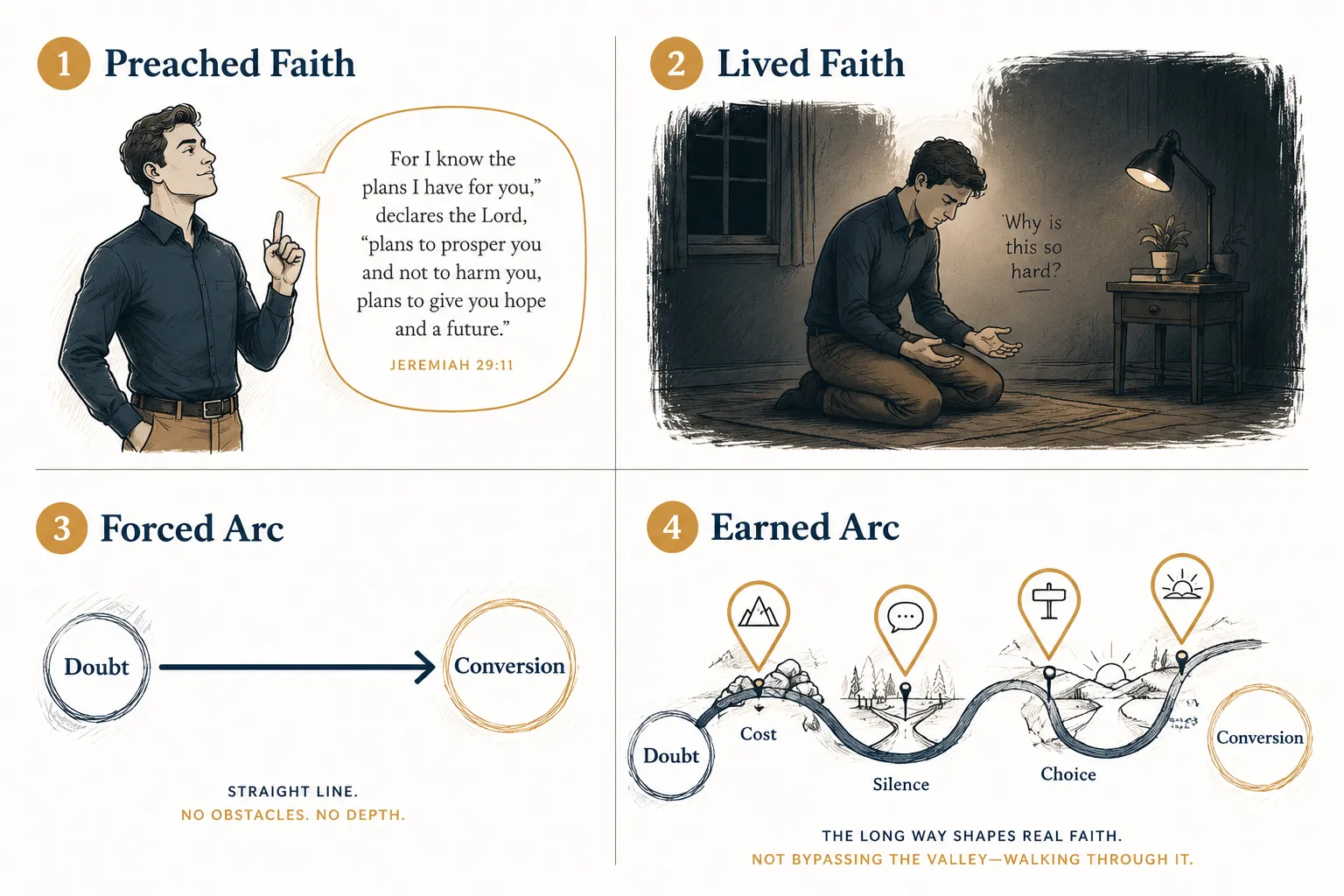
The fastest path to a preachy character is making faith their answer rather than their question. Real Christian characters in fiction carry a misbelief about God, something they’ve gotten wrong, something the plot will force them to confront.
Practical craft rules for keeping faith authentic:
- Show the prayer, not just the answer. A character who prays and immediately receives clarity is less believable than one who prays into silence and has to act anyway.
- Let doubt be specific. “She wasn’t sure God was listening” is vague. “She hadn’t opened her Bible since the funeral” is a story.
- Faith shows up in decisions, not dialogue. When a marshal in a frontier western refuses to falsify a record even though it costs him his job, that’s a faith statement. He doesn’t need to say so.
- Avoid the conversion-scene shortcut. A single dramatic moment of surrender can work, but only if the ground has been laid across many scenes of smaller, quieter choices.
“Walking with them, not talking at them”, that’s the whole contract. The reader should feel accompanied by the character’s faith, not instructed by it.
What’s the Difference Between Christian Fiction and Inspirational Fiction?
Christian fiction places the God of Scripture at the center of the story’s moral and spiritual architecture. Inspirational fiction draws on broadly spiritual themes, hope, redemption, inner strength, without anchoring them to a specific theological framework.
The practical difference for readers: Christian fiction assumes God is real and active inside the story’s world. Inspirational fiction leaves that question open. Both can be clean, both can be emotionally resonant, but they make different promises to different readers.
Choose Christian fiction if: your character’s growth is specifically shaped by prayer, Scripture, community of faith, repentance, or the particular tension between grace and justice that comes from a biblical worldview.
Choose inspirational fiction if: you want spiritual themes to be present but not load-bearing, where a character might find peace or purpose without that being explicitly tied to faith in Christ.
Common Mistakes Writers Make With Faith-Based Character Development
Most craft failures in Christian fiction come from one of four patterns:
| Mistake | What It Looks Like | Why It Fails |
|---|---|---|
| The Perfect Christian | Character has no real doubt, models correct behavior throughout | No arc, no tension, no recognition for the reader |
| The Scripture Drop | Character quotes a verse that resolves the scene’s conflict | Faith becomes a plot device, not a lived reality |
| Cheap Grace | Character sins, feels bad briefly, is immediately restored | Redemption that costs nothing means nothing |
| The Tacked-On Moral | Final chapter explains what the story meant | Treats the reader as someone who missed the point |
A May 2026 guide on authentic faith-based storytelling argues that the most effective Christian fiction is built from a character’s misbelief about God being challenged and replaced by truth, and that this process must be visible through narrative action, not explanation [4]. That’s the standard worth holding.
How Much Theology Should Be in Christian Novels?
Enough to make the faith stakes clear, no more. Theology in fiction works best when it’s embedded in the specific problem the character is facing, not delivered as background information.
A character wrestling with whether God can forgive a specific, named sin is doing theology. A character who pauses to reflect on the doctrine of grace in general is doing a devotional. Fiction needs the first; the second stops the story.
Practical test: If a passage of your novel could be lifted out and published as a devotional thought for the day without losing anything, it’s probably doing too much explaining and not enough dramatizing.
What Makes a Spiritual Arc Feel Earned Rather Than Forced?
An earned arc requires three things: a real cost, a genuine choice, and a consequence that follows from that choice. Forced arcs skip the cost.
In The False Warrant from The Mercy Line, Caleb’s spiritual question isn’t abstract, it’s whether obedience to a lawful-looking document can substitute for obedience to conscience. The answer costs him something concrete. That’s what makes the resolution feel like grace rather than convenience.
Earned grace shows up after cost, not instead of it. When a character receives mercy, the reader should be able to point to the exact scene where that mercy became necessary, the moment the character ran out of their own resources and had to stop pretending they hadn’t.
How to Show Faith Struggle Without Being Heavy-Handed
Faith struggle becomes heavy-handed when the author signals it too loudly, when the prose keeps telling the reader that the character is struggling rather than letting the struggle show in behavior.
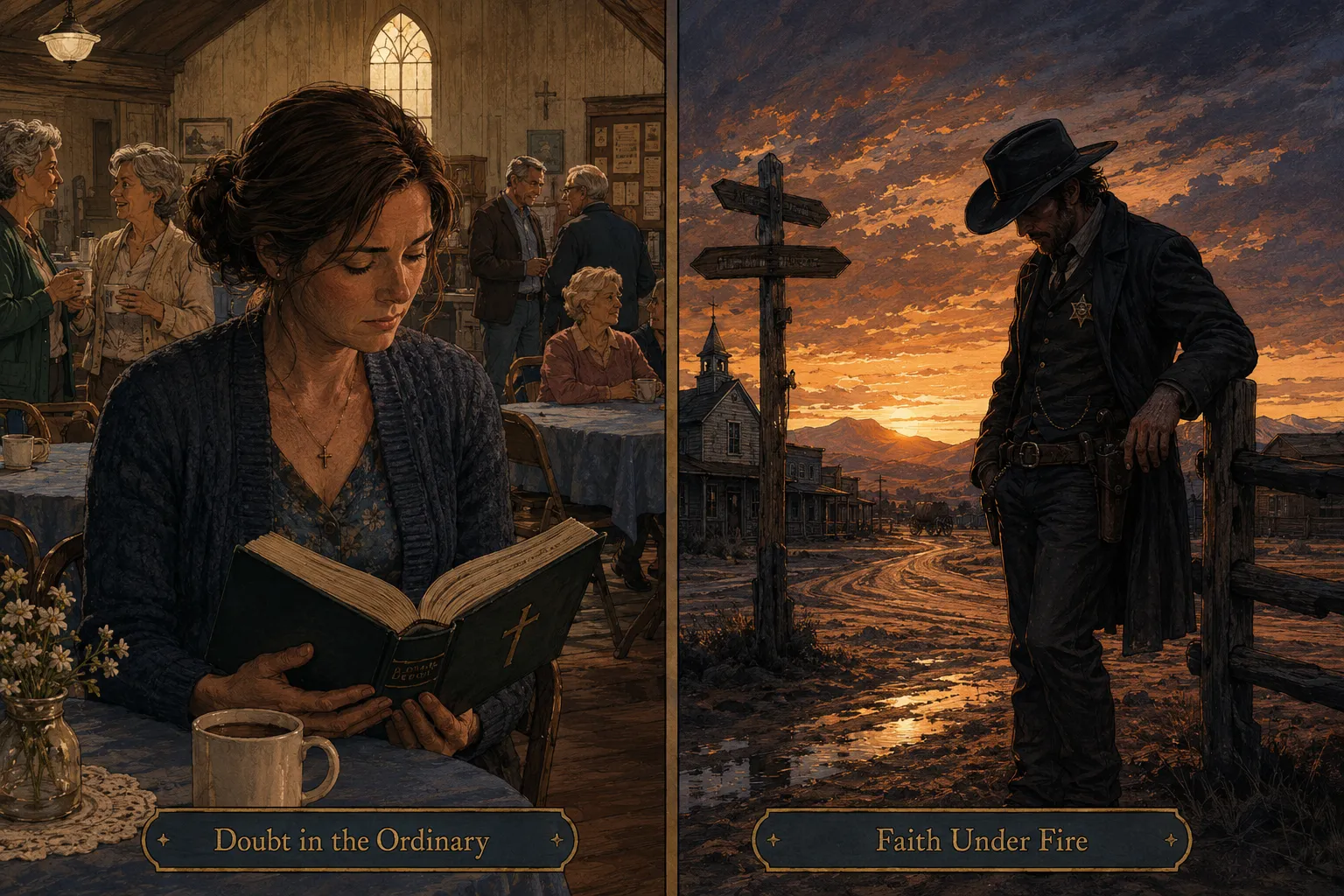
Techniques that work across genres:
- In cozy mystery: A character skips the Wednesday prayer meeting for the third week in a row. Nobody comments. The reader notices.
- In frontier western: A man who used to say grace before meals stops. The silence at the table does the work.
- In epic fantasy: A covenant-keeper who has always spoken the old words of blessing hesitates before a dying enemy. The hesitation is the story.
- In psychological thriller: A woman who transcribed a hundred testimonies can’t write down her own. The blank page is the spiritual crisis.
The rule is simple: behavior before narration. Show what the character does differently when their faith is under pressure. Trust the reader to understand what it means.
Can Non-Christian Readers Enjoy Faith-Rooted Character Arcs?
Yes, when the human stakes are specific, honest, and not contingent on the reader sharing the character’s beliefs. A reader who has never prayed in their life can recognize the experience of reaching the end of their own resources. That’s the universal register faith-rooted fiction can access.
What pushes secular readers away is not faith itself but the sense that the story is trying to persuade them of something. When a character’s faith is presented as one honest human response to an impossible situation, rather than as the correct answer the story is proving, non-Christian readers can follow that arc with genuine investment.
The Christian fiction market remains large and growing, with religion book sales reaching $926 million in 2025 [2], but the craft principles that make faith-rooted stories work for Christian readers are the same ones that make them accessible to skeptical readers: specificity, honesty, and cost.
How to Develop Doubt and Questioning in Faith-Based Characters
Doubt is not the opposite of faith in good Christian fiction, it’s the condition under which faith becomes real rather than assumed. A character who has never doubted has never actually chosen to believe.
Craft approach to writing doubt well:
- Give the doubt a specific trigger. Not “she lost her faith” but “she couldn’t reconcile what happened to her sister with the God she’d been taught to trust.”
- Let the doubt last. Doubt that resolves in a single scene isn’t doubt, it’s a speed bump. Real doubt reshapes how the character moves through the rest of the story.
- Resist the urge to answer it. The character’s doubt doesn’t need to be theologically resolved for the story to end well. Sometimes hope in the dark is the most honest ending available.
Should Christian Fiction Characters Always Have Happy Endings?
No. Christian fiction is not required to deliver a tidy resolution, it’s required to be honest about what faith costs and what it offers. Those are not always the same thing as happiness.
A character can lose something real, grieve honestly, and still end the story with their faith intact, or even deepened by the loss. That’s not a sad ending. That’s a true one. Comfort earned through honesty about hard things is more durable than comfort that comes from avoiding them.
The distinction worth holding: hope is not the same as happiness. Christian fiction can end in hope, in the dark, with questions unanswered, and still be doing exactly what faith-rooted storytelling is supposed to do.
Who Is the Audience for Faith-Rooted Character Development Stories?
The primary audience is Christian fiction readers, predominantly women between 35 and 65, who read on Kindle Unlimited and want clean, honest stories with real stakes [3]. They are not looking for devotionals dressed as novels. They want characters who actually doubt, serve, fail, repent, and find grace, on an ordinary Tuesday that suddenly isn’t ordinary anymore.
A secondary audience, and a growing one, is readers who identify as broadly spiritual or who grew up in faith communities and carry complicated feelings about them. These readers respond to fiction that treats faith as something genuinely difficult rather than something that makes life easier.
The Christian fiction market is seeing strong demand for dual-timeline novels and genre-diverse releases across suspense, romance, fantasy, and historical fiction [1], which signals that this audience is sophisticated and not easily satisfied by formula.
Techniques for Weaving Faith Into Plot Naturally
Faith integrates most cleanly when it drives plot decisions rather than commenting on them. Here are the most reliable techniques:
- The conscience line: Give the character a specific moral threshold they will not cross. When the plot forces them toward it, the spiritual stakes become visible without explanation. (The Mercy Line’s tagline, “Where law runs out, a man finds what he answers to”, is this principle in twelve words.)
- The record and the truth: What a character does with evidence, a letter, a ledger, a testimony, a prayer list, reveals their theology more clearly than any speech. Do they tell the truth when it costs them? Do they protect someone else’s record at the expense of their own?
- The community of faith as pressure, not comfort: Church communities in fiction work best when they create tension as well as belonging. A congregation that expects one thing from a character while the character knows something different is a spiritual conflict engine.
- Prayer as action, not pause: When a character prays in a scene, something should change, not necessarily the circumstances, but the character’s posture toward them.
Conclusion: Writing Faith That Earns Its Place on the Page
Faith-rooted character development in Christian fiction: authentic spiritual arcs without sermonizing is not a formula to apply, it’s a standard to hold. The standard is this: every moment of grace in the story should cost something, and the reader should be able to feel the weight of what was paid.
Actionable next steps for writers:
- Identify your character’s misbelief about God before you write chapter one. That misbelief is the real antagonist of the spiritual arc.
- Map the cost. For every moment of grace or resolution in your outline, ask: what does the character lose or surrender to get here? If the answer is nothing, the arc isn’t earned yet.
- Read your faith scenes aloud. If they sound like a devotional, rewrite them as behavior, a choice, a silence, an action that speaks without explaining itself.
- Trust your reader. The audience for clean Christian fiction is not fragile. They can hold complexity, sit with unanswered questions, and find hope in the dark without being told where to look.
- Let the genre carry the weight. Whether you’re writing a cozy mystery in Juniper Gap, a frontier western in Mercy Crossing, or a covenant fantasy in the highlands of Marat-Sol, the setting and the plot are the delivery mechanism for faith, not the other way around.
Stories rooted in faith don’t need to announce themselves. When the faith is real and the cost is real, the reader will feel it in the choices, and that’s exactly where it belongs.
FAQ
What is a spiritual arc in Christian fiction? A spiritual arc tracks how a character’s relationship with God changes across the story through real choices, costs, and consequences, not through narration or theological explanation.
How do you avoid being preachy in Christian fiction? Show faith through what characters do, not what they say. A character who acts on conscience under pressure demonstrates faith more powerfully than one who quotes Scripture to resolve a scene.
What is earned grace in storytelling? Earned grace means mercy arrives after a character has paid a genuine cost, lost something real, made a hard choice, or reached the end of their own resources. Grace that costs nothing carries no weight.
Can a Christian fiction character lose their faith and still have a good arc? Yes. A character can wrestle with doubt, lose certainty, and end the story in honest uncertainty while still completing a meaningful spiritual arc, because the wrestling itself is the story.
What’s the difference between Christian fiction and inspirational fiction? Christian fiction anchors its spiritual themes in a specific theological framework, God is real, active, and named. Inspirational fiction uses broadly spiritual themes without that anchor.
Should every Christian fiction novel include prayer scenes? Not necessarily. Prayer can appear as silence, hesitation, or a changed posture rather than a formal scene. What matters is that the character’s relationship with God is visible in behavior.
How do you write doubt without undermining the faith message? Give doubt a specific trigger, let it last across multiple scenes, and resist resolving it too quickly. Doubt that costs the character something and reshapes their choices is faith-building, not faith-undermining.
Can secular readers enjoy Christian fiction? Yes, when the human stakes are specific and honest, and when faith is presented as one genuine human response to an impossible situation rather than as the correct answer being proven.
What makes a conversion scene feel forced? A conversion scene feels forced when it arrives without sufficient preparation, when the character hasn’t accumulated enough scenes of smaller, quieter choices that made the larger surrender inevitable.
How much Scripture should appear in Christian fiction? Only as much as a real person in that situation would naturally carry. A verse that a character has held for years and returns to in crisis is authentic. A verse that appears to resolve a scene’s conflict is a shortcut.
References
[1] Top Selling Christian Fiction – https://www.accio.com/business/top-selling-christian-fiction
[2] Best Selling Christian Novels 2026 Data Driven Market Analysis Top Titles – https://www.alibaba.com/product-insights/best-selling-christian-novels-2026-data-driven-market-analysis-top-titles.html
[3] The Rise Of Christian Fiction Market Trends Regional Dynamics And Future Predictions For 2026 – https://www.alibaba.com/product-insights/the-rise-of-christian-fiction-market-trends-regional-dynamics-and-future-predictions-for-2026.html
[4] Marketersmedia 2026 4 17 Christshare Releases Report On Christian Reading Trends In 2026 – https://markets.financialcontent.com/lightport.lightport8/article/marketersmedia-2026-4-17-christshare-releases-report-on-christian-reading-trends-in-2026