
Last updated: August 28, 2026
Quick Answer: Clean Christian fiction and inspirational romance are related but distinct categories. Clean Christian fiction treats faith as load-bearing, it shapes plot, consequence, and character in every genre from mystery to western to fantasy. Inspirational romance centers a romantic arc and uses faith as emotional texture, often with a lighter spiritual touch. The difference isn’t about which is more devout; it’s about what the story is fundamentally about.
Key Takeaways
- Clean Christian fiction spans every genre and requires faith to be structurally present, not decorative.
- Inspirational romance is a subgenre of romance first; faith enriches the love story but rarely drives the plot mechanics.
- Both categories prohibit explicit sexual content, graphic violence, and profanity, but their content floors differ in intimacy and spiritual intensity.
- Inspirational romance readers expect a happily-ever-after (HEA) or happily-for-now (HFN); clean Christian fiction readers may accept ambiguous or bittersweet endings if the faith arc resolves honestly.
- A conversion story is common in inspirational romance but not required; in clean Christian fiction, faith is usually already present and tested, not newly acquired.
- Publishers now formally separate “Christian inspirational” imprints from “clean and wholesome” imprints, they serve overlapping but distinct audiences. [4]
- Kissing and mild physical affection are acceptable in both categories; anything beyond that crosses into territory most publishers in either lane decline.
- The fastest-growing reader segment in 2026 wants both, clean content and genuine spiritual depth, not one at the expense of the other. [2]
- Authors who mistake “clean” for “Christian” risk disappointing readers in both camps.
- Earned grace, faith tested and proven through plot, not announced through narration, is the hallmark of the strongest books in either category.
What’s the Difference Between Clean Christian Fiction and Inspirational Romance
Clean Christian fiction is a broad content category defined by what it excludes (graphic content) and what it includes (faith as a structural element). Inspirational romance is a specific genre defined by its story shape: a romantic arc that moves toward commitment, with spiritual themes woven through the emotional journey.
Think of it this way: every inspirational romance novel is clean Christian fiction (or at minimum clean fiction), but not every clean Christian fiction novel is an inspirational romance. A Christian psychological thriller, a faith-rooted frontier western, or a covenant fantasy can all qualify as clean Christian fiction without containing a romance plot at all.
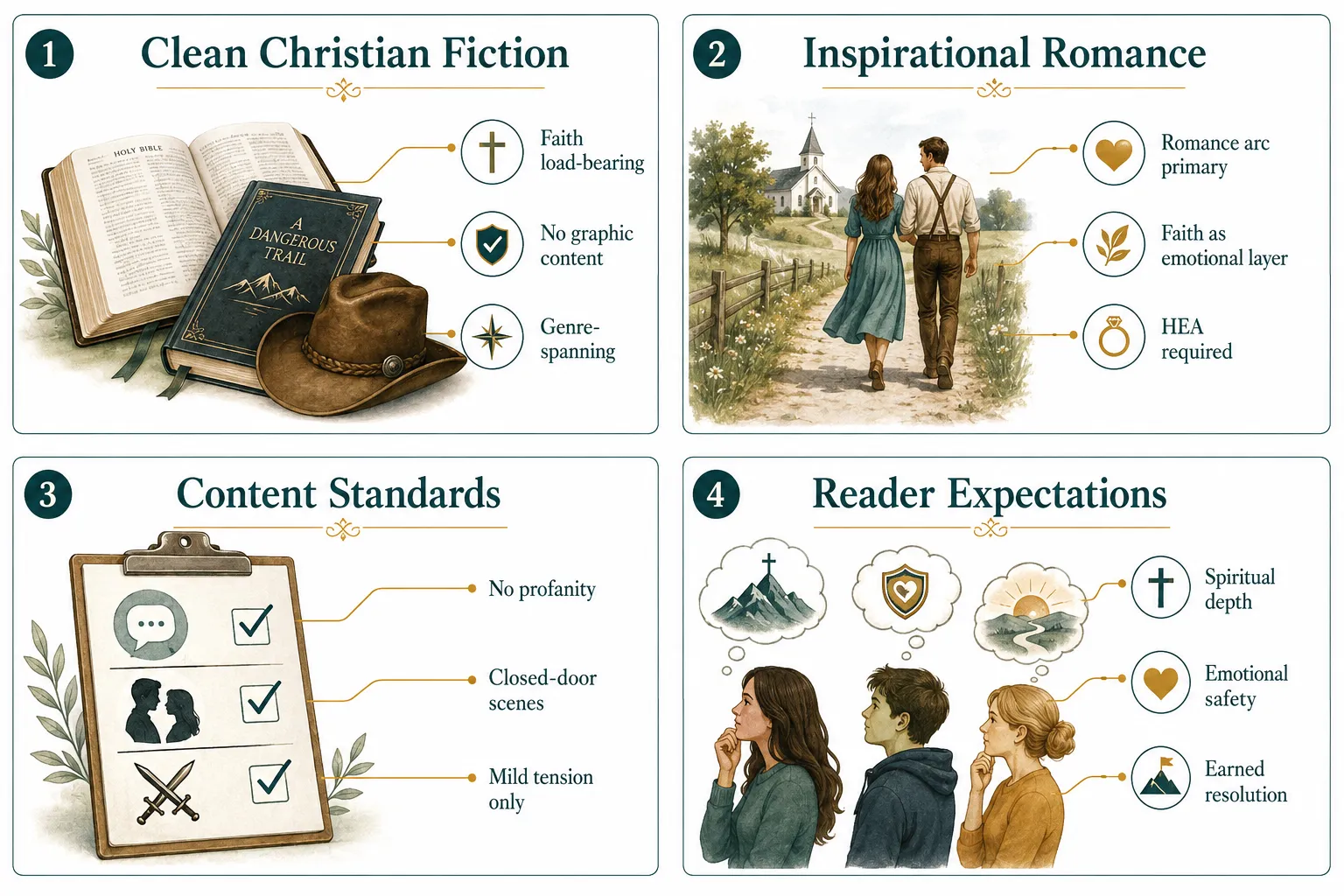
The structural distinction matters for readers choosing their next book:
- Clean Christian fiction, faith is load-bearing, present in every genre, shapes how characters make decisions and face consequences
- Inspirational romance, romance arc is primary, faith is the emotional and moral atmosphere the love story breathes in
- Clean secular fiction, no graphic content, no required faith element (a third category publishers now formally distinguish) [4]
“Walking with them, not talking at them”, the best books in either category let faith show up through what characters choose, not through what narrators announce.
How Much Faith Content Belongs in Inspirational Romance vs. Christian Fiction
Inspirational romance typically carries lighter spiritual freight than dedicated Christian fiction. Faith appears in how characters pray, how they wrestle with forgiveness, or how a shared belief becomes the ground on which love grows, but the story doesn’t stop to examine doctrine.
Clean Christian fiction, particularly in genres like psychological thriller or epic fantasy, often puts faith under direct pressure. The question isn’t whether characters believe; it’s whether belief holds when the cost gets real. That’s a different kind of spiritual weight, and readers who want it know the difference. [10]
A rough guide by genre:
| Category | Faith Role | Romance Role |
|---|---|---|
| Inspirational romance | Emotional/moral atmosphere | Primary plot engine |
| Christian cozy mystery | Structural, shapes community and conscience | Secondary or absent |
| Christian thriller/suspense | Under fire, tested by plot events | Minimal |
| Christian epic fantasy | Covenantal, world-building level | Variable |
| Christian western | Conscience line, mercy vs. law | Often absent |
Can Inspirational Romance Have Romance as the Main Plot, or Does Faith Have to Come First
Romance can absolutely be the main plot in inspirational romance, that’s what defines the genre. Faith doesn’t need to outweigh the love story; it needs to be genuinely present, not decorative. [7]
The practical test: if you removed every faith element from the book and the story still worked exactly the same way, it’s probably clean secular romance, not inspirational romance. In a true inspirational romance, faith shapes at least one pivotal choice, a character’s willingness to forgive, the decision to stay or leave, the moment they stop running from something they’ve been avoiding.
Common mistake: Authors sometimes add a church scene or a brief prayer and call it inspirational. Readers notice. The spiritual element needs to have consequence, it should cost something or change something, not just provide atmosphere.
What Content Is Not Allowed in Clean Christian Fiction Books
Both clean Christian fiction and inspirational romance share a core content floor:
- No explicit sexual content, physical intimacy stays behind closed doors; scenes end before they become graphic
- No profanity, mild expressions of frustration are sometimes acceptable depending on publisher guidelines, but strong language is out
- No graphic violence, conflict and danger are permitted; gore and torture-level detail are not
- No occult content presented approvingly, this applies especially in fantasy subgenres
Within those shared walls, clean Christian fiction sometimes allows more narrative tension and moral complexity than inspirational romance. A Christian psychological thriller can portray manipulation, gaslighting, and spiritual abuse as real and damaging, because confronting those things honestly is part of how the story earns its grace. [5]
The line isn’t about avoiding hard things. It’s about handling them without gratuitous detail.
Is Inspirational Romance the Same Thing as Christian Romance
They overlap significantly but aren’t identical. Christian romance implies an explicitly Christian faith framework, characters who identify as Christian, a faith tradition that’s recognizably Protestant or Catholic, and spiritual content aligned with mainline Christian belief. Inspirational romance is a slightly broader marketing term that can include faith-adjacent spirituality, though in practice most inspirational romance on the Christian market is Christian in orientation. [3]
Publishers now formally distinguish these lanes. Some imprints require “Christian or clearly redemptive content” aligned with mainline Christianity; others publish “clean and wholesome” fiction with strong moral compasses but no required Christian elements. [4] A reader who wants explicitly Christian content should look for “Christian romance” or “Christian inspirational” labels, not just “clean romance.”
How Do Readers Know If a Book Is Clean Christian Fiction or Just Regular Fiction
The clearest signals are in the marketing metadata, not the cover art:
- BISAC categories: “Fiction / Christian / Romance” or “Fiction / Religious” vs. “Fiction / Romance / Clean & Wholesome”
- Publisher imprint: Christian imprints (Revell, Bethany House, Love Inspired) vs. general clean fiction imprints
- Series branding: phrases like “clean Christian” or “faith-based” in series descriptions
- Retailer categories: Amazon’s “Christian Books & Bibles > Literature & Fiction” vs. “Romance > Clean & Wholesome”
When the metadata is ambiguous, the author bio and book description usually tell the story. A book rooted in faith will show it in how the description is written, not by announcing “this book is clean,” but by the way faith shows up in what the characters are actually facing. [6]
What Do Readers Expect From Inspirational Romance Stories
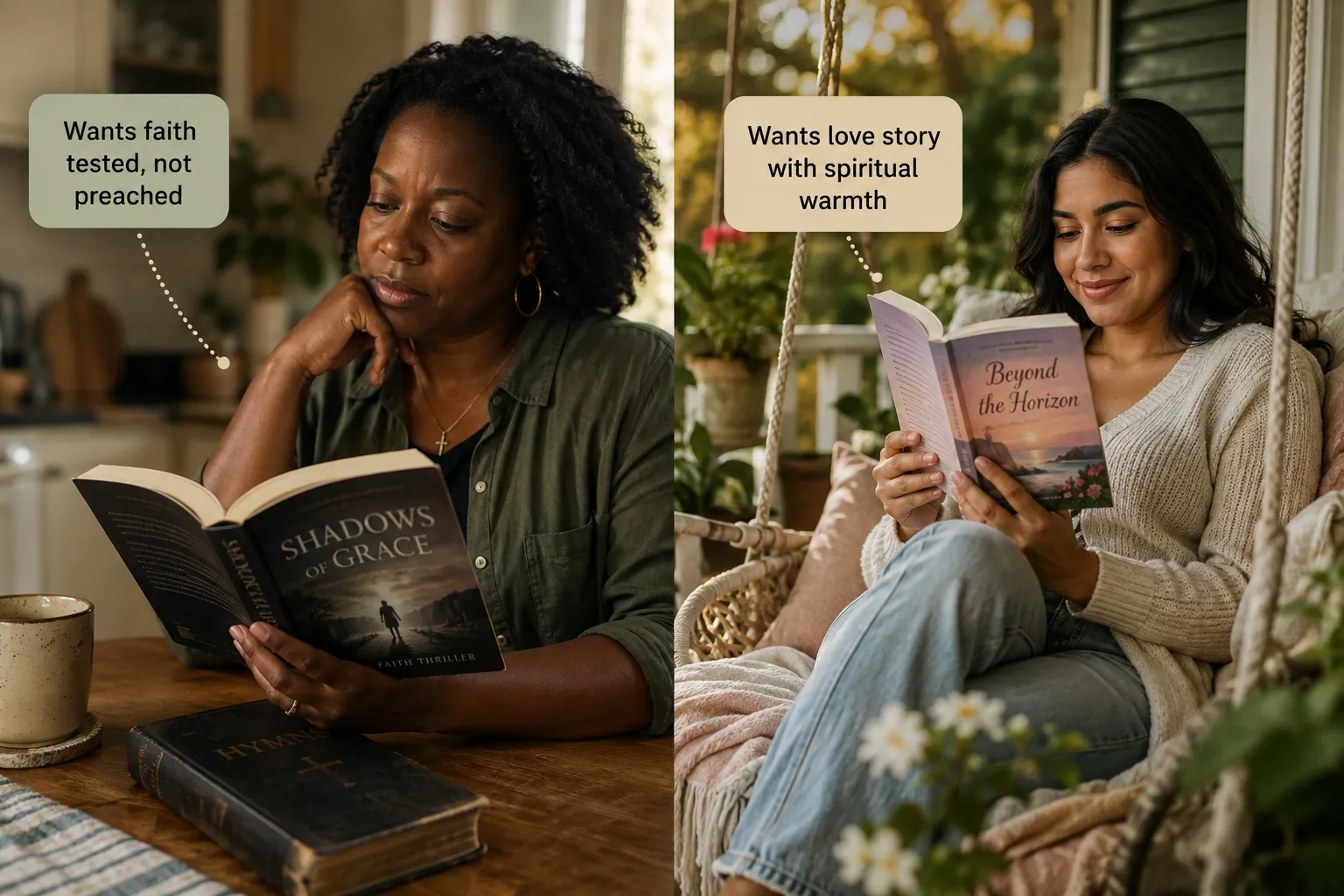
Inspirational romance readers arrive with a specific contract in mind, and it’s worth naming clearly. [7]
They expect:
- A romantic arc that resolves in commitment (HEA or HFN)
- Emotional safety, the story won’t traumatize them or leave them in despair
- Faith that feels lived-in, not performed, characters who pray because they need to, not because the plot requires a spiritual beat
- Forgiveness as a real plot element, not a shortcut
- A sense that love and faith reinforce each other rather than compete
They don’t expect:
- A sermon or a conversion narrative (though those can appear)
- Heavy doctrinal content
- Ambiguous or bittersweet endings
- Graphic depictions of sin, even if the character repents afterward
The 2026 reader survey landscape shows this audience skews toward women 35-65, Kindle Unlimited subscribers, and readers who’ve been burned by books that promised clean content and didn’t deliver it. [2] Trust is the currency, and it’s earned title by title.
Can Clean Christian Fiction Have Kissing and Physical Affection
Yes. Kissing and mild physical affection, holding hands, an embrace, a first kiss, are standard in both clean Christian fiction and inspirational romance. The content floor is about explicit content, not all physical expression.
The practical guideline most publishers use: scenes can build romantic tension and include physical affection up to and including kissing; anything that moves toward sexual detail crosses the line. “Closed-door” is the standard descriptor, the door closes before anything explicit occurs.
In clean Christian fiction outside the romance genre (mystery, thriller, western, fantasy), physical affection between characters may appear even more sparingly, because the story’s emotional center isn’t the romantic relationship.
Which Genre Is Better for Readers Who Want More Romance and Less Preaching
Inspirational romance is the better fit. It leads with the love story, and faith shows up as texture rather than subject matter. The spiritual content is present but rarely demands the reader’s full attention the way it might in a Christian novel where faith is the central dramatic question.
Choose inspirational romance if:
- A satisfying romantic arc is the primary reason you’re reading
- You want faith present but not examined at length
- You prefer emotional warmth over narrative tension
- HEA endings feel necessary, not optional
Choose clean Christian fiction (non-romance) if:
- You want faith tested by real stakes, doubt, failure, moral cost
- You’re drawn to mystery, thriller, fantasy, or western as genres
- You can accept endings where the resolution is spiritual rather than romantic
- You want stories that walk with you through hard things, not around them
Do Inspirational Romance Books Need a Conversion Story or Spiritual Journey
A conversion story is common but not required. What’s required is that faith has some kind of movement, a character who starts resistant and softens, a believer who loses faith and finds it again, or two people whose shared faith deepens through the relationship. [9]
The weakest inspirational romances treat faith as a static backdrop, characters are Christian at the beginning, Christian at the end, and nothing about their belief was actually tested. Readers notice this too, and it’s one of the most common complaints in reader reviews of the genre.
The strongest books let faith under fire do real work: a character chooses forgiveness when it costs them something, or trusts God in a situation where the outcome isn’t guaranteed. That’s earned grace, and it’s what separates a memorable inspirational romance from one that’s merely clean.
Common Mistakes Authors Make Writing Inspirational Romance
These patterns show up repeatedly in reader feedback and editorial rejections: [10]
- Faith as decoration, a prayer here, a church scene there, but nothing spiritual actually changes the plot
- Preaching through dialogue, a character explains their theology to another character (and really to the reader) at length
- Cheap resolution, conflict resolves through a sudden spiritual insight rather than through character action and consequence
- Mismatched content signals, marketing as “clean Christian” while including content that crosses the stated floor
- Flat spiritual arcs, the protagonist’s faith is identical at the end of the book as at the beginning
- Over-explaining the theme, stating what the story means rather than trusting the reader to feel it
The fix for most of these is the same: let faith show through what characters do, not what they say about God.
Is There a Market Difference Between Clean Christian Fiction and Inspirational Romance Readers
Yes, and publishers are formalizing it. [4] The audiences overlap but have different primary motivations:
- Inspirational romance readers are primarily romance genre readers who want faith content, they follow romance conventions (series, tropes, HEA expectations) and choose Christian content as a filter
- Clean Christian fiction readers are primarily faith readers who want genre fiction, they follow authors and series across genres because they trust how faith is handled, not because they’re committed to a single story shape
This distinction matters for authors. An inspirational romance reader disappointed by a slow romantic arc will leave a negative review even if the faith content is excellent. A clean Christian fiction reader disappointed by shallow spiritual content will leave a negative review even if the mystery or thriller plot is strong. [7]
The fastest-growing segment in 2026 wants both: substantive spiritual depth and clean content, regardless of genre. [2] That’s the reader who follows a worldview brand across mystery, western, fantasy, and thriller, because the promise isn’t about genre, it’s about how faith gets handled inside the story.
How Explicit Can Violence or Language Be in Christian Fiction
Neither violence nor language can be graphic in clean Christian fiction or inspirational romance. The standard across both categories:
Language:
- Mild expressions (frustration, surprise) are sometimes acceptable
- Profanity is not, this is a firm line for most Christian publishers and readers
Violence:
- Conflict, danger, and consequence are fully permitted
- Graphic detail, wounds described at length, torture, gore, is not
- Psychological threat and suspense are fair territory; the goal is tension, not shock
The distinction that matters: Clean Christian fiction can portray the reality of violence and its moral weight without dwelling on graphic detail. A character can be shot; the story doesn’t need to describe the wound at length. A villain can be genuinely threatening; the narrative doesn’t need to make the reader feel physically ill to prove it.
This is where the brand promise of hope in the dark does its real work, stories that don’t flinch from hard things, but don’t exploit them either.
FAQ
Q: Can a clean Christian fiction book have no romance at all? Yes. Many clean Christian fiction titles, mysteries, westerns, thrillers, fantasy, carry no romantic subplot. The “clean Christian” label describes content standards and faith integration, not story shape.
Q: Is “clean romance” the same as “inspirational romance”? Not exactly. Clean romance excludes explicit content but doesn’t require faith elements. Inspirational romance requires faith to be genuinely present. A book can be clean without being inspirational.
Q: Do Christian publishers require authors to be Christian? Most Christian imprints expect the faith content to be authentic and aligned with mainline Christian belief, but policies vary by publisher. The content contract matters more than the author’s biography in most submission guidelines.
Q: Can inspirational romance include a villain or serious conflict? Yes. Conflict is what makes the romantic arc meaningful. Inspirational romance can include antagonists, misunderstandings, grief, and moral failure, as long as the resolution moves toward hope and the content stays within the clean standard.
Q: Why do some books labeled “Christian fiction” feel preachy while others don’t? The difference is usually technique. Preachy books tell the reader what to believe through character dialogue or narration. Non-preachy books let faith show up through what characters choose and what those choices cost. The conviction is the same; the method is different.
Q: Is Kindle Unlimited a good platform for clean Christian fiction? KU has become a primary discovery channel for clean and Christian fiction readers, particularly women 35-65 who read frequently and prefer series. [5] Many successful clean Christian fiction authors publish KU-exclusive series specifically because the subscription model matches how their readers consume books.
Q: Can clean Christian fiction include doubt and spiritual struggle? Not only can it, the best of it does. Faith that’s never tested isn’t dramatically interesting. Characters who doubt, fail, and find their way back to belief are more honest and more compelling than characters whose faith is static.
Q: What’s the difference between “earned grace” and “cheap grace” in fiction? Cheap grace is when a character receives forgiveness or spiritual resolution without it costing them anything, a sudden conversion, a tidy moment of insight that fixes everything. Earned grace is when redemption comes after real consequence, real cost, and real choice. Readers feel the difference.
Q: Do inspirational romance readers care about genre (western, small-town, historical)? Yes, strongly. Setting and trope preferences are as important to inspirational romance readers as faith content. Small-town contemporary, historical, and Amish settings are perennially popular. The faith content is the filter; the genre trappings are what readers browse by. [7]
Q: Can a book be too Christian for the inspirational romance market? It can be mismatched. Heavy doctrinal content, extended scripture passages, or a story that prioritizes theological argument over character and plot can feel more like devotional fiction than genre fiction, and may not satisfy readers who came for the romantic arc.
Conclusion
The question of clean Christian fiction vs. inspirational romance isn’t really about which is more devout or more entertaining. It’s about what a story is fundamentally built to do.
Inspirational romance is built to deliver a love story that faith makes more meaningful. Clean Christian fiction, across mystery, thriller, western, fantasy, and beyond, is built to put faith itself under pressure and show what it looks like when belief holds, or nearly doesn’t.
Both categories share a content floor: no graphic content, no profanity, no explicit scenes. But they serve readers with different primary hungers, and authors who understand that distinction write better books and find their audience faster.
For readers deciding what to pick up next: if you want a satisfying romantic arc with faith as its moral atmosphere, look for inspirational romance. If you want faith tested by real stakes across any genre you love, mystery, suspense, frontier justice, covenant fantasy, clean Christian fiction is the wider territory, and it’s worth exploring.
For authors writing in either lane: the readers who stay loyal are the ones who felt the faith was real, not performed. That’s not a content checklist. It’s a conviction that shows up in every sentence.
Rooted in Faith, because stories and belief have always belonged together.
Explore Silas Bellhaven’s catalog of clean Christian fiction, cozy mystery, frontier western, psychological thriller, and epic fantasy, at the Silas Bellhaven author page on Amazon. Start with A Donation to Die For, the first Mercy House Mystery, or The False Warrant, the opening of The Mercy Line.
References
[1] Christian Fiction Publishing Now In The Future State Of The Industry Report 4896154 – http://prsync.com/the–and-only-publishing/christian-fiction-publishing-now–in-the-future-state-of-the-industry-report-4896154/
[2] Christian Fiction 14 7 Yearly Surge Dramatic Market Expansion Data – https://www.firmenpresse.de/pressrelease734029/christian-fiction-14-7-yearly-surge-dramatic-market-expansion-data.html
[3] 99493 Christian Novelists Seek Readers Of All Faiths Or None – https://www.publishersweekly.com/pw/by-topic/industry-news/religion/article/99493-christian-novelists-seek-readers-of-all-faiths-or-none.html
[4] 97986 Baker Publishing Group Launches Imprint For Clean Secular Fiction – https://www.publishersweekly.com/pw/by-topic/industry-news/religion/article/97986-baker-publishing-group-launches-imprint-for-clean-secular-fiction.html
[5] news.marketersmedia – https://news.marketersmedia.com/christshare-highlights-clean-fiction-as-cozy-mysteries-gain-interest/89191539
[6] Top Selling Christian Novels – https://www.accio.com/business/top-selling-christian-novels
[7] 2024 Familyfiction Romance Author Readers Poll Results – https://familyfiction.com/2024-familyfiction-romance-author-readers-poll-results/
[9] Christian Romantic Books – https://barkerbooks.com/christian-romantic-books/
[10] 91845 Redefining Christian Fiction – https://www.publishersweekly.com/pw/by-topic/industry-news/religion/article/91845-redefining-christian-fiction.html