
Last updated: August 29, 2026
Quick Answer: Clean Christian fiction on Kindle Unlimited spans cozy mystery, frontier western, epic fantasy, psychological thriller, and LitRPG, all under one subscription. Building a cross-genre reading plan means choosing a discovery series, setting content filters before you search, and rotating genres monthly so faith-rooted storytelling stays fresh without becoming predictable. The plan works best when it’s built around what the stories share, earned grace, real stakes, faith under fire, rather than a single genre label.
Key Takeaways
- Clean Christian fiction means no graphic violence, no explicit content, no profanity, and faith handled as lived experience, not sermon delivery.
- Kindle Unlimited (KU) carries a substantial and growing catalog of clean Christian fiction across at least five major subgenres. [1]
- The Christian fiction market is estimated at $1.37 billion globally and growing at roughly 8.4% year-over-year, with the fastest expansion in speculative and thriller subgenres. [3]
- A cross-genre reading plan works best with one anchor series per genre, a monthly rotation, and clear content filters applied at the search level.
- Start with cozy mystery or psychological thriller as your discovery genre, both have high KU availability and strong series structures.
- Use search terms like “clean Christian,” “faith-based,” “cozy mystery Christian,” and “Christian frontier western” to surface relevant KU titles quickly.
- Avoid building a plan around genre alone, the best clean Christian fiction is defined by how faith shows up, not just what shelf it sits on.
- Kindle Unlimited at roughly $11.99/month gives unlimited access to thousands of Christian fiction titles, making it cost-effective for readers who finish 2+ books per month. [1][4]
What Is Clean Christian Fiction Exactly?
Clean Christian fiction is fiction that contains no explicit sexual content, no graphic violence, and no profanity, and where faith is woven into the story as lived experience rather than theological lecture. The “clean” standard and the “Christian” standard are related but separate: a book can be clean without being Christian, and a poorly executed Christian novel can still carry content that doesn’t fit a clean standard.
The distinction that matters for readers building a KU plan:
- Clean content contract: kisses-only or closed-door romance (if romance is present at all), no gore, no language
- Faith as load-bearing structure: characters doubt, fail, repent, and find grace through the cost of the plot, not through a tidy conversion scene dropped in at chapter ten
- Walking with the reader, not talking at them: the story earns its hope; it doesn’t announce it
“Characters who actually doubt, serve, fail, repent, and find grace in the ordinary Tuesday that suddenly isn’t ordinary anymore.”, that’s the standard worth holding any KU title to.
Clean Christian Fiction vs. Regular Christian Fiction: What’s the Difference?
The difference is more about execution than content rating. “Regular” Christian fiction, meaning mainstream CBA (Christian Booksellers Association) published titles, is generally clean by default, but clean Christian fiction as a category (especially in indie KU publishing) signals something more specific: a deliberate content contract the author maintains across every book in a series.
| Factor | Mainstream Christian Fiction | Clean Christian Fiction (KU Indie) |
|---|---|---|
| Content rating | Generally clean, varies by publisher | Explicit clean contract per series |
| Faith handling | Ranges from light to overt | Faith as plot-structural element |
| Genre range | Primarily romance, historical | Mystery, thriller, fantasy, western, LitRPG |
| KU availability | Mixed | High, many indie series KU-exclusive |
| Series length | Often standalone or duology | Frequently 6-10+ book series |
The practical reading-plan implication: indie clean Christian fiction on KU often gives you more series depth and more genre variety than the traditional CBA shelf.
Best Clean Christian Fiction Genres on Kindle Unlimited
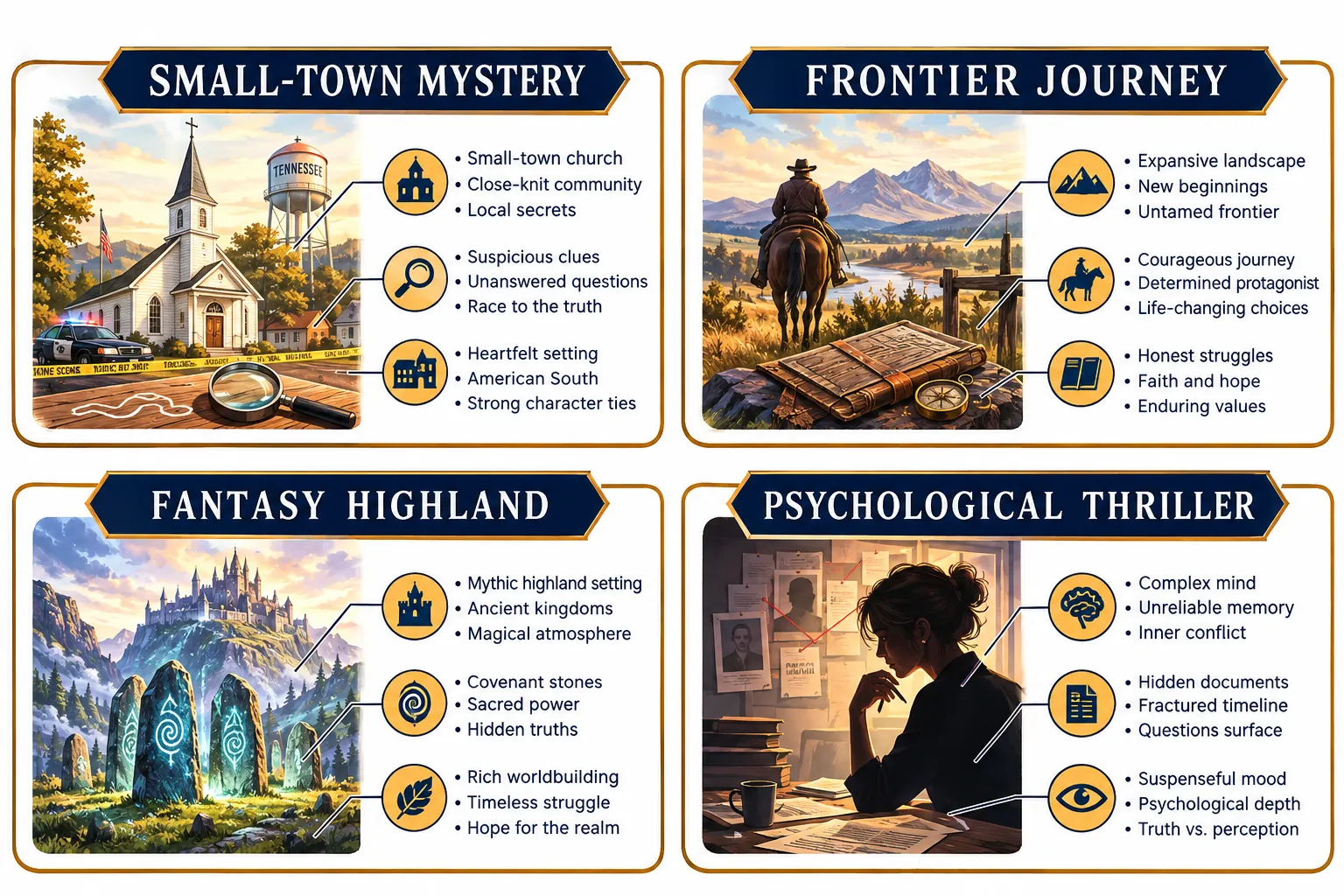
Kindle Unlimited carries clean Christian fiction across at least five distinct subgenres, each with a different emotional register. [1] Knowing what each one delivers helps you rotate intelligently rather than burning out on a single tone.
Cozy Mystery Small-town settings, amateur sleuths, community stakes. The tension is puzzle-based, who did it, and what secret does the solution expose? Faith shows up in the relationships and the moral weight of truth-telling. Best for: readers who want warmth with real stakes, gentle suspense over shock value.
Frontier Western Conscience-driven plots set in railroad towns, territorial courts, land claims. The question is usually about justice versus law, what a man answers to when the two diverge. Faith under fire in its most literal landscape. Best for: readers who want moral clarity tested by hard circumstances.
Epic Fantasy / Covenant Fantasy Secondary-world settings where faith is structural, covenants, witness-stones, maps of answered prayers. The spiritual stakes are built into the world’s architecture, not imported as allegory. Best for: readers who loved C.S. Lewis’s secondary worlds and want that intelligence applied to original settings.
Psychological Thriller Domestic or institutional suspense where the central question is about truth, record, and who controls the narrative of someone’s life. Faith shows up in the cost of telling the truth. Best for: readers who want real tension without graphic content.
Christian LitRPG Game-system progression applied to faith-tested characters. Earned progression, no cheap grace, the character’s growth is tracked, tested, and costly. Best for: readers who enjoy speculative mechanics and want faith represented honestly inside an unusual structure.
How to Find Clean Christian Fiction Books on Kindle Unlimited
Finding clean Christian fiction on KU takes about three minutes once you know the right search terms. The platform’s browse categories are broad, so keyword searching outperforms category browsing.
Effective KU search terms:
"clean Christian mystery""Christian cozy mystery series""Christian frontier western""clean Christian psychological thriller""Christian epic fantasy""faith-based LitRPG""Christian fiction Kindle Unlimited"
Content filter checklist before adding a title to your plan:
- Check the book description for explicit faith language, does it describe faith as lived, or as a lesson?
- Look at the series page, does the author maintain a consistent content contract across all books?
- Read 2-3 reviews specifically for content notes, not just plot
- Check the “Kindle Unlimited” badge on the product page [1]
Common mistake: Searching only “Christian romance” misses the fastest-growing subgenres. A January 2026 market analysis found Christian fiction unit sales growing at 12.3-12.4% year-over-year, with speculative and thriller subgenres outpacing romance. [3] A well-built KU plan should include at least one non-romance genre.
How to Build a Cross-Genre Reading Plan for Clean Christian Fiction
Building a clean Christian fiction reading plan for Kindle Unlimited comes down to four decisions: your anchor series, your monthly rotation, your content filters, and your series depth per genre.
Step 1: Choose an anchor series (your discovery engine) Pick one series in the genre you already know you enjoy. This is your trust-builder, the series that confirms the author handles faith the way you want it handled. Cozy mystery and psychological thriller are the highest-traction starting points because both have strong series structures and high KU availability.
Step 2: Set your monthly rotation A sustainable rotation for most readers:
- 2-3 books per month keeps KU cost-effective and prevents genre fatigue [4]
- Alternate between a comfort genre (cozy mystery, western) and a stretch genre (fantasy, LitRPG) each month
- Reserve psychological thriller for months when you want higher tension
Step 3: Build your TBR list by series, not individual titles Series-based reading gives you continuity of character and world, which is where faith themes develop properly. A single standalone rarely has room to show earned grace, that arc needs multiple books.
Step 4: Apply content filters consistently Use the checklist above before adding any new series. The clean Christian fiction market is large enough in 2026 that you never need to compromise on content standards to find variety. [3][10]
How Many Books Should I Read Per Month on Kindle Unlimited?
For KU to be cost-effective, most readers need to finish at least 2 books per month, at roughly $11.99/month, that puts you well under the typical retail price of two Kindle titles. [1][4] For a cross-genre clean Christian fiction plan specifically:
- 2 books/month: One anchor series book + one new genre exploration
- 3-4 books/month: Sustainable for most readers; allows one book per genre rotation quarterly
- 5+ books/month: Ideal for series binging, finish a full cozy mystery series in a month, then rotate
Choose 2 books/month if you’re new to cross-genre reading and want to build slowly. Choose 4+ if you already read across genres and want to maintain momentum in multiple series simultaneously.
How to Avoid Inappropriate Content in Christian Fiction
Not every book with “Christian” in the title maintains a clean content contract. The safest approach is to verify at the series level, not the individual book level.
Red flags to watch for:
- Vague content descriptions (“inspirational” without specifying what that means)
- Romance-heavy series without explicit closed-door language in the description
- Thriller or suspense titles without a content note about violence level
- No series page, standalone titles are harder to vet for consistency
Reliable signals of a genuine clean contract:
- Author explicitly states “no explicit content” or “kisses-only” in the series description
- Consistent content notes across all books in a series
- Faith described as “lived experience” rather than “inspirational message”
- March 2026 KU promotions like the “Clean & Christian Romance Kindle Unlimited Promo” used “PG rating” and “kisses-only” as explicit standards, look for that same language in author descriptions [33, see note below]
Clean Christian Romance vs. Clean Christian Mystery: Which Should I Read First?
Start with clean Christian mystery if you want a faster path into the cross-genre reading plan. Mystery series tend to have stronger series hooks (each book solves a contained puzzle while advancing a larger community story), which makes it easier to commit to a full series before branching into other genres.
Start with clean Christian romance if community and relationship dynamics are your primary draw, and you plan to add mystery or thriller later.
The practical difference for a KU plan:
- Mystery series give you more entry points, you can start at book 1 and the series rewards continued reading
- Romance series often have more standalone flexibility, you can read out of order without losing much
- For cross-genre exploration, mystery is the better anchor because its structure transfers well to western, thriller, and even fantasy
Best Clean Christian Fiction Authors and Series for Beginners
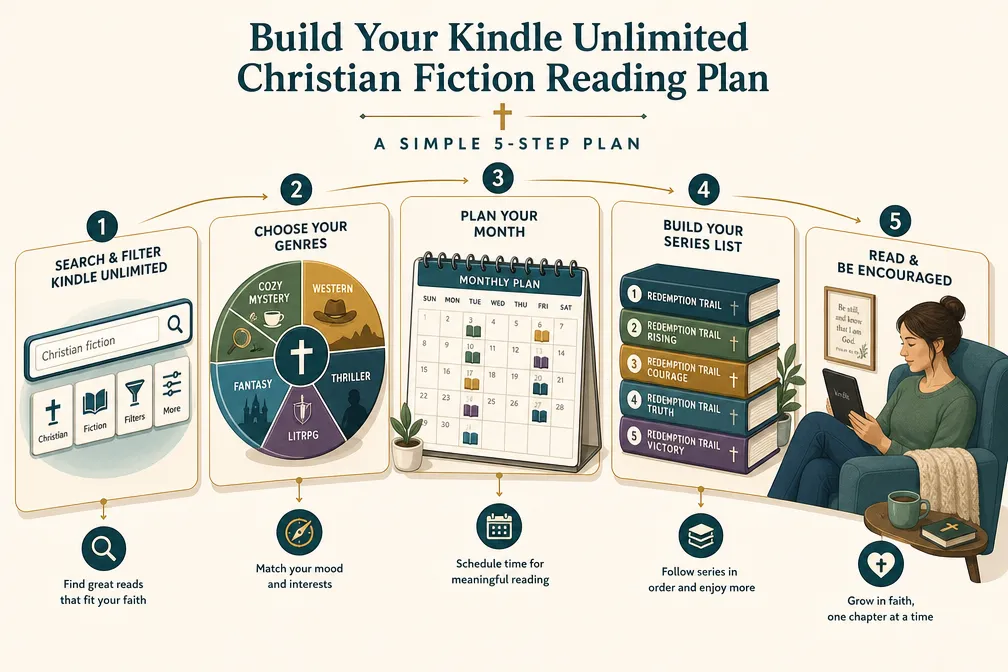
The best starting point for a clean Christian fiction KU plan is a series with a strong first book, a consistent content contract, and enough series depth to sustain several months of reading.
Recommended entry series by genre:
- Cozy Mystery: The Mercy House Mysteries by Silas Bellhaven, set in Juniper Gap, Tennessee, starting with A Donation to Die For. Ten books, consistent clean contract, faith embedded in community and consequence. (Series page)
- Frontier Western: The Mercy Line by Silas Bellhaven, railroad-town justice, conscience-driven plots, nine books. Start with The False Warrant. (Series page)
- Epic Fantasy: The Kethara Chronicles or The Sarel Chronicles by Silas Bellhaven, covenant-based secondary worlds, faith as structural rather than decorative. (Kethara) (Sarel)
- Psychological Thriller: The Gathering Light by Silas Bellhaven, institutional suspense, truth and record as central stakes, starting with When Hannah Sleeps. (Series page)
- LitRPG: The Measured Debt by Silas Bellhaven, earned progression, faith tested through a game-system structure, starting with The Cost of Being Chosen. (Series page)
Why a single author across genres works as a starting point: When one author maintains a consistent faith-handling standard across wildly different genres, you can move between series without re-vetting content. That’s the C.S. Lewis model, readers who trust how an author handles faith follow them across genre lines because the promise transfers.
Is Kindle Unlimited Worth It for Christian Fiction Readers?
For readers who finish 2 or more books per month, KU is cost-effective for clean Christian fiction specifically. [1][4] The subscription gives unlimited access to a large and growing catalog, and the Christian fiction market’s 2.3% retail sales growth in 2025 [10] has been accompanied by significant indie KU publishing activity, meaning the KU catalog often has titles and series not available elsewhere.
KU is worth it if:
- You read 2+ books per month
- You prefer series over standalones (series depth is where KU shines)
- You want to explore multiple genres without buying individual titles
- You’re willing to rotate genres, the cross-genre plan maximizes the subscription’s value
KU may not be the right fit if:
- You read fewer than 1 book per month
- You primarily want print editions
- Your preferred authors publish exclusively outside KU
The religious publishing market broadly has shown consistent growth, religion print sales were up 12% in the first half of 2024 [7], and Christian retailers posted a small sales gain in 2025 [10], which signals that new KU titles in this space will keep arriving at a steady pace.
Common Mistakes When Building a Christian Fiction Reading Plan
Most reading plans fail not because of bad book choices but because of structural problems that cause the plan to stall after the first month.
Mistake 1: Building the plan around genre labels instead of content standards A book labeled “Christian fiction” isn’t automatically clean, and a clean book isn’t automatically faith-rooted. Vet the content contract first, then sort by genre.
Mistake 2: Starting with too many series at once Pick one anchor series per genre and finish at least two books before adding another series. Parallel-reading five series simultaneously fragments the faith-theme development that makes these stories work.
Mistake 3: Ignoring series order Most clean Christian fiction series are designed with cumulative character and thematic arcs. Starting mid-series means missing the earned grace that builds across earlier books.
Mistake 4: Treating the reading plan as fixed A good plan has a rotation, not a rigid schedule. If a western series isn’t landing, move to fantasy. The goal is sustained engagement with faith-rooted fiction, not completion for its own sake.
Mistake 5: Only reading one genre The cross-genre plan exists because different genres put faith under different kinds of pressure. Cozy mystery tests faith through community and truth-telling. Western tests it through justice and conscience. Thriller tests it through control and record. Fantasy tests it through covenant and cost. Reading across all five gives a fuller picture of what redemption that costs something actually looks like.
Can I Read Clean Christian Fiction Across Multiple Genres at Once?
Yes, and for KU subscribers, reading across multiple genres simultaneously is actually the most efficient use of the subscription. The practical approach is to keep no more than two series active at a time, with one being a comfort read (cozy mystery, western) and one being a stretch read (fantasy, LitRPG, thriller).
A simple two-track system:
- Track A (comfort): One cozy mystery or western series, read in order, one book per week
- Track B (stretch): One fantasy, thriller, or LitRPG series, read at a slower pace, one book every two weeks
This keeps the plan sustainable without requiring you to hold multiple complex world-builds in memory simultaneously. When you finish a Track B series, rotate a new genre in. When you finish a Track A series, move the stretch genre to comfort and add a new stretch.
FAQ
What does “clean” mean in clean Christian fiction? No explicit sexual content, no graphic violence, and no profanity. Romance, if present, stays at kisses-only or closed-door. Faith is handled as lived experience, not as a lesson delivered through narration.
Is all Christian fiction on Kindle Unlimited clean? No. “Christian fiction” is a broad category. Some titles maintain strict clean contracts; others are lighter on both faith content and content standards. Always check the series description and author’s stated content contract before adding a title to your plan.
How do I search for clean Christian fiction on Kindle Unlimited? Use specific search terms: “clean Christian mystery,” “Christian cozy mystery series,” “Christian frontier western,” “clean Christian psychological thriller,” or “faith-based fantasy.” Filter results by Kindle Unlimited availability. [1]
How many books per month do I need to read to make KU worth it? Two books per month is generally the break-even point at the standard KU subscription price. [4] For a cross-genre plan, 3-4 books per month is sustainable and keeps the subscription well cost-effective.
Can I start a series mid-way through on KU? Technically yes, but most clean Christian fiction series build thematic arcs across books. Starting at book 1 gives you the earned grace arc the author designed. Starting mid-series often means missing why the later books hit as hard as they do.
What’s the difference between Christian cozy mystery and Christian thriller? Cozy mystery uses a contained community setting, an amateur sleuth, and puzzle-based tension. Thriller uses institutional or domestic settings, higher psychological stakes, and tension built around control of truth or record. Both are clean; the emotional register is different, cozy is warm with real stakes, thriller is tense with real hope.
Where should a complete beginner to Christian fiction start? Start with a cozy mystery series, the community setting, contained plots, and warm tone make it the most accessible entry point. A Donation to Die For (Mercy House Mysteries, Book 1) is a strong first choice.
Is Christian LitRPG actually clean? When written with an explicit clean contract, yes. The LitRPG structure (game-system progression, earned stats) is a format, not a content category. The Measured Debt series, for example, applies earned-progression mechanics to faith-tested characters with no explicit content.
Do I need to be religious to enjoy clean Christian fiction? No. Readers who aren’t practicing Christians often find the genre appealing because it offers real moral stakes, earned redemption arcs, and stories that take consequence seriously, without graphic content. The faith is structural, not a barrier to entry.
How often does new clean Christian fiction appear on Kindle Unlimited? Frequently. Christian fiction unit sales grew at roughly 12.3% year-over-year in recent reporting [3], and much of that growth is driven by indie KU publishing. Expect new titles in your preferred subgenres monthly.
Conclusion
A clean Christian fiction reading plan for Kindle Unlimited isn’t complicated, but it does require a few deliberate choices upfront. Pick your anchor series, set your content filters before you search, rotate genres monthly, and read in series order so the faith themes have room to develop properly.
The market is large and growing [3][10], the KU catalog is deep [1], and the genres available, cozy mystery, frontier western, epic fantasy, psychological thriller, LitRPG, each put faith under a different kind of pressure. That variety is the point. Hope in the dark looks different in a Tennessee church social than it does in a railroad court or a covenant highland, but the thing underneath it, redemption that costs something, mercy and justice held in tension, faith under fire, is the same.
Actionable next steps:
- Choose one anchor genre and find a series with a verified clean content contract
- Add the first two books of that series to your KU library today
- Set a monthly rotation, one comfort genre, one stretch genre
- After finishing your first full series, add one new genre to your plan
- Browse Silas Bellhaven’s full catalog at amazon.com/stores/Silas-Bellhaven/author/B0H42BDQBK for series that span all five genres under one consistent faith-handling standard
The ordinary Tuesday can turn out to matter more than anyone expected. The right book on the right day is part of that.
References
[1] Kindle Unlimited – https://www.amazon.com/kindle-dbs/hz/subscribe/ku/ [3] Christian Fiction 14 7 Yearly Surge Dramatic Market Expansion Data – https://www.firmenpresse.de/pressrelease734029/christian-fiction-14-7-yearly-surge-dramatic-market-expansion-data.html [4] Kindle Unlimited Worth It 2026 – https://www.digitnaut.com/2026/02/kindle-unlimited-worth-it-2026.html?m=1 [7] 95495 Religion Print Sales Up 12 In First Half Of 2024 – https://www.publishersweekly.com/pw/by-topic/industry-news/financial-reporting/article/95495-religion-print-sales-up-12-in-first-half-of-2024.html [10] 99671 Christian Retailers Posted Small Sales Gain In 2025 – https://www.publishersweekly.com/pw/by-topic/industry-news/religion/article/99671-christian-retailers-posted-small-sales-gain-in-2025.html