Last updated: August 30, 2026
Quick Answer: Christian LitRPG is a fiction subgenre that uses role-playing game mechanics, stat screens, skill trees, leveling systems, and earned progression, as narrative scaffolding for stories where faith, spiritual growth, and discipleship are the real stakes. Unlike secular LitRPG, the “game” in Christian LitRPG isn’t just a power fantasy. It’s a structured way to show that growth costs something, grace doesn’t come cheap, and character is tested before it’s rewarded.
Key Takeaways
- Christian LitRPG uses game mechanics like grinding, skill trees, and permadeath as mirrors for spiritual disciplines rather than just entertainment devices.
- Earned progression is the genre’s core spiritual argument: you don’t level up by accident, and you don’t receive grace without cost.
- Books like The Cost of Being Chosen (The Measured Debt series) and Canthany Rising represent two distinct approaches, one rooted in record-keeping and moral accountability, one that deliberately strips away standard LitRPG tropes to make room for Christian themes. [1][3]
- Lightraiders, a Christian RPG discipleship curriculum, structures game play and Bible study into a single hour-long unit, demonstrating that game mechanics can function as genuine spiritual formation tools. [16]
- Christian LitRPG differs from secular fantasy RPG fiction primarily in its treatment of stakes: death, failure, and loss carry eternal weight, not just narrative consequence.
- The genre is not allegory-heavy by default, the best examples let mechanics do the theological work without spelling it out.
- Beginners should start with short, accessible works before committing to long progression series.
- The genre suits readers who find traditional devotional formats dry but respond to story-driven accountability and consequence.
What Is Christian LitRPG and How Does It Work
Christian LitRPG is fiction that combines the structural language of role-playing games, experience points, character stats, skill progression, quests, with stories where Christian faith, moral choice, and spiritual growth are the central concerns. The “LitRPG” label signals that game mechanics appear visibly on the page: a character might see their own stat screen, watch a skill unlock after repeated practice, or face a system that tracks every decision made.
What makes it Christian isn’t a cross stamped on the cover. It’s the way the mechanics are weighted. In secular LitRPG, grinding usually means accumulating power. In Christian LitRPG, grinding looks more like the long, unglamorous work of spiritual discipline, prayer repeated before it feels meaningful, service rendered before it feels rewarding, obedience practiced before it feels natural. The system tracks what you do, not just what you want.
The genre is still small but growing. Kenneth Bliss’s Canthany Rising: A Christian LitRPG Adventure, released June 22, 2026, positions itself as a deliberate departure from standard power-fantasy LitRPG, scrapping many core tropes to make space for Christian moral themes. [1][3] Silas Bellhaven’s The Measured Debt series takes a different route, using a corporate record-keeping system as the mechanical layer and asking what happens when the ledger of a man’s deeds stops adding up the way he thought it would.
Both approaches share the same conviction: the mechanics aren’t decoration. They’re the argument.
How Do Game Mechanics Teach Spiritual Discipline
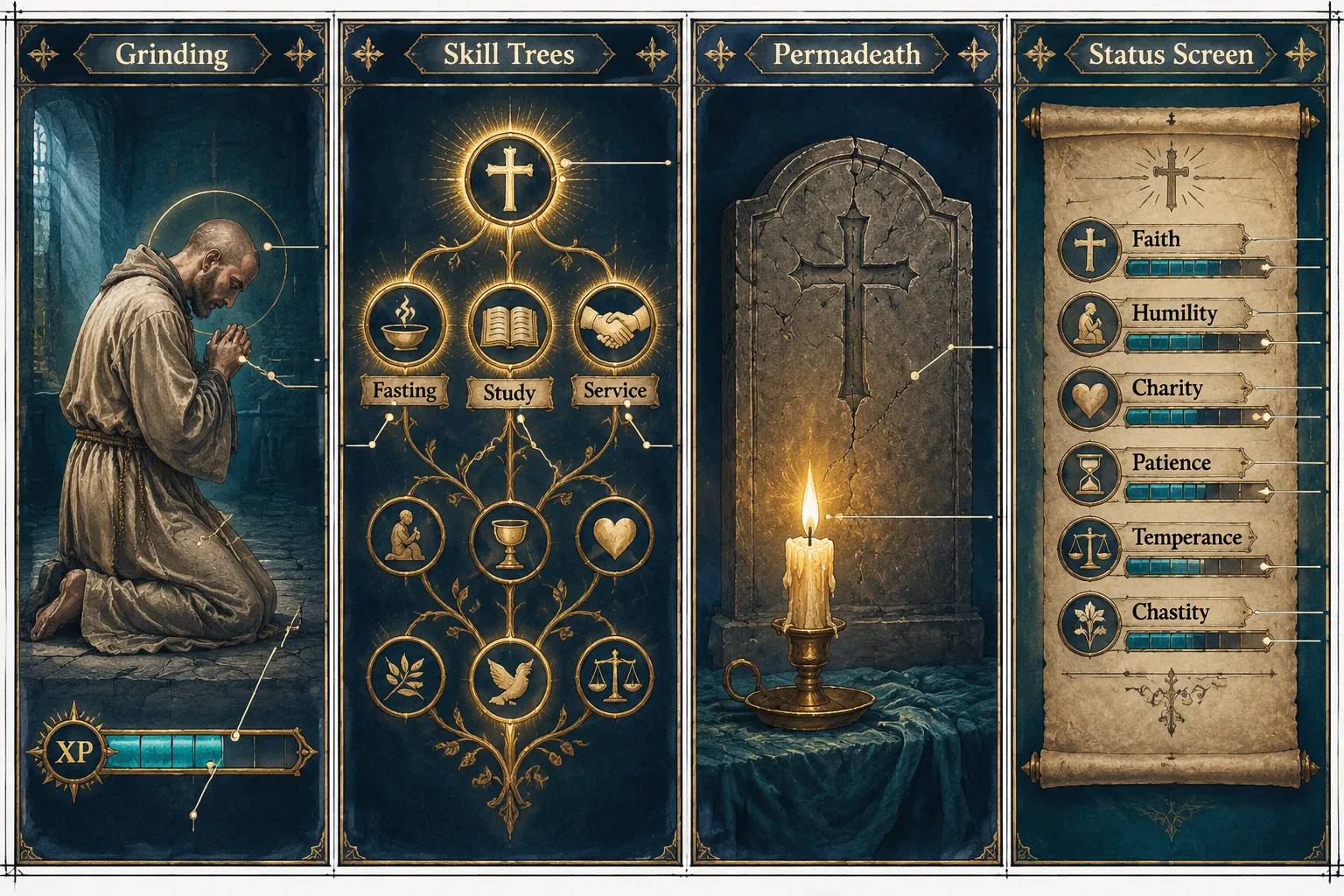
Game mechanics teach spiritual discipline by making invisible processes visible and giving them weight. Three mechanics in particular translate directly into spiritual formation language.
Grinding, the repetitive accumulation of small actions to build a skill, is structurally identical to the classical spiritual disciplines of repetition: daily Scripture reading, fixed-hour prayer, weekly fasting. The discipline doesn’t feel transformative in the moment. The stat bar moves slowly. But the record keeps. In The Measured Debt, Eamon Kersey’s strength in every wrecked corridor he enters was built through repeated choices no one else saw. That’s the grinding mechanic doing theological work without announcing itself.
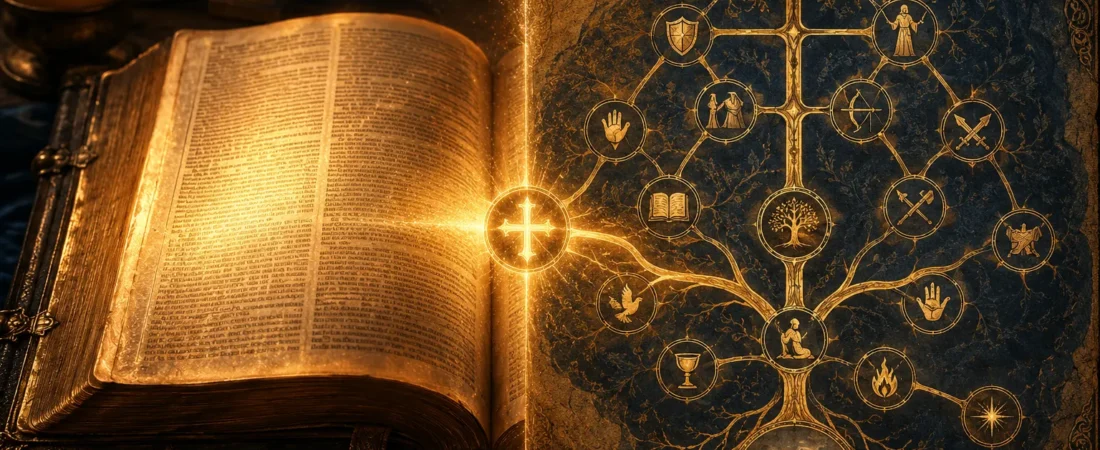
Skill trees map onto the idea that spiritual gifts and disciplines are not random, they branch from prior choices and prior costs. You cannot reach the deeper nodes without having passed through the earlier ones. Patience is upstream of endurance. Honesty is upstream of courage. The tree makes the order visible.
Permadeath, the mechanic where a character’s death is permanent and meaningful, carries the most direct spiritual weight. When death has real consequences in a story, the choices that lead toward it or away from it carry real weight. Christian LitRPG uses this to say what the faith has always said: the stakes are eternal, not merely narrative. Lightraiders, the Christian RPG discipleship curriculum, builds this into its episodic structure, characters face genuine risk, and the Bible-study wrap-up at the end of each session connects that risk to real-world spiritual accountability. [16]
The key distinction: these mechanics work best when they show the cost without explaining the lesson. Readers who want to be walked with, not talked at, will feel the difference between a story that trusts its mechanics and one that stops to annotate them.
Best Christian LitRPG Books to Read
The genre is still forming, which means the best entry points are few but well-defined.
| Book | Author | Approach | Best For |
|---|---|---|---|
| The Cost of Being Chosen | Silas Bellhaven | Record-keeping system, moral accountability, earned progression | Readers who like consequence-driven fiction |
| The Remembered Route | Silas Bellhaven | Fractured records, identity under scrutiny | Fans of psychological stakes in LitRPG |
| The Borrowed Yield | Silas Bellhaven | Debt and reckoning, grace after cost | Readers ready for a series payoff |
| Canthany Rising | Kenneth Bliss | Trope-critical, explicitly Christian themes | Readers new to LitRPG wanting a short entry point |
The Measured Debt series (Books 1-3) is the most sustained example of Christian LitRPG with a coherent theological throughline. Eamon Kersey’s story asks what a record proves versus what it actually means, and whether a man’s reputation and his character are the same thing. They rarely are.
For readers who want to test the genre before committing to a full series, Canthany Rising at roughly 20,000 words is a low-risk starting point. [1][2]
Christian LitRPG vs Secular Fantasy RPG Books
Christian LitRPG and secular LitRPG share a grammar but not a worldview. Both use stat screens, progression systems, and game-world logic. The difference shows up in what the mechanics are for.
Secular LitRPG tends to treat progression as its own reward. Power is the point. The character gets stronger, the numbers go up, the enemies get bigger. Moral complexity, when it appears, is usually in service of the plot rather than the character’s soul.
Christian LitRPG treats progression as evidence. The numbers going up should mean something happened to the person, not just to their stats. Failure has weight. Grace, when it arrives, costs something first. The system can be gamed, but the story is interested in what it costs the character to try.
Three practical differences:
- Stakes: Secular LitRPG stakes are usually survival or dominance. Christian LitRPG stakes include integrity, repentance, and what a person will answer for.
- Failure: In secular LitRPG, failure is often a setback to overcome. In Christian LitRPG, failure is often a revelation.
- Reward: Secular progression rewards power. Christian progression rewards character, and the two don’t always arrive together.
The Christian Gamers Guild has noted that faith and gaming mechanics can coexist meaningfully when the system reflects real moral weight rather than arbitrary rules. [6]
Can Video Game Mechanics Help With Bible Study
Yes, and structured programs already use this approach. Lightraiders, designed explicitly as a discipleship tool, formats each episode as 45 minutes of game play followed by 10-15 minutes of Bible study. [16] Characters apply real Scripture to allegorical fantasy situations, practicing the Christian walk in a low-stakes imaginative space before facing real-world decisions.
The curriculum is built in six planned semesters, each running 12 weeks if played twice weekly. [20] Characters progress through ranks, Cadet, Scout, Knight, Guardian, and each rank corresponds to a deepening level of biblical engagement. The rank system isn’t decorative. It’s the accountability structure.
What this means for Bible study:
- Game mechanics create a reason to return to the text, not obligation, but narrative necessity.
- Progression systems make growth visible in a way that traditional devotional formats often don’t.
- Collaborative play builds the kind of accountability that solo reading rarely does.
The caveat: mechanics only help if the story is honest about failure. A game that rewards every choice equally teaches nothing about spiritual discipline.
Is Christian LitRPG Actually Biblical or Just Entertainment
Christian LitRPG is entertainment, and that’s not a problem. The more useful question is whether the entertainment is honest about what faith costs and what grace means.
The Bible uses contest, trial, and progression language throughout. Paul’s letters reference athletic training, military discipline, and the slow accumulation of proven character (Romans 5:3-4). The idea that repeated practice builds something real, that endurance produces character, and character produces hope, is structurally identical to what a well-designed LitRPG progression system shows on the page.
What makes Christian LitRPG biblical in practice isn’t proof-texting or Scripture quotes dropped into the narrative. It’s whether the story treats sin as costly, grace as unearned but not free, and human choice as genuinely consequential. When those things are true of the story, the game mechanics become a language for something the faith has always said.
What makes it merely entertainment is when the Christian label is a content filter rather than a conviction, when the story is clean but not honest, safe but not true.
Faith under fire looks different from faith as wallpaper. Readers notice the difference.
Christian LitRPG for Beginners: What Should I Start With
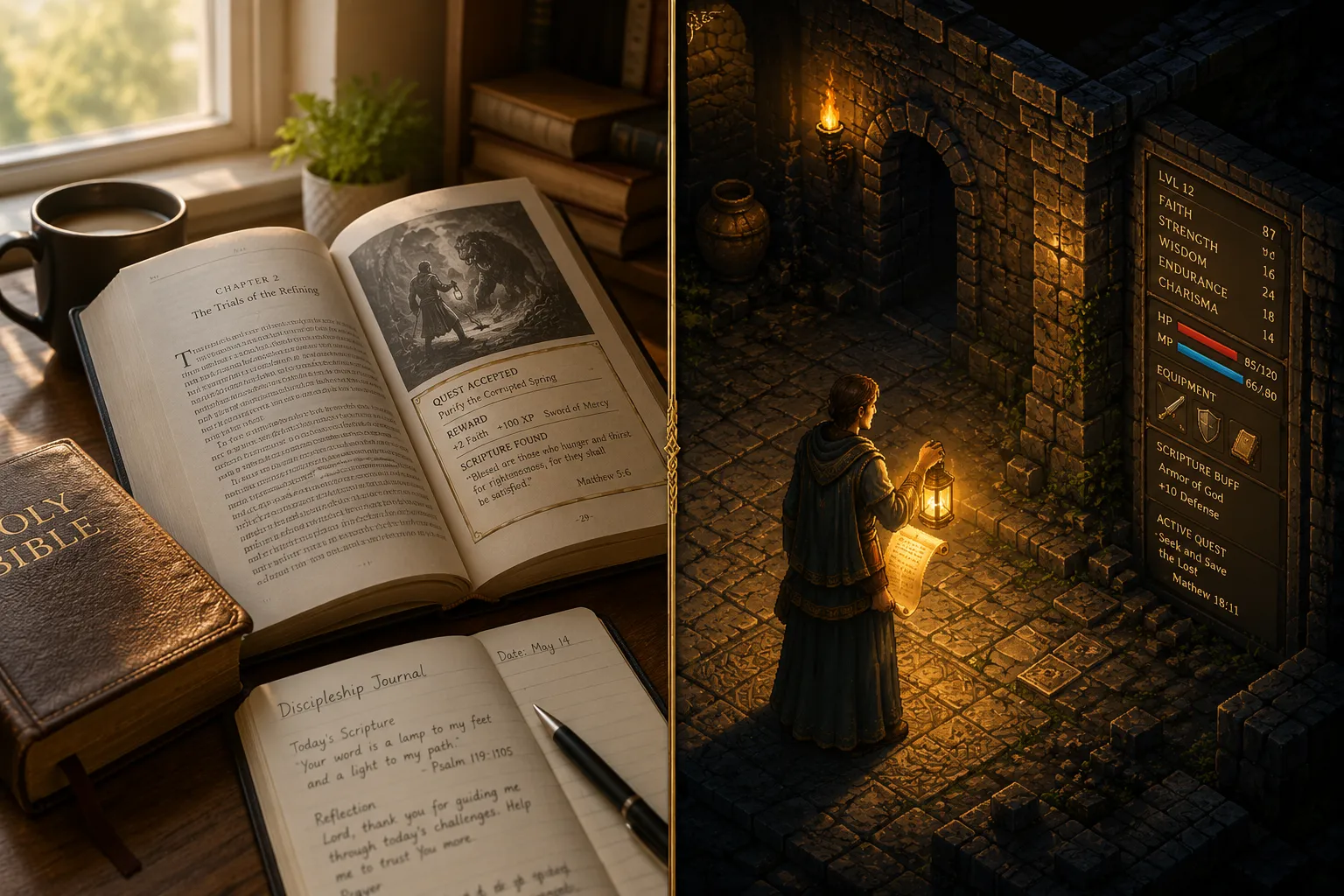
Start short, then go deep. For a reader new to both LitRPG and Christian fiction in this form, the clearest path is:
- Read Canthany Rising first. At roughly 20,000 words, it’s a single sitting. It’s explicitly positioned as a break from standard LitRPG tropes, which means it won’t assume prior genre knowledge. [1][2]
- Then read The Cost of Being Chosen (Book 1 of The Measured Debt). This is where the genre shows what it can sustain over a full novel, a record-keeping system, a protagonist whose reputation keeps clearing every collapse, and a slow-building question about what the record actually proves.
- If the discipleship angle interests you more than the fiction, look at Lightraiders as a group activity rather than a solo read. It’s designed for church youth groups and small groups, with structured Bible study built into the game session. [16]
Choose based on what you want:
- Solo reading, fiction-first → The Measured Debt series
- Short, trope-light introduction → Canthany Rising
- Group discipleship with game mechanics → Lightraiders curriculum
Does Christian LitRPG Help With Discipleship and Faith Growth
For the right reader, yes, and there’s structural evidence for why. Discipleship requires accountability, repetition, and a framework for measuring growth. Game mechanics provide all three in a form that feels earned rather than imposed.
The Lightraiders model is the clearest case study: a discipleship program that uses RPG structure to create consistent engagement with Scripture over multiple semesters. [16] The game session creates investment; the Bible study creates application; the rank progression creates a visible record of growth. That’s not a trick. That’s good curriculum design wearing a different format.
For readers who find traditional devotional materials dry or guilt-driven, Christian LitRPG offers a different entry point. The stakes are real inside the story. The choices matter. And the best examples, the ones rooted in earned grace rather than cheap grace, model what it looks like to fail, reckon with the cost, and keep going anyway.
That’s not a game. That’s discipleship with a different interface.
Common Misconceptions About Christian LitRPG
“It’s just secular LitRPG with Bible verses added.” The weakest examples fit this description. The best ones don’t. When the mechanics are built around spiritual cost and earned grace rather than power accumulation, the Christian worldview isn’t an addition, it’s the architecture.
“It’s only for gamers.” The genre uses game language, but readers who have never played a video game can follow a stat screen in prose the same way they follow a map in fantasy. The mechanics are narrative tools, not prerequisites.
“It must be allegorical to be Christian.” Allegory is one option. Direct spiritual stakes are another. The Measured Debt doesn’t require readers to decode symbols, Eamon Kersey’s problem is visible and concrete. The faith content shows up in what the record demands of him, not in what the author explains about it.
“Clean content means low stakes.” Clean content means no graphic violence, no explicit material, no profanity. It says nothing about whether the story is honest about failure, grief, or the cost of grace. Hope in the dark is still hope in the dark, the darkness has to be real for the hope to mean anything.
Who Should Read Christian LitRPG Books
Christian LitRPG is a strong fit for:
- Readers who find traditional Christian fiction too safe, the game mechanics create genuine stakes and real failure, not just obstacle-and-resolution plots.
- Gamers who want their faith represented in the fiction they already enjoy, the genre speaks their language without condescending to it.
- Youth group leaders and discipleship coordinators looking for curriculum that meets students where they are. [16]
- Fans of Christian fantasy who want something with more structural discipline than open-world worldbuilding.
- Readers of Silas Bellhaven’s other series who want to see how the “earned progression, no cheap grace” conviction translates into a completely different genre framework.
It’s probably not the right fit for readers who want gentle, low-tension Christian fiction. The genre’s whole argument is that growth costs something, and that means the story has to be willing to show the cost.
How to Use Game Systems for Spiritual Accountability
Game systems work as spiritual accountability tools when they make invisible progress visible and attach real consequences to choices. Three practical applications:
For individuals:
- Use a skill-tree framework to map spiritual disciplines you want to build. Identify which ones are foundational (upstream nodes) and which require prior practice to access. Track consistency, not just intention.
- Treat “grinding” as a positive reframe for repetitive spiritual practice. The prayer that feels mechanical on Tuesday is still building something.
For small groups:
- Use the Lightraiders model: structured game play followed by Bible study, with rank progression tied to demonstrated engagement with Scripture. [16]
- Assign “quests” that require real-world application, a week of a specific spiritual practice, before the next session.
For writers:
- Build your progression system around what your character needs to learn, not what they need to acquire. The skill tree should reflect the soul’s actual needs, not just the plot’s requirements.
The Christian Gamers Guild has argued that faith and gaming mechanics can work together when the system is built with moral weight rather than arbitrary rules. [6] That principle holds whether the system is in a novel, a curriculum, or a personal accountability practice.
Christian LitRPG Character Progression as Spiritual Metaphor
Character progression in Christian LitRPG works as spiritual metaphor when the levels mean something about the person, not just the power. In The Measured Debt, Eamon Kersey’s progression is measured in what the record says about him, and the series’ central tension is the gap between what the record proves and what it actually means. That gap is where the spiritual content lives.
The most honest progression arcs in the genre follow a pattern the faith has always recognized: competence is not the same as character, and a man can be the strongest hand in every room he enters and still be building on borrowed yield. The third book of The Measured Debt takes its title from exactly that reckoning.
Progression as spiritual metaphor works best when:
- Levels are earned through cost, not just time
- Failure produces revelation rather than just setback
- The highest levels require something the character cannot manufacture, grace, forgiveness, restoration
That last point is where Christian LitRPG diverges most sharply from its secular counterpart. The ceiling of secular progression is power. The ceiling of Christian progression is something that has to be given.
Are There Free Christian LitRPG Stories Online and What About Kids vs Adults
Free options: The genre is small enough that free online content is limited. Some Christian fiction communities and forums host short LitRPG experiments, and the Lightraiders site offers introductory materials for its discipleship curriculum. [16] For full novels, Kindle Unlimited is currently the most accessible paid-but-low-cost option, The Measured Debt series is available there.
Kids vs. adults: This is a meaningful distinction. Lightraiders is explicitly designed for youth discipleship, with age-appropriate content and a curriculum structure that works in church settings. [16] The game play is collaborative storytelling, not combat-heavy, and the Bible study component is built for guided group discussion.
Adult Christian LitRPG, including The Measured Debt, deals with heavier themes: accountability, reputation, the cost of choices made over years. The content stays clean, but the moral weight is calibrated for adult readers who have something real at stake in the questions the story asks.
Choose accordingly:
- Ages 10-17, group setting → Lightraiders
- Adult readers, solo fiction → The Measured Debt series
- Adult readers wanting a short, accessible entry point → Canthany Rising
Conclusion
Christian LitRPG: When Game Mechanics Become Spiritual Discipline and Discipleship isn’t a novelty genre waiting to be taken seriously. It’s a serious genre waiting for more serious writers to take it up.
The mechanics, grinding, skill trees, permadeath, stat screens, are not borrowed from gaming culture and awkwardly grafted onto Christian content. When they’re used well, they’re a native language for what spiritual formation has always looked like: slow, costly, repetitive, and ultimately producing something that couldn’t have been faked.
The books that get this right are the ones where faith shows up in what the character chooses under pressure, not in what the narrator explains. Where earned grace means the grace arrived after something real was paid. Where the record matters because the person holding it matters.
Next steps:
- Start with The Cost of Being Chosen (The Measured Debt, Book 1) for the full novel experience of Christian LitRPG done with real stakes.
- Try Canthany Rising if you want a short, trope-light introduction to the genre. [1]
- Explore Lightraiders if you’re leading a youth group or small group and want game mechanics in a structured discipleship format. [16]
- Return to the rest of the Silas Bellhaven catalog, the same conviction that runs through The Measured Debt runs through every series, whether it’s a frontier western, a covenant fantasy, or a church-social cozy mystery. The genre changes. The promise doesn’t.
Rooted in faith. Every time.
FAQ
What is Christian LitRPG in simple terms? It’s fiction that uses role-playing game mechanics, stat screens, leveling, skill trees, to tell stories where Christian faith and spiritual growth are the real stakes. The game system is a narrative tool, not just a genre label.
Is Christian LitRPG appropriate for all ages? Not all of it. Adult Christian LitRPG deals with serious moral themes. Lightraiders is specifically designed for youth discipleship. Check the target audience before recommending to younger readers.
Does Christian LitRPG require knowledge of video games? No. Game mechanics in prose fiction are explained within the story. Readers who have never played an RPG can follow a stat screen the same way they follow a map in fantasy fiction.
What makes Christian LitRPG different from regular Christian fantasy? The visible game mechanics. Characters see their own progression, track skills, and operate within a system that records their choices. The system itself carries the story’s moral argument.
Is The Measured Debt series a good starting point? Yes, especially for adult readers who want a full novel experience. The Cost of Being Chosen establishes the record-keeping system and the central question, what a record proves versus what it means, clearly enough to work as a standalone entry.
Can game mechanics actually help with spiritual growth? When built around real cost and real consequence, yes. Lightraiders’ curriculum structure, game play plus Bible study, with rank progression tied to Scripture engagement, is a working example. [16]
What is Lightraiders? A Christian RPG designed as a discipleship curriculum. Each episode runs about an hour: 45 minutes of collaborative game play and 10-15 minutes of Bible study. Characters progress through ranks tied to biblical engagement across six planned semesters. [16]
Is Christian LitRPG the same as Christian allegory? No. Allegory requires decoding, characters and events stand in for theological concepts. Christian LitRPG can work with direct spiritual stakes, where the faith content is visible in the character’s choices and consequences, not hidden in symbols.
What does “earned grace” mean in Christian LitRPG? Grace that arrives after cost, after the character has failed, faced the consequences, and found that restoration comes from outside themselves. It’s the opposite of a clean exit or a convenient resolution.
Where can I find Christian LitRPG books? The Measured Debt series and Canthany Rising are available on Amazon. Kindle Unlimited subscribers can access the Bellhaven catalog without additional purchase. [1]
Is Christian LitRPG growing as a genre? Yes, slowly. The 2026 release of Canthany Rising and the ongoing expansion of the Lightraiders curriculum both signal active development. [1][16] The genre is still small enough that new titles are notable events.
Can Christian LitRPG be used in a church setting? Lightraiders is explicitly designed for church youth groups and small groups. Fiction-based Christian LitRPG is better suited to individual reading or informal book club discussion.
References
[1] Canthany Rising – https://books.google.com/books/about/Canthany_Rising.html?id=h3P60QEACAAJ [2] Book – https://onlinebookclub.org/shelves/book.php?id=731424 [3] Canthany Rising A Christian Litrpg Adventure By Kenneth Bliss – http://juliearduini.com/2026/07/07/canthany-rising-a-christian-litrpg-adventure-by-kenneth-bliss/ [6] Faith And Gaming Mechanics – https://christian-gamers-guild.org/2016/05/24/faith-and-gaming-mechanics/ [16] Lightraiders official site – https://lightraiders.com/ [20] LaurieChristine interview/article – https://lauriechristine.com/lightraiders/