
Last updated: August 31, 2026
Quick Answer: Christian LitRPG on Kindle Unlimited blends the stat-progression mechanics of game-world fiction with faith-rooted themes, earned grace, moral consequence, and spiritual growth, rather than treating faith as a decorative overlay. The subgenre is small but active in 2026, making it a genuinely novel space for readers who want progression fantasy with real spiritual stakes. Expect clean content, character-driven plots, and faith that shows up through cost and consequence, not sermon.
Key Takeaways
- Christian LitRPG is a niche within a niche, the broader LitRPG genre is healthy on KU in 2026, but explicitly faith-based titles remain few and selective [8]
- Faith functions as plot architecture, not decoration, characters grow spiritually through the same progression systems that drive the story forward
- Clean content is standard, no graphic violence, no explicit content, no profanity; the tone carries the contract without announcing it
- KU enrollment is not permanent, faith-based speculative titles cycle in and out of Kindle Unlimited, so availability must be checked title by title [1]
- You don’t need to be religious to follow the stories, but readers who share the worldview will find the deepest resonance
- Typical length varies widely, from short novellas around 20,000 words to full serial-length novels exceeding 80,000 words [2]
- Earned progression is the core mechanic, grace arrives after cost, not instead of it; stat gains reflect genuine moral and spiritual choices
- The subgenre is still forming, new titles like Canthany Rising (June 2026) signal active experimentation rather than a mature, crowded catalog
- Reading series in order matters, progression systems build on prior choices; starting mid-series loses the earned weight of earlier decisions
- Silas Bellhaven’s The Measured Debt is among the most developed Christian LitRPG series currently available, built around the question of what a record proves versus what it actually costs
What Is Christian LitRPG and How Does It Differ From Regular Fantasy?
Christian LitRPG is a subgenre that combines the game-world mechanics of LitRPG fiction, character stats, skill progression, leveling systems, and structured challenges, with a Christian worldview at the story’s moral and thematic center. Unlike regular fantasy, where faith might appear as a background religion or a vague “light versus dark” framework, Christian LitRPG treats God as real and present within the story’s logic, and spiritual formation as the actual progression arc.
Regular LitRPG is built around power fantasy: the protagonist gains strength, skills, and status through measurable increments. Christian LitRPG keeps that structure but redirects its meaning. The numbers on a stat sheet aren’t just about becoming stronger, they reflect what a character has paid, chosen, or surrendered. Earned progression replaces pure power accumulation. Grace shows up in the ledger only after something real has been spent.
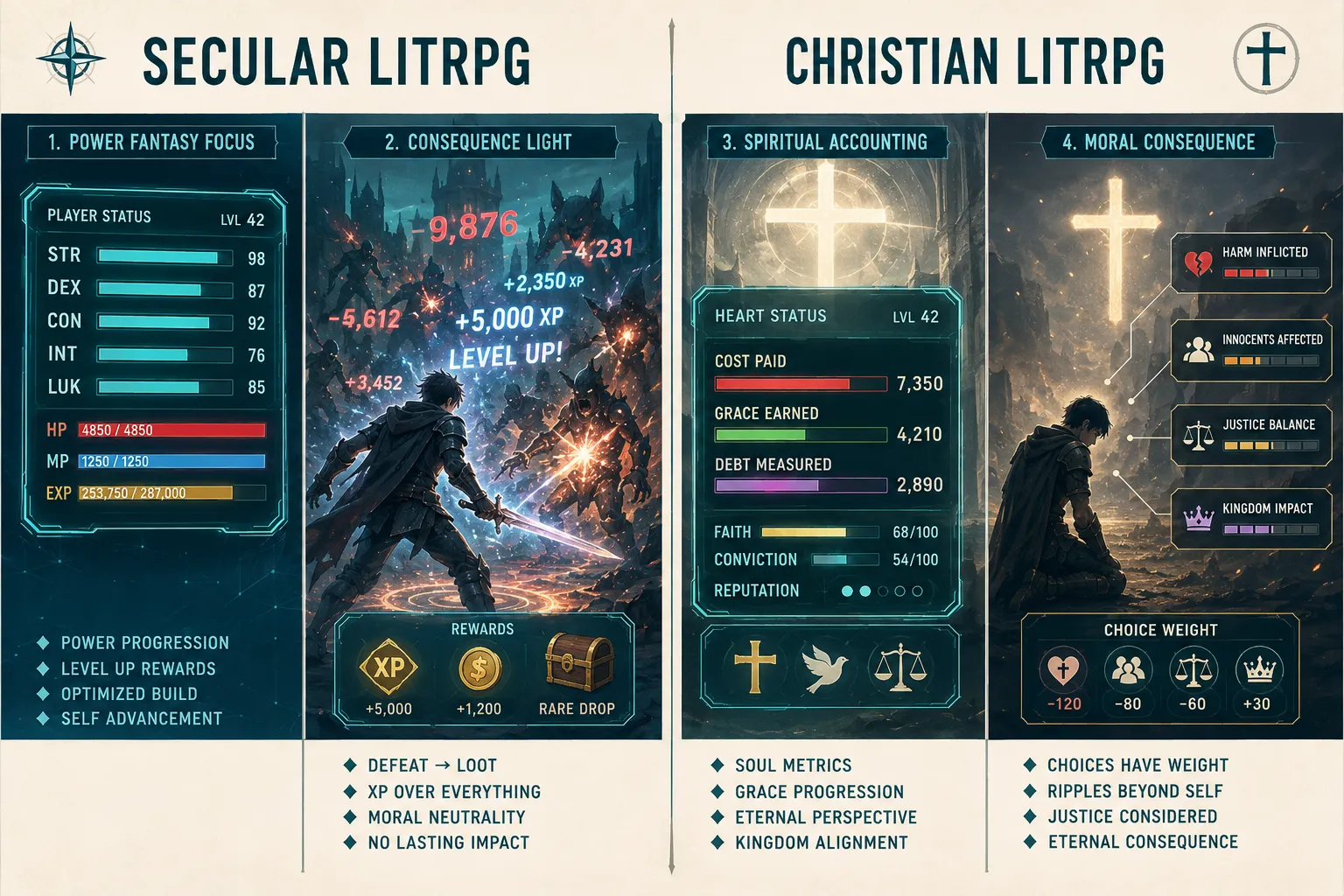
The difference from standard Christian fantasy is also worth naming. Christian fantasy often uses allegory or secondary-world theology to explore faith themes. Christian LitRPG adds an explicit game-layer, visible mechanics, quantified growth, challenge structures, that makes the spiritual testing feel immediate and measurable rather than atmospheric.
What Makes a LitRPG Book Actually Christian-Themed?
A LitRPG book qualifies as genuinely Christian-themed when faith functions as load-bearing structure in the story, not as window dressing. Three markers tend to separate authentic Christian LitRPG from books that simply feature a cross on the cover:
- God is real within the story’s logic, not a metaphor, not a vague cosmic force, but a presence whose nature shapes the world’s moral architecture
- Progression reflects spiritual consequence, stat gains and level-ups are tied to choices that carry genuine moral weight, including failure, repentance, and restored trust
- Grace costs something, mercy arrives after real cost, not as a shortcut around difficulty; characters who receive grace have usually paid a price the reader can feel
Christian speculative-fiction writers often describe their goal as portraying God accurately while allowing flawed characters to grow, showing human brokenness as something only God can heal, rather than something the protagonist outlevels on their own. [32, 38] That’s the distinction between a Christian LitRPG and a secular one with religious aesthetics.
“Faith tested and proven through the plot, never delivered as a sermon.” That’s the standard worth holding any Christian LitRPG to.
Christian LitRPG vs. Secular LitRPG: What’s the Difference?
The mechanical surface looks similar: both use stat panels, skill trees, and progression loops. The difference lives in what the progression means and what it costs.
| Feature | Secular LitRPG | Christian LitRPG |
|---|---|---|
| Core progression drive | Power, status, survival | Spiritual formation, moral integrity |
| Failure function | Obstacle to overcome | Consequence with spiritual weight |
| Grace/mercy | Rare or absent | Central, but earned, not free |
| Moral framework | Situational, protagonist-centered | Grounded in a consistent divine standard |
| Content contract | Varies widely, often graphic | Clean: no explicit content, no profanity |
| Worldview | Humanist or neutral | God is real and present in the story’s logic |
Secular LitRPG readers who pick up a Christian title will notice the tone shift immediately, not because the mechanics change, but because the stakes change. Losing a fight in secular LitRPG costs XP. Losing a fight in Christian LitRPG might cost something closer to integrity, trust, or the character’s own account of who they are.
Is Christian LitRPG Preachy, or More Story-Focused?
The best Christian LitRPG is story-focused, and the faith shows through character choice and consequence rather than narration or scripture-dropping. When it works, readers never feel talked at, they feel the weight of a moral world where decisions matter and grace is real.
The risk of preachiness is real in any faith-based fiction, and some titles do fall into it. The warning signs are easy to spot: a character who exists mainly to deliver doctrine, a plot that pauses for theological explanation, or a conversion moment that arrives too cleanly and costs nothing. Faith under fire looks different from faith on a pedestal. The former makes for better fiction.
The stronger Christian LitRPG titles, including Silas Bellhaven’s The Measured Debt series, embed conviction in the story’s structure. Eamon Kersey’s progression at Federated Record isn’t a parable explained to the reader; it’s a reckoning that builds across three books, where the numbers he built his reputation on turn out to carry a debt he didn’t fully see. The spiritual reckoning arrives through plot, not through a character stopping to explain it.
Common Tropes in Faith-Based Game-World Fiction
Christian LitRPG draws from both its parent genres, and certain patterns appear consistently across faith-based game-world fiction:
- The Chosen One with a hidden cost, the protagonist is marked or selected, but that selection comes with a price that unfolds over the series rather than conferring immediate advantage
- Records and ledgers as moral objects, what gets written down, who controls the record, and what it costs to tell the truth once you’re holding it
- Mercy as a structural mechanic, grace appears as a game-system element, not just a theme; forgiveness might literally restore a stat or open a locked path
- The false progression trap, a character gains power through means that look legitimate but carry hidden spiritual debt, which the later books collect
- Community over solo play, unlike secular LitRPG’s lone-protagonist power fantasy, Christian LitRPG often emphasizes covenant relationships and shared burden
- Hope in the dark as a literal game state, the darkest point of the story is also the point where faith is most structurally necessary, not just emotionally comforting
Broader fandom discussion has noted that LitRPG mechanics map naturally onto biblical concepts like sanctification, moral testing, and the cost of discipleship, the progression loop itself becomes a kind of spiritual formation structure. [31]
Do You Need to Be Religious to Enjoy Christian LitRPG?
No, but the experience is different depending on where you’re standing. Readers who share the Christian worldview will find layers of resonance in the mechanics and themes that non-religious readers may read as interesting moral philosophy. The stories work on both levels because good fiction always does.
What non-religious readers should expect: a moral universe that operates on consistent principles, protagonists who fail and recover rather than simply power up, and a tone that takes the question of what you owe seriously. What they won’t find: moral ambiguity used for shock value, cheap redemption arcs, or protagonists whose faith is never tested.
Choose Christian LitRPG if you want progression fiction with real moral stakes and a coherent worldview underneath the mechanics. Look elsewhere if you want morally neutral power fantasy or grimdark progression with no redemptive arc.
Best Christian LitRPG Books on Kindle Unlimited in 2026
The catalog is small and still forming, which is worth saying plainly. The broader LitRPG genre is extremely active on Kindle Unlimited in 2026, titles like Cultivation Nerd 3 (March 2026) and Unmapped (August 2026) show that the subscription model remains standard infrastructure for the genre [9], but explicitly Christian LitRPG titles remain selective.
Notable titles to check:
- The Measured Debt series by Silas Bellhaven, three books (The Cost of Being Chosen, The Remembered Route, The Borrowed Yield) built around Eamon Kersey’s reckoning at Federated Record, where earned progression and spiritual debt are the same thing. Series page
- Canthany Rising: A Christian LitRPG Adventure (announced May 2026, released June 2026), described as combining biblical allegory, fantasy adventure, and game-inspired mechanics; notable as a short-form entry at approximately 20,300 words [2]
- Openings: A LitRPG Adventure, an earlier title in the space that blends faith themes with game-world structure [6]
⚠️ Important: KU enrollment is not permanent. Faith-based speculative titles cycle in and out of Kindle Unlimited, so availability must be verified at the time of reading. [1]
How Much Does Christian LitRPG Cost on Kindle Unlimited?
Kindle Unlimited operates as a flat-rate subscription service, subscribers pay a monthly fee and can read enrolled titles without additional per-book charges. Individual Christian LitRPG titles that are not KU-enrolled are typically available for standard Kindle purchase pricing, which varies by title and author.
For readers who primarily want Christian LitRPG, a KU subscription makes the most sense if the specific titles they want are currently enrolled. Because enrollment changes, checking a title’s current KU status before subscribing is the practical move. The subscription also opens access to the broader LitRPG catalog on Amazon [8], which is relevant for readers who want to sample the genre before committing to faith-based titles specifically.
Do Christian LitRPG Authors Use Actual Bible Verses in Their Stories?
Some do, some don’t, and the best ones tend not to lean on direct quotation as a primary tool. The more effective approach, used by authors across Christian speculative fiction, is to embed biblical themes in the story’s structure so that readers who know the text recognize the resonance without needing it flagged. [32, 38]
When Bible verses do appear, they typically function as epigraphs, character reflections, or objects within the story (a margin note, a memorized passage surfacing under pressure) rather than as narrative commentary. The distinction matters: a verse dropped into narration to explain what just happened is the story talking at the reader. A verse a character reaches for in a moment of genuine need is the story walking with them.
What Age Group Is Christian LitRPG Written For?
Most Christian LitRPG titles are written for adult readers, roughly 18 and up, though the clean content contract means they’re accessible to mature teens as well. The primary audience tends to skew toward readers who are already familiar with both Christian fiction and the LitRPG genre, meaning adults who grew up with RPGs and now want fiction that reflects their faith alongside their genre preferences.
The Silas Bellhaven catalog, including The Measured Debt, is written for adult readers who want real stakes, psychological weight, moral complexity, consequences that accumulate, without graphic content. The tone is serious without being grim, and hopeful without being naive.
Can You Read Christian LitRPG Series Out of Order?
For most Christian LitRPG series, reading in order is strongly recommended. The progression system is the point, stat growth, skill development, and spiritual debt all build on prior events. Starting mid-series means missing the earned weight of earlier choices, which is the same as watching someone receive grace without knowing what it cost them.
The Measured Debt specifically is structured so that each book’s reckoning depends on what Eamon established (and spent) in the previous one. The Borrowed Yield (Book 3) lands hardest for readers who watched the numbers accumulate from Book 1.
Edge case: Short-form or standalone Christian LitRPG titles (like the 20,300-word Canthany Rising) [2] may be designed as complete single entries and can be read independently.
How Long Are Typical Christian LitRPG Books on Kindle?
Length varies more in Christian LitRPG than in mainstream LitRPG, partly because the subgenre is still forming its conventions. Here’s a practical range:
- Short-form entries: ~15,000-25,000 words (novella length), Canthany Rising falls here at approximately 20,300 words [2]
- Standard novel length: ~60,000-90,000 words, typical for series entries like The Measured Debt books
- Serial-length: 100,000+ words, common in mainstream LitRPG but rare in Christian-specific titles at this stage of the subgenre
Mainstream LitRPG readers accustomed to long serial pacing may find some Christian LitRPG entries shorter than expected. That’s a market signal worth noting: the subgenre is still calibrating to reader expectations, and short-form entries are partly experiments in finding what the audience wants. [2]
Where Can I Find Christian LitRPG Recommendations?
Finding Christian LitRPG recommendations requires checking a few different places, since no single hub has consolidated the subgenre yet:
- Amazon’s LitRPG storefront [8], search “Christian LitRPG” or browse the LitRPG category and filter by content guidelines
- Silas Bellhaven’s author page, amazon.com/stores/Silas-Bellhaven/author/B0H42BDQBK, one of the more developed Christian LitRPG catalogs currently available
- Faith-based KU roundups, sites like Heidi McCahan’s blog compile faith-based Kindle Unlimited titles periodically [1]
- Reddit communities, r/CozyMystery and similar Christian fiction communities occasionally surface Christian-adjacent speculative fiction recommendations [5]
- Online Book Club, lists new Christian LitRPG releases as they appear [2]
The honest answer is that the community infrastructure for this subgenre is still forming. Readers who find a title they trust are well-served by following that author directly rather than waiting for a curated hub to emerge.
Mistakes New Readers Make With Christian LitRPG
Starting with wrong expectations is the most common issue. Readers coming from secular LitRPG may expect faster power escalation and morally neutral progression. Readers coming from Christian fiction may expect lighter stakes and a more devotional tone. Christian LitRPG sits between those expectations deliberately, the stakes are real, the progression is earned, and the faith is neither decorative nor preachy.
Other mistakes worth avoiding:
- Skipping Book 1 because it seems slow, the spiritual debt that matters in later books is established in the opening entries; the slow build is the point
- Expecting clean to mean safe, clean content means no graphic material, not no difficulty; characters in these books face genuine moral danger, loss, and cost
- Treating the game mechanics as the main event, in Christian LitRPG, the stat system is a lens for the spiritual story, not the story itself
- Assuming all faith-based LitRPG is the same, the subgenre is small enough that individual authors make very different choices; Silas Bellhaven’s ledger-and-record approach is distinct from a title built on biblical allegory
FAQ
Q: Is Christian LitRPG appropriate for teenagers? A: Most titles are written for adults but carry clean content, no graphic violence, no explicit material, no profanity. Mature teens who enjoy both Christian fiction and game-world stories will find them accessible.
Q: Does Christian LitRPG require knowledge of RPG games to enjoy? A: No. The game mechanics are explained within the story. Readers who have never played a tabletop or video RPG can follow the progression systems without prior knowledge.
Q: How is faith handled, is it heavy-handed? A: In the stronger titles, faith functions through character choice and consequence rather than narration or direct teaching. The goal is stories that walk with readers, not talk at them.
Q: Are there Christian LitRPG audiobooks available? A: Some LitRPG titles are available in audio format through Audible alongside their Kindle editions, but Christian LitRPG audio availability is limited at this stage of the subgenre’s development.
Q: What’s the difference between Christian LitRPG and Christian fantasy? A: Christian fantasy uses secondary-world settings and allegory to explore faith themes. Christian LitRPG adds explicit game mechanics, visible stats, leveling systems, structured challenges, that make the spiritual testing feel immediate and quantifiable.
Q: How often do new Christian LitRPG titles release? A: As of 2026, new titles are appearing but not at the volume of mainstream LitRPG. The subgenre is in active formation, Canthany Rising (June 2026) is a recent example, rather than producing a steady monthly pipeline. [2]
Q: Can I trust Christian LitRPG to stay clean throughout a series? A: Authors who establish a clean content contract at the series level, like Silas Bellhaven’s The Measured Debt, maintain it across all books. Check the series page and author brand rather than individual book descriptions.
Q: Is the Kindle Unlimited subscription worth it for Christian LitRPG specifically? A: If the titles you want are currently enrolled, yes. The subscription also opens the broader LitRPG catalog [8], which is useful for readers exploring the genre. Verify enrollment before subscribing, since KU status changes. [1]
Conclusion: Where to Start With Christian LitRPG Kindle Unlimited
The subgenre is real, it’s growing, and it’s genuinely different from both secular LitRPG and standard Christian fantasy. For readers who want progression fiction with spiritual stakes, where the numbers on a stat sheet reflect something closer to a moral ledger than a power meter, Christian LitRPG on Kindle Unlimited offers something the broader market doesn’t.
Practical next steps:
- Start with The Cost of Being Chosen (Book 1 of The Measured Debt by Silas Bellhaven), amazon.com/dp/B0HBLPPPDQ, to experience what earned progression looks like when the debt is spiritual as well as mechanical
- Browse the full Silas Bellhaven catalog at amazon.com/stores/Silas-Bellhaven/author/B0H42BDQBK, if Christian LitRPG resonates, the cozy mystery, frontier western, and covenant fantasy series carry the same rooted-in-faith promise across different genres
- Check KU enrollment at the time of reading, faith-based titles cycle in and out of Kindle Unlimited, so verify before subscribing [1]
- Read in series order, the earned weight of Christian LitRPG depends on watching the debt accumulate from the beginning
The subgenre rewards patience. Grace that costs something always does.
References
[1] Faith Based Kindle Unlimited Books – https://heidimccahan.com/2026/01/24/faith-based-kindle-unlimited-books/ [2] Book – https://onlinebookclub.org/shelves/book.php?id=731424 [6] B07vzwch9t – https://www.amazon.com/Openings-LitRPG-Adventure-Divided-Lands-ebook/dp/B07VZWCH9T [8] Litrpg Kindle Store – https://www.amazon.com/LitRPG-Kindle-Store/s?k=LitRPG&rh=n:133140011 [9] Unmapped – https://www.fantasticfiction.com/k/dakota-krout/unmapped.htm [5] Christian Kindle Unlimited Recommendations – https://www.reddit.com/r/CozyMystery/comments/15jyto1/christian_kindle_unlimited_recommendations/