
Last updated: August 31, 2026
Quick Answer: Designing faith-integrated quest lines in Christian LitRPG means structuring quests so that spiritual progression, confession, reconciliation, calling, functions as actual game mechanics with real costs and earned rewards, not as decorative scripture drops. The difference between a quest chain that feels authentically Christian and one that feels preachy comes down to a single principle: faith shows up through what the character chooses and what those choices cost, not through what the narrator explains.
Key Takeaways
- Faith-integrated quest lines work when spiritual milestones replace or augment traditional XP gates, the player earns progression through moral consequence, not just combat.
- The line between preachy and authentic is structural: preachy faith is delivered through dialogue boxes; authentic faith is embedded in quest conditions and outcomes.
- Side quests are the best place to introduce spiritual themes, they’re lower stakes, which gives players space to sit with a moral question before the main arc demands an answer.
- Redemption arcs only work as quests when they carry a mechanical cost, cheap grace is as unconvincing in a game system as it is in a novel.
- Biblical references land best when they’re embedded in world-logic (names, laws, covenants) rather than quoted directly in quest text.
- The audience for Christian LitRPG is specific: readers who want faith handled honestly, not readers who want a Bible lesson with a health bar.
- Prayer and devotion mechanics function best as reflection gates, moments that pause the loop and require the character to reckon with something before continuing.
- When a character rejects the spiritual path, the system should record that rejection honestly, not punish it theatrically.
What Makes a Quest Line Feel Authentically Christian in LitRPG
An authentically Christian quest line is one where the faith content is load-bearing, remove it, and the quest collapses. If the spiritual element could be swapped out for any other moral framework without changing the quest’s structure, the faith integration is decorative, not real.
The distinction matters because Christian LitRPG readers aren’t looking for a game with a cross on the cover. They’re looking for stories that handle faith the way faith actually works: tested, costly, and sometimes quiet. Scholars studying religion in games have noted that mainstream RPGs tend to reduce religion to a “resource system”, a stat to buff, a faction to align with, rather than an identity-shaping force [5]. Christian LitRPG has the opportunity to do the opposite.
What load-bearing faith looks like in a quest:
- The quest’s resolution requires the character to act against self-interest in a way the game system records and rewards differently than a neutral choice would.
- The NPC at the center of the quest is changed by the character’s decision, not just grateful, but genuinely altered.
- The quest’s failure state isn’t death or loss of loot. It’s a missed opportunity for reconciliation that the world remembers.
In The Measured Debt series, Eamon Kersey’s progression isn’t measured by combat power alone, it’s measured by what he’s willing to have on his record. That’s the model: faith under fire, not faith as a power-up.
How to Balance Spiritual Themes With Game Mechanics in Christian RPGs
The balance point is simple to state and hard to execute: spiritual themes should generate game mechanics, not decorate them. When a writer designs a confession mechanic, the question isn’t “how do we make this feel holy?” It’s “what does this cost the character, and what does the system give back?”
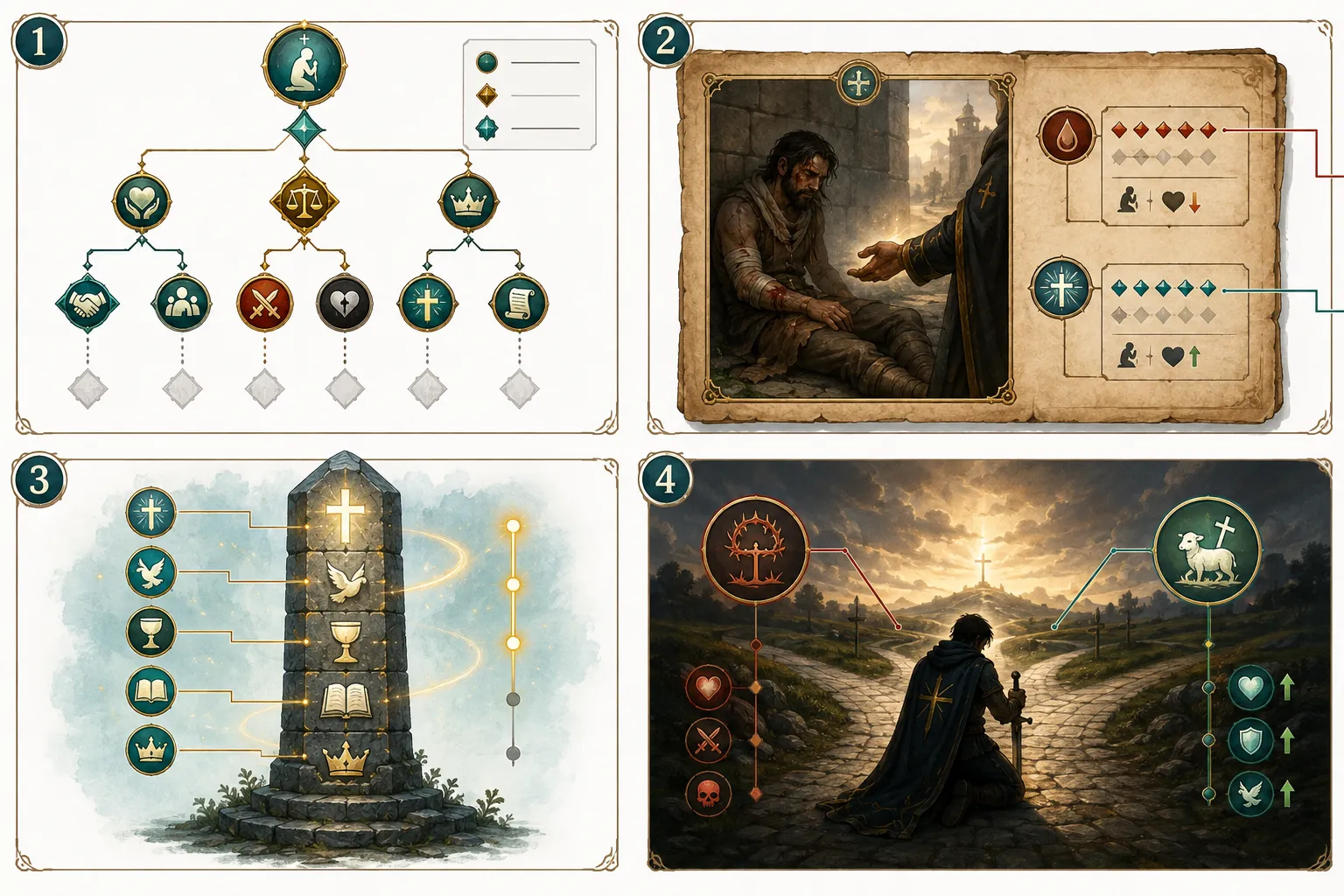
Academic work on religion in games points to a multi-layer integration model, world, rules, play, and culture all need to carry the theme, not just the narrative layer [6]. For Christian LitRPG, that means:
| Layer | What it carries | Example |
|---|---|---|
| World | Covenant history, named places, sacred objects | A town built on a broken oath; a sword that records its kills |
| Rules | Mercy costs something; grace follows cost | Forgiving an enemy reduces your combat stats temporarily |
| Play | Moral choices create branching quest states | Choosing restitution over revenge opens a locked quest chain |
| Culture | NPC memory of the character’s choices | Townsfolk reference past decisions in ambient dialogue |
The mistake most writers make is loading all the faith content into the world layer, beautiful lore, scripture-named locations, a church in every town, while leaving the rules layer completely secular. When the rules don’t reflect the worldview, the faith feels like wallpaper.
Examples of Faith-Based Side Quests That Actually Work in LitRPG Stories
Side quests are the proving ground for faith-integrated design. They work best when they’re structured around a single spiritual concept, one that the main quest will later demand at a higher cost.
Three side quest frameworks that carry real spiritual weight:
The Restitution Quest. A character discovers they benefited from someone else’s loss, not through malice, but through ignorance. The quest doesn’t ask them to fight anyone. It asks them to give something back that the system has already recorded as theirs. The reward isn’t loot. It’s a relationship restored and a stat called Standing that affects how NPCs respond in later chapters.
The Witness Quest. A dying NPC needs someone to hear their confession, not to absolve them, but to hold the record. The character gains nothing material. But the quest unlocks a later chain that would otherwise be permanently closed, because the world remembers who showed up.
The Intercession Quest. A character can spend accumulated favor (earned through prior mercy choices) to intervene in a situation they have no direct stake in. The cost is real. The outcome isn’t guaranteed. This mirrors intercessory prayer without naming it, the mechanic carries the theology.
Game-based Bible curriculum research has explored episodic quest structures paired with reflection wrap-ups, finding that the episodic format creates natural space for spiritual processing between sessions [9]. That same rhythm, act, then reflect, is exactly what side quests can provide in a LitRPG narrative.
What’s the Difference Between Preachy and Naturally Integrated Faith in Fantasy RPGs
Preachy faith is delivered. Integrated faith is discovered. That’s the whole distinction, and it determines everything about quest design.
A preachy quest hands the player a scripture reference in a dialogue box and calls it spiritual content. An integrated quest puts the character in a situation where the scripture would be true, and lets them find out whether they believe it before the narrator tells them what to think.

Religion-in-games scholars have flagged a specific failure mode: when games “mechanize” religion, they kill the mystery that makes faith meaningful [4]. The fix isn’t to make faith less mechanical, it’s to make the mechanics point toward something the system can’t fully resolve. A quest that ends with a clean answer isn’t a faith quest. A quest that ends with a choice the character has to live with is.
Quick diagnostic, ask these questions about any faith-integrated quest:
- Does the quest’s spiritual content require the character to act, or just to listen?
- Could a non-Christian writer have written this quest without noticing the faith element?
- Does the quest’s resolution feel earned, or does grace arrive before the cost is paid?
If the answer to the second question is yes, the faith isn’t integrated, it’s applied like a label after the fact.
How Spiritual Milestones Replace Traditional Level-Up Systems
Spiritual milestones function as progression gates tied to character transformation rather than accumulated points. Instead of “you’ve killed 500 enemies, you are now Level 12,” the system says “you’ve chosen mercy three times under genuine cost, something in you has changed.”
This isn’t anti-game. It’s a different theory of what progression means. Traditional LitRPG progression is additive, more stats, more power. Spiritual progression in a Christian LitRPG is often subtractive first: the character loses something (pride, a grudge, a false identity) before they gain anything.
Milestone structure for a three-act spiritual arc:
- Act 1 Milestone, Confession: Character acknowledges a specific failure to a specific person. The system records this. No immediate reward. The world responds differently to a character who has a public record of honesty.
- Act 2 Milestone, Reconciliation: Character acts to repair a broken relationship at personal cost. This unlocks quest chains that were closed to a character carrying unresolved debt.
- Act 3 Milestone, Calling: Character accepts a role they didn’t seek and can’t profit from. This is the capstone, the point where earned grace becomes visible in the system’s record.
The Measured Debt series structures Eamon Kersey’s progression exactly this way: what he’s spent defines what he’s worth, and the record doesn’t lie.
Common Mistakes Writers Make When Adding Christian Themes to Quest Design
Most mistakes come from treating faith as content to be added rather than structure to be built from. The result is a quest that feels like a Sunday school lesson wearing armor.
The most common errors:
- Scripture-dropping without context. Quoting a verse in a dialogue box doesn’t make a quest Christian. It makes it awkward. Biblical references earn their place when they’re embedded in the world’s logic, a law, a covenant, a name, not when they’re cited directly.
- Cheap grace as a reward. If a character can sin, complete a brief repentance sequence, and immediately receive full restoration with no lasting consequence, the system has taught that grace is free. It isn’t. Redemption that costs something is the only kind that reads as real [3].
- Faith as a faction. Treating Christianity as one alignment option among several (the “good” path vs. the “neutral” path vs. the “dark” path) reduces it to a preference rather than a conviction.
- Resolved faith questions. A quest that ends with the character’s doubt fully answered is a quest that doesn’t trust its reader. Leave something unresolved. Faith under fire means the fire doesn’t always go out by the final scene.
Who Is the Audience for Faith-Integrated LitRPG, and Who Isn’t
The audience for Christian LitRPG is readers who want their faith represented honestly inside a genre they already love, not readers who want a Bible study with game mechanics. That distinction matters for every design decision.
The LitRPG market is currently in what analysts are calling a “discovery crisis”, explosive release growth has made it harder for readers to find books that match their specific expectations. Faith-integrated LitRPG fills a real gap, but only if it delivers on both sides of the promise: it has to be a satisfying LitRPG and a genuinely faith-rooted story.
This audience wants:
- Real stakes, real doubt, real cost, not sanitized spiritual victories
- Clean content that doesn’t require them to filter out graphic material
- Faith that shows up in character choices, not narrator commentary
- Progression that feels meaningful beyond combat stats
This audience doesn’t want:
- A game-format devotional
- Allegory so heavy the story stops breathing
- Characters who never genuinely struggle with belief
- A conversion moment in every third chapter
The Silas Bellhaven catalog, particularly The Measured Debt series, is built for this reader: someone who wants to be walked with, not talked at.
How to Write Redemption Arcs as Actual Game Quests, Not Just Plot
A redemption arc becomes a quest when it has discrete stages, each with a cost and a condition for completion. Plot-level redemption happens to a character. Quest-level redemption is something the character does, step by step, with the system watching.
A redemption quest chain structure:
- Trigger event, Character commits or enables a specific harm. The system records it. NPCs remember.
- Recognition stage, A quest unlocks that requires the character to name what they did, to someone who was affected. No combat. No workaround. The quest won’t advance until the character speaks.
- Restitution stage, Character takes a specific action to repair the harm. This costs resources the system values, time, favor, material goods, combat advantage.
- Witness stage, A third party acknowledges the restitution. This is the grace moment, it comes after the cost, not instead of it.
- Carrying stage, The record of what happened doesn’t disappear. The character carries it forward. Some doors it closes. Others it opens.
This structure mirrors the theological arc of confession, repentance, and restoration without ever needing to name those terms in the quest text. The mechanics carry the theology.
Can You Do Christian LitRPG Without Making It Feel Like a Sermon, and How Prayer Mechanics Work
Yes, and the key is that prayer mechanics should function as reflection gates, not power sources. If prayer gives the character a stat buff, it becomes a resource. If prayer requires the character to stop, reckon with something specific, and continue differently, it becomes a spiritual act.
Prayer and devotion mechanics that work:
- Lament as a quest condition. Before a major quest chain can advance, the character must process a loss, not move past it, but acknowledge it to the system in a specific way. This mirrors the Psalms of lament without quoting them.
- Intercession as a resource expenditure. The character spends accumulated favor (earned through prior mercy choices) to affect an outcome they can’t control directly. The outcome isn’t guaranteed. The spending is the act of faith.
- Sabbath mechanics. A rest period that doesn’t just restore health but unlocks reflection dialogue, NPC conversations, journal entries, or world observations that only appear when the character chooses to stop.
A gamification framework for Christian religious education emphasizes reflection as the core mechanic, not information delivery, but the pause that lets meaning settle [9]. That same principle applies here: the best prayer mechanics create a pause the player has to choose.
What Happens When Characters Reject the Spiritual Path in a Faith-Based RPG
When a character rejects the spiritual path, the system should record that rejection honestly, not punish it theatrically. A world that makes rejection impossible or immediately catastrophic isn’t a world with real faith. It’s a world with a moral electric fence.
The honest design approach: rejection closes some doors and opens others. A character who refuses the restitution quest can still progress, but the world remembers. NPCs who witnessed the refusal respond differently. Quest chains that required a certain kind of standing are no longer available. The character isn’t punished by the system; they’re shaped by their choices, the way people actually are.
This also means the character can return. A closed door isn’t necessarily a locked one forever. Designing re-entry points, moments where a character who refused earlier can revisit the choice at greater cost, is one of the most theologically honest things a Christian LitRPG can do. Grace doesn’t expire. But it doesn’t come cheap the second time either.
Best Practices for Weaving Scripture or Biblical References Into Quest Text
Biblical references work best when they’re structural, not decorative. A quest named after a Psalm, set in a location whose geography mirrors a biblical narrative, governed by laws that echo covenant principles, that’s integration. A quest that ends with a character reciting a verse is a footnote dressed as a story.
Practical approaches:
- Name the world’s laws after covenant principles. A city that practices gleaning rights (leaving the edges of fields for the poor) doesn’t need to cite Leviticus. The practice carries the theology.
- Use biblical narrative shapes. The prodigal structure, the wilderness testing structure, the Joseph-in-the-pit structure, these are recognizable to Christian readers without being announced. Build quest chains that follow these shapes and let readers find the resonance.
- Embed scripture in artifacts, not dialogue. A sword engraved with a partial verse, a letter that quotes a psalm without attribution, a map legend that echoes prophetic language, these reward attentive readers without lecturing casual ones.
- Let characters misquote or misapply scripture. A villain who uses a verse to justify harm, or a well-meaning NPC who applies a promise out of context, these are more theologically honest than a protagonist who always gets it right.
The goal, always, is a story that walks with the reader rather than talks at them, faith under fire, hope in the dark, mercy and justice held in the same hand.
Tools and Frameworks for Structuring Faith-Based Quest Lines
No single tool does all the work, but several frameworks help writers build quest chains that hold together spiritually and narratively.
Useful structural frameworks:
- The Debt Ledger Model. Track what each character owes and is owed across the quest chain. Every spiritual milestone either adds to or reduces the ledger. This keeps grace from arriving cheaply, the ledger has to show the cost was paid.
- The Three-Gate Structure. Every major quest chain passes through three gates: recognition (the character sees the truth), cost (the character pays something for it), and witness (the world acknowledges the change). No gate can be skipped.
- The Episodic Reflection Model. Borrowed from game-based Bible curriculum research [9], this structures each quest arc as an episode with a built-in reflection beat, a moment after the action where the character (and reader) can sit with what happened before the next arc begins.
- The Multi-Layer Integration Check. Before finalizing any quest, check whether the faith content appears in all four layers: world (setting and lore), rules (mechanics and conditions), play (player choices and consequences), and culture (NPC memory and world response) [6].
For writers working in the Christian LitRPG space, The Cost of Being Chosen and its sequels in The Measured Debt series offer a working model of how these frameworks operate in published fiction, earned progression, no cheap grace, a record that doesn’t lie.
Conclusion: Building Quest Lines That Are Rooted in Faith
Designing faith-integrated quest lines in Christian LitRPG isn’t about adding spiritual content to a secular structure. It’s about building a structure where faith is the load-bearing wall, where the quest collapses without it, and where grace, when it arrives, has been genuinely earned.
The writers who get this right aren’t the ones who know the most Bible verses. They’re the ones who understand that redemption that costs something is the only kind worth writing, that hope in the dark lands harder than hope in the daylight, and that a character who doubts and chooses anyway is more convincing than one who never had to choose at all.
Actionable next steps for writers:
- Audit one existing quest in your manuscript using the Three-Gate Structure, does it pass through recognition, cost, and witness?
- Check your progression system: does faith show up in the rules layer, or only in the world layer?
- Design one side quest built entirely around a single spiritual concept, no combat required.
- Review your redemption arc for cheap grace: does grace arrive before the cost is paid?
- Read The Measured Debt series for a published model of how earned progression and faith integration work together in Christian LitRPG.
Faith under fire. Mercy and justice. Clean Christian fiction that walks with its readers, not at them. That’s the standard, and it’s worth building toward.
FAQ
What is Christian LitRPG? Christian LitRPG is a subgenre of LitRPG (literary role-playing game fiction) in which the game mechanics, world-building, and character progression are built around Christian faith themes, earned grace, covenant, redemption, rather than standard power-fantasy structures.
Do faith-integrated quest lines require explicit scripture references? No. Scripture works best when it’s structural, embedded in world laws, narrative shapes, and artifact text, rather than quoted directly in dialogue. Direct quotation often reads as preachy; structural embedding rewards attentive readers without lecturing casual ones.
How is Christian LitRPG different from Christian fantasy? Christian LitRPG uses explicit game mechanics (stats, quest logs, progression systems) as part of its narrative structure. The faith integration has to work at the mechanical level, not just the thematic level. Christian fantasy can carry faith through symbol and narrative alone.
Can a character in a Christian LitRPG reject faith entirely? Yes, and the system should record that rejection honestly rather than punishing it theatrically. Real faith requires real choice. A world where rejection is impossible or immediately catastrophic doesn’t represent faith; it represents coercion.
What’s the biggest mistake in designing faith-integrated quests? Cheap grace, designing a repentance sequence that restores the character to full standing with no lasting cost. Redemption that costs something is the only kind that reads as real.
How do prayer mechanics work without becoming a stat buff? Prayer mechanics function best as reflection gates, moments that require the character to stop and reckon with something specific before the quest can advance. The act is the mechanic, not the outcome.
Who is the target reader for Christian LitRPG? Readers who already love LitRPG and want their faith represented honestly inside the genre, not readers looking for a devotional in game format. They want real stakes, clean content, and faith that shows up in character choices.
How long should a spiritual milestone quest chain be? Long enough to make the cost feel real. A single session of play or a single chapter isn’t enough for a milestone that’s supposed to represent genuine transformation. Three to five quest stages, each with a distinct cost and condition, is a workable minimum.
Can humor exist in Christian LitRPG quest design? Absolutely. Warmth and wit aren’t in conflict with serious faith themes. The best Christian fiction, cozy mystery, frontier western, LitRPG, holds both. Humor that comes from character is always welcome; humor that deflects from cost is a design problem.
What’s the difference between a spiritual milestone and a regular level-up? A regular level-up is additive, more power, more stats. A spiritual milestone is often subtractive first: the character loses something (pride, a false identity, a grudge) before they gain anything. The progression is transformation, not accumulation.
References
[1] journal.equinoxpub – https://journal.equinoxpub.com/RST/article/view/1391 [3] Finding Christ In The Litrpg – https://www.dappledthings.org/deep-down-things/17469/finding-christ-in-the-litrpg [4] dspace.cuni.cz – https://dspace.cuni.cz/bitstream/handle/20.500.11956/110668/120342768.pdf?sequence=3&isAllowed=y [5] academic.oup – https://academic.oup.com/book/12221/chapter/161696446 [6] 12156 Article Text 21292 2 10 20140303 – https://backend.irw.uni-heidelberg.de/sites/default/files/documents/2024-03/12156-article_text-21292-2-10-20140303.pdf [9] Engaging Faith Throu – https://www.azlcci.org/2025/06/11/engaging-faith-throu/