
Last updated: September 1, 2026
Quick Answer: Christian psychological thrillers and secular thrillers both deliver genuine suspense and moral complexity, but faith-based suspense builds tension through conscience, consequence, and earned grace rather than graphic violence or shock. For readers who want real stakes without the moral or visual grime of mainstream franchises, clean Christian fiction offers something the secular market rarely does: hope that costs something to reach.
Key Takeaways
- Christian psychological thrillers use psychological and spiritual tension rather than graphic violence or profanity to generate suspense.
- Faith-based suspense treats moral dilemmas as load-bearing story elements, not decoration, characters face real consequences for their choices.
- “Clean” in Christian fiction means no graphic violence, no explicit content, and no profanity, but it does not mean sanitized or stakes-free.
- Major publishers including Baker Publishing Group and Harlequin Love Inspired are actively expanding their Christian suspense and mystery lines in 2026, signaling strong commercial demand. [6]
- Christian thrillers can and do appeal to non-religious readers who simply want well-crafted suspense without content they find exhausting or gratuitous.
- The best Christian psychological thrillers show faith under fire, characters who doubt, fail, and find grace through the plot, not through a sermon.
- Authors like Dani Pettrey, Jaime Jo Wright, and Silas Bellhaven represent a range of Christian suspense styles from romantic suspense to gothic-tinged psychological thriller.
- Redemption in faith-based suspense is earned, not handed out, which often makes the emotional payoff stronger than secular equivalents.
What Makes Christian Psychological Thrillers Different From Regular Thrillers
Christian psychological thrillers differ from secular thrillers primarily in how they generate and resolve tension. Where mainstream suspense often relies on graphic violence, explicit content, or moral nihilism to create stakes, faith-based suspense builds pressure through conscience, spiritual conflict, and the cost of truth-telling.
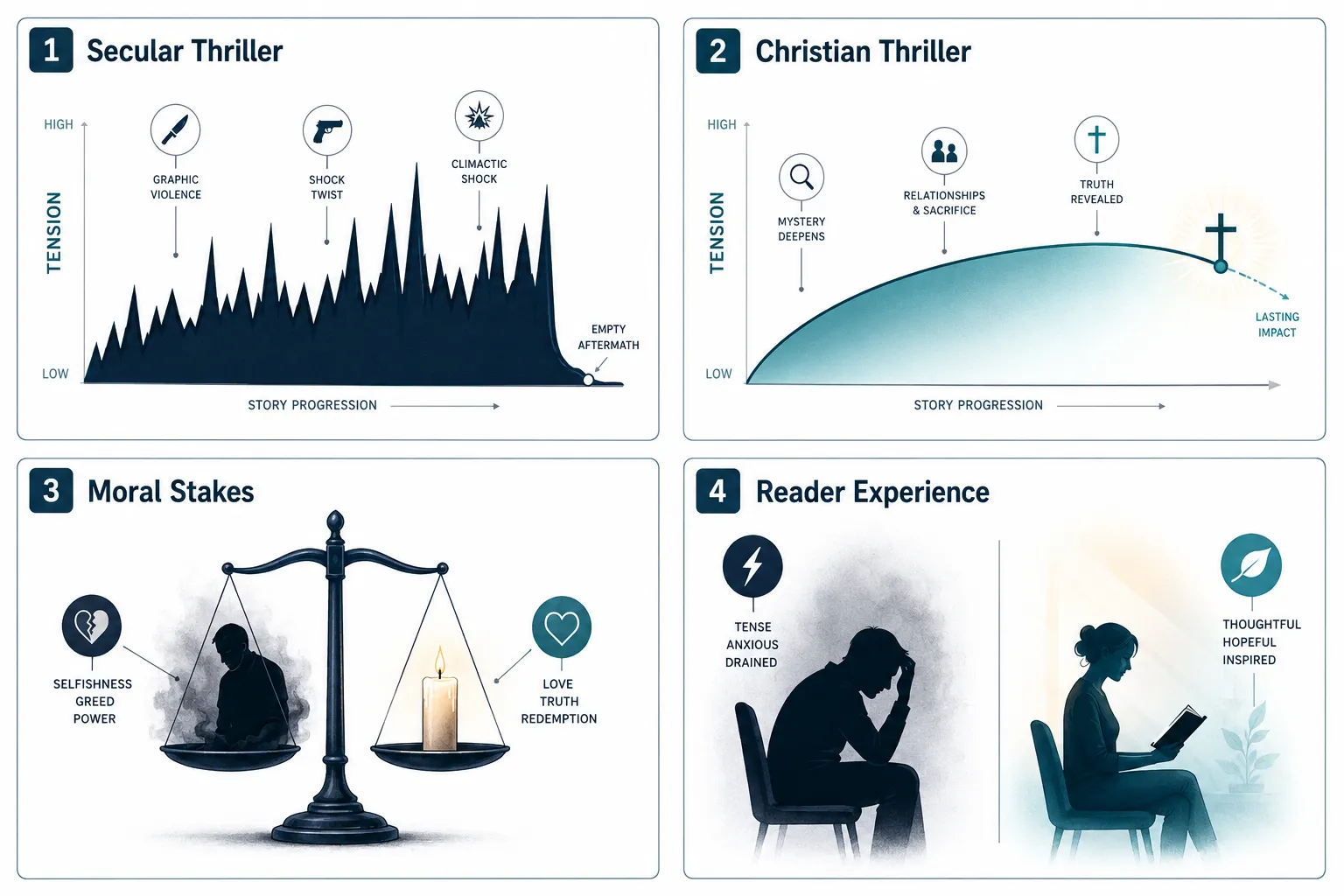
The distinction runs deeper than content filters. In a secular psychological thriller, the central question is often will the protagonist survive? In a Christian psychological thriller, the question underneath that one is what will survival cost them, and who will they be when it’s over? That second question is where faith becomes load-bearing rather than decorative.
Consider the difference in how each handles a character who discovers a dangerous secret:
- Secular thriller approach: The secret creates physical jeopardy. The protagonist acts on self-preservation instinct. Moral ambiguity is often left unresolved as a feature, not a flaw.
- Christian thriller approach: The secret creates a crisis of conscience. The protagonist must decide what truth is worth. Resolution requires a moral reckoning, not just a physical escape.
This is why faith in fiction without preaching matters so much to readers who want their worldview represented honestly. The faith isn’t a disclaimer tacked onto the back cover, it’s the engine running the plot.
Do Faith-Based Thrillers Have Less Violence and Profanity Than Secular Ones?
Yes, and that’s a deliberate craft choice, not a limitation. Clean Christian fiction maintains a content contract that excludes graphic violence, profanity, and explicit material, but skilled authors replace those elements with psychological and emotional intensity that can hit just as hard.
A scene doesn’t need blood to be frightening. A character doesn’t need to swear to convey desperation. What faith-based suspense trades in graphic content for is precision: the right detail at the right moment, the silence that follows a revelation, the weight of a choice made in a locked room with no witnesses.
Rachelle Gardner, president of Gardner Literary Agency, has noted that suspense fits Christian themes like “truth, justice and forgiveness” more naturally than some other subgenres, which explains why the category keeps growing even as it maintains its content standards. [6]
What “clean” actually means in Christian thriller fiction:
- No profanity or crude language
- No graphic depictions of violence (tension and consequence, yes, gore, no)
- No explicit sexual content
- Faith handled as lived experience, not as a lesson delivered to the reader
For a fuller breakdown of what clean means in practice, see what “clean” really means to readers.
Can You Get Genuine Suspense Without Graphic Scenes in Christian Fiction?
Absolutely, and the evidence is in the sales. The Christian suspense market has grown steadily enough that Baker Publishing Group launched a dedicated “clean and wholesome fiction” imprint in 2026, and Harlequin Love Inspired Trade is expanding into mysteries with faith-centered titles. [6]
The psychological thriller genre is actually well-suited to a clean content framework because its best tools are internal: paranoia, unreliable memory, institutional manipulation, the slow erosion of a character’s certainty about what they know. None of those require a single graphic scene to work.
“The most frightening thing in a psychological thriller isn’t what happens in the room. It’s what the character does with what they know, and what it costs them to tell the truth.”
Silas Bellhaven’s The Gathering Light series demonstrates this directly. In When Hannah Sleeps, Hannah Garrick has spent years transcribing other women’s testimonies at a Christian retreat, until her own words start appearing in someone else’s file. The horror is bureaucratic and psychological. No graphic violence required. The stakes are identity, truth, and who controls the record of someone’s pain.
How Do Christian Thrillers Handle Moral Dilemmas Differently?
Christian thrillers treat moral dilemmas as the actual subject of the story, not as obstacles between action sequences. Faith under fire means a character’s belief system is tested by the plot, and the outcome is never guaranteed to be comfortable.

In secular thrillers, moral ambiguity is often a stylistic choice, think of the antihero franchises that made shows like Dexter or Breaking Bad culturally dominant. Those stories are well-crafted, but their moral architecture is built on the premise that good and evil are negotiable. Christian psychological thrillers work from the opposite premise: good and evil are real, the cost of choosing wrong is real, and mercy, when it comes, has to be earned through the plot, not handed out as a resolution device.
Key differences in how moral dilemmas are handled:
| Element | Secular Thriller | Christian Psychological Thriller |
|---|---|---|
| Moral framework | Often relativistic or nihilistic | Grounded in conscience and consequence |
| Character failure | May be celebrated or left unresolved | Acknowledged, and carries weight |
| Resolution | Survival or revenge as satisfying end | Redemption that costs something |
| Faith’s role | Absent or used as character flaw | Load-bearing, tested through plot |
| Tone after darkness | Often bleak or cynical | Hope earned through honesty |
This is what the Silas Bellhaven brand describes as earned grace, mercy that shows up after cost, not instead of it.
Are Christian Psychological Thrillers as Intense as Secular Thrillers?
For the right reader, yes, and sometimes more so, because the stakes are personal and moral rather than just physical. A character who might lose their life is frightening. A character who might lose their integrity, their faith, or their sense of what is true is frightening in a way that lingers longer.
The intensity in Christian psychological thrillers comes from:
- Institutional betrayal, a church, a ministry, or a faith community being used as a tool of manipulation
- Spiritual gaslighting, a character’s perception of reality being undermined using the language of faith
- Conscience under pressure, knowing the right thing and being systematically prevented from doing it
- The cost of truth, what a character has to give up to tell the truth when the record has been falsified
These are not soft stakes. They’re the kind that keep readers turning pages at midnight, which is why psychological tension techniques matter as much in Christian fiction as in any other suspense subgenre.
What to Expect From Faith-Based Suspense Novels
Faith-based suspense novels deliver genuine tension, morally complex characters, and a worldview that treats good and evil as real, all within a content framework that excludes graphic material. Readers should expect:
- Characters who doubt and struggle, not cardboard saints
- A mystery or threat that has genuine stakes and a satisfying resolution
- Faith woven into the story through character choice, not through narrated theology
- A sense of hope in the dark, not cheap optimism, but the kind that has been tested
What readers should not expect: easy answers, tidy conversions, or a protagonist whose faith never wavers. The best Christian psychological thrillers put faith under fire and let it prove itself through the plot.
The 2026 publishing landscape reflects this maturity. Jaime Jo Wright’s gothic-tinged suspense, Elizabeth Goddard’s wilderness thrillers, and the growing Amish mystery subgenre all demonstrate that Christian suspense has moved well past inspirational romance with a mild threat attached. [6]
Common Themes in Christian Suspense That Secular Thrillers Don’t Explore
Several thematic territories appear consistently in Christian psychological thrillers that secular thrillers rarely touch, not because secular authors lack the skill, but because the worldview that makes those themes meaningful isn’t present.
Themes specific to faith-based suspense:
- Mercy and justice in tension, the question of whether forgiveness and accountability can coexist, and what it costs to hold both
- The corruption of sacred institutions, when a church, ministry, or faith community becomes the source of harm, the betrayal carries a specific weight that secular thrillers can’t replicate
- Testimony and truth, who controls the record of someone’s experience, and what happens when that record is falsified
- Redemption that costs something, not a feel-good ending, but a genuine reckoning that changes the character permanently
- Hope in the dark, the conviction that meaning exists even in suffering, which shapes how stories end
These themes are why readers who want faith-based fiction for secular readers often find Christian psychological thrillers more emotionally satisfying than their secular counterparts, the moral architecture is more honest about what darkness costs.
How to Find Christian Thrillers That Aren’t Preachy
The best Christian psychological thrillers show faith through character choice and consequence, not through narrated scripture or conversion scenes. If a book feels preachy, it’s usually because the author is telling the reader what to believe rather than letting the story demonstrate it.
Signs a Christian thriller is story-first, not sermon-first:
- Characters fail, doubt, and make wrong choices, faith is tested, not assumed
- Scripture or prayer appears when it’s organic to the character’s situation, not as a chapter-closing moral
- The antagonist has a coherent internal logic, not just a “godless” label
- The resolution requires the protagonist to act, not just to pray and wait
- The tone is honest about hard things rather than softening them for comfort
The Silas Bellhaven catalog is built on this principle, what the brand calls “walking with readers, not talking at them.” For a broader look at how Christian authors keep story first while still exploring spiritual themes, see faith in fiction without preaching.
Authors worth trying if you want non-preachy Christian suspense:
- Jaime Jo Wright (gothic suspense with deep psychological tension)
- Dani Pettrey (romantic suspense in law enforcement settings)
- Silas Bellhaven, The Gathering Light series (institutional psychological thriller, clean content)
Do Christian Thrillers Appeal to Non-Religious Readers?
Many do, particularly readers who are simply fatigued by the content levels of mainstream psychological thrillers and want well-crafted suspense without graphic material. Baker Publishing Group’s 2026 launch of a “clean and wholesome” imprint explicitly targets readers who want low-violence, low-profanity fiction regardless of their faith background, recognizing that the audience for clean content is broader than the explicitly Christian market. [6]
A non-religious reader picking up a Christian psychological thriller will find:
- Competent plotting and genuine tension
- Morally complex characters who feel real
- A worldview that takes good and evil seriously
- An ending that earns its resolution
What they won’t find is content designed to convert them. The best Christian thrillers are written for readers who want stories that walk with them, whatever their starting point.
Best Christian Suspense Books That Don’t Have Graphic Content
The Christian suspense category in 2026 is more varied than it has ever been. [6] Here are strong starting points across different suspense styles:
Psychological thriller (institutional/domestic):
- When Hannah Sleeps, Silas Bellhaven (The Gathering Light, Book 1), view on Amazon
- When the Voice Breaks, Silas Bellhaven (The Gathering Light, Book 2), view on Amazon
- When the Prayer List Opens, Silas Bellhaven (The Gathering Light, Book 3), view on Amazon
Romantic suspense (faith-centered):
- Dani Pettrey’s The Lock Directives series (HarperCollins Christian Publishing, 2026)
- Elizabeth Goddard’s wilderness suspense titles
Gothic-tinged Christian suspense:
- Jaime Jo Wright (The Resurrection of Evania James, 2026)
Cozy mystery with faith elements:
- The Mercy House Mysteries by Silas Bellhaven, beginning with A Donation to Die For
For a broader reading list, the Clean Christian Fiction TBR for 2026 covers cross-genre Kindle Unlimited options.
Conclusion
The comparison between Christian psychological thrillers and secular thrillers isn’t really about which side is darker or which side is safer. It’s about what kind of tension a reader wants to sit with, and what kind of resolution they find honest.
Secular thrillers can be brilliant. But for readers who have grown tired of graphic content as a substitute for genuine psychological depth, or who want their faith represented as something real and tested rather than ignored or mocked, Christian psychological thrillers offer something distinct: hope in the dark, earned through the plot rather than promised on the back cover.
The Gathering Light series is a good place to start if you want to see what faith under fire looks like in a clean psychological thriller. Begin with When Hannah Sleeps, where a woman who has spent years preserving other people’s testimonies discovers that someone has been rewriting her own.
If you want to explore how this same rooted-in-faith approach works across other genres, the Mercy House Mysteries and The Mercy Line western series are built on the same foundation: mercy and justice in tension, redemption that costs something, and stories that walk with readers rather than lecture them.
FAQ
What is a Christian psychological thriller? A Christian psychological thriller is a suspense novel that uses psychological tension, paranoia, manipulation, unreliable perception, institutional betrayal, as its primary source of fear, within a framework where faith is load-bearing and the content is clean (no graphic violence, profanity, or explicit material).
Are Christian thrillers less scary than secular ones? Not necessarily. The fear in Christian psychological thrillers comes from moral and psychological stakes, identity, truth, conscience, rather than graphic violence. For many readers, that kind of fear is more lasting.
Can non-Christians enjoy Christian psychological thrillers? Yes. The best Christian thrillers are built around universal questions about truth, justice, and what people do when no one is watching. Readers don’t need to share the faith to find the stories compelling.
What does “clean” mean in Christian fiction? Clean means no profanity, no graphic violence, and no explicit sexual content. It does not mean stakes-free or conflict-free, it means the author generates tension through other means.
How is faith handled in Christian thrillers without being preachy? Faith shows up through character choice and consequence, not narrated theology. A character prays because they’re desperate, not because the author wants to make a point. The story demonstrates the worldview rather than explaining it.
What’s the difference between Christian suspense and Christian romance? Christian romance centers a relationship arc; Christian suspense centers a threat or mystery. Many titles blend both (romantic suspense), but pure psychological thrillers in the Christian market focus on the threat and the moral reckoning it creates.
Are Christian psychological thrillers available on Kindle Unlimited? Many are, including the full Gathering Light series by Silas Bellhaven. The Kindle Unlimited Christian fiction category has grown significantly in 2026.
What makes The Gathering Light series different from other Christian thrillers? The Gathering Light uses institutional manipulation, a Christian retreat that turns its own testimony-preservation system against the women inside it, as the source of threat. Each book follows a new protagonist, and the faith is tested rather than assumed throughout.
Do Christian thrillers always have a happy ending? They tend toward hope rather than despair, but the best ones earn that hope through genuine cost. Resolution in Christian suspense usually requires the protagonist to act with integrity at significant personal risk, the ending is satisfying because it was paid for.
Where should a new reader start with Christian psychological thrillers? Start with When Hannah Sleeps by Silas Bellhaven for a clean, institutional psychological thriller, or with Dani Pettrey’s work for romantic suspense with faith elements. Both are widely available on Kindle Unlimited.
Is Christian suspense growing as a genre? Yes. Major publishers including Harlequin Love Inspired and HarperCollins Christian Publishing are actively expanding their suspense and mystery lines in 2026, and indie authors are releasing Christian psychological thrillers at a high rate. [6]
How do I find Christian thrillers that aren’t preachy? Look for books where faith is woven into character behavior rather than narrated explicitly. Reviews that mention “not preachy” or “faith shown through action” are good signals. The non-preachy Christian novels tag on the Silas Bellhaven blog is also a useful starting point.
References
[6] The Business of Christian Fiction – https://www.publishersweekly.com/pw/by-topic/industry-news/religion/article/70450-the-business-of-christian-fiction.html
[7] Publishers Remain Faithful to Fiction – https://www.publishersweekly.com/pw/by-topic/industry-news/religion/article/91841-publishers-remain-faithful-to-fiction.html
[9] Christian Fiction Keeps Its Allure – https://www.publishersweekly.com/pw/by-topic/industry-news/religion/article/73661-christian-fiction-keeps-its-allure.html