
Last updated: September 3, 2026
Quick Answer: Dexter Morgan is one of television’s most discussed antiheroes because his “code” raises genuine questions about justice, mercy, and moral accountability, questions Christian readers and viewers already care about deeply. Whether Dexter is appropriate for Christian audiences depends less on a blanket yes or no and more on what a viewer brings to it, what they take from it, and whether the content’s graphic elements cross personal conviction lines. For readers who want that same moral tension without the gore, a growing catalog of faith-based psychological thrillers delivers the suspense with the darkness handled honestly rather than gratuitously.
Key Takeaways
- Dexter’s “code” mirrors certain ethical frameworks but ultimately substitutes personal judgment for divine authority, a distinction that matters theologically.
- Christian critics are divided: some find redemptive value in the show’s moral questions, others cite its graphic violence and glorification of vigilante killing as disqualifying.
- The show’s core tension, justice vs. revenge, is one of Scripture’s oldest questions, which is part of why it resonates with faith-formed viewers.
- Watching Dexter as a Christian is a matter of personal conviction, not a settled cultural consensus; the graphic content is the most consistent concern across Christian commentary.
- Faith-based psychological thrillers can explore the same moral complexity, doubt, guilt, hidden identity, the cost of secrets, without graphic violence or explicit content.
- The antihero archetype is not inherently anti-Christian; Scripture is full of flawed protagonists whose moral failures drive the story forward.
- Clean Christian fiction in the psychological thriller space has grown significantly through 2026, giving readers real alternatives rather than a choice between sanitized stories and secular darkness.
- Earned grace, redemption that costs something, is the theological concept that separates meaningful dark fiction from gratuitous shock content.
What Makes Dexter Appealing to Christian Audiences
Dexter resonates with Christian audiences because it dramatizes moral questions that faith communities wrestle with constantly: what does justice actually require, who has the authority to deliver it, and what happens to a person who takes that authority on themselves.
Dexter Morgan is not appealing despite his moral complexity, he’s appealing because of it. His “code,” instilled by his adoptive father Harry, functions as a kind of prescriptive ethics: only kill those who have killed, follow the rules, protect the innocent. That structure echoes retributive justice frameworks that appear throughout Christian ethical tradition [2]. The show essentially asks its audience to sit with a character who is doing something clearly wrong in a way that feels, at least provisionally, right, and that discomfort is exactly where serious moral reflection begins.
Christian viewers who engage thoughtfully with narrative fiction often find that kind of tension valuable. It’s the same reason the Psalms include cries for vengeance alongside prayers for mercy. The question isn’t whether darkness exists in the story, it’s whether the story handles that darkness with honesty about its cost [3].
Is Dexter Morally Acceptable for Christian Viewers, and Can Christians Watch It Without Compromising Values
There is no single Christian answer to whether Dexter is acceptable viewing. Christian commentary on the show ranges from thoughtful engagement to firm caution, and both positions are held by serious believers.
The most consistent concern across Christian critics is the graphic violence [5]. Dexter’s kills are depicted with forensic detail, and the show does not look away. For many Christian viewers, that level of graphic content, regardless of the moral questions underneath, crosses a personal conviction line rooted in Philippians 4:8’s instruction to dwell on what is pure and honorable. Crosswalk’s Dr. James Emery White has pointed to shows like Dexter as examples of content that normalizes what should disturb us [5].
On the other side, writers at outlets like Christ and Pop Culture have argued that Dexter’s premise, “we are all serial killers inside”, actually aligns with a Reformed understanding of total depravity: the capacity for darkness lives in every human heart, and pretending otherwise is its own kind of dishonesty [3]. Reel World Theology has similarly explored how shows like Dexter and Breaking Bad use moral depravity not to celebrate it but to trace its consequences [2].
A practical framework for Christian viewers considering Dexter:
- Content sensitivity: The graphic violence is real and consistent. If that crosses your personal conviction threshold, no amount of theological depth changes that calculus.
- Engagement posture: Watching critically, with awareness of what the show is doing morally, is different from passive consumption.
- Community context: Watching alone vs. discussing with a thoughtful group changes the experience significantly.
- Age and maturity: This is not a show for younger viewers or those in early recovery from trauma.
The Reddit communities for both r/Christian and r/Christianity have hosted active threads on this exact question in 2026, with responses ranging from “I watch it and find it thought-provoking” to “the content itself is the problem, not just the themes” [1][9]. That range is honest, and it reflects genuine Christian disagreement, not confusion.
How Does Dexter Explore Themes of Justice vs. Revenge
Dexter’s central moral engine is the collision between justice and revenge, and the show never fully resolves which one Dexter is actually serving.
Harry’s code frames Dexter’s kills as justice: targeted, rule-bound, aimed at those who escaped the legal system. But the show repeatedly undermines that framing. Dexter’s motivations are personal, emotional, and often self-serving. He doesn’t kill because society needs protection, he kills because he needs to kill, and the code is the container he uses to make that need feel acceptable [8].
This is theologically significant. Sojourners has described this as “Dexter theology”, the idea that violence done in the name of justice can be sanctified by the righteousness of the cause [8]. That logic has a long and troubling history in Christian contexts, from crusades to capital punishment debates. The show, intentionally or not, dramatizes exactly why that logic is dangerous: the person wielding the sword always believes their cause is just.
Scripture draws a sharp line between vengeance and justice. Romans 12:19 reserves vengeance for God. Dexter’s code is, at its core, a human attempt to occupy that space, and the show’s tragedy is that it never quite admits that’s what’s happening.
For readers who want that same tension explored with a clear theological framework underneath, psychological thrillers with strong moral frameworks handle the justice-vs.-mercy question without letting the protagonist off the hook.
What Are the Main Ethical Issues in Dexter, and Does It Align With Christian Ethics
The main ethical issues in Dexter are vigilante justice, the glorification of a killer protagonist, the absence of legal or divine accountability, and the show’s implicit argument that some lives are worth less than others.
Key ethical fault lines from a Christian perspective:
| Ethical Issue | Dexter’s Position | Christian Ethical Response |
|---|---|---|
| Who has authority to take life | The individual, if the cause is just | God alone; delegated to lawful authority (Romans 13) |
| Basis for moral judgment | Personal code, emotional need | Scripture, community, accountability |
| Value of human life | Conditional (killers forfeit it) | Unconditional (imago Dei) |
| Redemption | Absent or unresolved | Central; available to all |
| Consequence for wrongdoing | Dexter largely escapes it | Grace comes after cost, not instead of it |
A 2016 academic study in the Journal of Religion and Popular Culture described Dexter as functioning like a “secular religion”, complete with ritual, code, and a quasi-priestly protagonist who enacts judgment [4]. That framing is useful for Christian readers: the show doesn’t reject the religious impulse, it redirects it toward a human figure with no accountability structure above himself.
Baptist ethical analysis has noted that Dexter’s code, while superficially resembling prescriptive Christian ethics, lacks the two elements that make Christian ethics coherent: a transcendent lawgiver and the possibility of genuine repentance [6]. The code is a law without a Lawgiver, which is precisely why it keeps bending.
How Does Dexter Handle Moral Ambiguity and Redemption
Dexter handles moral ambiguity well but handles redemption poorly, and for Christian readers, that gap is the most important thing to notice.
The show is genuinely good at sitting with moral ambiguity. Dexter is not presented as a hero. The audience is invited to root for him while simultaneously being shown why that’s uncomfortable. That’s skilled storytelling, and it produces real moral reflection in engaged viewers [2].
But redemption, actual, costly, transformative change, is largely absent from the original series. Dexter’s arc is one of management, not transformation. He learns to control his impulses better, to hide more effectively, to care about specific people. What he never does is reckon with the full weight of what he’s done and seek something outside himself to answer for it.
That’s the theological gap. Earned grace, the kind that costs something real before it arrives, requires a protagonist who actually faces what they’ve done. Dexter’s code is designed specifically to prevent that reckoning.
For readers who want moral ambiguity with genuine redemption, the Gathering Light series follows protagonists whose hidden identities and institutional secrets eventually demand a full accounting, and the grace that follows is not cheap.
Christian Perspective on Antihero Characters in TV and Fiction
Antiheroes are not a problem for Christian fiction, they’re actually one of its oldest tools. The issue is not moral complexity in a protagonist; it’s whether that complexity is handled with honesty about cost and consequence.
Scripture’s most compelling figures are deeply flawed: David is an adulterer and a murderer. Jonah is a reluctant, resentful prophet. Peter denies Christ three times. The difference between a biblical antihero and a secular one is not the absence of darkness, it’s the presence of accountability and the possibility of genuine change.
The push for more complex Christian suspense protagonists has been one of the defining conversations in Christian fiction through 2026. Readers are asking for characters who actually doubt, fail, and carry real moral weight, not sanitized figures who make the right choice on page three and never look back. That’s faith under fire, not moral compromise.
The antihero works in Christian fiction when:
- Their darkness is shown with honesty about its cost
- The story doesn’t let them escape consequence indefinitely
- Redemption, if it comes, is earned rather than granted as a narrative convenience
- The moral framework of the story is coherent, even if the character’s isn’t
Best Faith-Based Psychological Thrillers Like Dexter, and Faith-Based Alternatives to Dark Psychological Thrillers
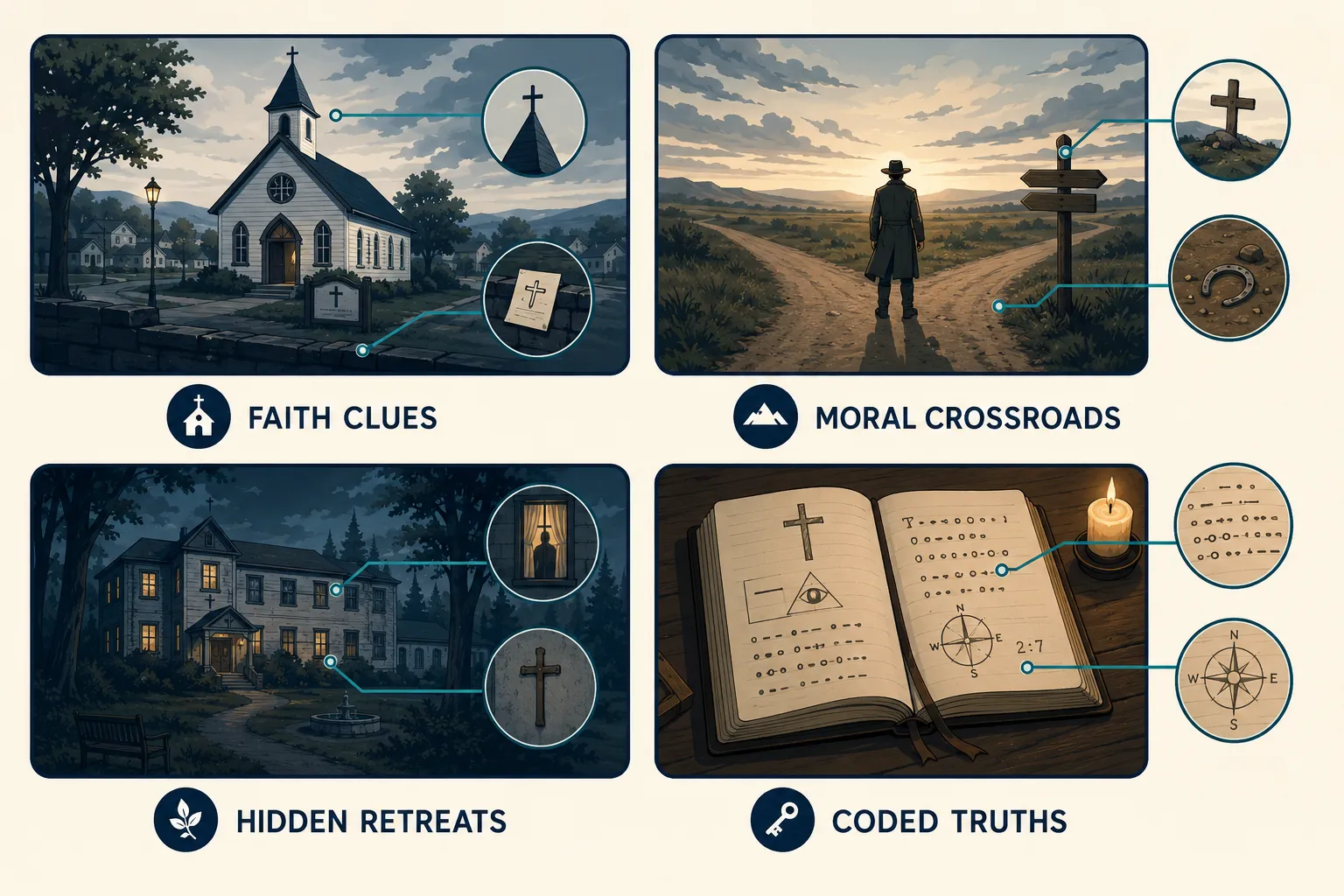
The best faith-based psychological thrillers for readers drawn to Dexter’s moral complexity are ones that take the same questions, hidden identity, justice vs. mercy, the cost of secrets, and run them through a framework where grace is real and accountability is non-negotiable.
For readers who want Dexter’s moral tension without the graphic content:
The Gathering Light series (Silas Bellhaven) is the closest structural match. Each book follows a woman whose carefully constructed identity inside a Christian retreat system begins to collapse when the system turns its own tools against her. The spine question, who controls the record of someone’s truth?, maps directly onto Dexter’s core tension, but the resolution requires genuine reckoning rather than escape.
- When Hannah Sleeps, Hannah Garrick transcribes other women’s worst nights until her own testimony appears in someone else’s file.
- When the Voice Breaks, Caris Weller built her career on careful language, until the retreat’s system starts speaking for her.
- When the Prayer List Opens, Taryn Vickers finds her own name on the prayer list, written in the hand of a woman who was supposed to be safe.
For readers who want moral complexity in a cleaner suspense register, the Mercy House Mysteries deliver genuine stakes and hidden secrets in Juniper Gap, Tennessee, where the church social is never quite as safe as it looks.
The broader market for clean Christian fiction in the psychological thriller space has expanded significantly through 2026, with new authors entering the space alongside established voices. Readers no longer have to choose between moral depth and content they can trust.
For a deeper look at how these alternatives are structured, non-violent suspense in Christian psychological thrillers walks through exactly how stakes get raised without graphic content doing the heavy lifting.
What Do Christian Critics Say About Dexter, and Common Misconceptions About Christian Viewers and Dark Media
Christian critics are not uniformly opposed to Dexter, and the assumption that they are is one of the most persistent misconceptions about faith-formed audiences.
What critics actually say:
- Crosswalk / Dr. James Emery White: The graphic content normalizes violence in ways that should concern Christian viewers, regardless of the show’s moral questions [5].
- Christ and Pop Culture: The show’s premise about universal human depravity has genuine theological resonance and shouldn’t be dismissed [3].
- Reel World Theology: Dexter and similar shows use moral darkness to trace consequences, which has value when engaged critically [2].
- Sojourners: The “Dexter theology” of violence in God’s name is a real danger, and the show dramatizes it without fully condemning it [8].
- Everyday Christian: There are biblical lessons embedded in Dexter’s premise, even if the execution is problematic [6].
Common misconceptions:
- “Christians only want sanitized, feel-good stories.”, False. The fastest-growing segment of Christian fiction in 2026 is suspense and psychological thriller, not inspirational romance.
- “Engaging with dark media means approving of it.”, Critical engagement and moral endorsement are different things. Many Christian viewers watch Dexter precisely to think through what it gets wrong.
- “If a show has good themes, the content doesn’t matter.”, Content and theme are not separable. How a story tells itself is part of what it’s saying.
The most honest position is that Christian viewers are not a monolith, and the question of whether to watch Dexter is genuinely a matter of personal conviction, not a test of theological seriousness in either direction.
Conclusion: Hope in the Dark, Redemption That Costs Something
The reason Dexter for Christian readers remains a live conversation, not just a quick content warning, is that the show touches something real. The hunger for justice. The awareness of evil that escapes punishment. The question of what a person becomes when they take moral authority into their own hands. Those are not secular questions. They are among the oldest questions faith has ever tried to answer.
The difference between Dexter and the best Christian psychological thrillers isn’t that one is dark and the other isn’t. It’s that one leaves the protagonist’s reckoning perpetually deferred, while the other insists that grace, when it finally comes, has to mean something. Redemption that costs nothing is not redemption. It’s just a clean exit.
For readers ready to explore that territory with their faith intact rather than bracketed, the options in 2026 are genuinely good. Start with When Hannah Sleeps if you want the institutional dread and hidden-identity tension. Start with A Donation to Die For if you want the moral weight carried in a warmer register. Browse the full Silas Bellhaven catalog if you want stories rooted in faith that walk with you rather than talk at you.
The dark doesn’t have to be avoided. It just has to be handled honestly, and hope has to be earned.
FAQ
Q: Is Dexter appropriate for Christian viewers? A: It depends on personal conviction. The graphic violence is the most consistent concern among Christian critics. The moral questions the show raises have genuine theological value, but the content level is significant and not suitable for all viewers [5][9].
Q: What is the “Dexter code” and how does it relate to Christian ethics? A: The Dexter code is a rule-based system for vigilante killing: only target killers who escaped justice, follow the rules, protect the innocent. It mirrors retributive justice frameworks but lacks a transcendent lawgiver and any mechanism for repentance, two things that make Christian ethics coherent [6].
Q: Does Dexter deal with redemption? A: Not in any theologically meaningful sense. The show handles moral management well but avoids the full reckoning that genuine redemption requires. Dexter’s arc is about control, not transformation [2].
Q: What are the best Christian alternatives to Dexter for psychological thriller fans? A: The Gathering Light series (Silas Bellhaven) is the closest structural match, institutional secrets, hidden identity, and the cost of controlling someone else’s truth, without graphic content. Start with When Hannah Sleeps.
Q: Can a Christian watch Dexter without compromising their values? A: Many Christian viewers do watch it critically and find it thought-provoking. Whether it compromises values depends on the individual’s convictions about graphic violence and the posture they bring to the viewing [1][9].
Q: Is the antihero archetype compatible with Christian fiction? A: Yes. Scripture is full of deeply flawed protagonists. The antihero works in Christian fiction when darkness is shown with honesty about its cost and redemption, if it comes, is earned rather than convenient.
Q: What do Christian scholars say about Dexter’s moral framework? A: Academic analysis has described Dexter as a form of “secular religion” with ritual, code, and a quasi-priestly protagonist [4]. Baptist ethical analysis notes the code mirrors prescriptive ethics but lacks a Lawgiver and the possibility of repentance [6].
Q: Why does Dexter appeal to Christian audiences specifically? A: The show dramatizes justice, mercy, and moral accountability, questions faith communities engage constantly. The discomfort of rooting for a killer who follows a code is exactly the kind of moral tension that produces serious reflection [3].
Q: Are there faith-based psychological thrillers with real stakes and no graphic content? A: Yes. The market has grown significantly through 2026. The Gathering Light series, the Mercy House Mysteries, and the Mercy Line all carry genuine moral weight without graphic violence or explicit content.
Q: What is “earned grace” in Christian fiction? A: Earned grace means redemption arrives after real cost, not as a narrative shortcut or a clean exit. The protagonist faces what they’ve done, and the grace that follows means something because of what it cost to get there.
References
[1] Can A Christian (I’m A Catholic) Watch Dexter – https://www.reddit.com/r/Christian/comments/1n0ydyh/can_a_christian_im_a_catholicwatch_dexter/
[2] Playing With Depravity: Breaking Bad & Dexter – https://www.reelworldtheology.com/playing-with-depravity-breaking-bad-dexter/
[3] Dexter: We Are All Serial Killers Inside – https://www.patheos.com/blogs/christandpopculture/2010/10/dexter-we-are-all-serial-killers-inside/
[4] Journal of Religion and Popular Culture: Dexter (Vol. 27.3) – https://utppublishing.com/doi/abs/10.3138/jrpc.27.3.2388
[5] What Not to Watch – https://www.crosswalk.com/headlines/contributors/dr-james-emery-white/what-not-to-watch-11609189.html
[6] Biblical Lessons From Dexter – http://www.everydaychristian.com/blogs/post/biblical_lessons_from_dexter/
[8] Dexter Theology: Shedding Blood in God’s Name – https://sojo.net/articles/dexter-theology-shedding-blood-gods-name
[9] Can I Watch Dexter As A Christian – https://www.reddit.com/r/Christianity/comments/1kq8ufd/can_i_watch_dexter_as_a_christian/