
Last updated: September 5, 2026
Quick Answer: Clean Christian fiction consistently outperforms graphic alternatives in long-term sales and Kindle Unlimited borrow rates because its readers are among the most loyal in publishing. They borrow in series, return to trusted authors repeatedly, and actively curate their reading lists to exclude explicit content. The result is a self-reinforcing cycle of trust, discovery, and repeat engagement that graphic-content titles rarely build at the same depth. Why clean Christian fiction outsells graphic alternatives comes down to reader psychology, content standards, and how subscription platforms like Kindle Unlimited reward binge-reading behavior.
Key Takeaways
- Christian fiction grew 14.7% year-over-year as of 2026, with the segment estimated at $75-85 million, driven by sustained demand for clean reads [7]
- The broader religious publishing market reached $926 million in U.S. retail sales, with fiction now 10.3% of Christian store sales [7]
- Religious publishing as a whole climbed to $1.409 billion in 2026, signaling that Christian fiction is part of a healthy, expanding ecosystem [4]
- Clean Christian fiction readers are disproportionately Kindle Unlimited subscribers who borrow entire series rather than single titles
- Reader loyalty in this segment is built on content trust, not just story quality, when a reader knows what she won’t find, she reads faster and borrows more
- Authors who maintain consistent content standards across a catalog see higher series read-through rates than those with inconsistent content signals
- Kindle Unlimited’s per-page-read payment model structurally rewards the binge-reading patterns that clean Christian fiction readers already practice
- Curated KU promo lists for clean and Christian romance titles are proliferating as a primary discovery mechanism in 2026 [2]
- The core demographic, women aged 35-65, prioritizes emotional stakes and faith authenticity over shock value
- Clean Christian fiction succeeds not by avoiding hard things, but by handling them with honesty rather than graphic detail
What Is Clean Christian Fiction and How Is It Different From Other Genres
Clean Christian fiction is a category of faith-rooted storytelling that excludes explicit sexual content, graphic violence, and profanity while still engaging honestly with moral complexity, doubt, grief, and human failure. It differs from both secular clean fiction and general Christian fiction in one specific way: faith is load-bearing inside the story, not decorative.
In practice, “clean” means:
- No explicit or even strongly implied sexual content (kisses-only or closed-door romance at most)
- No graphic violence, tension and consequence are present, but gore is not
- No profanity, including taking the Lord’s name in vain
- Faith handled as lived experience, not as a lesson delivered to the reader
This is different from general Christian fiction, which sometimes allows more mature content, and from secular clean fiction, which may have no faith element at all. The clean Christian reader is looking for both, and that combination is rarer and more valued than either alone.
For a deeper look at what “clean” actually means to the readers who seek it out, see what ‘clean’ really means to readers and how authors can deliver it.
Why Do Christian Fiction Readers Prefer Clean Books Over Explicit Content
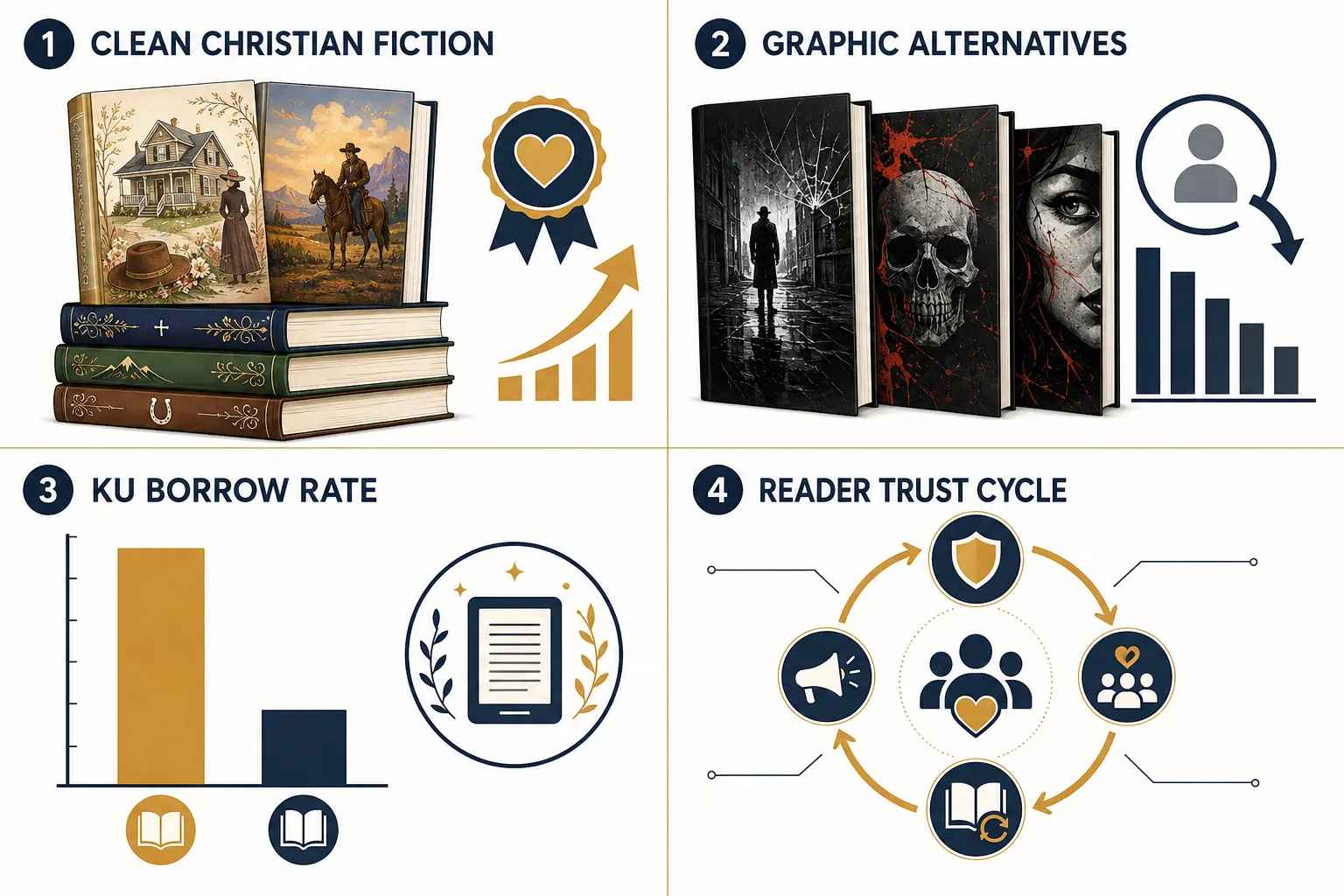
Christian fiction readers prefer clean books because content standards function as a trust contract, not a content restriction. When a reader knows a book won’t blindside her with graphic material, she reads faster, recommends more freely, and returns to the same author without hesitation.
This isn’t about avoiding hard topics. The best clean Christian fiction, psychological thrillers, frontier westerns, covenant fantasy, carries real stakes. Characters fail. Marriages fracture. Faith goes dark before it comes back. The difference is that the story earns its weight through consequence and character rather than through shock.
Why trust drives loyalty more than quality alone:
- A reader who finishes a book without being blindsided will start the next one the same night
- A reader who was surprised by graphic content she didn’t want will not return, regardless of the story’s quality
- Word-of-mouth in this community travels fast and is content-specific, “this one is safe” is a genuine recommendation
- Church groups, women’s Bible studies, and online faith communities share book lists where content standards are the first filter, not the last
The psychology here is straightforward: graphic content creates friction for this reader. Clean content removes friction. Lower friction means more borrows, faster series completion, and stronger author loyalty.
How Much Do Clean Christian Fiction Books Sell Compared to Graphic Alternatives
Clean Christian fiction is not a niche, it is a measurable growth segment. Christian fiction grew 14.7% year-over-year as of 2026, with the segment estimated at $75-85 million, and industry analysis explicitly attributes this to sustained demand for clean reads [7]. The broader religious publishing market reached $926 million in U.S. retail sales, with fiction now accounting for 10.3% of Christian store sales [7].
Religious publishing as a whole climbed to $1.409 billion in 2026, confirming that Christian fiction is riding a larger wave of faith-based content consumption [4].
What this means in practical terms:
- Clean Christian fiction is growing faster than the general fiction market
- The segment is large enough to support multiple subgenres, cozy mystery, western, psychological thriller, epic fantasy, each with dedicated readership
- Publishers are taking notice: Baker Publishing Group launched a dedicated imprint for clean secular fiction, signaling that “clean” as a content standard has crossed over from a niche preference into a market signal [6]
“Clean reads” are not a compromise position, they are the product. The reader isn’t settling for less; she’s choosing more of what she actually wants.
What Is Kindle Unlimited and How Does It Affect Christian Fiction Sales
Kindle Unlimited (KU) is Amazon’s subscription reading service, readers pay a flat monthly fee and can borrow from a catalog of enrolled titles. Authors are paid per page read from a shared monthly royalty pool, not per download.
This structure matters enormously for clean Christian fiction because of how its readers actually read:
- They borrow the first book in a series, finish it in a few days, and immediately borrow the next
- They read multiple books per month, often 8-15, making the flat subscription fee highly cost-effective
- They are less likely to abandon a book mid-read than graphic-content readers who may sample widely and finish rarely
KU’s payment model rewards pages read, which means a reader who finishes a 300-page book pays the author more than one who borrows and abandons at page 40. Clean Christian fiction readers finish books. That’s not a soft claim, it follows directly from the trust dynamic described above.
For authors thinking about how to position their catalog inside KU, Kindle Unlimited strategy for Christian fiction authors covers discoverability, categories, and faith-friendly branding in detail.
Do Christian Fiction Readers Borrow More Books Than They Buy
Yes, and by a significant margin within the KU ecosystem. Clean Christian fiction readers are among the heaviest KU users in any genre. The combination of high monthly reading volume, strong series loyalty, and content-filtering behavior makes KU the natural home for this audience.
Borrow behavior patterns specific to this demographic:
- Series bingeing: Once a reader trusts an author’s content standards, she will borrow the entire backcatalog in sequence
- List-driven discovery: Curated KU promo lists for clean and Christian titles are a primary discovery channel in 2026 [2]
- Low abandonment: Clean readers who start a series rarely stop mid-series, the trust contract extends across books
- Gifting and sharing: Many readers who borrow through KU also purchase physical copies as gifts, creating a secondary sales layer
A January 2026 curated list titled “The Ultimate Clean Christian Romance & Fiction Books” highlighted dozens of titles specifically tagged as available on Kindle Unlimited, demonstrating how actively readers use KU-availability as a filter when building their reading lists [1].
What Age Group Reads the Most Clean Christian Fiction
The core demographic for clean Christian fiction is women aged 35-65, with the 45-60 bracket representing the highest engagement. This group reads more books per year than almost any other demographic, is disproportionately represented among KU subscribers, and makes purchasing decisions based on community recommendations and content trust.
What this demographic wants from fiction:
- Real stakes, characters who actually doubt, fail, and pay a cost for their choices
- Faith handled honestly, not as a tidy answer, but as something worked through across a plot
- Emotional safety, knowing the book won’t introduce content she has to put down or explain to someone nearby
- Series depth, characters and settings she can return to across multiple books
This is not a passive or unsophisticated readership. These readers are highly literate, highly opinionated about content quality, and deeply networked with other readers through church communities, Facebook groups, and faith-based book clubs. A single strong recommendation in one of those communities can move hundreds of borrows.
Men are also a growing segment, particularly for Christian fiction for men who don’t read romance, frontier westerns, psychological thrillers, and LitRPG with faith themes are drawing male readers who have historically found little in the Christian fiction market aimed at them.
What Makes Readers Stick With a Christian Fiction Series
Series loyalty in clean Christian fiction is built on three things: content consistency, earned progression, and faith authenticity. Remove any one of them and read-through rates drop.
Content consistency means the reader never has to wonder whether book four will suddenly introduce content that wasn’t in books one through three. This sounds simple, but it’s the single most common reason readers abandon a series mid-run.
Earned progression means characters change because of what happens to them, not because the plot needs them to. Grace shows up after cost, not instead of it. A character who finds faith in chapter two and never doubts again is not a character, she’s a resolution. Readers who’ve lived actual faith know the difference.
Faith authenticity means the story walks with the reader rather than talking at her. When faith shows up as a lived, doubted, worked-through thing, not as a sermon delivered by a character who has all the answers, readers recognize it as true. That recognition is what creates the emotional bond that keeps them coming back.
For more on how faith can drive plot without becoming preachy, see faith in fiction without preaching: how Christian authors keep story first.
Is Clean Romance Fiction More Profitable Than Explicit Romance in the Christian Market
Within the Christian and faith-adjacent market, yes. Clean romance consistently outperforms explicit alternatives because the audience actively filters for it and the community amplification effect is stronger.
In March 2026, a curated “Clean & Christian Romance Kindle Unlimited Promo” organized by author Sophie Toovey demonstrated the commercial logic clearly: every title had to meet strict content standards (kisses-only or closed-door romance, no strong language, family-safe genres), and the promo was structured specifically around KU availability [2]. The fact that authors and marketers are building entire promotional campaigns around clean content standards, not just tagging it as a feature, signals that “clean” has become the primary value proposition, not a secondary filter.
Why clean romance outperforms explicit romance in this market:
- The clean reader will not read explicit content regardless of story quality, there is no crossover audience to win
- The explicit reader will sometimes read clean content if the story is strong enough, the clean author has a larger potential audience
- Community recommendations in faith spaces specifically exclude explicit titles, removing them from the most powerful discovery channel in the market
Can Graphic Novels Succeed in the Christian Market
Graphic content, meaning explicit sexual content, graphic violence, or heavy profanity, faces a structural disadvantage in the Christian fiction market that story quality cannot overcome. The reader’s content filter is applied before she reads the first page. A book that fails the content check never gets the chance to prove its story.
This doesn’t mean Christian fiction must be soft or conflict-free. The most successful titles in the space, psychological thrillers, frontier westerns with genuine moral weight, fantasy with real darkness, carry significant tension. The distinction is between tension and graphic content. Tension is what the reader came for. Graphic content is what she came to avoid.
The practical ceiling for graphic content in this market:
- Christian bookstore placement requires content standards that exclude graphic material
- KU promo lists for faith-based readers filter explicitly for clean content [2]
- Community word-of-mouth, the primary discovery channel, will not carry a graphic title regardless of its quality
- Cross-genre authors who allow graphic content in one series find it contaminates reader trust across their entire catalog
What Do Christian Fiction Readers Actually Want in a Story
They want stories that cost something. Not suffering for its own sake, and not a clean exit from hard things, but earned grace. A character who finds mercy after it has been genuinely withheld. A faith that holds not because the plot was kind to it, but because it was tested and didn’t break.
The specific story elements this readership responds to:
- Moral complexity without moral relativism, characters face genuine ethical weight, and choices have real consequences
- Doubt that is taken seriously, a character who questions God is more believable than one who never does
- Community and place, small towns, frontier settlements, secondary worlds with emotional specificity
- Redemption that costs something, not a dramatic conversion moment, but a slow, costly turning
- Hope in the dark, not the absence of darkness, but light that holds inside it
This is why series like the Mercy House Mysteries and The Mercy Line build the kind of loyalty they do. Juniper Gap, Tennessee and the railroad courts of Mercy Crossing are places with real weight, and the faith inside those stories is faith under fire, not faith on display.
For readers who want to explore what this looks like across genres, how to find clean Christian fiction across every genre is a practical starting point.
How Do Subscription Services Like Kindle Unlimited Change Reader Behavior
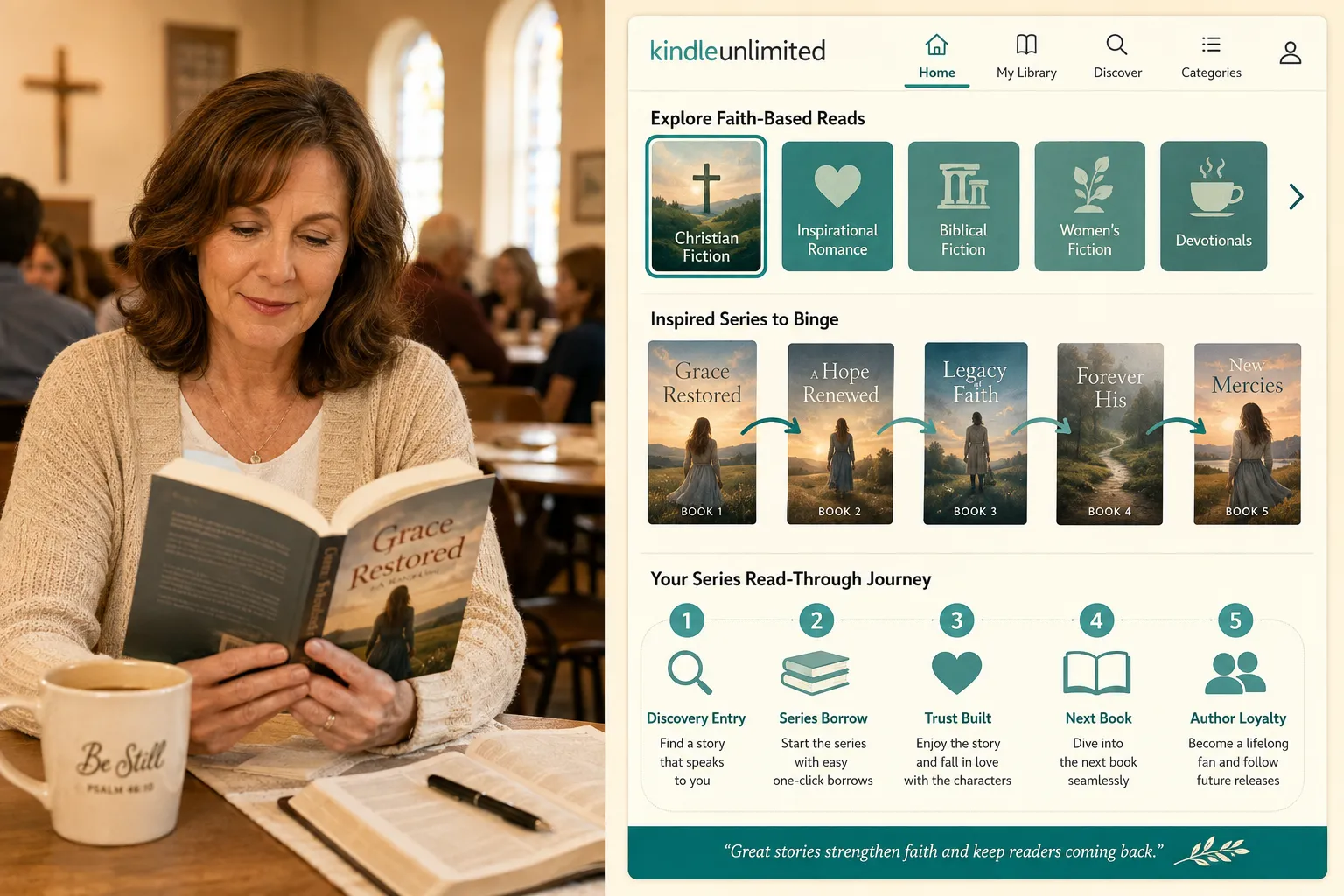
KU changes reader behavior in ways that specifically benefit clean Christian fiction authors. The subscription model removes the per-book purchase decision, which lowers the barrier to trying a new author. But it also changes what happens after the first book.
How KU reshapes the reading cycle for this demographic:
- Reader discovers a new series through a curated list or community recommendation
- She borrows book one, no financial risk beyond her monthly subscription
- She finishes it the same week and borrows book two immediately
- By book three, she has established a content-trust relationship with the author
- She begins recommending the series to her reading community
- She purchases physical copies as gifts, adding a sales layer outside KU
This cycle is more powerful for clean Christian fiction than for any other genre because the trust established in step four is content-based, not just quality-based. She knows what she’s getting. That certainty accelerates every step of the cycle.
Curated KU lists for clean and Christian titles are proliferating as a discovery mechanism precisely because they compress step one, the discovery, into a pre-filtered, trust-ready list [1][2].
Conclusion: What This Means for Readers and Authors in 2026
The data and the psychology point in the same direction. Why clean Christian fiction outsells graphic alternatives isn’t a mystery, it’s the natural result of a readership that knows exactly what it wants, has the community infrastructure to find it, and uses subscription platforms in ways that reward author consistency and series depth.
For readers, the practical takeaway is simple: the clean Christian fiction market in 2026 is larger, more varied, and more available through KU than it has ever been. There are series worth your entire subscription across cozy mystery, frontier western, psychological thriller, epic fantasy, and LitRPG, all of them rooted in faith handled honestly.
Actionable next steps for readers:
- Browse curated KU lists for clean Christian fiction to find new series without content risk
- Look for authors with deep backcatalogs, the binge-reading payoff is real
- Check best Christian fiction books: five trilogies worth your Kindle Unlimited subscription for a vetted starting list
For authors, the signal is equally clear: content consistency is not a marketing constraint, it’s the product. Readers who trust your content standards will finish your books, borrow your backcatalog, and tell everyone they know. That’s not a small thing. That’s the whole engine.
FAQ
What does “clean” mean in clean Christian fiction? Clean means no explicit sexual content, no graphic violence, and no profanity. In Christian fiction specifically, it also means faith is handled as lived experience rather than as a lesson or sermon.
Why do clean Christian fiction readers use Kindle Unlimited so heavily? Because they read high volumes, often 8-15 books per month, and the flat subscription fee makes KU highly cost-effective. They also borrow entire series at once, which fits the KU model perfectly.
Is clean Christian fiction growing or shrinking as a market? Growing. Christian fiction grew 14.7% year-over-year as of 2026, with the segment estimated at $75-85 million, driven specifically by demand for clean reads [7].
What age group reads the most clean Christian fiction? Women aged 35-65 are the core demographic, with the 45-60 bracket showing the highest engagement. This group reads more books per year than almost any other demographic.
Can a Christian fiction book have real tension and still be clean? Yes. The best clean Christian fiction, psychological thrillers, frontier westerns, covenant fantasy, carries significant moral weight and genuine stakes. Clean means no graphic content, not no conflict.
Why do clean Christian fiction readers have higher series loyalty than other readers? Because their loyalty is built on content trust, not just story quality. Once a reader knows an author’s content standards, she borrows the entire backcatalog without hesitation.
Do men read clean Christian fiction? Yes, and the segment is growing, particularly in frontier westerns, psychological thrillers, and LitRPG with faith themes. These subgenres attract male readers who have historically found little in the Christian fiction market aimed at them.
How does word-of-mouth work differently in the Christian fiction community? Content standards travel as part of the recommendation. “This one is safe” is a genuine endorsement in faith communities, church groups, and women’s Bible studies, and it carries significant weight.
What makes a Christian fiction series worth bingeing on KU? Content consistency across the series, earned character progression, and faith that is tested rather than performed. Readers who find all three will borrow the entire series the same week.
Is clean romance more profitable than explicit romance in the Christian market? Within the Christian and faith-adjacent market, yes. The clean reader will not cross over to explicit content regardless of story quality, but the explicit reader will sometimes read clean content if the story is strong enough.
What is the biggest mistake authors make in the clean Christian fiction market? Inconsistent content standards across a catalog. A single book that violates the content contract can break reader trust across an author’s entire series lineup.
Where can readers find curated clean Christian fiction lists for KU? Faith-based book communities, church reading groups, and curated KU promo lists are the primary channels. In 2026, these lists are proliferating as a discovery mechanism specifically because they pre-filter for content standards [1][2].
References
[1] 2026 Must Read Books – https://www.designingtomorrow.net/2026-must-read-books/
[2] Clean Christian Romance Kindle Unlimited Promo Discover Your Next Wholesome Read 2 – https://sophietoovey.com/2026/03/01/clean-christian-romance-kindle-unlimited-promo-discover-your-next-wholesome-read-2/
[4] Marketersmedia 2026 4 17 Christshare Releases Report On Christian Reading Trends In 2026 – https://markets.financialcontent.com/lightport.lightport8/article/marketersmedia-2026-4-17-christshare-releases-report-on-christian-reading-trends-in-2026
[6] Baker Publishing Group Launches Imprint For Clean Secular Fiction – https://www.publishersweekly.com/pw/by-topic/industry-news/religion/article/97986-baker-publishing-group-launches-imprint-for-clean-secular-fiction.html
[7] Christian Fiction 14.7 Yearly Surge Dramatic Market Expansion Data – https://www.firmenpresse.de/pressrelease734029/christian-fiction-14-7-yearly-surge-dramatic-market-expansion-data.html