Last updated: September 6, 2026
Quick Answer: Stephen King’s The Long Walk, now streaming on HBO Max after its 2025 theatrical release, is one of the most psychologically intense stories in King’s catalog, but its graphic violence, profanity, and absence of any redemptive framework make it a hard pass for most faith-conscious readers. The good news: the moral tension at the heart of the story, conscience under pressure, the cost of survival, what a person will do when no one is watching, is exactly what the best Christian psychological thrillers are built around. Clean-read alternatives exist, and they carry the same weight without the content that makes The Long Walk difficult for Christian audiences.
Key Takeaways
- The Long Walk is rated extreme for violence, language, and psychological distress by multiple content-warning databases and Christian reviewers (August 2026 assessments)
- The story’s core themes, moral endurance, the cost of survival, systemic injustice, are deeply compatible with Christian fiction’s concerns, even if the execution is not
- Christian psychological thrillers can match secular suspense for intensity by raising the stakes spiritually and relationally rather than graphically
- The Christian fiction market is growing fast, with suspense identified as a leading growth category [1][2]
- Clean-read thrillers avoid graphic violence, profanity, and explicit content while preserving genuine moral jeopardy
- Silas Bellhaven’s The Gathering Light series (When Hannah Sleeps, When the Voice Breaks, When the Prayer List Opens) is a direct alternative for readers drawn to institutional psychological suspense
- Kindle Unlimited now carries a substantial catalog of faith-forward suspense, making it easier than ever to find alternatives
- The best Christian suspense treats faith as load-bearing, not as a tidy answer, but as something tested and proven through what the character actually does
What Is Stephen King’s The Long Walk About?
The Long Walk is a dystopian psychological thriller, originally published in 1979 under King’s Richard Bachman pen name, set in a near-future America where 100 teenage boys compete in a government-sponsored endurance walk. The single rule: maintain a pace of four miles per hour or receive a warning. Three warnings and you’re shot. The last walker alive wins. No explanation is given for why the boys entered. No rescue is coming.
The 2025 film adaptation, directed by Francis Lawrence, leaned hard into the psychological intensity of the source material. Since its HBO Max streaming launch in July 2026, it has climbed rapidly to the top of streaming charts, bringing a new wave of readers back to the original novel and raising fresh questions about its content.
At its core, the story is about what happens to human conscience and human connection when a system strips away every option except endurance. That question, what does a person owe to another person when survival is on the line?, is genuinely theological. But King’s execution is unsparing in ways that matter to faith-conscious readers.
Is The Long Walk Appropriate for Christian Readers?
For most Christian readers, The Long Walk presents significant content concerns. Content-warning databases and Christian reviewers converging in August 2026 assessments classify the book and film as extreme for: graphic depictions of death and bodily deterioration, sustained profanity, and a worldview that offers no redemptive framework, no grace, no mercy, no hope that costs anything to earn.
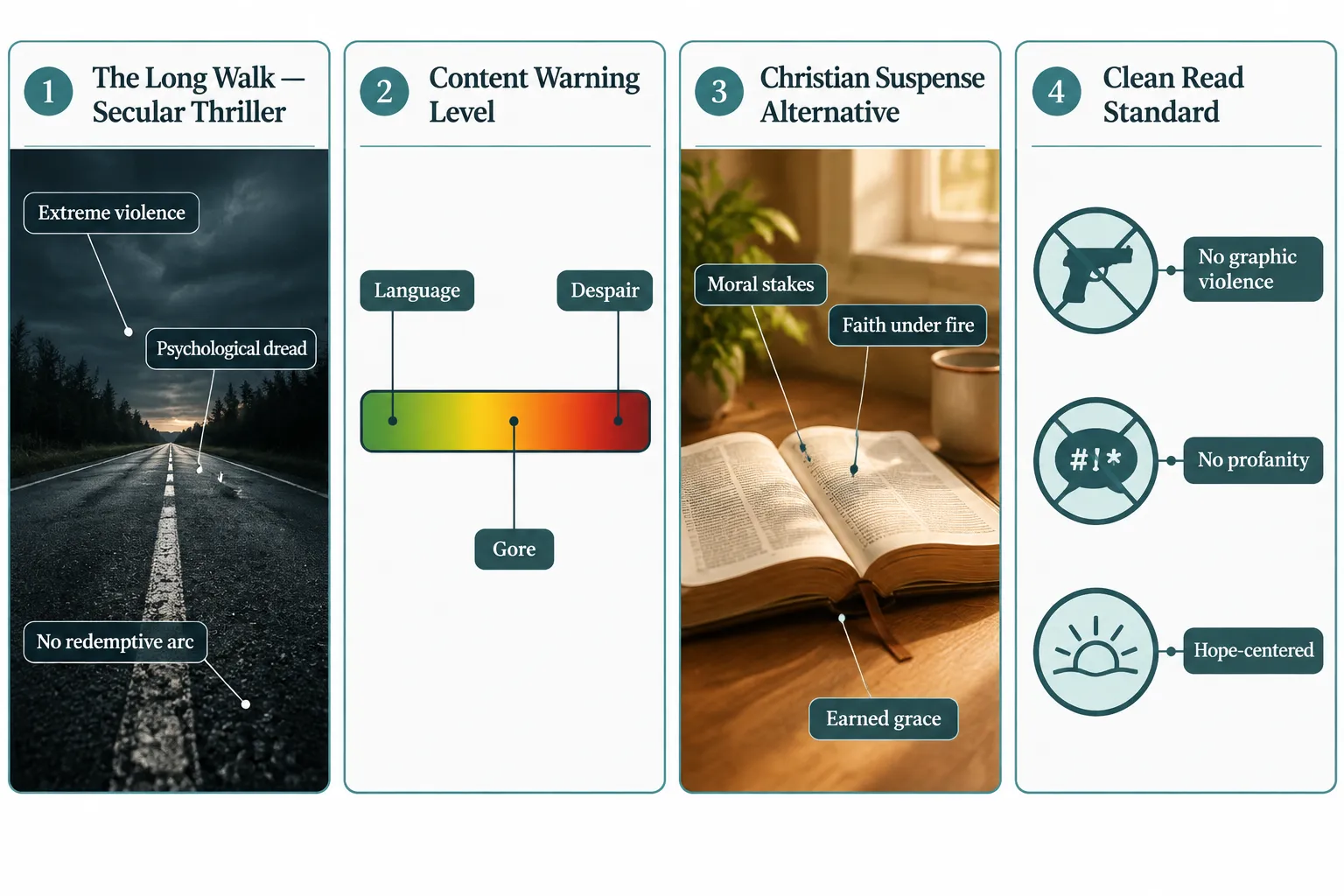
That last point matters most. The story doesn’t just contain dark content, it argues, structurally, that darkness is all there is. Characters form bonds, and those bonds are severed without meaning. The system wins. That’s a coherent artistic choice, but it runs directly against the conviction that stories should carry hope, not cheap hope, not easy answers, but the kind of hope that has been through something real.
Content concerns at a glance:
- Graphic violence and death (sustained throughout)
- Strong profanity
- Psychological despair without resolution
- No faith element or redemptive arc of any kind
- Francis Lawrence’s adaptation amplified the graphic intensity of the source material
For readers who want the themes without the content, the answer is to look for Christian suspense that takes the same moral questions seriously, and then actually answers them.
Does The Long Walk Have Religious or Moral Themes?
Yes, and this is worth sitting with, because it’s why the story draws thoughtful readers in the first place. The Long Walk is saturated with questions that belong to theology: the nature of sacrifice, the legitimacy of unjust authority, what one person owes another when both are dying, and whether endurance has any meaning if nothing is waiting on the other side.
King has never been a religious writer, but he has always been a moral one. The Long Walk functions almost as an anti-theodicy, a story that asks “where is God in a system designed to destroy the innocent?” and answers with silence. For Christian readers, that silence is the problem. The question is exactly right. The answer is where the story and a faith-rooted worldview part ways.
Christian suspense takes the same question, faith under fire, mercy and justice in conflict, what a person will do when the cost is real, and refuses to let silence be the last word.
How Violent Is The Long Walk Compared to Other King Books?
The Long Walk is considered one of King’s most relentlessly grim works precisely because the violence is not episodic, it is constant and cumulative. Unlike The Shining or It, where horror arrives in peaks, The Long Walk builds dread through attrition. Characters die slowly, in detail, over the course of the entire narrative.
Francis Lawrence’s 2025 adaptation made deliberate choices to heighten the physical and psychological intensity, which classification offices and Christian reviewers alike flagged as extreme content in their August 2026 reviews.
By comparison:
- The Shining, intense horror, supernatural violence, but with more narrative breathing room
- Misery, graphic in specific scenes, but structured around a single contained threat
- The Long Walk, sustained graphic content from roughly the first quarter through the end
For readers who found Misery manageable but The Long Walk too much, that distinction is useful. The graphic content here isn’t incidental, it’s the mechanism of the story.
What Makes a Thriller a Clean Read vs. Explicit?
A clean-read thriller maintains genuine suspense and moral stakes while avoiding graphic violence, profanity, and explicit sexual content. The distinction is not about avoiding darkness, it’s about how darkness is handled. For more on this, see non-violent suspense in Christian psychological thrillers: raising stakes without graphic content.
Clean read means:
- Threat and danger are real, but deaths occur off-page or without graphic detail
- Language stays clean, tension is built through situation and character, not profanity
- Sexual content is absent or limited to non-explicit romantic tension
- The story’s moral weight comes from consequence and character choice, not shock
Explicit means:
- Violence is described in physical detail for effect
- Language is used as a tonal tool throughout
- Sexual content may be present and described
The key insight for faith-conscious readers: clean does not mean low-stakes. The best Christian psychological thrillers carry enormous weight, they just build it differently. Psychological suspense, relational jeopardy, institutional corruption, the slow unraveling of a character’s sense of reality, none of those require graphic content to hit hard. See also: Christian psychological thrillers vs. secular thrillers: why faith-based suspense feels different.
Best Christian Suspense Novels Like The Long Walk, Clean-Read Psychological Thrillers for Faith-Conscious Fans
The best alternatives to The Long Walk for Christian readers share its psychological intensity and moral seriousness, but carry hope as a structural element, not a decoration.

Silas Bellhaven, The Gathering Light series
This is the closest direct alternative for readers drawn to The Long Walk‘s institutional horror and psychological unraveling. The series is set at Gathering Light Restoration Retreat, where every testimony is preserved word for word, and that careful record-keeping becomes the mechanism of control and harm.
- When Hannah Sleeps, Hannah Garrick has transcribed a hundred women’s worst nights, until her own testimony starts appearing in someone else’s file. The spine question: who controls the record of someone’s truth?
- When the Voice Breaks, Caris Weller built her career on careful language, until the retreat’s own system starts speaking for her instead.
- When the Prayer List Opens, Taryn Vickers finds her own name on the retreat’s prayer list, written in the hand of a woman who was supposed to be safe.
The series explores institutional manipulation, the weaponization of faith language, and the cost of telling the truth once you’re holding it. No graphic violence. No profanity. Real stakes. The psychology of faith in thriller narratives explains why this approach works so effectively for faith-conscious readers.
Other authors worth finding on Kindle Unlimited:
- Terri Blackstock, Intervention, Vicious Cycle, Downfall (the Intervention series): family-centered suspense with faith under serious pressure
- DiAnn Mills, FBI: Houston series: procedural suspense with a protagonist whose faith is tested, not performed
- Lynette Eason, Danger Never Sleeps, Lake City Heroes: fast-paced clean suspense with genuine moral stakes
- Frank Peretti, The Oath, Monster: darker-toned Christian suspense that handles evil seriously without glorifying it
For a broader reading list, see best Christian fiction authors across cozy mystery, western, fantasy, thriller, and LitRPG.
Christian Suspense Books With Moral Dilemmas, Are There Faith-Forward Versions of Popular Thrillers?
Yes. The moral dilemma at the heart of The Long Walk, do you help someone else at cost to yourself, knowing both of you may die anyway?, is exactly the kind of question Christian fiction is built to carry. The difference is that faith-forward fiction refuses to let the question be rhetorical.
In The Gathering Light series, the moral dilemma is quieter but no less sharp: do you speak the truth about what you’ve seen when the institution that employs you has already decided what the record will say? That’s not a thriller premise that needs a body count to feel dangerous. The cost is real. The choice matters. Grace shows up after the cost, not instead of it, which is the only kind of grace that means anything.
The Christian fiction market has recognized this. Suspense is now identified as a leading growth driver in the category, with reader surveys consistently showing strong preference for fiction that is both realistic about hard things and hope-centered in its resolution [1][2]. The role of redemption arcs in Christian thrillers and dark fantasy explores how authors build that arc without making it feel unearned.
Psychological Suspense That Doesn’t Glorify Evil, What to Look For
The distinction between suspense that takes evil seriously and suspense that glorifies it comes down to consequence and framing. The Long Walk takes evil seriously, the system is genuinely monstrous. But the story offers no moral framework for responding to that monstrousness. Evil wins, and the narrative treats that as the final word.
Christian suspense that handles evil well:
- Shows the real cost of harm, to perpetrators, not just victims
- Refuses cheap resolution, characters don’t escape consequences through luck or convenience
- Treats faith as a tool for discernment, not a shield from suffering
- Allows doubt, characters who never question their faith under pressure aren’t believable
- Ends with earned hope, not everything is fixed, but something true has been established
The role of prayer and discernment in Christian thriller plots is a useful guide for understanding how the best authors in this space handle spiritual conflict without making it feel like a sermon.
The Christian Fiction Market in 2026, Why Suspense Is Leading the Growth
Christian fiction is not a niche category quietly holding on. It is expanding, and suspense is at the front of that expansion. Industry data points to a 14.7% yearly surge in Christian fiction, with suspense among the fastest-growing sub-categories [1]. Reader surveys consistently show that faith-conscious readers want stories that are realistic about hard things, not sanitized versions of reality, while remaining clean and hope-centered [5][6].
Kindle Unlimited has been a significant accelerant. The platform’s subscription model lowers the barrier to trying new authors, which benefits indie Christian suspense writers who can build readership without relying on traditional retail placement [7]. For readers, it means a larger and more diverse catalog of clean psychological thrillers than existed even three years ago.
The market data confirms what faithful readers have known for a long time: there is genuine appetite for stories that walk with readers through the dark rather than pretending the dark isn’t there. The 2026 clean and Christian Kindle Unlimited book hauls reflect exactly that appetite.
FAQ
Q: Is The Long Walk book less graphic than the 2025 film? The novel is psychologically intense and contains sustained depictions of death and physical deterioration throughout. The film adaptation by Francis Lawrence amplified the graphic content. Both are considered extreme by Christian content reviewers.
Q: Can a Christian reader enjoy The Long Walk without it being a problem? That depends on the reader’s convictions and tolerance for graphic content. The moral questions in the story are genuinely interesting. But the absence of any redemptive framework and the sustained graphic content make it a difficult read for most faith-conscious readers.
Q: What is The Gathering Light series about? It’s a clean Christian psychological thriller series set at a faith-based retreat where testimonies are recorded and controlled. Each book follows a different woman who discovers the system she trusted is being used against her. No graphic violence, no profanity, real stakes.
Q: Are Christian psychological thrillers actually suspenseful, or do they feel safe? The best ones are genuinely suspenseful. Psychological jeopardy, institutional manipulation, and the slow erosion of a character’s certainty about what is real, none of those require graphic content to be frightening. The stakes are different from secular thrillers, but they are not lower.
Q: Where can I find clean Christian psychological thrillers on Kindle Unlimited? Silas Bellhaven’s The Gathering Light series is available on Kindle Unlimited. Terri Blackstock, DiAnn Mills, and Lynette Eason also have significant Kindle Unlimited catalogs. Searching “Christian suspense” filtered by Kindle Unlimited on Amazon surfaces a growing catalog [7].
Q: Does Christian suspense ever deal with institutional corruption or systemic injustice? Yes. The Gathering Light series centers on exactly that, a faith-based institution that weaponizes its own language against vulnerable women. The Mercy Line western series deals with land fraud and false warrants in a frontier justice system. Systemic injustice is a core concern of faith-rooted fiction, because mercy and justice are inseparable in a biblical worldview.
Q: What makes Silas Bellhaven’s thrillers different from other Christian suspense? The faith in these stories is load-bearing, not decorative. Characters doubt, fail, and make costly choices. Grace shows up after the cost, not as a shortcut around it. The books are written for readers who want fiction that walks with them, not talks at them.
Q: Is there Christian suspense for readers who prefer King’s darker, more literary style? Frank Peretti’s The Oath and Monster handle genuine darkness with literary seriousness. Silas Bellhaven’s The Gathering Light series leans into psychological complexity rather than action. For readers who want the weight of King’s best work without the content, those are the closest matches.
Conclusion
The Long Walk asks a question worth asking: what does a person owe to another person when the system offers no mercy and survival is the only currency? That question is not going away. It shows up in every era of fiction that takes human dignity seriously.
But the answer matters as much as the question. For readers rooted in faith, a story that ends with silence, no grace, no mercy, no cost that meant something, isn’t the whole truth. The whole truth includes the possibility that endurance has weight, that what one person does for another in the dark is not erased by the dark, and that hope earned through suffering is different in kind from hope that was never tested.
That’s what the best clean Christian psychological thrillers are built to carry. Start with The Gathering Light series, When Hannah Sleeps is the entry point, and the institutional suspense it builds is as psychologically intense as anything in the clean-read space. Then follow the thread through Terri Blackstock, DiAnn Mills, and Lynette Eason for a broader picture of what faith under fire looks like when it’s written honestly.
The catalog is larger than it’s ever been. The stories are better than they’ve ever been. And for readers who want the weight of The Long Walk without what makes it unreadable, they’re waiting.
References
[1] Christian Fiction 14 7 Yearly Surge Dramatic Market Expansion Data – https://www.firmenpresse.de/pressrelease734029/christian-fiction-14-7-yearly-surge-dramatic-market-expansion-data.html
[2] The Rise Of Christian Fiction Market Trends Regional Dynamics And Future Predictions For 2026 – https://www.alibaba.com/product-insights/the-rise-of-christian-fiction-market-trends-regional-dynamics-and-future-predictions-for-2026.html
[5] The Better Books Survey Results Part 1 – https://kingdompen.org/the-better-books-survey-results-part-1/
[6] Christian Book Statistics – https://powelld.com/christian-book-statistics
[7] kindleranker – https://www.kindleranker.com/search/christian+suspense/category/all/US