
Last updated: September 10, 2026
Quick Answer: Private investigator heroes in Christian suspense romance combine the moral weight of investigative work with faith-tested character arcs and clean romantic tension. These detectives don’t just solve cases, they wrestle with conscience, extend mercy when justice would be easier, and find love through the kind of trust that only forms under pressure. The genre is one of the fastest-growing segments in Christian fiction right now, and the PI hero sits at its center. [4]
Key Takeaways
- PI heroes work in Christian suspense romance because their profession forces moral choices that faith must answer, not just solve.
- The best faith-filled detective characters carry real flaws, real doubt, and earn their grace through the plot rather than a tidy conversion scene.
- Christian suspense romance differs from secular mystery romance primarily in how moral stakes are framed, through conscience, prayer, and spiritual cost rather than just legal outcome.
- Readers expect clean content (no graphic violence, no explicit scenes) but also real tension, a PI hero who never struggles is not interesting.
- Romantic arcs in this genre are earned slowly, built on shared danger and growing trust rather than instant attraction.
- The PI archetype is expanding, Love Inspired Suspense and independent Christian publishers are actively launching new investigator-led series. [3]
- Flawed PI heroes are not only acceptable, they’re preferred, as long as the flaw costs something and the character moves through it honestly.
- Faith should show in choices, not narration, a PI hero who prays before a confrontation rather than narrating his theology is far more compelling.
- Investigation detail matters, but the spiritual and emotional stakes must carry equal weight or the book reads as a thriller with a Bible verse stapled on.
What Makes a Good Private Investigator Hero in Christian Romance Novels
A strong PI hero in Christian romance earns the reader’s trust by carrying a genuine moral burden. The investigation gives him something to do; the faith gives him something to answer to; the romance gives him something to lose.
Three qualities separate memorable faith-filled detective characters from forgettable ones:
- A conscience that creates conflict. The PI must face moments where the legal path and the merciful path diverge. How he handles that gap is where faith becomes visible.
- Competence that doesn’t tip into arrogance. Readers want a detective who is good at his job, but a hero who never doubts his methods has no room for grace to enter.
- Vulnerability that the romance can reach. The investigative work should crack something open in him, a past wound, a failure he hasn’t forgiven himself for, and the heroine (or the case itself) should press on that crack.
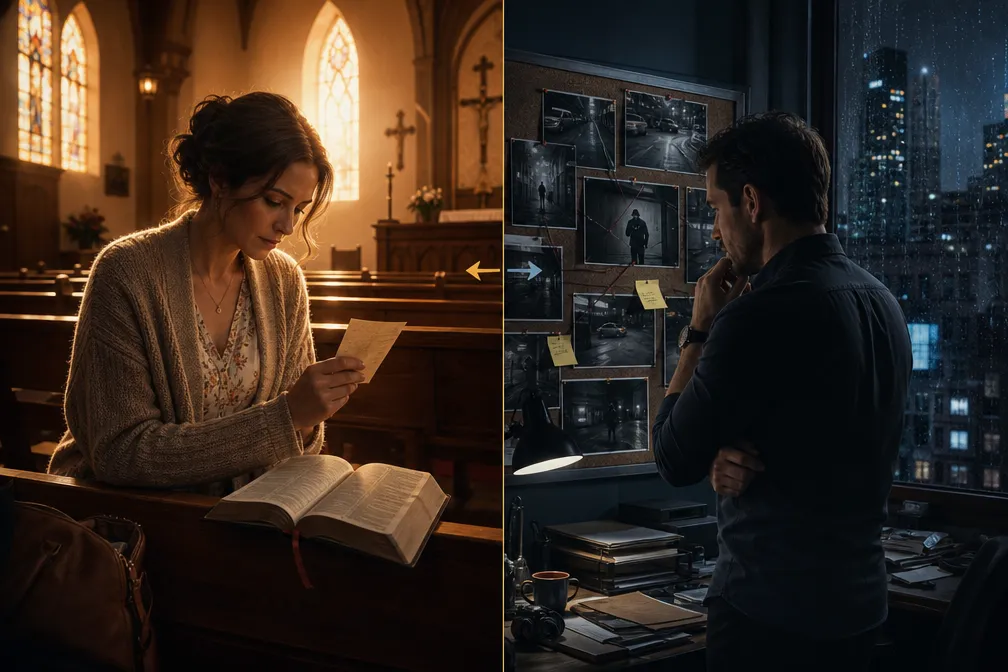
The PI archetype suits Christian suspense romance particularly well because investigators operate in the space between mercy and justice, two of the genre’s defining themes. A detective who must decide whether to turn in a frightened widow or protect a child from a corrupt system is not solving a puzzle. He’s doing theology with his hands.
For a deeper look at how faith-rooted character arcs are built without sermonizing, see Faith-Rooted Character Development in Christian Fiction: Authentic Spiritual Arcs Without Sermonizing.
What’s the Difference Between Christian Suspense and Regular Mystery Romance
Christian suspense romance and secular mystery romance share plot architecture, a crime, an investigation, a romantic subplot, but they differ in what the stakes mean to the characters.
In secular mystery romance, the moral weight of a case is usually measured in legal or emotional terms: will justice be served, will the couple survive the danger? In Christian suspense romance, those same questions carry a spiritual dimension. The detective isn’t just asking who did this, he’s asking what does God require of me now that I know?
Key differences at a glance:
| Element | Secular Mystery Romance | Christian Suspense Romance |
|---|---|---|
| Moral framework | Legal / emotional | Conscience / spiritual |
| Romance heat level | Often moderate to high | Clean, earned slowly |
| Character failure | May go unaddressed | Must cost something |
| Resolution tone | Justice or closure | Mercy alongside justice |
| Faith presence | Rare or incidental | Load-bearing to the plot |
This doesn’t mean Christian suspense is gentler, it can carry real psychological weight. The difference is that darkness in Christian suspense exists to be answered, not just witnessed. For more on how faith functions as the engine of tension rather than a tacked-on element, see Psychological Thriller With Purpose: Using Christian Faith as the Engine of Suspense Instead of an Afterthought.
How Do Authors Balance Faith and Mystery Solving in Christian Suspense
Faith and investigation are balanced when both create pressure on the same character at the same time. The mistake most writers make is treating them as separate tracks, the mystery plot in one lane, the spiritual arc in another.
The better approach: let the case force the faith question. A PI who uncovers evidence that will destroy an innocent family alongside a guilty one doesn’t need a sermon, he needs to make a choice. That choice is the faith content.
Practical craft principles:
- Show prayer as action, not pause. A character who prays before a dangerous confrontation is doing something, not interrupting the plot.
- Let doubt be real. A PI hero who never questions whether God is present in the worst rooms he enters isn’t believable to most readers.
- Use the case as a mirror. The crime being investigated should reflect something unresolved in the detective’s own spiritual history.
- Avoid the “convenient verse” trap. A scripture that appears exactly when the hero needs comfort, with no prior setup, reads as formula. Earn it.
The Mercy House Mysteries series by Silas Bellhaven demonstrates this balance in a cozy mystery frame, the cases in Juniper Gap, Tennessee, consistently surface questions about truth-telling, forgiveness, and what a community owes its most hidden members. The faith is never announced. It’s just the reason the protagonist can’t look away.
Private Investigator Romance Tropes and Common Plot Patterns
PI heroes in Christian suspense romance follow recognizable patterns, and readers come to the genre partly because those patterns feel safe to trust. The skill is in honoring the trope while finding the specific detail that makes it feel earned rather than assembled.
Most common PI romance tropes:
- Protecting the witness. The PI is assigned to guard a woman who saw something she shouldn’t have. Proximity creates trust; trust creates feeling.
- Cold case reopened. A past failure (often connected to a lost loved one) drives the PI back into danger, and the heroine is connected to the original case.
- Undercover partnership. The PI and heroine must pose as a couple to gather evidence. Pretend closeness becomes real.
- Reluctant client. The heroine hires the PI against her better judgment. She doesn’t trust him at first, which means the romance has real ground to cover.
- The PI with a past. Former law enforcement, military, or someone who left a career after a moral failure. The case forces him to reckon with what he walked away from.
In Christian suspense, these tropes carry additional weight because the PI’s professional code and his faith code are not always the same thing. The moment they diverge is where the story gets interesting. [2]
Are Christian Suspense Romances Appropriate for All Ages
Christian suspense romance is generally written for adult readers, though the content is clean by design. Most titles in this genre, particularly those published under imprints like Love Inspired Suspense, contain no explicit content, minimal graphic violence, and no profanity. [3]
Age suitability breakdown:
- Adults (18+): The primary audience. Themes of grief, moral failure, spiritual doubt, and danger are handled honestly.
- Older teens (15-17): Many titles are appropriate, though the romantic tension and darker suspense themes are aimed at adult emotional experience.
- Younger readers: Not the target audience, not because of content violations, but because the emotional and spiritual weight assumes adult life experience.
The “clean” designation in this genre means the content contract is held, not that the stakes are softened. A PI hero can face real danger, real moral failure, and real spiritual crisis, the difference is that none of it is rendered with graphic detail or explicit content. For a broader look at finding clean reads across the genre spectrum, see How to Find Clean Christian Fiction Across Every Genre.
Can a Private Investigator Hero Be Flawed and Still Fit Christian Romance
Yes, and in fact, a PI hero without real flaws rarely works in this genre. Readers who come to Christian suspense romance are not looking for a perfect man. They’re looking for a man who is trying, failing, and being met by grace he didn’t earn.
The key distinction is between flaws that cost something and flaws that are decorative. A PI who is “a little rough around the edges” but never actually hurts anyone or makes a wrong call isn’t flawed, he’s just styled that way. A PI who made a choice three years ago that got someone killed, and who now carries that weight into every case, has a flaw that the story must answer.
What makes a flaw work in Christian suspense romance:
- It connects directly to the central case or the romantic conflict (or both)
- It produces a moment of genuine moral failure during the story, not just backstory
- The character is not rescued from it cheaply; the cost is real before the grace arrives
This is the principle of earned grace, the idea that mercy means more when it comes after cost, not instead of it. A PI hero who repents of something real, at real personal expense, and is still chosen by the heroine and held by God, is far more moving than one who never needed either. [5]
For more on how redemption arcs function in Christian suspense and thriller fiction, see The Role of Redemption Arcs in Christian Thrillers and Dark Fantasy.
Best Published Examples of Faith-Filled Detective Romance Characters
The Christian suspense romance market has produced a strong pipeline of PI and investigator heroes, particularly through Love Inspired Suspense and independent authors on Kindle Unlimited. [3] [7]
Notable examples and series worth knowing:
- Dana Mentink’s investigative heroes, Mentink is one of the most consistent voices in faith-filled detective romance, with titles like Tracking the Truth featuring investigators whose faith is tested by the cases they take. Her characters doubt, act, and find grace in the specific rather than the general. [2]
- Rebecca Hartt’s The Lost Are Found series, Features a protagonist whose investigative work intersects with spiritual warfare and redemption themes in a clean romantic suspense frame. [10]
- Love Inspired Suspense PI titles, The imprint continues to launch new investigator-centered series, including security and investigations teams, with new titles appearing through 2026 and into 2027. [3] [9]
- Lynette Eason’s protective hero series, Though not always strictly PI-focused, Eason’s law enforcement and security heroes carry the same moral weight and faith-tested character arcs that define the best of the genre.
The common thread across all of these: the detective’s faith is not a personality trait. It’s a load-bearing element of the plot, the reason he stays when leaving would be easier, and the reason he extends mercy when justice alone would close the case.
How to Write Realistic Investigation Scenes in Christian Suspense Romance, and What Readers Actually Expect
Readers of private investigator heroes in Christian suspense romance expect investigation scenes to feel procedurally honest without becoming technical manuals. The goal is credibility, not exhaustiveness.
What readers want from investigation scenes:
- Observation over gadgetry. A PI who reads a room, notices the wrong photo on the mantle, the too-clean desk, the shoes that don’t match the story, is more compelling than one who runs forensic software.
- Moral friction in the process. The investigation should create ethical pressure, not just gather clues. Following someone, reading private correspondence, pressing a frightened witness, these actions should cost the PI something internally.
- The heroine as a genuine partner. In Christian suspense romance, the female lead is rarely just a witness to protect. She often has information, skills, or perspective the PI lacks. The romance deepens when the investigation requires both of them.
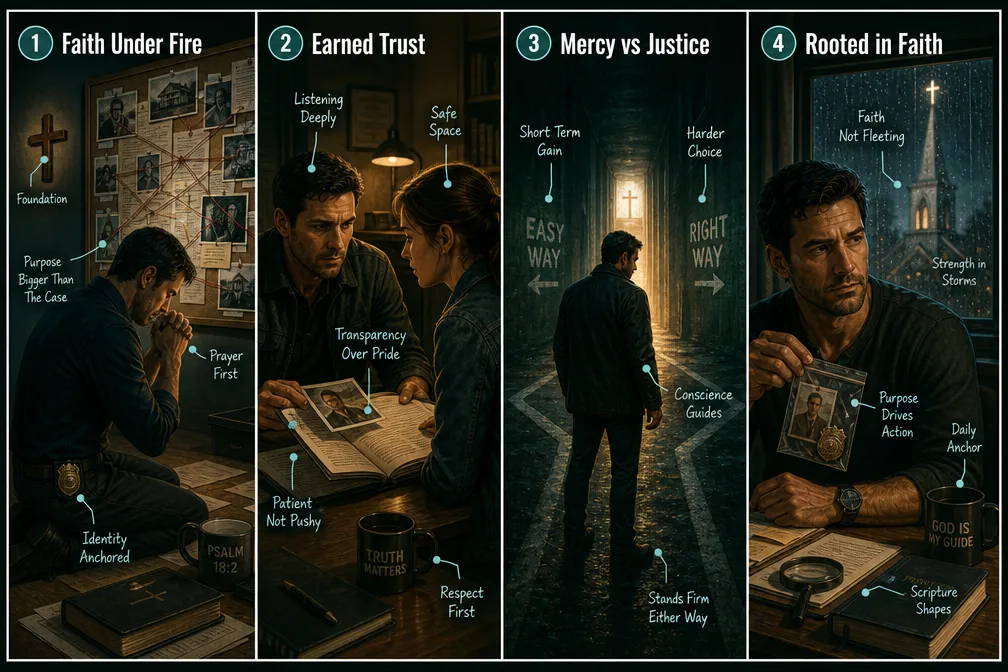
- Faith visible in method. A PI who pauses before questioning a grieving parent, who chooses honesty over a useful deception, who refuses to use a source he knows is compromised, this is faith under fire, shown through craft rather than narration.
Common mistakes to avoid:
- Overloading investigation scenes with procedural detail that stalls the emotional arc
- Using the case as pure backdrop while the romance dominates, the mystery must have real stakes
- Resolving the case with information the reader couldn’t have found, this breaks trust
- Dropping the faith content during action sequences, as though it only applies when things are quiet
For more on how Christian authors build suspense that holds its integrity, see How Christian Authors Build Suspense Without Darkness in Psychological Thrillers.
What Makes Readers Connect With a PI Hero’s Spiritual Journey
Readers connect with a PI hero’s spiritual journey when it mirrors something they’ve experienced, the gap between what they believe and what they can bring themselves to do in the hardest moment.
The PI profession is uniquely suited to this because investigators live in that gap professionally. They know things other people don’t. They hold information that could help or harm. They make judgment calls in the dark, without witnesses, and have to live with what they chose.
What creates genuine reader connection:
- Specific doubt, not vague struggle. “He wondered if God was listening” is thin. “He had prayed over three crime scenes in two years and walked away from all three with the wrong answer” is a faith crisis a reader can hold.
- Grace that arrives through people, not epiphany. The heroine, a mentor, a stranger at the right moment, grace in Christian suspense romance usually has a human face. That’s more honest than a private revelation.
- A spiritual arc that matches the case arc. The PI’s faith question should be answered (or deepened) by the resolution of the case, not separately from it.
- No cheap conversion moments. A dramatic foxhole prayer that resolves a lifelong wound in one scene breaks the contract with the reader. Earned progression, small moments of trust accumulating into something real, is what the genre does at its best.
This is what it means for fiction to walk with readers rather than talk at them. The PI hero’s faith journey isn’t a lesson delivered. It’s a road walked alongside. [4]
FAQ
What is Christian suspense romance? Christian suspense romance is a fiction genre that combines a mystery or thriller plot with a clean romantic arc and faith-based themes. Characters face real danger and moral conflict, and their faith is load-bearing to the story, not decorative.
Why are private investigator heroes so popular in this genre? PI heroes operate in the space between mercy and justice, which are the defining tensions of Christian suspense romance. Their profession forces moral choices that faith must answer, making them a natural fit for stories where belief is tested by circumstance.
Is Christian suspense romance always clean? Most titles in the genre maintain a clean content contract, no explicit scenes, no graphic violence, no profanity. This is especially true of major imprints like Love Inspired Suspense and most Kindle Unlimited Christian romance titles.
Can PI heroes in Christian romance have a dark past? Yes. A dark past is often what makes the character worth following. The key is that the past must cost something in the present story, and any grace that comes must be earned through the plot, not handed over cheaply.
How much faith content is typical in a Christian suspense romance? Faith content varies, but in the strongest titles it appears through character choice and consequence rather than narration or scripture-dropping. A PI who makes a costly moral choice because of what he believes is showing faith. A narrator explaining that the character trusted God is telling it.
What’s the difference between a Christian cozy mystery and Christian suspense romance? Cozy mysteries are lower-stakes, community-centered, and often feature amateur sleuths. Christian suspense romance carries higher physical danger, a more prominent romantic arc, and typically a professional investigator or law enforcement hero. Both are clean, but suspense romance carries more tension and emotional weight.
Are there Christian suspense romance books with female PI heroes? Yes, and the subgenre is growing. Female investigator protagonists appear across both traditional Christian publishers and independent Kindle Unlimited titles, often paired with a male romantic interest from law enforcement or security.
How do I find more Christian suspense romance on Kindle Unlimited? Search by imprint (Love Inspired Suspense is the most consistent), browse Clean Christian Fiction for Kindle Unlimited, or use Goodreads lists specifically tagged for Christian romantic suspense.
What makes a PI romance feel “rooted in faith” rather than just labeled Christian? The faith has to change what the character does, not just describe who he is. A PI who chooses a harder, costlier path because of what he believes, and who pays a real price for that choice, is rooted in faith. A PI who mentions church attendance is just labeled.
Conclusion
Private investigator heroes in Christian suspense romance work because the job and the faith ask the same hard question: what will you do with the truth once you’re holding it?
The best titles in this space don’t use the PI archetype as a delivery system for action scenes with a prayer tacked on. They use it to put a character, someone with real skills, real failures, and real belief, into situations where mercy and justice don’t line up neatly, and then watch what he chooses.
If you’re a reader looking for where to start, Dana Mentink’s investigative fiction and the Love Inspired Suspense catalog are reliable entry points. For Kindle Unlimited readers, the 2026 Clean and Christian Kindle Unlimited Book Hauls guide is a practical place to build a reading list.
If you’re a writer working in this genre, the single most useful discipline is this: before every scene, ask what the PI’s faith requires of him that his profession alone would not. The gap between those two answers is where the story lives.
And if you want fiction that takes both the mystery and the faith seriously, that treats the ordinary Tuesday as the place where grace actually shows up, the Mercy House Mysteries and the broader Silas Bellhaven catalog are built on exactly that conviction.
Rooted in faith. Every case. Every choice. Every page.
References
[1] Its Beginning To Look A Lot Like Christmas Reads Giveaway Deadly Christmas Inheritance – https://readingismysuperpower.org/2024/11/25/its-beginning-to-look-a-lot-like-christmas-reads-giveaway-deadly-christmas-inheritance/
[2] Book Review Tracking The Truth By Dana Mentink – https://readingismysuperpower.org/2024/05/26/book-review-tracking-the-truth-by-dana-mentink/
[3] New Releases In Christian Fiction November 2024 – https://janetsketchley.ca/new-releases-in-christian-fiction-november-2024/
[4] Christian Fiction 14 7 Yearly Surge Dramatic Market Expansion Data – https://www.firmenpresse.de/pressrelease734029/christian-fiction-14-7-yearly-surge-dramatic-market-expansion-data.html
[5] Cold Threat (Goodreads) – https://www.goodreads.com/book/show/181857640-cold-threat
[9] The Rise Of Christian Fiction Market Trends Regional Dynamics And Future Predictions For 2026 – https://www.alibaba.com/product-insights/the-rise-of-christian-fiction-market-trends-regional-dynamics-and-future-predictions-for-2026.html
[10] Rebecca Hartt Deliver From Evil The Lost Are Found – https://play.google.com/store/books/details/Rebecca_Hartt_Deliver_From_Evil_The_Lost_Are_Found?id=2EnCEQAAQBAJ