
Last updated: September 13, 2026
Quick Answer: Dexter-style antiheroes can work in Christian psychological thrillers when the narrative holds the protagonist accountable rather than applauding them. The difference between exploring darkness and glorifying it comes down to one question: does the story treat the character’s moral compromise as a wound that costs something, or as a superpower the reader is meant to admire? Christian fiction can carry morally complex, deeply flawed leads, but faith must function as the story’s moral gravity, not its decoration.
Key Takeaways
- An antihero in Christian fiction is defined by moral conflict and conscience, not by the absence of wrongdoing
- The line between exploring sin and glorifying it is drawn by consequence, what the story makes the character pay
- Dexter Morgan’s appeal comes from his internal code and self-awareness, not his violence; Christian writers can use that tension without the vigilante glamor
- Faith functions as moral weight in a Christian thriller, not as a tidy resolution that arrives without cost
- “Earned grace” means the character’s redemption arc is paid for by real loss, real reckoning, not a dramatic conversion that erases the damage
- Clean Christian fiction can carry psychological darkness through implication, consequence, and emotional honesty rather than graphic content
- The biggest mistake writers make is resolving moral complexity too quickly, before the reader has felt the full weight of what the character has done
- Readers of Christian psychological thrillers expect flawed protagonists, they just expect the story to take the flaws seriously [1][2]
What Makes an Antihero Different from a Villain in Christian Fiction
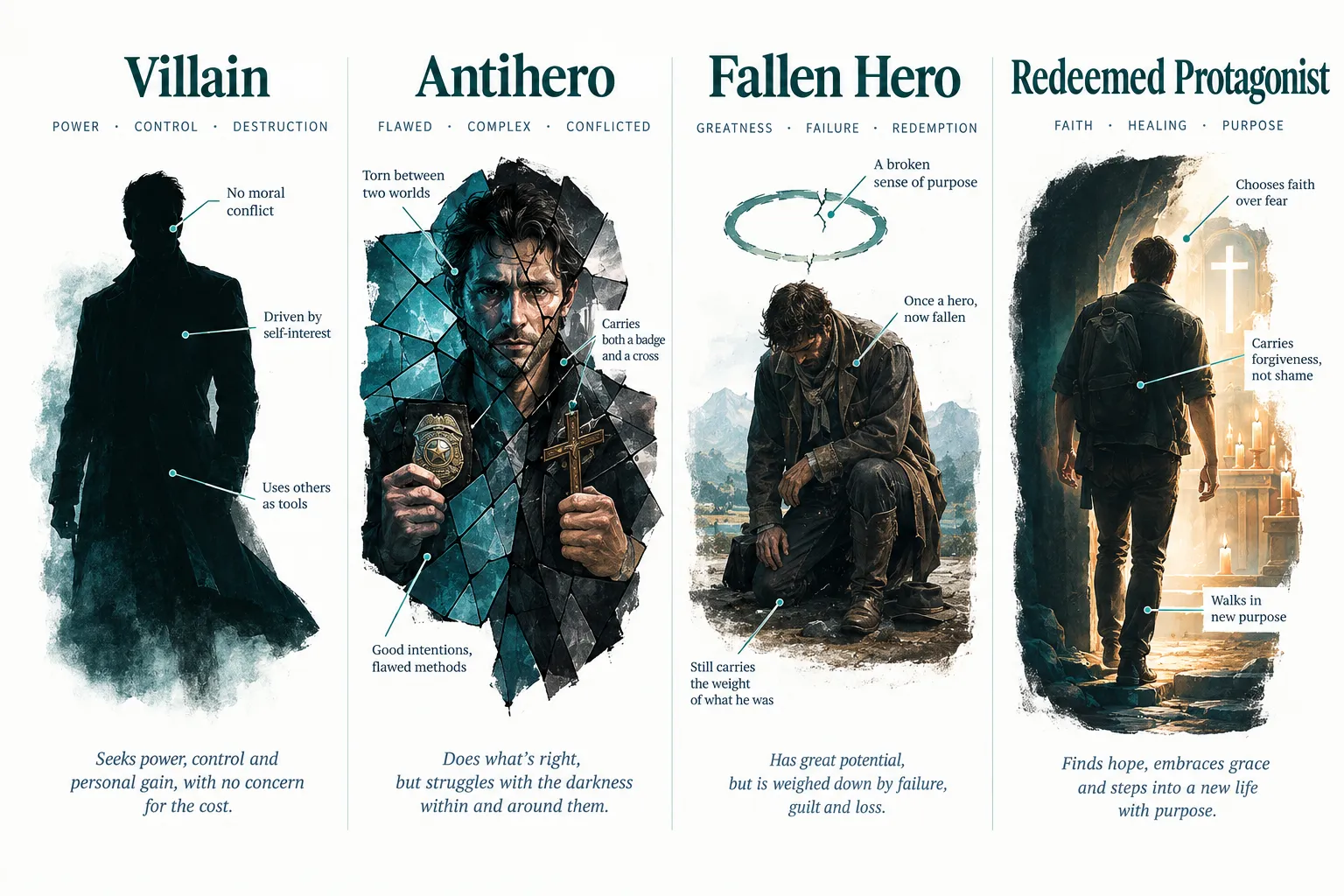
An antihero has a conscience. A villain, at least in the structural sense, does not, or has silenced it completely. That distinction is what makes Dexter-style antiheroes in Christian psychological thrillers worth writing at all: the moral conflict is the story.
A villain acts from self-interest or ideology without genuine internal resistance. An antihero acts wrongly, or in morally gray territory, while something in them knows it. That “something” is where faith enters. In Christian fiction, that internal voice is not just psychological guilt; it carries the weight of a God who sees, a standard that exists outside the character’s own rationalizations.
- Villain: No meaningful moral conflict; wrong action flows from corrupted or absent conscience
- Antihero: Wrong or questionable action exists alongside real moral awareness, the tension between the two is the narrative engine
- Fallen hero: A character who once held a moral standard and has compromised it; the story is about what that cost and whether it can be recovered
The theological distinction matters here. Christian fiction has always understood that humans are capable of both great mercy and genuine evil, that’s not a modern literary invention. What separates a Christian antihero from a secular one is that the moral framework isn’t invented by the character. It’s given. The character can reject it, ignore it, or wrestle with it, but they can’t simply define it away [5].
Can Christian Psychological Thrillers Have Protagonists Who Do Bad Things
Yes, and in 2026, the Christian suspense market is actively moving in this direction [1][2]. The question is never whether a protagonist can do bad things; it’s whether the story handles those actions with honesty about their weight.
Think of the Gathering Light series: Hannah Garrick, Caris Weller, and Taryn Vickers are not villains, but each is complicit in a system that uses careful language to contain other women’s pain. Their moral compromise is quiet, institutional, and deeply human. That’s a different flavor of antihero than Dexter Morgan, but the underlying craft principle is the same. The protagonist’s wrong choices must cost them something the reader can feel.
For readers looking at Christian psychological thrillers versus secular thrillers, the core difference is that faith-based suspense treats moral failure as a wound with a real source and a possible, costly healing, not as a personality quirk or a plot device.
Dexter Character Analysis: Redemption Arc vs. Justification
Dexter Morgan’s cultural staying power comes from a specific craft choice: the show gives him a code. He doesn’t kill randomly; he kills by a rule system his father gave him. That code creates the illusion of moral order, which is exactly what makes him so uncomfortable to examine from a Christian perspective [7].
The Baptist News Global analysis of Dexter’s ethics points to the core problem: Dexter’s code is self-authored. It’s a moral framework with no external authority, which means it’s ultimately just rationalization wearing the costume of principle [7]. The audience is invited to accept his logic because it feels ordered. But ordered self-justification is still self-justification.
For Christian writers, this is the precise fault line to write across. A Dexter-style antihero in a faith-rooted story can have a code, but the story must show where that code breaks down, where it fails to account for the people it harms, and where it collides with a moral order the character didn’t invent.
“The difference between a Christian antihero and a Dexter-style vigilante isn’t the darkness they carry. It’s whether the story lets them stay comfortable inside it.”
The redemption arc, done honestly, requires the character to stop justifying and start reckoning. That reckoning is where mercy and justice meet, and where the story earns the right to offer hope.
What’s the Difference Between Glorifying Sin and Exploring It in Fiction
Glorifying sin means the narrative rewards the wrong behavior without cost, frames it as admirable, or invites the reader to want more of it. Exploring sin means the narrative follows the wrong behavior into its actual consequences and lets the reader feel the weight of what it breaks.
Brian Godawa’s criterion, moral exhortation versus immoral exploitation, is a useful line to draw. The question is whether the darkness in the story serves the reader’s moral understanding or simply serves the reader’s appetite for transgression. Washington Stand’s framing is similar: sin in fiction should function like a dragon to be slain, not a dragon to be admired [5].
Practical markers for writers:
| Exploring Darkness | Glorifying Darkness |
|---|---|
| Wrong action has visible consequences | Wrong action is consequence-free |
| Protagonist feels the moral weight | Protagonist is self-satisfied |
| Other characters are harmed in ways the story acknowledges | Victims exist only as plot props |
| Faith or conscience creates real friction | Faith is absent or decorative |
| The reader is unsettled, not entertained by the harm | The harm is played for excitement |
For writing clean Christian fiction that still grips readers, the goal is emotional honesty without exploitation, which is a craft challenge, not a content restriction.
How to Write a Morally Gray Character Without Endorsing Their Actions
The narrator’s posture is everything. A story can follow a morally compromised protagonist without endorsing their choices if the narrative voice never loses its moral footing, even when the character has.
This doesn’t mean the narrator lectures. It means the story’s structure does the moral work. Consequences arrive. Relationships fracture. The character’s internal justifications are shown to be exactly that, justifications, not truth. Other characters in the story can see what the protagonist can’t, or won’t.
Three craft tools that keep moral clarity without preaching:
- Consequence architecture, Build the plot so that wrong choices generate real costs that accumulate. The character doesn’t have to be punished in a heavy-handed way; the damage just has to be visible and honest.
- Contrast characters, A secondary character who holds the line the protagonist has crossed gives the reader a moral reference point without requiring a sermon. The contrast speaks for itself.
- Internal fracture, Show the protagonist’s conscience working, even when they override it. The moment of choosing to do wrong despite knowing better is more morally serious than acting in ignorance, and more interesting to read.
For using faith as the engine of suspense rather than an afterthought, the antihero’s moral conflict is not a problem to solve, it’s the fuel.
How Much Darkness Is Too Much in a Christian Psychological Thriller
The threshold isn’t about content categories, it’s about whether the darkness serves the story’s moral purpose or exceeds it. Clean Christian fiction can go to genuinely dark places psychologically without graphic violence, explicit content, or gratuitous horror. The question is what the darkness is for.
Darkness that reveals character, tests faith, or shows the real cost of moral failure is doing narrative work. Darkness that exists to shock, titillate, or provide vicarious transgression is not, and that’s true regardless of whether the content would pass a “clean” filter [5].
Practical guidelines for Christian psychological thriller writers:
- Psychological threat and dread can be intense without graphic depiction
- Implication is often more disturbing than description, and more honest
- The protagonist’s internal experience of moral compromise can be portrayed with full emotional weight without detailed depiction of the harmful act itself
- Victims must be treated as full human beings, not as props for the protagonist’s arc
The Gathering Light series handles this by centering the harm on institutional manipulation and language, the darkness is real and felt, but it lives in psychology and consequence, not in graphic event. That’s a model worth studying for writers asking how far is too far.
Writing an Antihero With a Conscience vs. One Without Moral Conflict
An antihero without moral conflict is functionally a villain with better marketing. The conscience is what makes the character worth following, it’s the part of them the reader can hold onto while they watch the character do things they shouldn’t.
For Dexter-style antiheroes in Christian psychological thrillers, the conscience is specifically theological in nature. It’s not just psychological discomfort; it’s the awareness of being known by someone who doesn’t accept the rationalizations. That’s a different kind of pressure than secular guilt, and it creates different narrative possibilities.
Characters like the frontier lawmen in The Mercy Line, men who operate where law runs out and must decide what they answer to, carry this tension naturally. The conscience line “Where law runs out, a man finds what he answers to” is a built-in antihero framework: the external authority is absent, the internal one remains, and the story is about which one wins.
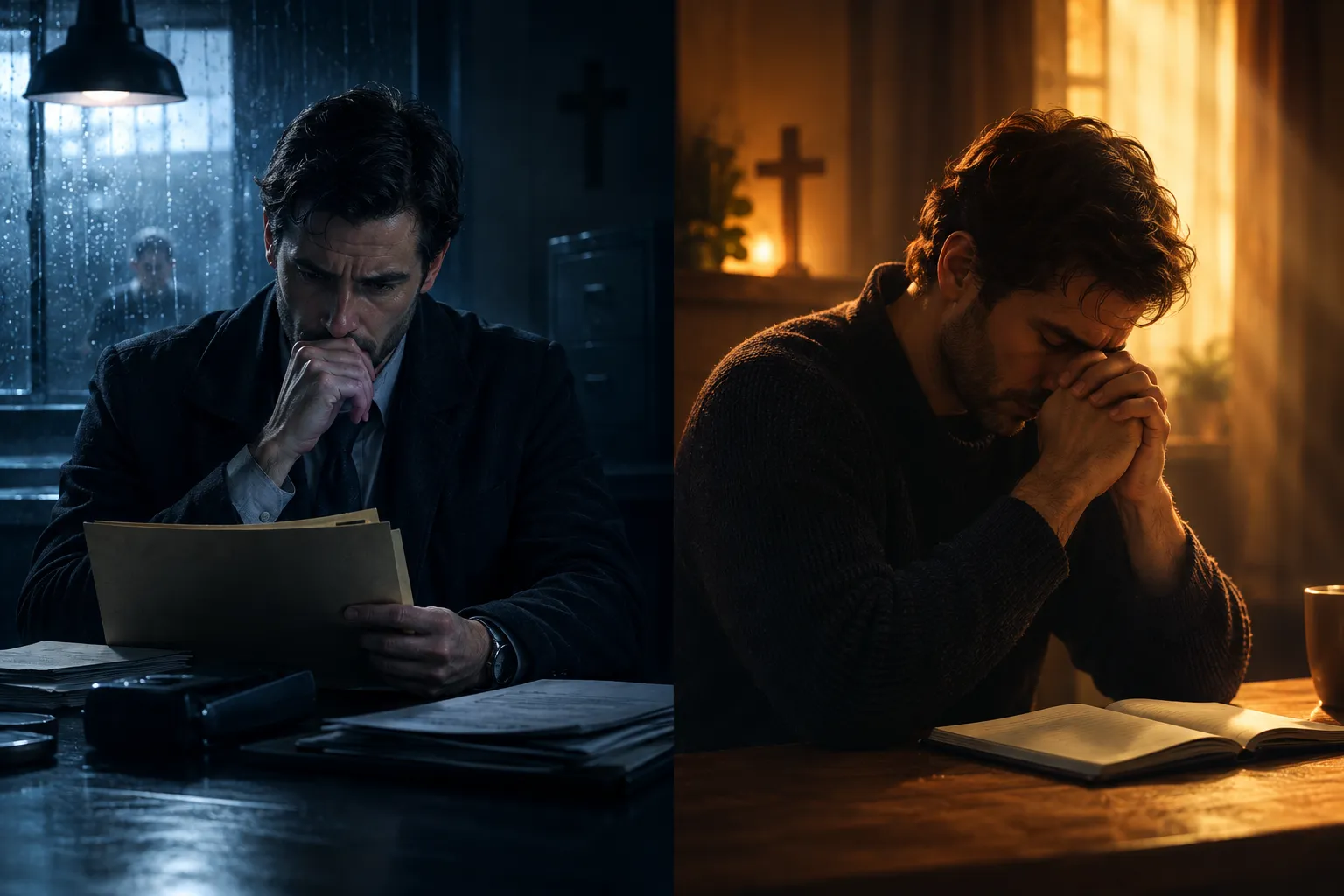
An antihero with a functioning conscience will:
- Hesitate before crossing moral lines, even when they cross them
- Experience the aftermath of wrong choices as something other than triumph
- Have relationships that reflect the cost of their choices
- Carry the weight of past decisions into present ones
Common Mistakes When Writing Christian Antiheroes
The most common failure is resolving the moral complexity too early, giving the character a clean conversion or a dramatic moment of grace before the reader has fully felt what the character has done. That’s not earned grace; it’s cheap grace, and readers who care about faith can feel the difference [3].
Mistakes to avoid:
- The sermon pivot: The antihero’s arc ends in an explicit faith statement that resolves all tension. Real repentance is messier and slower.
- The consequence bypass: The character does real harm but the story doesn’t follow the harm into the lives of those affected.
- The sympathetic framing that never breaks: The reader is kept so close to the protagonist’s perspective that the victims never become real people.
- The faith decoration: A cross on the wall, a prayer before bed, a Bible verse quoted, but none of it creates actual friction with the character’s choices. Faith as set dressing rather than load-bearing structure.
- The villain pivot: Overcorrecting by making the antihero so dark that no redemption arc is believable. The character needs to have something worth saving from the beginning.
For writing protagonists with real character flaws rather than flawless leads, the principle holds across genres: the flaw must be real, the cost must be real, and the grace, when it comes, must cost something too.
What Readers Expect from a Christian Thriller vs. a Secular One
Christian thriller readers in 2026 are not looking for sanitized stories with safe protagonists [1][2]. They want real stakes, real moral weight, and characters who actually doubt, fail, and reckon. What they don’t want is to feel manipulated into admiring behavior the story should be questioning.
The core expectation is that the story takes faith seriously as a moral framework, not as a genre label or a content filter. Faith should change what the character sees, what they choose, and what it costs them. That’s the promise clean Christian fiction makes, and it’s different from the promise secular thrillers make.
What Christian thriller readers expect:
- Moral complexity handled with honesty, not avoided
- Consequences that feel real and proportionate
- Faith that functions as genuine tension, not resolution-on-demand
- Hope that is earned rather than assumed
- Characters who are recognizably human in their failure and recognizably reaching toward something better
For a deeper look at how these expectations differ across the genre, Christian psychological thrillers versus secular thrillers covers the structural differences in how faith changes the story’s moral architecture.
Can You Write Dexter-Style Tension in a Faith-Based Story
Yes, and the tension is actually sharper in a faith-based context, because the moral stakes are higher. Dexter’s code is self-invented; a Christian antihero’s moral conflict runs up against something that doesn’t move when they push back on it.
The Lorehaven and Speculative Faith communities have noted that antiheroes can proclaim grace precisely because they show what grace is rescuing someone from. The character’s darkness is not an obstacle to the faith story, it’s the condition that makes the faith story possible.
The craft challenge is keeping the tension alive long enough to matter. That means resisting the urge to resolve the moral conflict before it has done its full work on the character and the reader. Hope in the dark is not the same as hope that arrives before the dark has been fully entered.
For readers exploring the antihero redemption thread across Christian fiction, the consistent finding is that the stories that land hardest are the ones that let the protagonist stay in the dark long enough to feel the cost, and then let grace arrive as something that costs something too.
Conclusion
Writing Dexter-style antiheroes in Christian psychological thrillers is not a contradiction. It’s one of the most honest things a faith-rooted story can do, because it takes seriously what humans are actually capable of, and what redemption actually requires.
The line is not drawn at darkness. It’s drawn at whether the darkness is handled with moral honesty or moral abdication. Faith under fire, mercy and justice held in tension, grace that shows up after cost rather than instead of it, these are not constraints on the story. They’re what give the story its weight.
Actionable next steps for writers:
- Map your protagonist’s conscience, before writing the first scene, know what they believe, what they’ve suppressed, and what would crack them open. That map is your story’s moral architecture.
- Build consequence into the plot structure, don’t leave consequences to the epilogue. Let them accumulate in real time, in relationships and choices the reader witnesses.
- Let faith create friction, not resolution, every time faith could appear as a tidy answer, ask instead how it could appear as a harder question.
- Read the Gathering Light series for a model of how psychological darkness can live in implication and consequence rather than graphic event, When Hannah Sleeps, When the Voice Breaks, and When the Prayer List Opens each show how a morally compromised protagonist can carry a story rooted in grace.
- Trust the reader, Christian fiction readers are not fragile. They want stories that walk with them through hard things, not stories that talk at them from a safe distance.
Rooted in faith doesn’t mean rooted in safety. It means the story knows where it stands, even when the character doesn’t.
FAQ
Can a Christian antihero commit actual crimes in a faith-based story? Yes, if the story treats those actions with moral seriousness, showing real consequences, real harm to real people, and real internal cost. The crime itself is less important than what the narrative does with it afterward.
Does a Christian antihero have to convert or repent by the end? Not necessarily in a clean, dramatic way. Earned grace can look like a single honest admission, a small act of repair, or simply stopping the self-justification. What matters is that the character moves toward truth rather than away from it, even if the movement is incomplete.
How do I avoid making my antihero too sympathetic? Keep the victims fully human. The moment the people harmed by your protagonist become props for their arc, the story has lost its moral footing. Give the harmed characters their own interior lives, their own grief, their own agency.
What’s the difference between a morally complex protagonist and a villain protagonist? Moral complexity requires genuine internal conflict. A villain protagonist can be interesting, but they require a different narrative contract with the reader, one that most Christian thriller audiences aren’t signing up for. The antihero still has something in them the reader can root for.
Can clean Christian fiction portray addiction, abuse, or trauma as part of an antihero’s backstory? Yes. These are human realities that faith-rooted fiction can and should engage honestly. The “clean” content standard applies to graphic depiction, not to subject matter. Implication, consequence, and emotional truth are all available tools.
How do I know if my story is glorifying darkness or exploring it? Ask this: at the end of the story, does the reader want to be more like the protagonist’s worst self, or do they feel the weight of what that worst self cost? If the answer is the former, the story has drifted into glorification.
Is the Dexter model compatible with Kindle Unlimited Christian fiction expectations? The tension and moral complexity, yes. The graphic violence and consequence-free vigilantism, no. KU Christian thriller readers want high stakes and real moral weight, they don’t need graphic content to feel the danger. See clean Christian fiction on Kindle Unlimited for more on what that audience actually expects.
How long should a Christian antihero’s redemption arc take? Long enough that the reader has fully felt the cost of what the character has done. Cheap grace resolves too quickly; earned grace arrives after the reader has sat in the discomfort long enough to understand why it matters.
References
[1] 3 Thrilling Christian Suspense Novels For Spring 2026 – https://www.bookpage.com/features/3-thrilling-christian-suspense-novels-for-spring-2026/ [2] Best Christian Suspense Books Of 2026 – https://gracefulreads.com/best-christian-suspense-books-of-2026/ [3] Christian Suspense Thrillers – https://christiansuspensenovels.com/christian-suspense-thrillers [5] Dragons To Be Slain The Role Of Sin And Evil In Storytelling – https://washingtonstand.com/article/dragons-to-be-slain-the-role-of-sin-and-evil-in-storytelling [7] The Ethics Of Dexter Morgan – https://baptistnews.com/article/the-ethics-of-dexter-morgan/