
Last updated: September 26, 2026
Quick Answer
Adult readers who loved Percy Jackson’s mix of myth, humor, and found family can find that same energy in Christian fantasy without giving up mythic-scale stakes. Series like The Wingfeather Saga, The Binding of the Blade, Morgan L. Busse’s The Nordic Wars, and Silas Bellhaven’s Kethara Chronicles and Sarel Chronicles deliver quests, sibling-style loyalty, and real moral consequence, with faith woven into the plot instead of preached at the reader.
Key Takeaways
- Christian fantasy earns the label through worldview, not decoration, a cross on a map doesn’t make a book Christian; a consequence structure rooted in grace and justice does.
- Found family is the bridge trope between Percy Jackson readers and Christian fantasy, most strong series (Wingfeather Saga, Kethara Chronicles) center on people who choose loyalty to each other under pressure.
- Adult Christian fantasy exists, but it’s often produced by small presses and independent authors rather than major traditional houses right now[1][4].
- Moral complexity is available, the best Christian fantasy lets good people make costly mistakes instead of sorting characters into clean heroes and villains.
- You don’t need to share the author’s faith to enjoy these books; the stakes, quests, and character growth work on their own terms.
- Romance ranges from absent to slow burn, readers who want plot-first fantasy without a love triangle have real options.
- New titles keep arriving through 2026, including Viking-inspired epics and fairy-tale retellings from small presses[1][7].
What Makes a Fantasy Book Christian vs. Just Having Religious Themes?
A book earns the “Christian fantasy” label when its moral structure, how sin, mercy, and sacrifice actually function in the plot, reflects a Christian worldview, not just when a character prays or a temple appears on the page. Religious decoration is set dressing. Religious structure is load-bearing.
Here’s the difference in practice:
- Decoration: A priest character exists, but nothing he believes changes what happens when the hero lies or steals.
- Structure: A character’s choice to tell the truth costs her something real, a friendship, a position, a chance at revenge, and the story doesn’t erase that cost just because she did the right thing.
L. B. Graham’s The Binding of the Blade is a clear example. The series treats weapons themselves as a symbol of the Fall, and their unmaking points toward restoration rather than victory for its own sake[1]. That’s theology built into the plot mechanics, not a sermon dropped into dialogue.
How Is Christian Fantasy Different From Percy Jackson, Style Urban Fantasy?
Christian fantasy usually trades Percy Jackson’s Greek-myth chaos and irreverent humor for a single coherent moral order that the whole world answers to. Both genres deliver quests, monsters, and teenage-or-adult heroes figuring out who they are, the difference is what’s underneath the adventure.
| Feature | Percy Jackson, style urban fantasy | Christian fantasy |
|---|---|---|
| Divine order | Squabbling, self-interested gods | One coherent moral source (Maker, covenant, calling) |
| Humor | Frequent, irreverent | Present but gentler, rarely mocking |
| Consequence | Often plot-driven, resets easily | Costly, choices carry lasting weight |
| Setting | Modern world with hidden myth | Usually full secondary world |
Readers who want the quest engine of Percy Jackson, a call to adventure, a found-family crew, monsters standing in for real fears, without the theological chaos of squabbling gods should look at Christian epic fantasy built around a single, consistent source of justice and mercy. For a deeper breakdown of how mythology-adjacent Christian fantasy handles magic systems the way Riordan handles Greek myth, see Christian Epic Fantasy for Fans of Percy Jackson.
Best Christian Fantasy Series for Adults With Found-Family Tropes and Quests Like Rick Riordan
Adults who want Rick Riordan’s mix of banter, danger, and chosen-family loyalty have several strong Christian fantasy options that scale the stakes up past middle-grade tone. The strongest picks combine a real quest structure with characters who need each other to survive, not just to feel good.
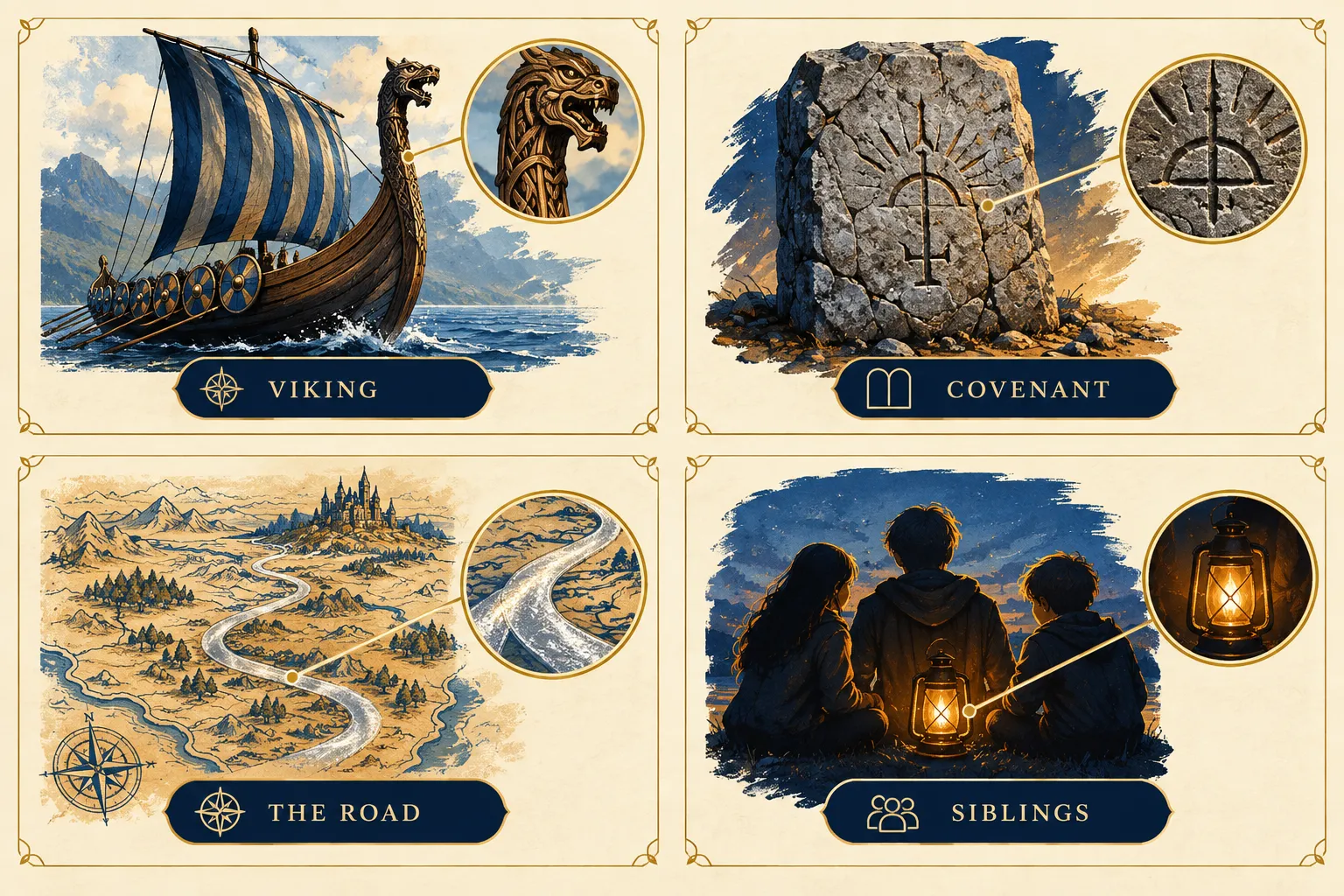
- Morgan L. Busse’s The Nordic Wars, Viking-inspired, mythic, and finished as of Winter’s Dawn (released August 11, 2026), giving adult readers warrior culture and faith-tested courage without an unfinished-series gamble[7].
- The Wingfeather Saga by Andrew Peterson, sibling loyalty carries the whole series; the appeal is family sacrifice and humor over adult complexity, and the publisher has described its pull as reaching well beyond the Christian market on story strength alone.
- The Kethara Chronicles, a covenant fantasy where two women carry a word an empire can’t audit or contain, built on the same found-family stakes Percy Jackson readers already trust.
- The Sarel Chronicles, a disgraced map-scribe follows an unrecorded truth past everything her order certified, trading easy answers for a slower, costlier kind of faithfulness.
Choose the Nordic Wars if you want warrior-culture atmosphere and a completed trilogy. Choose Wingfeather if you want a gentler, family-first tone that still works for adults. Choose Kethara Chronicles or the Sarel Chronicles if you want adult-pitched covenant fantasy with bureaucratic villains instead of monsters.
Christian Fantasy Books Without Preachy Dialogue or Heavy-Handed Messaging
The best Christian fantasy shows faith through what a character does under pressure, never through a paragraph explaining what the reader should believe. If a scene stops the plot to deliver a lesson, that’s a heavy-handed book, skip it.
Watch for these signs of story-first writing:
- Characters doubt, fail, and have to earn trust back through action, not through a monologue.
- Scripture or doctrine, if mentioned at all, comes from a character’s lived situation, not narrator commentary.
- The consequence of a moral choice shows up later, in a way the reader has to notice, not immediately with a tidy payoff.
Andrew Peterson has said plainly that he wrote the Wingfeather books to be the best story possible first, resisting the urge to force a lesson into the plot. That instinct, story over sermon, is exactly what separates fiction that walks with a reader from fiction that talks at them.
Are There Christian Fantasy Books With Moral Complexity, Not Just Good vs. Evil?
Yes, the strongest adult Christian fantasy avoids a flat hero-versus-villain map and instead gives good characters real reasons to make bad choices. Moral complexity means the reader has to sit with a decision, not just cheer for the right side.
Look for books where:
- The antagonist has a coherent, even sympathetic, reason for what they’re doing.
- The protagonist’s mistake costs someone else, not just themselves, and that debt doesn’t vanish by the next chapter.
- Grace, when it arrives, arrives after a real cost has been paid, not as a shortcut around it.
That’s the difference between cheap grace and earned grace: a character who lied to protect someone doesn’t just apologize and move on, they have to live with what the lie broke, and rebuild it piece by piece. Readers looking for that kind of theological depth under an adventure plot might start with the worldbuilding approach covered in Epic Fantasy With Biblical Themes.
Which Christian Fantasy Authors Write for Both YA and Adult Audiences?
Several Christian fantasy authors write books that work equally for teenage and adult readers because the emotional core, loyalty, sacrifice, identity, doesn’t age out. Andrew Peterson and L. B. Graham are the clearest examples: both are frequently shelved as YA, but the scope and theological weight of their series pull in adult readers too[1].

- Andrew Peterson, humor and sibling bond keep younger readers engaged; sacrifice and grief keep adults reading.
- L. B. Graham, large-scale conflict and a restoration theme give The Binding of the Blade enough weight for adult readers despite its YA classification[1].
- Morgan L. Busse, writes with a distinctly adult tone (violence implied rather than graphic, mature grief) that skews the Nordic Wars older than most crossover fantasy.
On diverse representation: Christian fantasy as a category is still growing its bench of authors and settings beyond Western-medieval defaults, and small presses are where that expansion is currently happening fastest, through fairy-tale retellings, non-European-inspired worlds, and a wider range of protagonist backgrounds[1][8].
Do I Need to Be Religious to Enjoy Christian Fantasy Books?
No. Christian fantasy works as adventure fiction first, so a reader doesn’t need to share the author’s faith to follow the quest, care about the found family, or feel the weight of a hard choice. The moral stakes are legible on human terms, courage, loyalty, forgiveness, even for readers who aren’t looking for spiritual content at all.
That said, readers who are looking for faith represented honestly will notice a difference: the belief in these books isn’t decorative, and it shapes what characters are willing to risk. Curious readers who want a wider map of what’s out there, faith-based or not, can browse crowd-sourced lists on Goodreads for Christian fiction fans to compare tone before committing to a series.
Christian Fantasy vs. Inspirational Fiction: What’s the Difference?
Christian fantasy is a genre defined by its secondary world and quest structure; inspirational fiction is a broader shelf category defined by tone and content promise (clean, hopeful, faith-affirming) that spans contemporary romance, historical fiction, and fantasy alike. A book can be both, but the terms aren’t interchangeable.
- Christian fantasy = dragons, covenants, magic systems, secondary worlds, quests.
- Inspirational fiction = a content promise (no explicit content, hope by the end) that can apply to any genre, including small-town romance or cozy mystery.
If a retailer lists something as “inspirational fantasy,” expect the clean-content promise of inspirational fiction wrapped around a fantasy plot, useful shorthand when browsing, but not a guarantee of the theological depth some readers want.
Best Christian Fantasy With Slow-Burn Romance or No Romance
Plenty of Christian fantasy series keep romance secondary or absent entirely, which suits readers who want the quest and the found family to carry the book instead of a love triangle. This is a real, deliberate content choice, not an accident of the genre.
- No romance, family-first: The Wingfeather Saga keeps sibling loyalty at the center; romantic subplots stay minor.
- Slow burn, plot-first: Several small-press Christian fantasy releases in 2026 are marketed specifically around “no-spice” romance, meaning attraction exists but never overtakes the quest[1].
- Romance-absent by design: Some frontier and covenant-fantasy lines build tension entirely through duty, justice, and found-family loyalty rather than courtship at all.
Choose no-romance fantasy if you want the emotional core to be sibling or crew loyalty. Choose slow-burn if you want a hint of chemistry without it steering the plot.
Common Mistakes New Christian Fantasy Authors Make
New Christian fantasy authors most often derail their own books by letting a lesson interrupt the plot instead of letting the plot become the lesson. The fix isn’t removing faith, it’s trusting the reader enough not to explain it.
Frequent missteps:
- Stopping the story to explain the moral, readers feel lectured, even when the point is true.
- Giving the antagonist no real motive, flattens the moral stakes into good-versus-evil instead of real conflict.
- Resolving every doubt with a tidy conversion scene, faith that never costs anything doesn’t read as earned.
- Skipping consequence, a character breaks a promise and nothing changes; readers stop trusting the stakes.
A quick example: if a character betrays a friend to save a village, the story owes the reader a scene where that friend’s trust has to be rebuilt, not a page later where everyone’s fine. That’s the difference between grace and a shortcut.
Where to Find Christian Fantasy Books That Avoid Common Tropes and Clichés
The most reliable way to find Christian fantasy that avoids stock tropes is to read past the back-cover copy into reader-curated lists and small-press catalogs, since major retail algorithms tend to surface the most formulaic titles first. Small presses like Enclave Publishing and independent author platforms are currently where the more inventive worldbuilding is happening[1][4].
Practical steps:
- Check reader-curated lists for specific tropes you want (found family, no romance, moral complexity) rather than browsing a genre shelf blind[6][8].
- Read the first chapter before buying, clichéd Christian fantasy often reveals itself in the first scene through an overly tidy moral setup.
- Follow small-press catalogs like Enclave Publishing, which specialize in Christian speculative fiction and tend to take more risk on unconventional worldbuilding[1].
- Cross-check Kindle Unlimited availability if you read fast, several strong series rotate through KU, which is worth checking before buying outright. See more on this in Christian Fantasy Kindle Unlimited picks.
For readers building worldbuilding intuition around how faith gets integrated without preaching, Christian Epic Fantasy Worldbuilding: Integrating Faith Without Preaching breaks down the mechanics further.
FAQ
Is there a Christian version of Percy Jackson for adults? Not a direct equivalent, but adult Christian fantasy series like the Nordic Wars, the Sarel Chronicles, and the Kethara Chronicles deliver similar quest energy and found-family stakes with a single coherent moral order instead of squabbling gods.
What is the best Christian fantasy series to start with as an adult? Start with a completed trilogy if you dislike cliffhangers, The Nordic Wars wrapped up with Winter’s Dawn in August 2026, making it a safe full-arc entry point[7].
Do Christian fantasy books avoid violence entirely? No, but violence is typically implied or handled without graphic detail, keeping tension high while staying clean.
Can I read Christian fantasy if I’m not religious? Yes. The quest, found-family loyalty, and moral stakes work as story elements on their own, independent of shared belief.
Is Christian fantasy the same as inspirational fantasy? Not exactly, Christian fantasy describes the genre and worldview; inspirational fantasy describes a clean-content promise that can sit on top of any genre.
Are there Christian fantasy books with diverse settings, not just medieval Europe? A growing number exist, largely from small presses and independent authors experimenting with non-European-inspired worlds and fairy-tale retellings[1][8].
Does Christian fantasy always include romance? No, many series keep romance minor or absent, centering found family and quest loyalty instead.
Where can I find new Christian fantasy releases? Small-press sites and reader-curated release trackers tend to surface new titles faster than general retail browsing[1][4].
Conclusion
Percy Jackson readers looking for their next mythic-scale quest don’t have to trade clean content for adventure, and they don’t have to trade adventure for a lecture either. The Christian fantasy shelf in 2026 has real options for adults: completed trilogies like The Nordic Wars, family-first classics like the Wingfeather Saga, and covenant-driven worlds like the Kethara Chronicles and Sarel Chronicles, where mercy and justice cost something before they pay off.
Next step: pick one series based on tone, not just genre label. Want warrior-culture atmosphere and a finished arc? Start with the Nordic Wars. Want sibling loyalty and humor? Start with Wingfeather. Want an adult-pitched covenant world where a name or a map becomes the whole plot’s engine? Start with the Kethara Chronicles or the Sarel Chronicles, and read the first chapter before buying, because that’s where a book’s honesty about faith under fire always shows itself first.
References
[1] Christian Fantasy – https://www.risingshadow.net/new-book-releases/christian-fantasy [4] Most Anticipated Books Of 2026 – https://www.shelfreflection.com/blog/most-anticipated-books-of-2026 [6] Monthly Themed Reading List Fantasy Book Recommendations – https://jendodrillwrites.com/monthly-themed-reading-list-fantasy-book-recommendations/ [7] New Christian Fiction Releasing In August 2026 – https://louallenwriter.wordpress.com/2026/07/23/new-christian-fiction-releasing-in-august-2026/ [8] Seven Clean Book Series To Read If You Love Fantasy And Fairy Tales – https://www.rachelblanchardwriter.com/seven-clean-book-series-to-read-if-you-love-fantasy-and-fairy-tales/