Last updated: August 6, 2026
Quick Answer: Epic fantasy with biblical themes works when faith, prophecy, and covenant function as structural story elements, not decorative religion. The key is building a world where belief costs something, where prophecy creates genuine moral weight, and where covenant binds characters to consequences they cannot outrun. Done right, the result is high-stakes adventure that resonates with readers who want their faith represented honestly, not preached at.
Key Takeaways
- Biblical themes in fantasy succeed when they drive plot and character choice, not when they deliver doctrine
- Covenant systems work best when breaking them has real, irreversible consequences, not just emotional ones
- Prophecy becomes cliché when it removes character agency; it becomes powerful when it creates impossible choices
- Allegory and biblical inspiration are different tools, knowing which one you’re using changes every structural decision
- Monotheistic fantasy worlds carry different dramatic tension than pantheon-based ones; both can honor Scripture-inspired themes
- Faith-driven characters feel authentic when they doubt, fail, and choose, not when they arrive at the right answer too easily
- The Christian fiction market is growing [7], and readers in 2026 are actively seeking epic fantasy that handles faith with intelligence
- Earned grace, mercy that arrives after cost, not instead of it, is the single most powerful redemptive arc structure available to the biblical fantasy writer
What Makes Biblical Themes Work in Epic Fantasy Worldbuilding
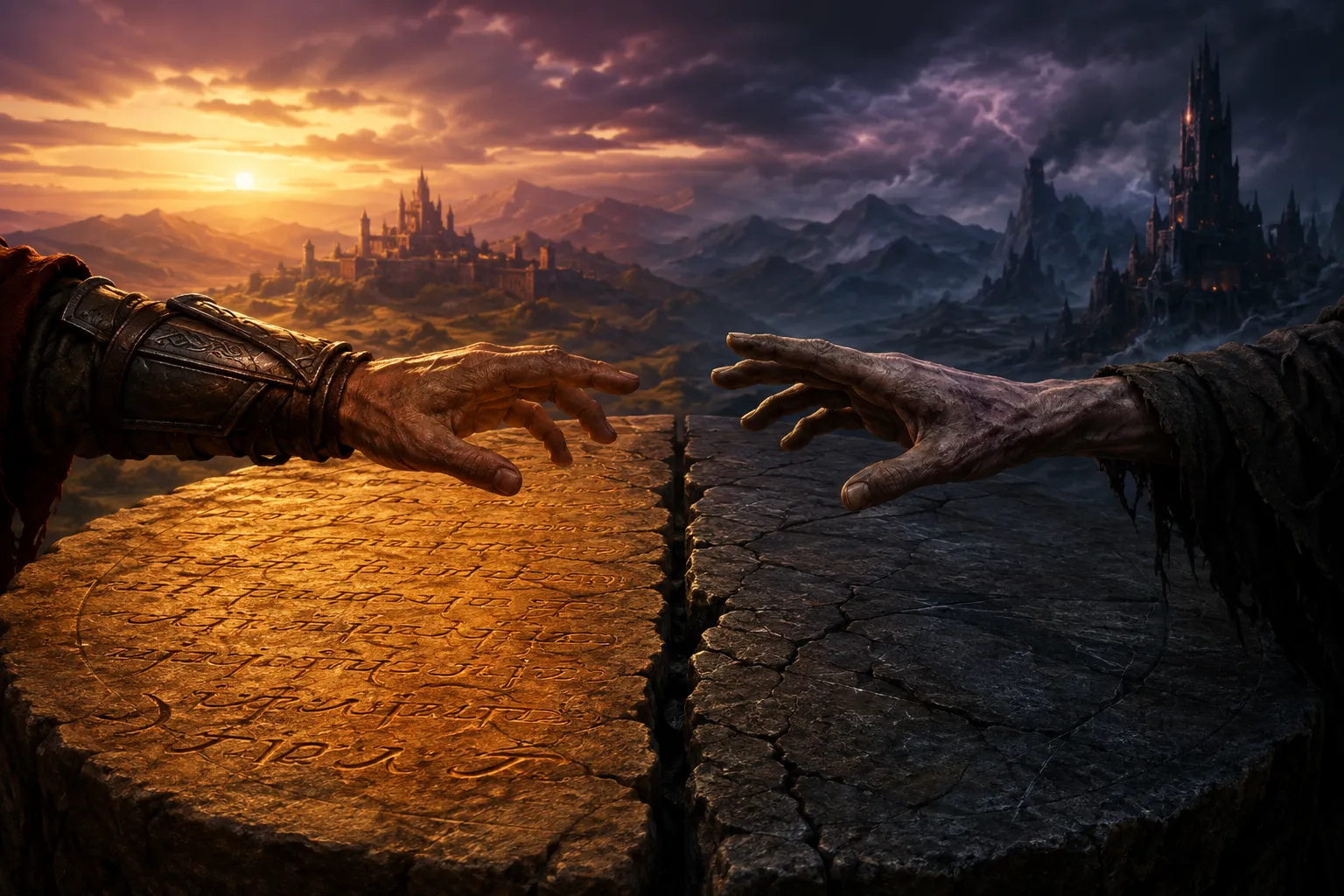
Biblical themes work in epic fantasy when they function as load-bearing architecture, not wallpaper. The moment a reader senses that the religious elements could be removed without changing the plot, the faith has become decoration.
What makes them structural:
- Moral law with consequences. If your world has a covenant code, breaking it must cost something the story actually shows, not just a vague sense of guilt.
- Creation myths that explain the present. A world where the Maker-Who-Hears answered some prayers and not others (as in The Sarel Chronicles) forces every character to live inside that theological tension. The myth isn’t backstory; it’s the engine.
- Ritual that reveals character. Daily observance, communal ceremony, and sacred objects show readers who a character is when no one important is watching. That’s where faith under fire becomes visible.
Start from need and fear. What are the people of your world afraid of? What do they lack? Build your cosmology from those questions outward, and the religion will feel lived-in rather than constructed. [31]
How to Create a Magic System Based on Faith and Covenant
A faith-based magic system is most compelling when power flows from relationship, not formula. The difference matters: formula-based magic rewards cleverness; covenant-based magic rewards faithfulness, and punishes betrayal.
Practical structure for a covenant magic system:
- Name the parties. Who made the covenant, and what did each side promise? A covenant between a people and a divine being carries different weight than one between two human houses.
- Define what activates power. Is it obedience? Sacrifice? Spoken oath? The activation mechanic is a theological statement, choose it deliberately.
- Build in the cost of breaking it. Broken covenants in Scripture don’t just end the relationship; they release consequences already written into the terms. Your magic system should do the same.
- Let characters misuse it. The most dramatic covenant stories involve characters who invoke the covenant for self-serving ends and discover the covenant is not theirs to control.
Earned grace, mercy that arrives after cost, not instead of it, is the most powerful structural move available to the biblical fantasy writer.
In The Kethara Chronicles, the covenant word Amara and Sela carry cannot be owned or audited by the empire precisely because covenant in that world belongs to the one who made it, not the one who holds it. That’s a theological position expressed through plot mechanics.
Examples of Epic Fantasy Books with Religious Themes Done Well
The strongest examples treat religion as a civilizational force, something that shapes law, conflict, and identity, rather than a character’s personal belief system alone.
- The Kethara Chronicles (Silas Bellhaven), covenant fantasy set in Marat-Sol, where an empire tries to count and contain every act of mercy. The tension between institutional religion and lived covenant drives every conflict. Series page
- The Sarel Chronicles (Silas Bellhaven), a map-scribe discovers that the official record of answered prayers has been used to justify abandonment. The faith is real; the institution has corrupted it. Series page
- Rebellion of the Watchers (2026 release) draws on the Nephilim tradition from Genesis 6, using the Watcher mythology as the cosmological foundation for its conflict. [3]
- Anna of Bethsaida takes a biblical-historical approach, grounding its world in first-century Judean religious life with careful attention to how faith shapes daily choice. [9]
The common thread: in each case, the religious world is specific enough to have internal logic, and that logic creates friction, not comfort.
How to Write Prophecy in Fantasy Without Making It Feel Cliché
Prophecy becomes cliché when it functions as a plot summary delivered early. It becomes powerful when it creates an impossible choice the character must make without certainty about what the prophecy actually means.
What separates weak prophecy from strong prophecy:
| Weak Prophecy | Strong Prophecy |
|---|---|
| Describes exactly what will happen | Describes what is at stake, not the outcome |
| The hero fulfills it without realizing it | The hero must choose whether to fulfill it |
| Only one interpretation is ever plausible | Multiple interpretations are each costly |
| Removes agency | Creates impossible agency |
The biblical prophetic tradition is actually the best model here. Old Testament prophecy was rarely a timetable, it was a covenant warning, a call to decision, a word that required a response. Characters who receive prophecy in your world should face the same weight: what do I do with this, and what does it cost me to act on it?
What’s the Difference Between Allegory and Biblical Inspiration in Fantasy
Allegory maps story elements directly onto theological counterparts, Aslan is Christ, the White Witch is sin, the Stone Table is the cross. Biblical inspiration uses Scripture as a source of moral architecture, narrative pattern, and thematic weight without requiring one-to-one correspondence.
Both are legitimate. But they demand different craft decisions:
- Allegory requires consistency. Once readers identify the mapping, every deviation breaks the contract. It works best in shorter works or when the author commits completely.
- Biblical inspiration gives more freedom. A covenant-breaking king doesn’t have to be David; he just has to carry the same moral weight. The story can breathe without the reader needing a decoder ring.
Most epic fantasy with biblical themes, including the Kethara and Sarel series, operates through inspiration rather than allegory. The faith is real and structural, but the world is its own world, not a parallel universe with Scripture characters renamed.
How to Build a Pantheon vs. Monotheistic Religion for Your Fantasy World
Monotheistic worlds carry inherent dramatic tension: if one God is sovereign and good, why does suffering exist? That question is load-bearing in a way pantheon worlds don’t require. It also means every unanswered prayer is a theological problem your characters must live inside.
Pantheon worlds distribute moral authority across competing divine wills, which makes political and military conflict feel cosmologically grounded. The gods disagree, and humans get caught in the middle.
Choose based on the story you want to tell:
- Choose monotheism if your story’s central question is about trust, faithfulness, or the silence of God
- Choose a pantheon if your story’s central question is about power, allegiance, or which authority deserves obedience
- Choose a hybrid (one true God plus lesser spiritual beings) if you want the moral clarity of monotheism with the conflict-generating variety of a pantheon, this is the structure closest to the biblical cosmology, and it’s deeply underused in Christian fantasy
Common Mistakes Writers Make with Religious Themes in Fantasy
The most common mistake is using religion to deliver the story’s thesis instead of to test it. When a character explains what the covenant means, or when a prophet arrives to clarify the moral stakes, the story has stopped trusting its own events.
Other mistakes worth naming:
- Making the devout character the wisest character. Real faith gets tested. A character who is always right because they pray is not a faith-driven character, they’re a mouthpiece.
- Designing religion with no internal conflict. Real religious communities disagree about interpretation, practice, and authority. A fantasy religion with no schisms, no heretics, and no honest doubters feels false.
- Treating conversion as a resolution. A character who comes to faith at the end of the book as the emotional payoff has received cheap grace, belief that cost nothing because the story was already over.
- Being too preachy. This warning appears consistently in craft resources for a reason. [35] The moment the story pauses to make a point, readers feel it. Show faith through character choice and consequence, not narration.
How to Make Prophecy Matter Without Railroading Characters
Prophecy railroads characters when the outcome is fixed and the character’s choices are just the mechanism of delivery. It creates genuine stakes when the character’s choices determine which version of the prophecy comes true, or whether it does at all.
Practical techniques:
- Write the prophecy in covenant language, not prediction language. “If you do this, then that” is more dramatically alive than “this will happen.”
- Give characters a reason to resist the prophecy. The most honest prophetic stories involve someone who knows the word and tries to avoid it, and discovers that avoidance has its own cost.
- Let the prophecy be partially wrong, or misread. This isn’t a betrayal of the biblical model; it’s faithful to it. Prophecy in Scripture was regularly misunderstood by the people who received it.
Can You Mix Multiple Real-World Religions in One Fantasy Setting
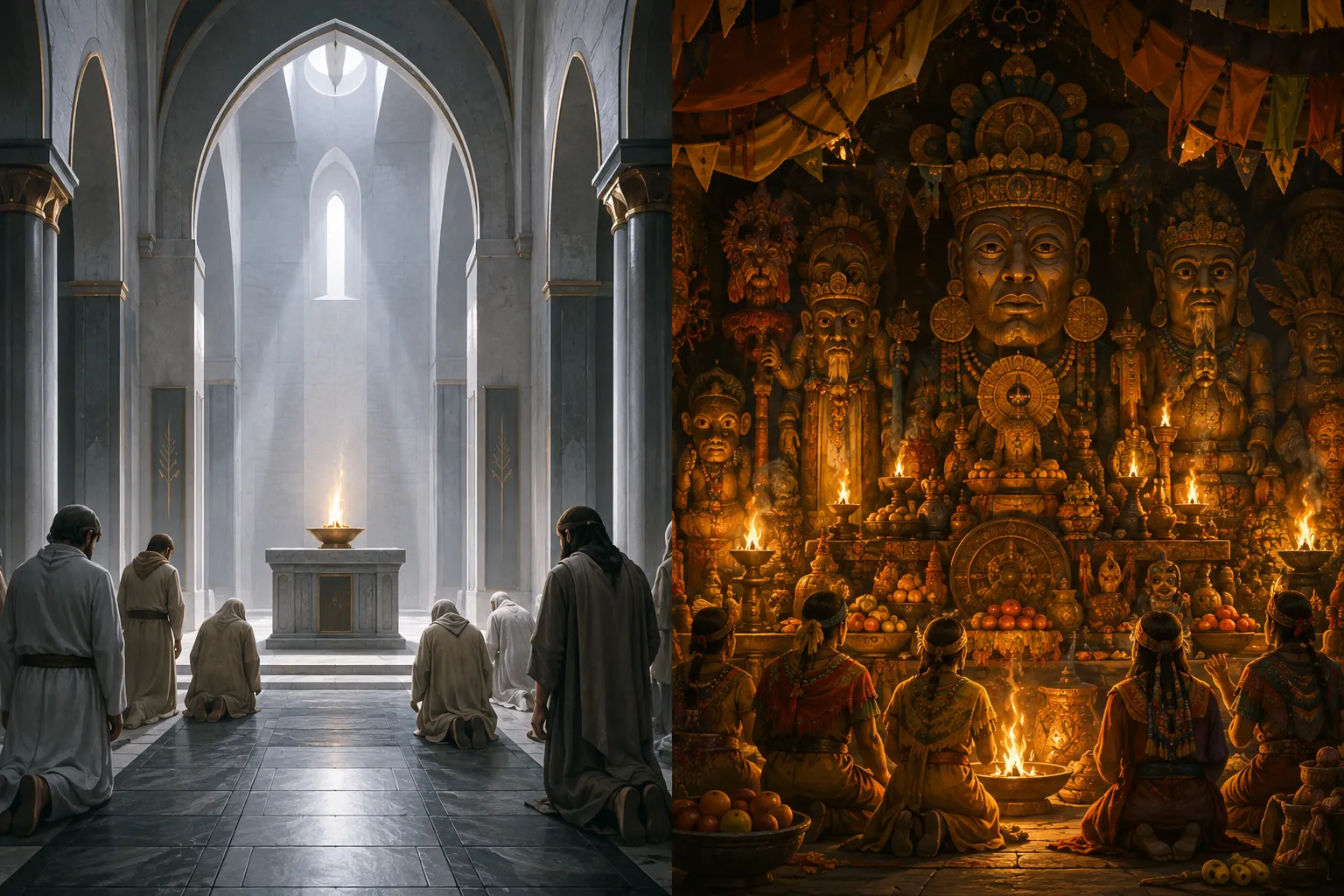
You can draw from multiple religious traditions, but the world needs its own internal theological logic, not a buffet of borrowed symbols. Readers familiar with the source traditions will feel the inconsistency if you use, say, Islamic prayer postures alongside Norse cosmology and Hebrew covenant law without a coherent reason for their coexistence.
A safer approach: identify the structural elements you want (covenant, prophecy, sacrifice, intercession, holy war) and build a world theology that produces those elements organically. The surface details can be invented. The underlying moral logic should be consistent.
If you’re writing explicitly Christian fantasy, as in the Kethara and Sarel series, the monotheistic framework is already the world’s spine. Everything else is built on that load-bearing conviction.
How to Write Faith-Driven Characters That Don’t Feel Preachy
Faith-driven characters feel authentic when their belief costs them something the reader can see. The character who prays in private and then makes a harder choice because of it is more compelling than the character who quotes Scripture at the moment of crisis.
Practical markers of a well-written faith-driven character:
- They doubt without losing the reader’s respect
- They fail in ways connected to their specific spiritual weakness, not just generic human weakness
- They find grace after the cost, not before it
- They serve without needing to be recognized for serving
- Their faith shows up in what they don’t do as much as what they do
The brand principle “walking with them, not talking at them” applies here directly. A faith-driven character who explains their beliefs to other characters is almost always a mouthpiece. A faith-driven character who makes a choice the reader understands only because they’ve watched that character pray, doubt, and hold on, that character is a witness.
What’s the Best Way to Establish Covenant Systems in Worldbuilding
Start with what the covenant protects and what it demands. A covenant without mutual obligation is just a promise. A covenant with real terms, what each party owes, what happens at breach, who enforces it, becomes a story engine.
Worldbuilding checklist for covenant systems:
- Who are the parties, and what is the power differential between them?
- What does each party gain? What does each party owe?
- What are the signs or seals of the covenant (physical, ritual, spoken)?
- What constitutes breach, and who decides?
- What are the stated consequences of breach?
- Can the covenant be renewed after breaking? At what cost?
- Is the covenant known publicly, or does its secrecy create conflict?
The covenant in The Kethara Chronicles is powerful precisely because the empire cannot own it. The covenant’s terms belong to the one who made it, and that asymmetry is the source of every conflict in the series.
How Much Religious Detail Should You Include in Epic Fantasy
Enough to make the world feel inhabited, not enough to make the reader feel lectured. The right amount of religious detail is the amount that creates friction, where a character’s belief collides with the world’s demands.
Daily ritual, communal practice, and sacred objects ground a world’s religion in lived experience. [31] But every detail should earn its place by revealing character, creating conflict, or raising a question the story will eventually have to answer.
A useful test: if a religious detail could be removed without changing any character’s choice or any scene’s tension, it’s probably decoration. If removing it would require rewriting the scene, it’s load-bearing, keep it.
How to Balance Adventure and Spiritual Themes in High-Stakes Fantasy
The adventure and the spiritual theme should be the same thing. When a character’s physical survival and their spiritual integrity are at stake in the same scene, the balance takes care of itself.
The mistake is treating them as separate tracks, action scenes here, faith moments there. In the strongest biblical fantasy, the battle is also a test of covenant faithfulness. The prophecy is also the thing that makes the next step terrifying. The magic system is also the moral system.
In The Map of Unanswered Prayers, Elya Renn’s disgraced status as a map-scribe is both a practical problem (she has no authority) and a spiritual one (she carries a mark the House of Witness refused to record). The adventure cannot be separated from the faith question because they are the same question: whose record is true?
What Audience Is Looking for Biblical Themes in Epic Fantasy
The Christian fiction market has seen significant growth, with some reports citing strong year-over-year expansion through 2026. [7] The most anticipated Christian fiction of 2026 includes multiple titles drawing on biblical and faith-based frameworks across genres. [6]
The core audience for epic fantasy with biblical themes in 2026:
- Christian readers who feel underserved by secular fantasy, they want secondary worlds with real spiritual stakes, not worlds where faith is absent or mocked
- Women 35-65 on Kindle Unlimited who read across cozy mystery, thriller, and fantasy but want a consistent faith promise across genres
- Readers who found C.S. Lewis or Tolkien early and have been looking for contemporary fiction that handles faith with the same intelligence and imagination
- Clean fiction readers who want high-stakes adventure without graphic content, the spiritual framework often signals the content contract they’re looking for
These readers are not looking for a sermon in novel form. They want stories that walk with them, that take their faith seriously enough to put it under real pressure and trust it to hold.
Conclusion: Building Worlds Where Faith Has Weight
Epic fantasy with biblical themes, done well, is not a niche. It’s one of the oldest story traditions in the world, and it’s finding new readers in 2026 who are hungry for it.
The practical blueprint comes down to this: build a world where covenant has real terms, where prophecy creates impossible choices rather than predetermined outcomes, and where faith shows up in what characters do when the cost is highest. Let grace arrive after the cost, not before it. Trust the story to carry the theology without stopping to explain it.
The writers who get this right, from Lewis and Tolkien to the emerging Christian fantasy voices of 2026, share one conviction: God is real, stories matter, and the two have always belonged together.
Next steps for writers:
- Audit your current world’s religion: does breaking the covenant have visible, irreversible consequences?
- Rewrite your prophecy in covenant language (“if/then”) rather than prediction language (“will”)
- Identify one scene where a character explains their faith, then cut the explanation and show the choice instead
- Explore the Kethara and Sarel Chronicles as working models of covenant fantasy built on these principles
FAQ
What makes biblical themes different from just using religious imagery in fantasy? Biblical themes are structural, they shape the moral logic of the world, the cost of choices, and the arc of redemption. Religious imagery is decorative. The difference is whether the faith could be removed without changing the plot.
Do I have to be a Christian to write epic fantasy with biblical themes? No, but the work is more honest when the writer has genuine respect for the tradition. Readers who know Scripture well will feel when it’s being used superficially.
Can a prophecy in fantasy be wrong? Yes, and it’s often more powerful when it is, or when it’s misread. The biblical prophetic tradition involves frequent misunderstanding by the recipients. That tension is dramatically rich.
How do I avoid making my faith-driven protagonist preachy? Show their belief through choice and consequence, not speech. The character who acts from faith without explaining it is always more compelling than the one who articulates their theology to other characters.
What’s the difference between clean Christian fantasy and general fantasy with religious elements? Clean Christian fantasy maintains a content contract (no graphic violence, no explicit content, no profanity) and treats faith as a lived, honest experience rather than backdrop. The faith is load-bearing, not decorative.
How long should a covenant system’s rules be explained to the reader? As briefly as possible. Readers need to understand the stakes, not the theology. Show what happens when the covenant is honored and when it’s broken, the rules will be clear.
Is allegory or biblical inspiration better for Christian epic fantasy? Biblical inspiration gives more creative freedom and tends to produce more durable stories. Allegory requires complete commitment and works best in shorter forms. Most successful Christian epic fantasy uses inspiration.
What’s the biggest mistake in writing prophecy for Christian fantasy? Making the prophecy a plot summary rather than a covenant call to decision. Prophecy should create impossible choices, not remove them.
Where can I find examples of covenant fantasy done well in 2026? The Kethara Chronicles and The Sarel Chronicles by Silas Bellhaven are current examples of covenant-based Christian epic fantasy with faith as a structural element rather than decoration.
How do I balance hope and darkness in biblical fantasy? Hope in the dark is earned, not assumed. Let the darkness be real, let characters lose things that matter, and let the light arrive because someone chose faithfulness when it cost them. That’s the arc Scripture itself uses.
Can a fantasy world have institutional religion that’s corrupt and still honor biblical themes? Yes. The prophetic tradition in Scripture is largely a critique of institutional religion by the very God that institution claims to serve. A corrupt religious institution in fantasy can be deeply biblical.
What content level is appropriate for Christian epic fantasy? Clean content, no graphic violence, no explicit content, no profanity, while still allowing real stakes, genuine danger, and honest moral darkness. The darkness should be present; the gratuitousness should not.
References
[3] Rebellion of the Watchers – https://www.goodreads.com/en/book/show/252216036-rebellion-of-the-watchers
[6] Most Anticipated Christian Fiction 2026 – https://www.goodreads.com/list/show/225610.Most_Anticipated_Christian_Fiction_2026
[7] The Rise of Christian Fiction: Market Trends, Regional Dynamics and Future Predictions for 2026 – https://www.alibaba.com/product-insights/the-rise-of-christian-fiction-market-trends-regional-dynamics-and-future-predictions-for-2026.html
[9] Anna of Bethsaida – https://www.goodreads.com/book/show/245061856-anna-of-bethsaida