
{“cover”:”Landscape editorial fantasy illustration (1536×1024) of a weathered stone bridge connecting two hillside villages inside a glowing game-world map, one side showing a small band of adventurers kneeling to bandage wounded travelers and rebuild a well, the other side showing a modest campfire council of mixed-age leaders passing a lantern between them. Soft dawn light, muted parchment-gold and deep teal palette, painterly editorial fantasy book-cover style, no armor glowing with excessive power, no text or titles anywhere on the image, balanced rule-of-thirds composition, magazine-quality detail, subtle glowing rune motifs along the bridge stones rather than on any character.”,”content”:[“Flat-vector illustrated skill-tree diagram (landscape 1536×1024) for a Christian LitRPG class system: four branching root-and-vine trees labeled with short tags only (Courage, Wisdom, Cooperation, Stewardship) growing from a single stone altar base, each branch ending in small icon nodes such as a shield over a kneeling figure, an open scroll, two clasped hands, and a wheat sheaf, thin callout lines connecting each icon to a one-to-three-word label, parchment-cream background, teal and warm gold ink palette, clean editorial fantasy infographic style, no damage numbers or pricing text anywhere.”,”Isometric illustration (landscape 1536×1024) of a fantasy village council scene at dusk: a seasoned mentor figure at a round wooden table delegating tasks to three younger apprentice adventurers, each apprentice holding a different tool (a healer’s satchel, a builder’s hammer, a scout’s map), thin labeled callout lines reading short two-to-three word tags like Mentorship Bond, Shared Watch, and Delegated Task pointing to each figure, warm lantern light, cool blue evening sky, muted amber and slate palette, no on-body text, editorial game-design concept art style.”}

Last updated: September 27, 2026
Quick Answer
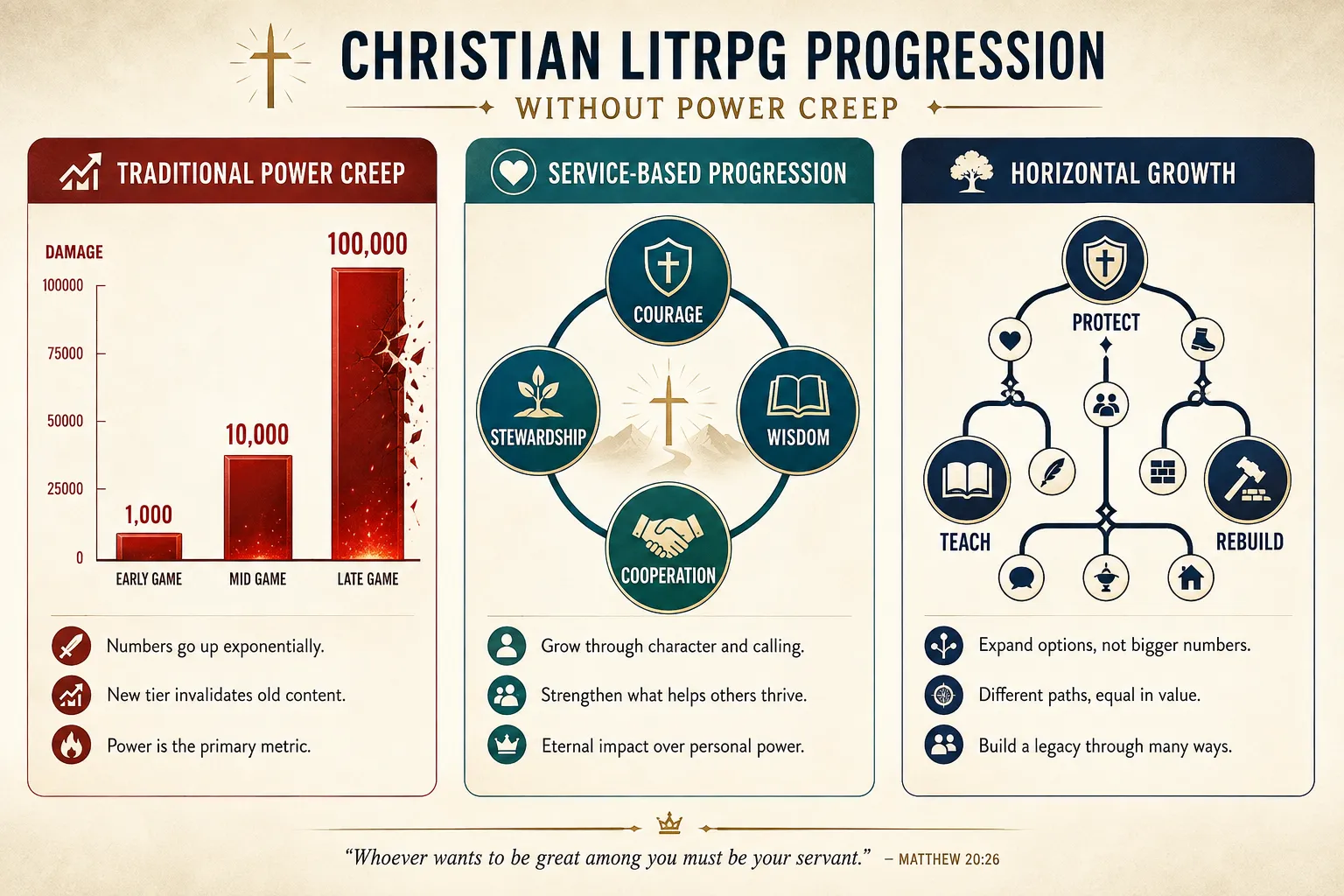
Christian LitRPG progression without power creep works by measuring advancement in courage, wisdom, cooperation, and stewardship instead of raw stat inflation. Classes gain new options for protecting, teaching, and rebuilding rather than bigger numbers, and leadership mechanics track how many people a character equips and releases, not how many enemies they defeat. The result is a story that can sustain ten books without every villain needing to be stronger than the last.
Key Takeaways
- Power creep happens when every sequel needs a bigger threat to feel earned, which eventually breaks a game’s internal logic.
- Service-based classes advance through what a character enables in others, not just what a character can personally destroy.
- Horizontal progression (new tools, roles, relationships) sustains long series better than vertical progression (bigger numbers) alone.
- Leadership mechanics should reward mentoring, delegating, and reconciling, not just commanding a larger party.
- Skill trees built around courage, wisdom, cooperation, and stewardship give players meaningful choices without a damage arms race.
- The LitRPG market has grown fast, with tracked releases up 188% from 2023 to 2025 [1], making a clear service-first premise a real discoverability advantage.
- Christian Fantasy was reported up 36% year over year as of mid-2026, suggesting real appetite for faith-centered speculative fiction [2].
- Series structure matters commercially, since later installments in a series capture the large majority of reader consumption [1].
What Is LitRPG and How Does It Differ From Traditional Fantasy
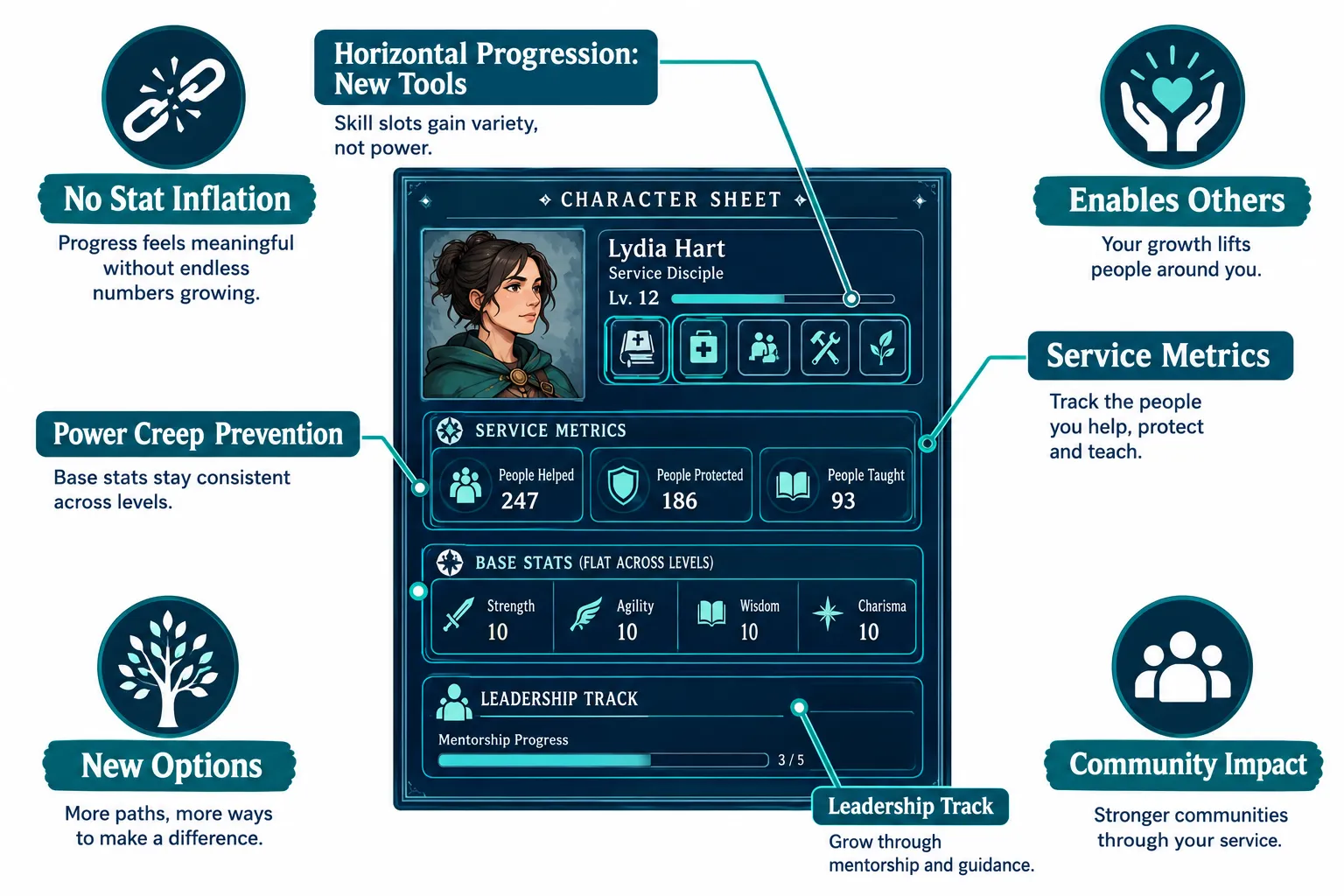
LitRPG is fantasy fiction that borrows visible game mechanics, levels, classes, stat blocks, skill notifications, and lets the reader watch a character’s growth in explicit, numbered terms. Traditional fantasy usually keeps power growth implied through prose; LitRPG puts it on the page as something close to a character sheet.
That transparency is a gift and a trap. It’s a gift because readers get to track progress the way they’d track a favorite sports team’s season. It’s a trap because once numbers are visible, a writer feels pressure to keep making them bigger, book after book, even when the story doesn’t need it.
A Christian LitRPG inherits both the gift and the trap, plus one more layer: the numbers now have to answer to something besides the plot. If a stat block exists, the question becomes what that stat is actually measuring, combat efficiency, or something closer to character.
How Do Christian Values Fit Into Game Design and Progression Systems
Christian values fit into LitRPG progression when the system itself, not just the narration, rewards mercy, humility, and costly obedience. That means the interface, the “level up” screen, the skill unlock, the class evolution, has to encode the value, not just describe it in dialogue afterward.
This is the difference between telling a reader a character is faithful and building a game system where faithfulness is the actual currency. A few practical patterns:
- XP for restraint, not just for kills, a character who chooses not to finish an enemy off, or who spares a resource for someone weaker, gains a tracked benefit.
- Class unlocks tied to sacrifice, a healer class that only opens its next tier after the character has given up something real (time, standing, safety) for someone else.
- Stat penalties for hoarding power, a system where refusing to share a resource or a skill with the party actually caps growth, mechanically punishing selfishness rather than just narrating it as a flaw.
The Character Arcs in Christian LitRPG approach treats faith and integrity as stat lines in their own right, leveling alongside strength and speed rather than sitting outside the system as commentary.
What Is Power Creep and Why Is It a Problem in RPGs
Power creep is the gradual inflation of stats, abilities, and threats across a series until early numbers feel meaningless and the story has no ceiling left to reach for. It’s a problem because it eventually collapses stakes: if book one’s dragon was terrifying and book six’s dragon needs to be fifty times stronger just to register, the emotional math stops working.
Power creep also flattens character. Once a protagonist can solve almost anything with enough force, choices about mercy, patience, or cooperation stop mattering, because the character was never really constrained in the first place. A LitRPG that avoids power creep keeps its cast believably limited, strong in specific ways, weak in others, and always dependent on people they can’t simply overpower.
“The strongest hand in every wrecked corridor” is only interesting once the story asks what that strength has cost, and who’s been quietly paying for it.
Designing Classes That Emphasize Service Over Combat Strength
Service-oriented classes advance by measuring what a character protects, teaches, or repairs rather than how much damage they output. This reframes the class sheet itself as a record of stewardship instead of a weapons catalog.
Some workable class concepts:
| Class | Core measure of growth | Signature ability example |
|---|---|---|
| Warder | People shielded, not enemies killed | Redirect a blow toward armor, never toward a kill count |
| Steward | Resources rebuilt or preserved | Convert scavenged supplies into shared, tracked stores |
| Intercessor | Conflicts de-escalated | Calm a hostile crowd without a single spell cast at them |
| Emissary | Trust built across factions | Unlock trade or safe passage others can’t negotiate |
Choose the Warder class if the story needs physical courage that still reads as restraint rather than aggression. Choose the Steward if the plot turns on scarcity and community survival rather than combat set pieces.
Skills That Reward Helping Others Instead of Just Damage Output
The clearest way to reward service mechanically is to give skills a measurable outcome tied to someone else’s wellbeing, not just to enemy hit points removed. A skill that heals is good; a skill that also tracks how many people returned to work, worship, or family life because of that healing is better design.
Examples that work well in a skill tree:
- Bear the Watch, take a night shift for an exhausted party member, granting them a rest bonus the next day.
- Teach the Ledger, pass a known skill to an NPC or ally, permanently reducing that ally’s future failure rate.
- Carry the Debt, absorb a penalty (fatigue, curse, financial loss) that would otherwise fall on someone weaker.
- Speak the Truth Costly, unlock a dialogue option that damages the character’s own standing but protects an innocent party’s reputation.
These mechanics reward the same instinct the magic systems rooted in grace, not power approach uses in cozy fantasy: ability tied to gift and cost, not accumulation.
How Do Leadership Mechanics Work in Progression-Based Games
Leadership mechanics in a well-designed LitRPG track how effectively a character grows and equips other people, not how many followers they can command. A “leadership level” should measure mentorship, delegation, and morale, the same territory real-world servant leadership research points toward, where growth in followers matters more than growth in personal authority.
Real leadership models that translate cleanly into game systems:
- Servant leadership, the leader’s success is scored by follower growth, not personal glory.
- Delegated stewardship, a growing party or guild only stays effective if responsibility is actively distributed, with structured check-ins and mentoring, rather than left to scale on its own.
- Earned trust over time, leadership XP unlocks slowly, through consistent small decisions, not a single dramatic victory.
Common mistake: giving a leader class automatic bonuses just for having a bigger guild. Scale without structure tends to weaken relational leadership rather than strengthen it, a large, poorly organized party should visibly underperform a small, well-mentored one.
What’s the Difference Between Horizontal and Vertical Progression in RPGs
Vertical progression makes a character stronger at the same tasks, bigger numbers, higher damage, more health. Horizontal progression gives a character new options, roles, and relationships without necessarily making them more powerful in a straight line.
A Christian LitRPG built for the long haul leans horizontal: new communities to serve, new forms of stewardship, new leadership responsibilities, new moral tradeoffs, rather than an ever-escalating threat ladder. Series data backs this instinct up. Fantasy series titles capture the large majority of estimated genre royalties, and later books in a series draw most of total reader consumption [1][2], which rewards a design built for repeatable variety, not endless escalation.
Can You Make a Compelling Story Without Constantly Increasing Player Power Levels
Yes, tension can come from constraint, timing, and relationship instead of raw strength, and many of fiction’s most memorable arcs already work that way. A character doesn’t need to get stronger to become more interesting; they need to face harder choices with the strength they already have.
Practical techniques:
- Raise the cost of using a power instead of raising the power itself.
- Introduce problems that strength can’t solve, grief, betrayal, a community that needs trust rebuilt, not rescuing.
- Let a character’s limits become plot-relevant, the way a Steward’s finite resources force hard triage decisions.
This mirrors how Christian LitRPG fiction handles game mechanics and faith-based storytelling more broadly: the system exists to pressure-test character, not to hand out bigger hammers.
How Do You Balance Multiple Character Classes So None Feels Overpowered
Balance multiple classes by giving each one a domain the others structurally can’t cover, so power comparisons stop being the right question. A Warder can’t out-negotiate an Emissary, and an Emissary can’t out-endure a Warder in a siege, the classes solve different problems by design.
Edge case: a solo protagonist who needs to function without a full party. Handle this by making their single class explicitly incomplete, strong in one domain, genuinely dependent on NPCs or allies in the others, so the story keeps needing other people even when the party is thin.
What Are Common Mistakes When Designing Faith-Based Game Mechanics
The most common mistake is turning a skill or stat into a disguised sermon, a “Faith” bar that fills up automatically whenever a character prays, with no cost or complication attached. That flattens belief into a resource bar instead of a lived choice, and readers who want faith under fire notice the shortcut immediately.
Other frequent errors:
- Making repentance a one-time stat reset instead of a slow, costly climb back.
- Letting “good” classes win every negotiation for free, removing real risk from service.
- Confusing niceness with virtue, a system that rewards being agreeable rather than rewarding what’s actually right.
Earned grace, not cheap grace, has to show up in the mechanics themselves, the same way it shows up in redemption arcs across Christian thrillers and dark fantasy.
Who Should Be Playing (or Reading) Christian-Themed Games and Who Might Not Enjoy Them
Christian LitRPG fits readers who want clean, high-stakes fantasy with faith treated as load-bearing rather than decorative, often the same audience drawn to Christian gamelit and clean speculative fiction generally. It’s a strong match for Kindle Unlimited readers who enjoyed the leveling mechanics of secular LitRPG but wanted the moral weight to mean something.
It’s a weaker fit for readers who want pure power fantasy with no constraint, or for readers expecting explicit theology lectures between fights, this genre works best when belief is shown through choice, not stated outright.
How Do You Keep Players Engaged If They’re Not Constantly Getting Stronger
Engagement holds up without constant power gains when the story keeps raising the stakes of relationship, who a character is responsible for, who they might fail, who’s watching them decide. Readers stay hooked on consequence, not just capability.
Tools that work:
- New responsibilities (a village, an apprentice, a rival faction) instead of new damage tiers.
- Visible impact, showing a rebuilt well, a reconciled family, a trained successor, since perceived impact drives emotional payoff more reliably than raw numbers.
- Leadership dilemmas with no clean answer, forcing mercy and justice to sit in tension rather than resolving neatly.
Are There Existing Christian Games That Handle Progression Well
Christian LitRPG fiction is a growing corner of a fast-expanding market, tracked LitRPG releases grew 188% between 2023 and 2025 [1], and titles built around earned progression rather than pure power fantasy are part of that growth. The Measured Debt series follows Eamon Kersey through The Cost of Being Chosen, The Remembered Route, and The Borrowed Yield, where a system that keeps proving his strength eventually has to answer for what that strength cost. Readers building their own reading lists can also browse the broader Goodreads-style guide for Christian fiction fans to find comparable titles.
Conclusion
A Christian LitRPG doesn’t need a bigger dragon in book six to earn its ending, it needs a character who’s had to choose courage, wisdom, cooperation, and costly service over and over, with the system itself keeping score of that instead of kill counts. Design the class sheet around what a character protects and enables, build leadership mechanics that reward mentoring over commanding, and let horizontal progression carry a series further than another stat inflation could.
For writers sketching a new series: start with one class built entirely around a service verb, shield, teach, mediate, rebuild, before adding a single combat stat. For readers hunting the next series: look for the story where strength keeps getting more expensive, not just bigger. That’s where hope in the dark actually holds up.
FAQ
What is Christian LitRPG? Christian LitRPG is fantasy fiction using visible game mechanics, levels, classes, skill trees, where faith, mercy, and service function as core parts of the progression system, not background flavor.
Does avoiding power creep mean the story feels stagnant? No. Stagnation comes from repeating the same stakes, not from keeping numbers modest. Rotating new responsibilities, relationships, and moral tradeoffs keeps tension high without escalating stats.
Can a service-based class still be exciting in combat? Yes. A Warder class, for example, can be as tactically demanding as a damage-focused class, it just measures success by who’s protected, not by kill totals.
Is Christian LitRPG only for young adult readers? No. Much of the audience is adult readers, often the same Kindle Unlimited readers drawn to Christian cozy mystery and epic fantasy, who want faith-based fiction with genuine stakes.
How is horizontal progression different from a “no progression” story? Horizontal progression still shows growth, new skills, roles, relationships, it just doesn’t rely on bigger numbers to signal that growth.
What’s the biggest sign a faith-based mechanic is too preachy? If the mechanic rewards a character for stating belief rather than acting on it at a cost, it’s likely functioning as narration dressed up as gameplay.
Should leadership XP scale with party size? Not automatically. Leadership systems work better when they require active mentoring and delegation as the group grows, rather than rewarding size alone.
Where can readers find more on this genre? The Christian LitRPG genre deep dive and the Kindle Unlimited guide to faith-based game-world fiction both cover the genre’s conventions in more depth.
References
[1] 2026 08 10 State Of Litrpg 2026 Discovery Crisis Market Analysis – https://litrpgcritic.com/blog/2026-08-10-state-of-litrpg-2026-discovery-crisis-market-analysis/ [2] Zeitgeist Cozy Fantasy And Litrpg Surge As Hottest Niches In 2026 – https://www.authormedia.com/zeitgeist-cozy-fantasy-and-litrpg-surge-as-hottest-niches-in-2026/