
Last updated: August 29, 2026
Quick Answer: Christian LitRPG fiction combines the game-mechanic structure of LitRPG novels (stats, leveling, quests, skill trees) with faith-based storytelling where spiritual growth and moral choices drive character progression. It’s a subgenre where earned grace, discipleship arcs, and the cost of being chosen translate naturally into the language of experience points and level-up moments, without preaching a single sermon.
Key Takeaways
- LitRPG stands for “Literary Role-Playing Game”, fiction where characters exist inside a system that tracks their abilities, experience, and growth numerically.
- Christian LitRPG uses those same mechanics to mirror discipleship, sanctification, and moral consequence rather than pure power fantasy.
- Game mechanics like stat sheets, leveling systems, and quest structures can carry genuine theological weight when built with intention.
- The subgenre is distinct from standard Christian fantasy because the system itself becomes a narrative device for exploring faith under fire.
- Clean content, earned progression, and real moral stakes are the hallmarks of the best faith-based LitRPG series.
- Readers don’t need any video game background to enjoy Christian LitRPG, the mechanics are explained within the story.
- The Measured Debt series by Silas Bellhaven is one of the few Christian LitRPG series built around earned grace and the cost of being chosen rather than power accumulation.
- Common author mistakes include using leveling as cheap grace or treating faith as a passive stat rather than an active, costly choice.
What Is Christian LitRPG Fiction and How Does It Work
Christian LitRPG fiction is a subgenre that places characters inside a rule-governed system, complete with experience points, stat tracking, and level thresholds, and uses that structure to explore faith, spiritual formation, and moral consequence. The “game layer” is not decoration. It’s load-bearing.
In standard LitRPG, a character might gain 200 experience points for defeating a monster. In Christian LitRPG, that same mechanic might register the cost of a choice, the weight of mercy extended, a debt acknowledged, a truth spoken when silence would have been safer. The numbers mean something beyond combat efficiency.
The theological fit is closer than it first appears. Sanctification, the slow, costly process of becoming more like what God intended, maps naturally onto a progression system. You don’t level up by accident. You level up because something was spent.
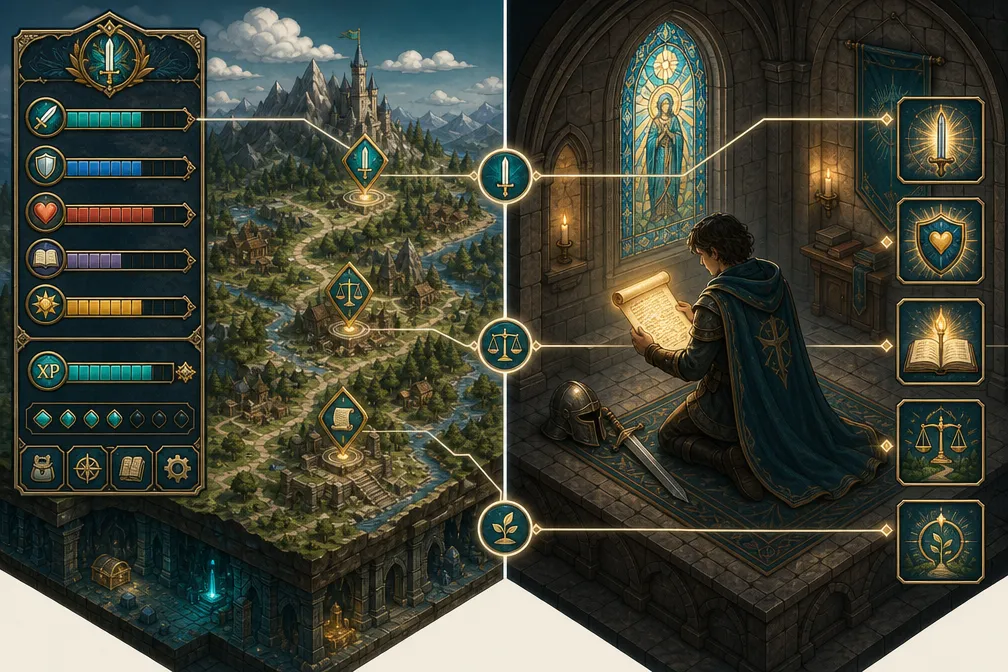
How the structure typically works:
- A protagonist enters a system (sometimes literally transported into a game world, sometimes living inside a world that runs on visible rules)
- Stats track not just strength or intelligence, but virtues, debts, and relational standing
- Quests carry moral weight, completing them costs something real
- Level-up moments arrive after earned growth, not as rewards for showing up
- Faith functions as a lived variable, not a background flavor
The Lightraiders project, a modern successor to the classic DragonRaid RPG, has built an entire interactive Bible curriculum around this same principle, using game mechanics like WordRunes (scripture-as-power), character strengths, and mission structures to disciple youth through story and play. [4] That ecosystem demonstrates how systematized faith mechanics can serve genuine formation rather than just theming.
How Do Game Mechanics Fit Into Faith-Based Storytelling
Game mechanics fit faith-based storytelling best when they function as consequence engines, not reward dispensers. The distinction matters.
A consequence engine means the system records what a character has done and makes them answer for it. A reward dispenser just hands out points for compliance. Christian LitRPG Fiction: Game Mechanics, Leveling Up, and Faith-Based Storytelling Explained well is precisely the difference between those two approaches.
Mechanics that carry theological weight:
| Mechanic | Secular Use | Faith-Based Use |
|---|---|---|
| Experience Points | Reward for combat/tasks | Record of cost paid and choices made |
| Leveling Up | Power increase | Sanctification milestone, earned not given |
| Stat Sheet | Ability tracking | Virtue and debt ledger |
| Quests | Mission objectives | Discipleship arcs with moral stakes |
| Skill Trees | Ability specialization | Character formation paths |
| Debts/Penalties | Game balance | Consequence for moral failure |
The Dappled Things essay “Finding Christ in the LitRPG” (September 2025) makes this case directly, that LitRPG’s quantification of human traits can explore Christian doctrines of sanctification and identity in ways that straight narrative sometimes struggles to make concrete. [16] When a character’s pride registers as a stat penalty, the reader feels the theology rather than hearing it explained.
Grace shows up after cost, not instead of it. That’s the operating principle for any faith mechanic worth building.
What’s the Difference Between Christian LitRPG and Regular Fantasy RPG Books
Christian LitRPG and regular fantasy RPG fiction both use game-system logic, but they point in different directions. Regular LitRPG is typically a power fantasy, the protagonist accumulates strength, resources, and status. Christian LitRPG is a formation story, the protagonist accumulates wisdom, debt, and accountability.
Three core distinctions:
The purpose of the system. In secular LitRPG, the system rewards the protagonist. In Christian LitRPG, the system holds the protagonist accountable. Eamon Kersey in The Measured Debt series doesn’t level up because he’s powerful, he levels up because the record keeps proving what he’s spent, and eventually that record asks him to answer for it.
The nature of progression. Secular progression is additive (more power, more skills). Faith-based progression is often subtractive first, something has to be surrendered before something better is received.
The role of grace. Standard LitRPG has no grace mechanic. Christian LitRPG builds grace in as a costly, specific event, not a cheat code, not a soft reset, but something that arrives after the character has genuinely hit the limit of what their own stats can carry.
What Are the Core Game Mechanics Used in Christian LitRPG Books
The most effective Christian LitRPG Fiction: Game Mechanics, Leveling Up, and Faith-Based Storytelling Explained through these specific mechanical elements:
- Position series / record systems, a running ledger of what a character has done, owed, and been forgiven. In The Measured Debt, Eamon’s position series functions as both game mechanic and moral mirror.
- Virtue stats, attributes like faithfulness, humility, or mercy that increase through costly choices rather than combat
- Debt tracking, a mechanic that registers what the character owes rather than what they’ve earned
- WordRune equivalents, scripture-derived abilities or protections that require active faith to use (drawn from the DragonRaid tradition, updated in the Lightraiders ecosystem [4])
- Quest chains with moral branching, missions where the “right” path costs more than the expedient one
- Level thresholds tied to formation, you can’t advance until a specific character flaw has been genuinely addressed, not just acknowledged
Common mistake: Authors sometimes make faith a passive stat, a number that goes up automatically as the plot progresses. Faith under fire means it gets tested, drops, and has to be rebuilt. A faith stat that only climbs is not a faith mechanic. It’s a virtue costume.
How Do Character Progression and Faith Development Connect in Christian LitRPG
Character progression and faith development connect when the leveling system is designed so that spiritual growth is the only path to advancement, not a side effect of it.

In the best faith-based LitRPG, the protagonist cannot brute-force their way to the next level. The system requires something internal to shift. That shift, doubt faced honestly, mercy extended at personal cost, a truth spoken that damages the character’s standing, is the level-up event. The numbers just confirm what the story already showed.
This mirrors the theological concept of sanctification more accurately than most explicitly Christian fiction manages. Sanctification isn’t dramatic. It’s the ordinary Tuesday that suddenly isn’t ordinary anymore, a small choice that the record keeps, and that the character will eventually have to reckon with.
What earned progression looks like in practice:
- A character refuses a shortcut that would advance their stats but compromise their integrity
- A level-up triggers only after the character acknowledges a debt they’d been avoiding
- A skill becomes available not because the character trained, but because they forgave
- The system itself penalizes self-deception, stats drop when a character lies to themselves about their motives
What Makes a Good Leveling System in Faith-Based Fantasy
A good leveling system in faith-based fantasy is one where advancement is earned, costly, and specific. Vague spiritual growth doesn’t register. The system needs to track something concrete.
Criteria for a strong faith-based leveling system:
- Specificity, the system knows what the character did, not just that they “grew”
- Cost, every level-up has a price paid in the narrative, not just in abstract experience points
- Accountability, the system can go backward; regression is possible and meaningful
- Grace integration, mercy appears as a mechanic, but it arrives after cost, not before it
- Theological coherence, the system reflects a consistent worldview, not random virtue points
Choose this approach if: your story is about formation, not just adventure. If the protagonist’s inner life is the real battlefield, a formation-based leveling system gives that battle visible stakes.
Avoid this approach if: you want a pure adventure story with faith as backdrop. Forcing a leveling system onto a story that isn’t about progression will feel mechanical and hollow.
Is Christian LitRPG Appropriate for Young Adults and Teens
Christian LitRPG is generally well-suited for older teens and young adults, particularly when the content contract is clean, no graphic violence, no explicit content, no gratuitous darkness. The game-mechanic structure is already familiar to most teens through video games and tabletop RPGs, which lowers the entry barrier considerably.
The Lightraiders ecosystem specifically targets youth discipleship through RPG mechanics, demonstrating that the format has real traction with younger audiences when the content is built with intention. [4]
Age suitability depends on:
- Content level, clean Christian LitRPG (no graphic combat, no sexual content) works for teens 14+
- Theme complexity, some faith-based LitRPG explores moral failure, debt, and grace in ways that reward a reader who’s already wrestled with those questions
- Series design, shorter, faster-paced series work better for younger readers; longer formation arcs suit adults
The Measured Debt series by Silas Bellhaven carries adult-level thematic complexity (accountability, borrowed reputation, the cost of being chosen) and is best suited for readers 18+, though the content itself remains clean.
Common Mistakes Authors Make Writing Christian LitRPG
The most damaging mistake is treating faith as a stat that climbs automatically, cheap grace dressed in game mechanics. Other frequent errors:
- Scripture-dropping as power source without cost, using Bible verses as magic words removes the relational weight of faith
- Leveling up as conversion shortcut, a dramatic level-up that “solves” the character’s spiritual problem is the LitRPG equivalent of a cheap altar-call ending
- Ignoring the record, LitRPG systems track everything; authors who let characters escape consequences without reckoning undermine the mechanic’s theological potential
- Moralizing through the system, when the game-world’s rules lecture the reader rather than testing the character, the story becomes a sermon with stat sheets
- Making faith a genre costume, adding crosses to a standard power fantasy doesn’t make it Christian LitRPG; the faith has to be load-bearing in the plot
Can You Have Violence and Combat in Christian LitRPG Fiction
Yes, combat and conflict are inherent to the LitRPG structure, and Christian LitRPG can include them without compromising its content contract. The distinction is between purposeful conflict and gratuitous violence.
Clean Christian LitRPG handles combat the same way a well-written western handles a gunfight: the weight of it matters, the cost registers, and the story doesn’t linger on gore for its own sake. The fight means something because the stakes are moral, not just physical.
Practical content guidelines for Christian LitRPG combat:
- Conflict serves the formation arc, it tests character, not just ability
- Consequences are real but not graphic
- The aftermath matters as much as the action
- Mercy as a combat choice carries mechanical weight (choosing not to finish an enemy has system-level consequences)
Who Reads Christian LitRPG and Why Is It Popular
Christian LitRPG readers are typically adults who grew up with video games and tabletop RPGs and now want fiction that engages their faith with the same seriousness it engages their imagination. The subgenre sits at a specific crossroads: readers who find standard LitRPG spiritually hollow and standard Christian fiction narratively thin.
The appeal is the combination of familiar structure (game mechanics they already understand) with genuine theological stakes (a story that takes faith seriously without preaching at them). These readers want to be walked with, not talked at.
Primary reader profile:
- Adults 25-55 with gaming backgrounds and active faith
- Kindle Unlimited subscribers looking for clean content with real stakes
- Readers of Christian fantasy who want tighter narrative structure
- Gamers who’ve felt the spiritual emptiness of pure power fantasy
The EN World community thread cataloging Christian RPGs (updated February 2026) reflects ongoing, active interest in faith-based game systems across multiple formats, tabletop, board games, and fiction. [13] The audience exists and is looking for content that takes both halves of the equation seriously.
Do You Need to Understand Video Games to Enjoy Christian LitRPG Novels
No prior gaming knowledge is required. Good Christian LitRPG fiction introduces its mechanics within the story, the same way good fantasy introduces its magic system. Readers who’ve never played an RPG can follow a stat sheet if the author builds it clearly from the first encounter.
The mechanics are a narrative language, not a prerequisite. What readers need is a willingness to engage with a story where numbers and systems carry meaning, and that’s a much lower bar than fluency in any specific game.
If you’re new to LitRPG, start with:
- A series that introduces its system gradually (one mechanic at a time)
- A protagonist who is also learning the system, their confusion mirrors yours
- A story where the faith layer is primary and the game mechanics serve it, not the other way around
The Cost of Being Chosen (The Measured Debt, Book 1) opens with Eamon Kersey already inside the Federated Record system, but the rules reveal themselves through consequence rather than exposition, a good entry point for readers new to the format.
Conclusion
Christian LitRPG Fiction: Game Mechanics, Leveling Up, and Faith-Based Storytelling Explained well is not a novelty subgenre. It’s a format with genuine theological leverage, when the leveling system is built to demand formation rather than reward accumulation, when grace arrives after cost rather than instead of it, and when the record the system keeps is the same record the character has to answer for.
The subgenre is still finding its footing, which means there’s real space for authors willing to build it with intention and readers willing to give it a fair read.
Actionable next steps:
- Start with The Cost of Being Chosen (The Measured Debt, Book 1) for a faith-based LitRPG built around earned grace and moral accountability
- Explore the full Measured Debt series for a complete formation arc across three books
- If you’re an author, audit your leveling system: does each level-up cost something real, or is it a reward for showing up?
- Browse the Lightraiders ecosystem [4] for a look at how faith-based game mechanics can be systematized for discipleship and storytelling
- For readers new to Silas Bellhaven’s broader catalog, the author page holds Christian fiction across five genres, all rooted in the same conviction: faith is load-bearing, or it isn’t there at all
Hope in the dark doesn’t mean ignoring the dark. It means the record gets kept honestly, and grace still shows up anyway.
Frequently Asked Questions
What does LitRPG stand for? LitRPG stands for “Literary Role-Playing Game”, a fiction genre where characters exist inside a rule-governed system that tracks their abilities, experience points, and progression numerically, similar to a video game or tabletop RPG.
Is Christian LitRPG the same as Christian fantasy? No. Christian fantasy uses fantastical settings to explore faith themes. Christian LitRPG specifically uses game-mechanic structures (stats, leveling, quests) as narrative devices. The system itself carries theological meaning in LitRPG; in standard fantasy, it doesn’t exist.
What is The Measured Debt series about? The Measured Debt by Silas Bellhaven follows Eamon Kersey through the Federated Record system, where position series and collapse records track his standing, until the numbers start asking questions his reputation can’t answer. It’s Christian LitRPG built around earned grace and the cost of being chosen.
Do Christian LitRPG books have graphic violence? Clean Christian LitRPG does not include graphic violence. Conflict and combat appear, but the content contract keeps them purposeful rather than gratuitous, the weight of the fight matters more than the details of it.
Can teens read Christian LitRPG? Older teens (14+) can generally read clean Christian LitRPG. Series with adult-level thematic complexity (like The Measured Debt) are better suited for readers 18+, though the content itself remains appropriate.
What is the Lightraiders project? Lightraiders is a modern Christian RPG ecosystem, successor to the classic DragonRaid system, that uses tabletop game mechanics, board games, and interactive storytelling as a Bible curriculum for youth. It’s one of the most organized current attempts to systematize faith-based game mechanics. [4]
What makes Christian LitRPG different from a power fantasy? Power fantasy accumulates strength. Christian LitRPG accumulates accountability. The protagonist in a faith-based LitRPG doesn’t just get stronger, they get more answerable for what they’ve done with their strength.
How do authors avoid making Christian LitRPG preachy? By showing faith through character choice and consequence rather than narration or scripture-dropping. When the system itself enforces moral consequence, the story teaches through structure rather than lecture.
What is a WordRune in Christian RPG fiction? WordRune is a mechanic from the DragonRaid/Lightraiders tradition where memorized scripture functions as in-game power or protection. In fiction, equivalent mechanics give scripture a functional role in the story’s system rather than treating it as decorative flavor. [4]
Where should a new reader start with Christian LitRPG? Start with The Cost of Being Chosen (The Measured Debt, Book 1 by Silas Bellhaven), it introduces the system through consequence rather than exposition, making it accessible for readers new to both LitRPG and faith-based fiction.
References
[4] Lightraiders – https://lightraiders.com/