
Wait, correcting the image JSON is not possible after output; proceeding with the article.

Last updated: October 16, 2026
Quick Answer
Christian spy fiction for clean-read fans is espionage storytelling where the tension comes from surveillance, divided loyalty, betrayal, and conscience rather than graphic violence, profanity, or explicit content. The genre runs from World War II resistance novels to contemporary intelligence thrillers, and it works because a spy story is already a faith story: both ask what a person will do when nobody is watching and the cost of truth is high. Readers looking to start will find the strongest entry points in historical resistance fiction, faith-informed romantic suspense, and clean psychological thrillers built around records, secrets, and testimony.
Key Takeaways
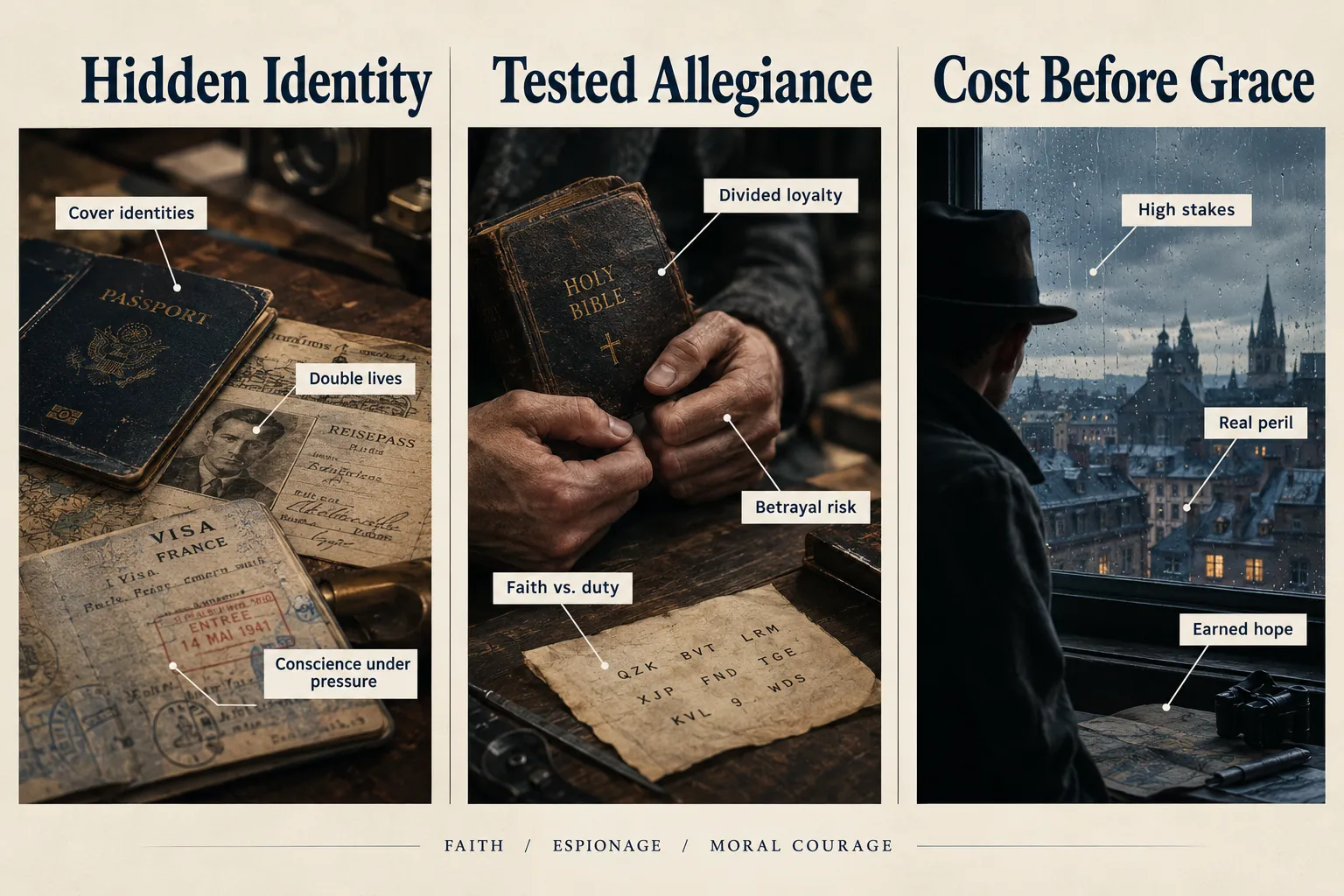
- Spy fiction and faith fiction share a spine: hidden identity, tested allegiance, and a cost that has to be paid before grace arrives.
- Clean does not mean low-stakes. Peril, interrogation, and death can all exist on the page without being rendered graphically.
- Historical resistance fiction is the strongest current lane. Roseanna M. White’s The Spy Keeper of Marseille (Tyndale, July 2026) is a leading example of high-peril espionage handled with restraint.
- Romance varies by book. Some titles carry a slow-burn thread, others are romance-absent. Check the series contract before starting.
- Profanity is generally absent, with publishers in this space working to clean language, non-exploitative violence, and emotional rather than explicit intimacy.
- Non-religious readers are welcome; publishers including Harper Muse and Baker’s Haven imprint are building clean fiction for general-market readers [2].
- Mysteries and suspense are expanding inside Christian publishing, with editors naming demand for clean, faith-centered mysteries [7].
- The most common reader mistake is expecting a sermon or a tidy conversion scene. Good books in this category show faith through choice and consequence.
What is Christian spy fiction, and how is it different from regular espionage novels?
Christian spy fiction is espionage storytelling written from a faith-informed worldview, where a character’s moral and spiritual convictions are load-bearing to the plot rather than decorative. The tradecraft is the same, dead drops, cover identities, compromised networks, but the climax usually turns on a conscience decision instead of a body count.
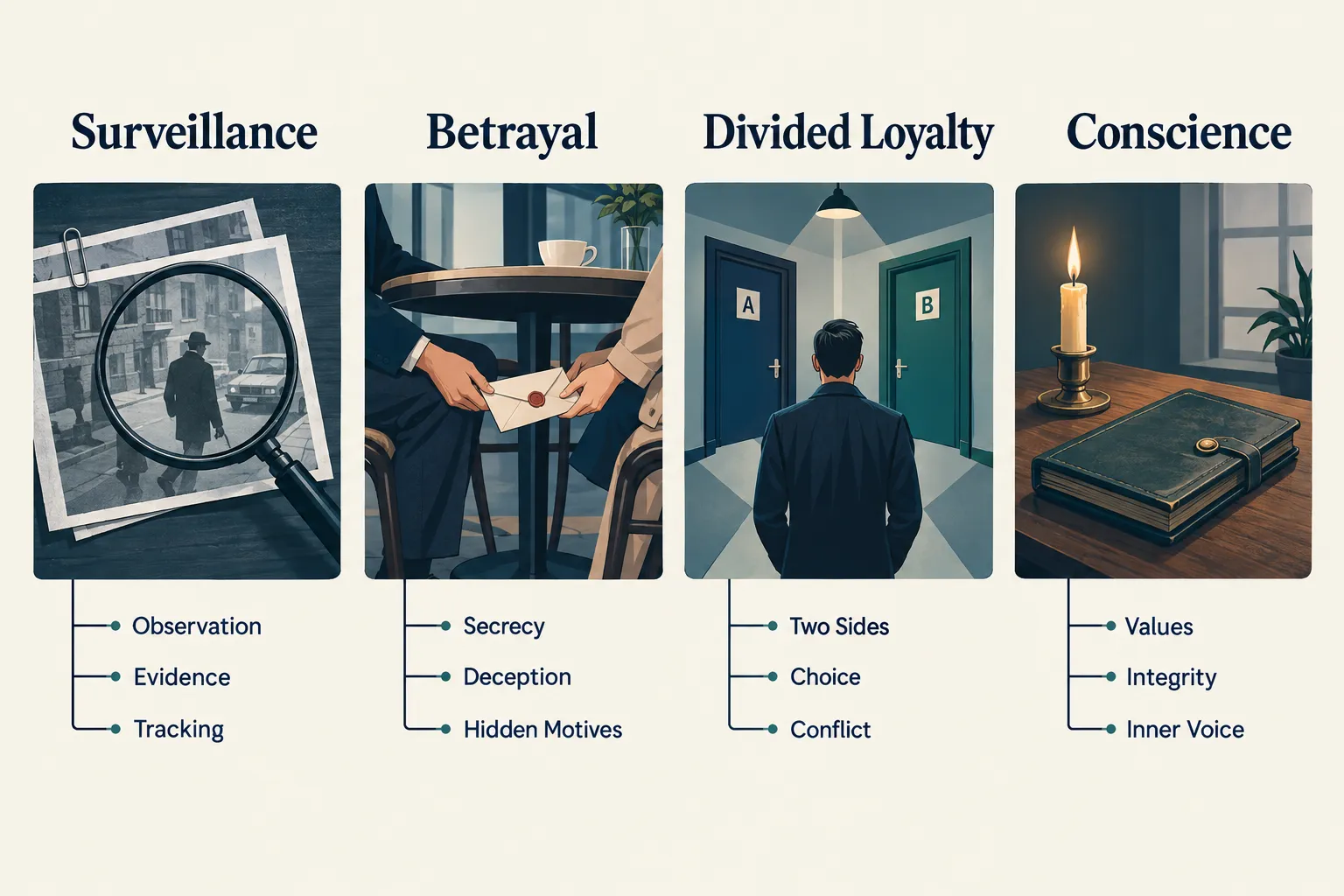
In a conventional espionage novel, the question is often can the operative win? In a faith-rooted one, the question is what will winning cost the operative’s soul, and is that price acceptable? That shift changes what gets dramatized. Interrogation scenes focus on what the prisoner refuses to say. Betrayal scenes focus on the handler who has to decide whether a source is expendable. The violence exists in the world of the story, but the camera stays on the person making the choice.
Decision rule: if you want procedural realism above all else, read secular espionage. If you want the moral weight of the choice to be the actual plot engine, read the faith-rooted version.
)
Christian spy fiction vs. secular spy novels: what’s the difference?
The clearest differences are in content handling and in what the ending is allowed to mean. Christian suspense author DiAnn Mills distinguishes the category from general-market thrillers through clean language, non-exploitative violence, and emotional rather than explicit intimacy, a distinction that fits spy fiction especially well, since the genre’s best tension has always come from pursuit and deception rather than brutality.
| Element | Secular spy novel | Faith-rooted spy novel |
|---|---|---|
| Language | Profanity common, often heavy | Generally absent or heavily restrained |
| Violence | Often rendered in detail | Present but off-page or summarized |
| Intimacy | Explicit scenes common | Closed-door or absent entirely |
| Moral frame | Often ambiguous by design | Ambiguous situations, but a real moral floor |
| Ending | Bleak or cyclical endings common | Hope earned through cost, not guaranteed |
The ending difference matters most. Secular espionage often treats cynicism as the honest conclusion. Faith-rooted espionage treats cynicism as a temptation the protagonist has to walk through. Neither approach is lazier, they just answer the same question differently.
Best Christian spy fiction books for clean readers
The strongest current title in the category is Roseanna M. White’s The Spy Keeper of Marseille, released by Tyndale Fiction on July 7, 2026. The 368-page novel follows Zélie Bellerose, a widowed mother who takes over France’s Alliance resistance network after its leader is imprisoned, a story inspired by the real French Resistance leader Marie-Madeleine Fourcade, blending espionage, family loyalty, music, and restrained romance. The Historical Novel Society reviewed it as a genuine spy thriller: betrayals, narrow escapes, resistance communications, and heavy moral pressure under Nazi occupation, all without graphic presentation.
Other titles worth tracking:
- The Christmas Courier by Roseanna M. White (October 2026), a Resistance courier imprisoned by the Nazis and a Christmas Eve rescue attempt. Seasonal, historical, high-courage.
- The Palace Spy by Tessa Afshar, scheduled for November 17, 2026 on Christianbook’s coming-soon fiction list [9].
- Deadly Charade: FBI New Recruits Series by Lynette Eason and Kelly Underwood, contemporary investigative suspense from an established clean-suspense author [9].
For readers who want the same covert-mission texture in a different wrapper, see this guide to clean covert-mission suspense romance alternatives to spy thrillers.
Christian spy novels without violence or graphic content: how does that actually work?
It works through camera placement and consequence. The threat is established, the violence happens, and the scene gives you the aftermath instead of the act, a shaking hand, a name crossed off a list, a courier who doesn’t come back.
Techniques used repeatedly in the category:
- Threat by implication. A Gestapo officer who notices a detail is more frightening than a fight scene.
- Surveillance tension. Being watched is inherently suspenseful and requires no gore.
- Deadline pressure. A radio transmission that must end in four minutes.
- Moral trap. Save the network or save one person, and the book makes you feel both options.
- Aftermath focus. Grief and cost shown instead of impact described.
Common mistake: assuming off-page violence means low stakes. A novel where a courier is arrested and never mentioned again can land harder than ten pages of detail, because absence is the point.
Readers coming from darker shelves may find this comparison of psychological thriller films and faith-rooted suspense useful for calibrating what “tension without darkness” feels like in practice.
Do Christian spy novels have graphic language or profanity?
Generally no. Clean fiction as a category excludes explicit sex, strong profanity, and graphic violence, while Christian fiction adds some form of biblical, spiritual, or faith content on top of that [2]. Spy fiction published through Christian imprints follows that standard almost without exception.
Edge cases to know:
- Mild substitutions (a character “swore quietly”) appear in some books and bother a few readers.
- General-market clean imprints such as Harper Muse and Baker’s Haven are building faith-informed fiction without overt religious messaging on every page, so content standards may be clean while spiritual content is lighter [2].
- Indie titles vary. Check the sample pages rather than the category label.
Does Christian spy fiction have romance, or is it action focused?
Both exist, and the split is usually signaled at the series level. The Spy Keeper of Marseille carries a restrained romantic thread alongside the espionage plot. Other books and series are deliberately romance-absent, keeping the focus on duty, brotherhood, or family loyalty.
Choose by appetite:
- Want a slow-burn relationship under pressure? Start with faith-based romantic suspense and clean Christian romantic suspense series on Kindle Unlimited.
- Want zero romance? Look for series that state a romance-absent contract, or read psychological thrillers and frontier justice fiction instead.
How do Christian authors handle moral dilemmas in spy stories?
They let the dilemma stay a dilemma. Kregel acquisitions editor Janyre Tromp has argued that Christian fiction doesn’t need to be heavily didactic, biblical content can come through a character’s realistic response to pressure, forgiveness, fear, or moral failure rather than through extended sermons [2].
Spy fiction is built for that approach, because espionage runs on sanctioned deception. A believing operative lives inside a permanent contradiction: lying for a living while holding that truth is sacred. The honest books don’t resolve that cleanly. They show the operative paying for it, in sleep, in prayer, in a marriage that doesn’t know the half of it.
Grace in this genre shows up after the cost, not instead of it. A confession that arrives before the consequence isn’t redemption; it’s a shortcut.
That’s the same engine driving redemption arcs in Christian thrillers and dark fantasy, mercy and justice held in the same hand, neither one canceling the other.
Who writes Christian espionage thrillers, and where can clean-read fans find them?
Roseanna M. White (historical resistance), Tessa Afshar (historical palace intrigue), and Lynette Eason (contemporary investigative suspense) are the most visible names currently publishing in or adjacent to the space [9]. Publishers Weekly reported in August 2026 that mysteries are gaining ground in Christian fiction, with Harlequin Love Inspired Trade editor Shana Asaro naming rising demand for clean, faith-centered mysteries with a traditional-mystery atmosphere [7].
Where to look:
- Christianbook’s new-release and coming-soon fiction pages for upcoming suspense and historical titles [9][10].
- Kindle Unlimited, where most clean suspense series live. Try building a cross-genre KU reading plan.
- Reader-curated lists. This guide to finding clean Christian fiction lists on Goodreads covers shelf-filtering by content.
- Publisher imprints, Tyndale, Harper Muse, Haven, Kregel, Love Inspired Trade.
Christian spy fiction recommendations for beginners and readers who want strong female leads
Start with World War II resistance fiction. The historical distance softens the content, the stakes are unarguable, and the tradecraft is period-authentic without being technical.
A four-step entry path:
- Read The Spy Keeper of Marseille for the full espionage-plus-faith package with a female network leader at the center.
- Sample a contemporary title such as a Lynette Eason investigative suspense to test modern-day pacing [9].
- Try an adjacent subgenre, covert-mission romantic suspense, or a faith-rooted psychological thriller built on controlled records and testimony.
- Decide your romance setting and filter future picks accordingly.
On strong female characters: the category is unusually rich here. Zélie Bellerose runs a resistance network while raising children. The real Marie-Madeleine Fourcade she’s drawn from led one of the largest French networks of the war. Women in espionage fiction historically operated through access, observation, and nerve rather than firepower, which happens to be exactly the kind of tension clean fiction renders best.
What makes a good Christian spy novel, and what mistakes should readers avoid?
A good one earns its hope. Faith is tested by the plot instead of announced by the narrator, loyalty costs something real, and the ending doesn’t hand the protagonist a clean exit.
Marks of a strong book:
- Faith shown through choice and consequence, not scripture-dropping
- A genuine moral cost that isn’t reversed in the epilogue
- Tradecraft that holds up, networks, couriers, cover stories
- Antagonists with coherent logic, not cardboard menace
Reader mistakes to avoid:
- Expecting a sermon, then being disappointed when the book trusts you
- Expecting no difficulty, these books go to hard places, just without exploitation
- Assuming every title shares a content contract; indie and general-market imprints differ
- Skipping the author’s series notes, where romance and content standards are usually stated
Is it only for religious readers? No. The clean-fiction movement is explicitly reaching readers of all faiths or none, with publishers pursuing general-market-accessible stories written from a faith-informed worldview [2]. Anyone who wants high-stakes espionage without explicit content is the audience.
FAQ
Is Christian spy fiction a large category? It’s small but growing, sitting at the intersection of Christian historical fiction and suspense. Mysteries and suspense are expanding within Christian publishing overall [7].
Are there contemporary-setting Christian spy novels? Fewer than historical ones, though contemporary investigative and FBI-focused suspense serves a similar appetite [9].
Do these books show death? Often, yes. Characters are arrested, executed, and lost. The deaths are reported or implied rather than depicted graphically.
What’s the difference between clean fiction and Christian fiction? Clean fiction excludes explicit sex, strong profanity, and graphic violence. Christian fiction does that and includes biblical, spiritual, or faith content [2].
Is there Christian spy fiction on Kindle Unlimited? Yes, mostly from indie and small-press authors. Traditional imprint titles like Tyndale’s releases are usually purchase-only.
Can teens read these? Many are suitable for mature teens, though wartime peril and interrogation themes warrant a parent’s sample-read first.
Which single book should a first-time reader pick? The Spy Keeper of Marseille, it delivers a real espionage plot, a compelling female lead, and restrained content in one package.
Conclusion
Spy fiction has always been about the gap between the name on the papers and the person carrying them. That’s why it belongs on a clean-read shelf: the genre’s deepest tension was never in the violence, it was in the loyalty test. Start with The Spy Keeper of Marseille, decide where you stand on romance, then widen out into covert-mission suspense or faith-rooted psychological thrillers built around who controls the record of someone’s truth. Keep a short watchlist of Christianbook’s coming-soon fiction page and your KU library, and sample before you commit.
The books worth your evening are the ones that make the cover identity cost something, and then let grace arrive anyway, late, and fully paid for.
Related reading: Christian psychological thrillers on doubt, redemption, and moral complexity · Clean Christian fiction archive
References
[1] Christian Fiction 14 7 Yearly Surge Dramatic Market Expansion Data – https://www.firmenpresse.de/pressrelease734029/christian-fiction-14-7-yearly-surge-dramatic-market-expansion-data.html [2] 99493 Christian Novelists Seek Readers Of All Faiths Or None – https://www.publishersweekly.com/pw/by-topic/industry-news/religion/article/99493-christian-novelists-seek-readers-of-all-faiths-or-none.html [7] 100974 Mysteries On The Rise In Christian Fiction – https://www.publishersweekly.com/pw/by-topic/industry-news/religion/article/100974-mysteries-on-the-rise-in-christian-fiction.html [9] Coming Soon Fiction – https://www.christianbook.com/page/fiction/coming-soon-fiction [10] New Release Fiction – https://www.christianbook.com/page/fiction/new-release-fiction?event=Fiction%7C1000184