
Last updated: August 23, 2026
Quick Answer: Christian psychological thrillers are suspense novels that place characters under intense mental and spiritual pressure, forcing them to wrestle with doubt, deception, and moral failure, while keeping hope in the frame. They differ from secular thrillers not by softening the darkness, but by insisting that the darkness isn’t the last word. For readers who want real stakes without graphic content, this subgenre delivers both.
Key Takeaways
- Christian psychological thrillers treat faith as load-bearing, not decorative, characters doubt, fail, and find grace through cost, not around it.
- The subgenre avoids graphic violence and explicit content without avoiding hard emotional territory.
- Redemption in these stories is earned, not handed out, grace shows up after something has been paid.
- Moral complexity is a feature, not a flaw: characters in these books make genuinely difficult choices with real consequences.
- The fastest-growing segment of Christian fiction in 2026 is suspense, with psychological and thriller hybrids leading that growth [7].
- Key titles to know include When Hannah Sleeps (Silas Bellhaven), Over the Edge (Susan May Warren & Tari Faris), and Ashes Beneath the Altar (Kaiden Hanks).
- These books are written for readers who want stories that walk with them, not preach at them.
- Kindle Unlimited has become a primary discovery channel for clean Christian suspense readers [8].
What Makes a Psychological Thriller “Christian”?
A Christian psychological thriller is defined not by the presence of scripture or church settings, but by a worldview that treats faith as a real force inside the story, one that gets tested, questioned, and ultimately proven through what characters choose when no one is watching.
The label “Christian” doesn’t mean safe or simple. It means the moral architecture of the story assumes that truth matters, that conscience is real, and that what a person does in the dark has weight. The psychological dimension adds internal pressure: manipulation, gaslighting, unreliable memory, hidden identity, and the slow erosion of trust. When those elements collide with a character whose faith is already under strain, the result is suspense that cuts deeper than plot mechanics alone.
Three markers that define the category:
- Faith is structural, not decorative. God isn’t mentioned in passing, belief shapes how characters interpret what’s happening to them and what they’re willing to do about it.
- The threat is psychological, not just physical. The danger lives in the mind: a manipulative institution, a false record, a voice that starts speaking for you instead of with you.
- Hope is present but not cheap. The story earns its ending. Mercy shows up after cost, not instead of it.
How Christian Psychological Thrillers Handle Dark Themes Differently
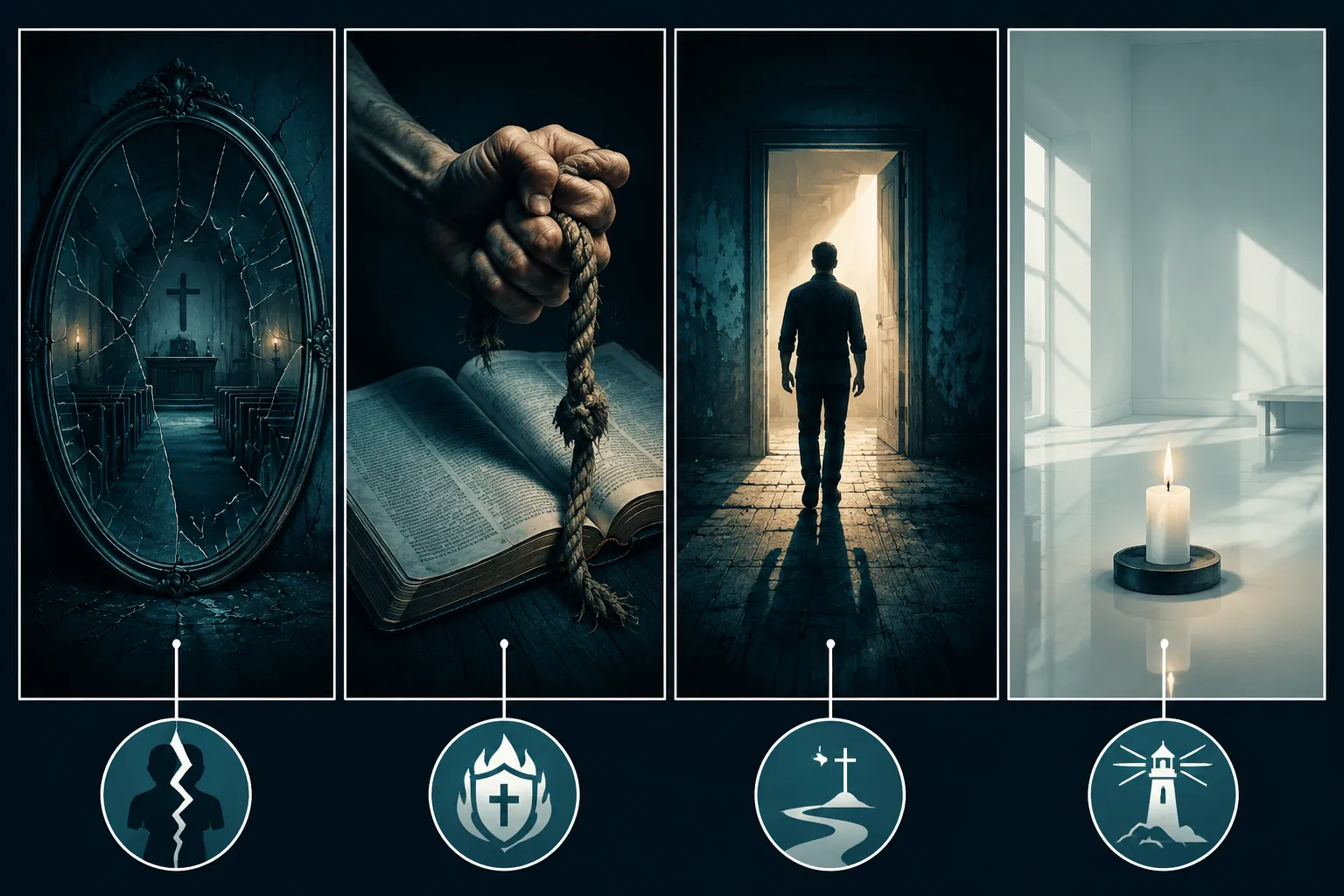
Christian psychological thrillers engage dark themes, trauma, deception, spiritual abuse, moral failure, but they handle them with a different set of commitments than secular suspense.
The difference isn’t that these books look away. It’s that they refuse to let darkness be the point. A secular thriller might use psychological horror for pure tension or shock effect. A Christian psychological thriller uses the same darkness to ask what a person is made of when everything they trusted turns out to be wrong.
What changes in practice:
- No graphic violence rendered in clinical detail. Threat and consequence are present; gore is not.
- No explicit content. Emotional and relational stakes replace physical titillation.
- Trauma is handled with care, not exploited. Characters who have been harmed are given interiority, not just backstory.
- Spiritual abuse is named honestly. Some of the most morally complex Christian thrillers are set inside religious institutions, not to indict faith, but to distinguish authentic belief from its counterfeits.
This is where the subgenre gets genuinely interesting. Books like When Hannah Sleeps (Silas Bellhaven, The Gathering Light series) place their protagonist inside a restoration retreat where testimonies are carefully preserved, and that careful preservation becomes the threat. The institution uses the language of healing to control the record of someone’s truth. That’s not a soft premise. But it’s handled without a single scene that a reader would need to skip.
Are Christian Thrillers Less Graphic Than Secular Ones?
Yes, and that’s a deliberate craft choice, not a limitation. Christian psychological thrillers achieve tension through psychological and moral pressure rather than physical horror or explicit content [5].
Readers who avoid secular thrillers because of graphic violence, sexual content, or heavy profanity will find Christian psychological thrillers genuinely different. The content contract is real: clean prose, no explicit scenes, no gratuitous suffering. What doesn’t change is the emotional weight. These books can be deeply unsettling in the best way, the kind of unsettling that comes from recognizing a situation, not from being assaulted by description.
Choose this subgenre if:
- You want suspense that keeps you turning pages without scenes you’ll regret reading.
- You’re drawn to stories about manipulation, hidden identity, or institutional deception.
- You want a protagonist whose faith is part of how they process, and survive, what’s happening to them.
This subgenre may not be for you if:
- You want action-forward thrillers with physical confrontations as the primary tension engine.
- You prefer stories where faith is entirely absent from the narrative frame.
Christian Psychological Thrillers Where Faith Is Questioned
Some of the strongest entries in this category are precisely the ones where the protagonist’s faith is the thing under attack, not just their safety.
Faith under fire is the spine of the best Christian psychological thrillers. The doubt isn’t resolved in chapter two. It sits in the character’s chest for most of the book, shaping every decision, coloring every relationship. When resolution comes, it’s earned, not a dramatic conversion moment, but a quiet, costly choice that proves what the character actually believes when belief costs something.
Notable examples in 2026:
- When Hannah Sleeps (Silas Bellhaven), Hannah Garrick has transcribed a hundred women’s worst nights. When her own testimony starts appearing in someone else’s file, she has to decide whether the institution she trusted was ever what it claimed to be.
- When the Voice Breaks (Silas Bellhaven), Caris Weller built her career on careful language, until the retreat’s own system starts speaking for her instead.
- Ashes Beneath the Altar (Kaiden Hanks, June 2026), dark secrets tied to a religious space, positioned squarely in the psychological suspense category [1].
- Over the Edge (Susan May Warren & Tari Faris, April 2026), a police detective and trauma survivor navigate healing in a faith context, with psychological suspense and romance woven together [4].
Best Christian Psychological Thrillers With Redemption Themes
The best Christian psychological thrillers with redemption arcs are the ones where redemption costs the character something real, a reputation, a relationship, a version of themselves they’d been protecting.
Redemption that costs something is the defining feature of the strongest titles in this category. Earned grace, the kind that shows up after the character has paid, reads completely differently from a tidy resolution where faith solves the problem without the protagonist having to lose anything.
What to look for in a strong redemption arc:
- The character makes a wrong choice early, and the story doesn’t let them off the hook.
- Grace appears through another person’s mercy, not through a private epiphany alone.
- The ending is hopeful but not clean, some things don’t get fixed, and that honesty is part of the hope.
The Gathering Light series by Silas Bellhaven runs all three books on this structure. Each protagonist helped build the system that eventually turns on them. The redemption arc isn’t about escaping, it’s about telling the truth once you’re holding it, even when the record says otherwise.
Bitter Chocolate, Sweet Grace (Candace Therese Beckford, June 2026) also fits this pattern, blending hardship with grace in a way that signals genuine moral and emotional arc rather than formula resolution [1].
Common Tropes in Christian Psychological Thrillers
Christian psychological thrillers return to a recognizable set of narrative patterns, not because authors lack imagination, but because these patterns carry the worldview questions the genre is built to ask.
The most common tropes:
| Trope | What it tests | Why it works |
|---|---|---|
| The false record | Whether truth can be suppressed | Connects to testimony, witness, justice |
| The trusted institution that deceives | Faith in human structures vs. divine truth | Exposes the gap between religion and belief |
| The unreliable narrator with a conscience | Whether self-deception is sustainable | Forces the reader to track moral drift |
| The isolated protagonist | Whether faith holds without community | Tests private belief against real pressure |
| The mercy figure | Whether grace can come from an unexpected source | Delivers hope in the dark without sentimentality |
The best entries in the genre use these tropes without letting them run on autopilot. The trope is the container; the specific character’s specific cost is what makes it matter.
Where to Find Christian Psychological Thrillers With Complex Characters
Christian psychological thrillers with genuinely complex characters are most reliably found through Kindle Unlimited, dedicated Christian fiction retailers, and curated recommendation lists, not through general bestseller charts, where the subgenre is underrepresented despite its growth [7][8].
Where to look:
- Kindle Unlimited, the primary subscription platform for clean Christian suspense, with a large and active reader base [8].
- Silas Bellhaven’s author page, The Gathering Light series is the most direct entry point for readers specifically seeking Christian psychological thriller with moral complexity and earned redemption.
- Goodreads Christian Mystery & Suspense lists, community-curated, updated regularly [10].
- ChristianBooks.Today, dedicated collection for the psychological thriller subcategory [2].
- GracefulReads.com, 2026 curated list with new releases and hidden gems [1].

FAQ
Q: Do Christian psychological thrillers always have a happy ending? A: Not always, but they consistently end with hope. The resolution may be painful or incomplete, but the worldview of the genre insists that darkness doesn’t have the final word. Hope in the dark is the promise, not a tidy fix.
Q: Is faith a major plot element, or just background? A: In the best examples, faith is structural, it shapes character motivation, moral stakes, and the meaning of the resolution. It’s not background decoration. Characters believe, doubt, fail, and reckon with what they actually trust.
Q: Are these books appropriate for teens? A: Most Christian psychological thrillers are written for adult readers, given the emotional complexity and psychological themes. Some titles are appropriate for mature teens, but parents should check individual content descriptions.
Q: What’s the difference between Christian suspense and Christian psychological thriller? A: Christian suspense is a broader category that includes action-forward plots, mysteries, and procedurals. Christian psychological thriller specifically centers on internal mental and spiritual conflict, manipulation, identity, doubt, and the erosion of trust, as the primary source of tension.
Q: Can I read The Gathering Light series out of order? A: Each book in The Gathering Light series follows a new protagonist, so they can be read independently. Reading in order adds thematic depth, but it isn’t required.
Q: Are there Christian psychological thrillers written from a male protagonist’s perspective? A: Yes, though the majority of the subgenre features female leads. Silas Bellhaven’s The Mercy Line series (frontier western) features exclusively male protagonists navigating justice, conscience, and moral cost, a related but distinct category.
Q: How is “clean” defined in this genre? A: Clean Christian fiction means no explicit sexual content, no graphic violence rendered in gratuitous detail, and minimal or no profanity. The emotional and psychological stakes remain fully intact, “clean” describes content boundaries, not emotional intensity.
Q: Is Christian psychological thriller growing as a genre? A: Yes. Christian suspense is currently the fastest-growing subgenre within Christian fiction, with psychological and thriller hybrids leading that expansion in 2026 [7].
Q: What if I’ve been burned by preachy Christian fiction before? A: The best Christian psychological thrillers show faith through character choice and consequence, not through narration or scripture-dropping. If a book feels like it’s talking at you rather than walking with you, it’s not representative of the subgenre at its best.
Q: Where does moral ambiguity fit in Christian fiction? A: Moral ambiguity is not only present in strong Christian psychological thrillers, it’s essential. Characters make genuinely wrong choices. Institutions fail. Good people do harmful things. The genre doesn’t resolve that ambiguity cheaply; it holds the tension until the cost has been fully paid.
Conclusion
Christian psychological thrillers occupy a specific and valuable space: they take the full weight of psychological suspense, manipulation, hidden truth, fractured identity, spiritual crisis, and carry it toward something that secular thrillers rarely attempt. Not a tidy resolution. Not a sermon. But hope that has been earned, grace that arrived after cost, and a protagonist whose faith was tested rather than assumed.
For readers who’ve avoided the thriller genre because of graphic content, this subgenre offers a genuine alternative. For readers who’ve avoided Christian fiction because it felt sanitized or preachy, the best entries here will read like something different entirely.
Next steps:
- Start with When Hannah Sleeps, Book 1 of The Gathering Light series, for a direct introduction to the subgenre’s strengths: psychological tension, institutional deception, and a protagonist whose faith is the thing most at risk.
- Browse The Gathering Light series page to see all three books.
- Check GracefulReads.com’s 2026 Christian suspense list for new releases worth adding to your reading list [1].
- If you read on Kindle Unlimited, search Silas Bellhaven’s full author page, multiple series are available in KU across thriller, mystery, fantasy, and western.
The stories worth reading in this genre are the ones rooted in faith, not as a formula, but as a conviction that the truth, once you’re holding it, is worth the cost of telling it.
References
[1] Best Christian Suspense Books Of 2026 – https://gracefulreads.com/best-christian-suspense-books-of-2026/ [2] Christian Psychological Thrillers – https://christianbooks.today/collections/christian-psychological-thrillers [4] Amazon New Releases: Christian Mystery & Suspense – https://www.amazon.com/gp/new-releases/books/332929011 [5] Christian Suspense Thrillers – https://christiansuspensenovels.com/christian-suspense-thrillers [7] Christian Fiction 14.7% Yearly Surge Dramatic Market Expansion Data – https://www.firmenpresse.de/pressrelease734029/christian-fiction-14-7-yearly-surge-dramatic-market-expansion-data.html [8] Christian Fiction Reading Plans January Through June 2026 – https://carlabruns.com/christian-fiction-reading-plans-january-through-june-2026/ [10] The Best Christian Mystery Suspense – https://www.goodreads.com/list/show/40558.The_best_Christian_mystery_suspense