

Last updated: October 24, 2026
Quick Answer
People searching for Bible verses after a loss usually want two things at once: words that name the pain, and someone who will sit with them in it. Scripture does the first. Christian fiction can do the second, by dramatizing verses like Psalm 34:18 and John 11:35 as scenes, a neighbor who stays, a pastor who refuses to explain the death, instead of lines recited at a graveside. That’s the bridge this guide builds: how Bible verses for readers processing grief become story-level comfort, and where fiction’s limits are.
Key Takeaways
- The most-used grief passages serve different emotional functions: nearness (Psalm 34:18), permission to weep (John 11:33-35), accompaniment (Psalm 23:4), recognition (Matthew 5:4), future hope (Revelation 21:4), and purpose from pain (2 Corinthians 1:3-4) [1].
- Scripture validates grief before it interprets grief. Jesus weeps at Lazarus’s tomb knowing the resurrection is minutes away.
- Fiction converts a verse into a choice with a cost, which is why a scene can land when a quoted verse bounces off.
- Clinical psychotherapy has far stronger evidence than reading for diagnosable grief disorders; books are support, not treatment.
- Fall 2026 Christian fiction is leaning into lament and “faithful ambiguity” over fast redemption arcs [2].
- Readers angry at God often do better with fiction than devotionals, because a character can say the furious thing out loud.
- Non-religious readers can find real comfort in these stories when the faith is lived rather than argued.
What Bible Verses Help With Grief and Loss?
There’s no single universal list. The useful approach is to match the verse to what the day actually requires, and the commonly cited grief passages sort cleanly into six functions [1].

| Verse | What it does | When it helps |
|---|---|---|
| Psalm 34:18 | Names God as near to the brokenhearted | Week one, when nothing else registers |
| John 11:33-35 | Gives permission to weep | When someone tells you to be strong |
| Psalm 23:4 | Promises accompaniment through, not around | Nights, anniversaries, the valley months |
| Matthew 5:4 | Recognizes mourning as blessed, not shameful | When grief feels like a faith failure |
| 2 Corinthians 1:3-4 | Links comfort received to comfort given | Months later, when purpose returns slowly |
| Revelation 21:4 | Supplies the long horizon | When the loss feels final and permanent |
Decision rule: if you’re still in the first raw stretch, stay with the nearness and permission verses. Hope-horizon passages handed over too early can read as dismissal, even when they’re true.
Bible verses about losing a loved one
For a specific person, a spouse, a parent, a child, the passages that tend to hold weight are Psalm 23:4, 1 Thessalonians 4:13 (grief, but not as those without hope), Psalm 34:18, and Revelation 21:4. Pastoral writing in 2026 keeps returning to the same instruction for comforters: presence, listening, and prayer rather than explanation [31, see Sources note]. Lament and hope are not opposites in Scripture; they share a page.
Does Scripture Really Help With Emotional Healing After Loss?
Scripture reliably helps with meaning and companionship. It is not a treatment for clinically significant grief. A 2026 systematic review in Annals of Internal Medicine examined 169 randomized controlled trials across 303 publications and found moderate-strength evidence that individual psychotherapy improves grief-disorder, grief, and depression symptoms, with weaker or mixed evidence for other approaches.
So the honest framing is layered:
- Scripture names the experience and anchors it in a story larger than the loss.
- Community, someone who shows up Tuesday with a casserole and no advice, carries the weight day to day.
- Professional care handles complicated or prolonged grief, intrusive memories, and functional collapse.
Common mistake: treating a verse like a dosage. If grief is interrupting sleep, work, and relationships months out, add a counselor. Adding help is not abandoning faith.
How Does Reading Christian Fiction Help You Process Grief?
Fiction helps because it externalizes the story you’re trapped inside. Narrative therapy research describes this as examining which account currently dominates, “I am abandoned,” “my life ended with the death,” “my faith failed”, and then building an alternative account out of love, memory, endurance, and community. A 2026-volume study in the Journal of Marital and Family Therapy by Lordello and da Silva models exactly this with bereaved families through “re-membering” and “re-authoring.”
A novel does something structurally similar without asking anything of you:
- You watch someone else carry a version of your weight.
- You see them make a bad decision because of grief, and survive it.
- You get distance plus proximity at the same time, close enough to feel it, far enough to breathe.
Readers already use stories this way. We’ve written more on how readers use Christian stories for reflection, healing, and everyday spiritual practice.
Why Do Bible Stories in Fiction Feel More Comforting Than Reading Scripture Directly?
Because fiction restores the duration that a quoted verse strips out. Psalm 34:18 read on a phone screen takes four seconds. A novel can take two hundred pages to earn the same sentence, and the earning is the comfort.
Three mechanics do the work:
- Cost. Grace that arrives after someone has paid for it reads as true. Grace handed over free reads as decoration.
- Time. Characters are allowed to stay devastated for chapters. Scripture allows this too, Psalm 13 asks “how long” four times, but devotional formatting often rushes past it.
- Specificity. “God is near the brokenhearted” becomes a widow who finds her neighbor has already mowed the lawn, twice, and said nothing about it.
A verse tells you what is true. A scene shows you what it costs someone to act like it’s true.
How Do Christian Authors Write About Loss Without Making It Preachy?
By letting faith be load-bearing in the plot rather than narrated over the top of it. The test is simple: if the spiritual content could be deleted without breaking the story, it was ornament.
Practical craft rules that keep grief fiction honest:
- Never resolve a faith question with a tidy conversion scene.
- Let someone ask the unanswerable question and let it stay unanswered on the page.
- Show the comforter who says the wrong thing, because real churches contain those people.
- Put the theological weight in action, who stays, who pays, who tells the truth.
That’s the whole argument behind keeping story first while still exploring spiritual themes, and the balance shifts by genre too, which we break down in how much faith is too much across mystery, western, fantasy, and LitRPG.
Is Christian Fiction Helpful If You’re Angry at God?
Often, yes, more than a devotional would be. Fiction lets a character voice the accusation you haven’t said out loud, and the book doesn’t flinch or correct them in the next paragraph.
Look for novels where:
- A believing character stops praying and the narrative doesn’t punish them for it.
- Someone prays and nothing visible changes.
- The faith that returns looks different from the faith that was lost.
Edge case: if a book’s grieving character is spiritually restored by chapter six, close it. That pacing will feel like an accusation when you’re twelve months in and still furious.
Can non-religious people find comfort in Christian grief fiction?
Yes, when the faith is lived rather than argued. A reader who doesn’t share the theology can still recognize a community that organizes itself around showing up. The stories that travel are the ones about what people do, not what they conclude.
What Are the Best Christian Fiction Books About Dealing With Death?
Fall 2026 offers a clear example of the trend. BookPage highlighted Johanna Rojas Vann’s Where Wilted Flowers Bloom (August 25, 2026), about a mother grieving her infant daughter after moving from New York City to Nashville, consolation structured through friendship, relocation, and community rather than a single quoted verse [2]. Publishers Weekly placed it inside a broader fall list covering suffering, abuse, and spiritual reconstruction, which tells you grief is being published as part of lived faith, not as a niche [70, see Sources note].
Market commentary in 2026 points the same direction: rising interest in lament, hospitality, and faithful ambiguity, with declining patience for arcs that sprint from brokenness to triumph [3]. Treat that as directional rather than audited.
Christian fiction book recommendations for grieving readers
Choose by what you can tolerate right now:
- If you need gentleness and structure: cozy mystery. Small towns, a puzzle to hold, grief running underneath. The Mercy House Mysteries begin with A Donation to Die For, where a mislabeled donation box holds a ledger and a deacon who died before he could confess. Why the subgenre works for hurting readers is covered in Christian cozy mystery tropes readers actually love.
- If you need distance: covenant fantasy. The Map of Unanswered Prayers is literally about prayers the official record refused to certify, useful when your own prayer went unanswered.
- If grief has made you suspicious of who controls your story: When Hannah Sleeps, from The Gathering Light, built on the question of who owns the record of someone’s truth. More in our guide to Christian psychological thrillers with tension but no graphic cases.
- If you want a wider reading plan: building a cross-genre clean Christian reading plan for Kindle Unlimited.
Best Christian grief books for processing sudden or traumatic loss
Sudden loss needs different pacing than anticipated loss. Look for novels where the death happens on page one or before it, so the book is entirely about the aftermath, not the dread. Avoid detailed on-page death scenes. Suspense that builds pressure without graphic content is possible; see non-violent suspense in Christian psychological thrillers.
Christian Fiction vs. Grief Counseling: Which Is More Effective?
Counseling is more effective for symptoms; fiction is better at meaning and companionship. They aren’t competitors.
| Christian grief fiction | Grief counseling | |
|---|---|---|
| Best for | Meaning, language, feeling less alone | Functional impairment, prolonged grief |
| Evidence | Pastoral and narrative, not clinical | Moderate-strength RCT evidence for individual psychotherapy |
| Access | Immediate, inexpensive, private | Scheduled, costs money, requires disclosure |
| Risk | A badly-paced book can sting | Fit with the counselor matters |
Choose counseling if grief is disrupting sleep, work, or caregiving months out. Choose fiction as a companion at any stage. Most people are served by both.
How to Use Bible Verses for Grief in Your Daily Life
Pick one verse per week, not twenty. Depth beats volume.
- Monday: write the verse by hand. Handwriting slows it down.
- Midweek: read a novel scene that embodies it, then ask what the character actually did.
- One action: do the thing the verse implies for someone else, sit with a widow, mow a lawn, say nothing.
- Sunday: note what changed. Often nothing. Note that honestly.
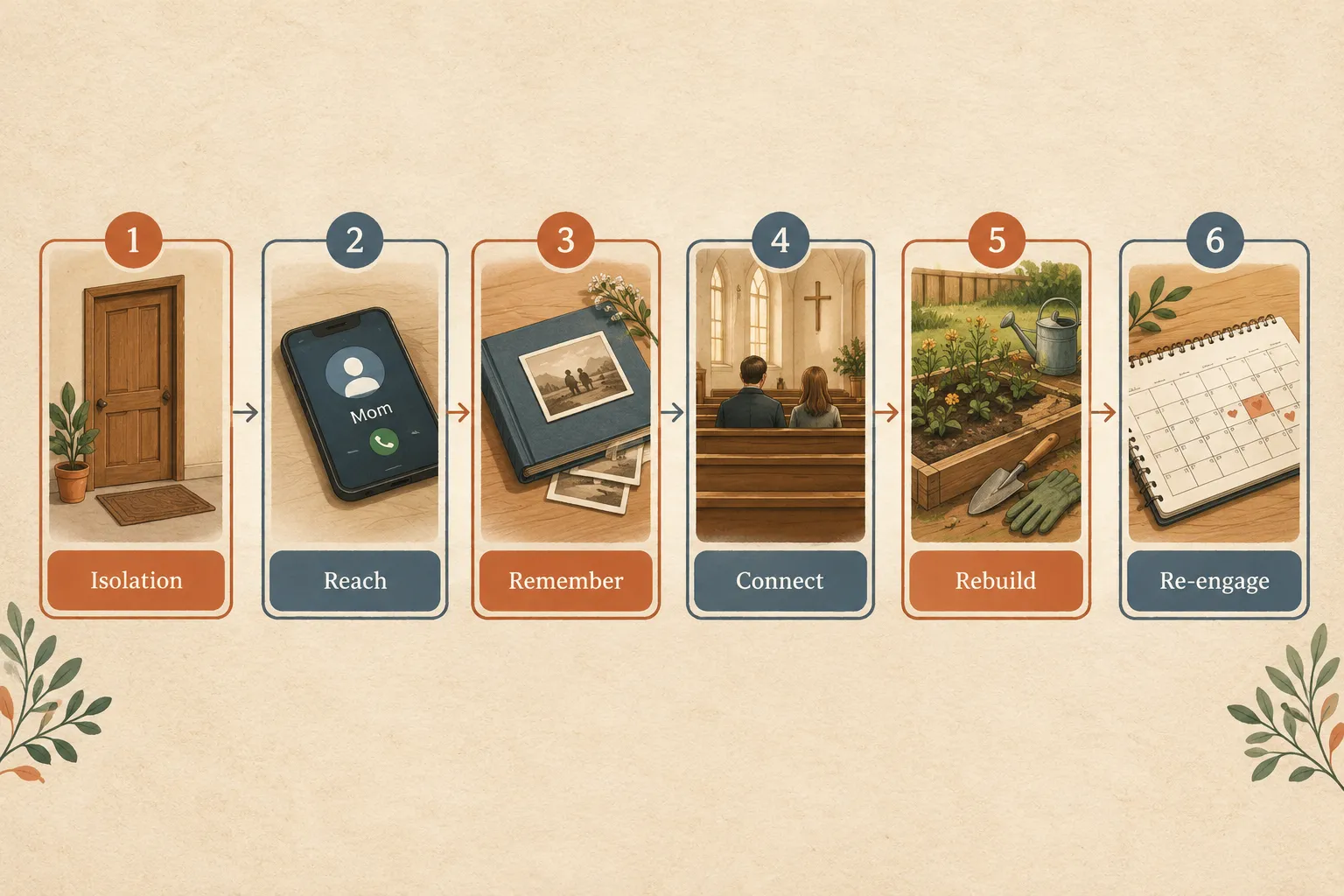
The six-session structure in the 2026 narrative-therapy model moves from safety, to support networks, to telling the deceased person’s story, to resonance, to skills and community, to future projects, a sequence that mirrors a well-built novel more than a devotional list.
FAQ
What is the single most quoted Bible verse for grief? Psalm 34:18, “The Lord is close to the brokenhearted”, is among the most commonly used because it asserts nearness without demanding an emotional response [1].
Why does “Jesus wept” matter so much in grief fiction? Because Jesus weeps at Lazarus’s tomb while knowing the resurrection is coming. It establishes that grief and hope coexist, which licenses fiction to let characters stay devastated before any resolution.
Can fiction replace a grief support group? No. A novel can’t check on you. Use it alongside people.
Are grief-centered Christian novels depressing? The well-made ones aren’t. Honesty about loss is what makes the eventual comfort believable.
What should a grieving reader avoid? Books where a character’s faith is fully restored in a single scene, and books with on-page traumatic death if your loss was sudden.
Is it a sin to be angry at God after a loss? Scripture records sustained protest, Psalm 13, Job, Lamentations, as prayer, not rebellion. Biblical grief includes tears, lament, and longing rather than suppression.
Do these books work on Kindle Unlimited? Most of the series referenced here are available through KU, which lowers the risk of trying a grief novel and setting it down.
What’s a good first chapter to test a book’s honesty? If the comforters in the first fifty pages all say the right thing, the author hasn’t been to a real funeral.
Conclusion
Verse searches and story searches come from the same place: you want to be told the truth without being managed. Scripture names the loss. Fiction gives it duration, cost, and a neighbor who stays. Start with one passage that matches where you actually are, nearness, not horizon, if the loss is fresh. Add one novel whose grieving character is allowed to stay broken longer than feels comfortable. Add a counselor if the days aren’t functioning. And if nothing resolves this month, that isn’t failure.
Grace shows up. It just tends to arrive after the cost, not instead of it.
References
- Bible Verses Times Grief. christianaid.org.uk.
- Christian Fiction Fall 2026. bookpage.com.
- Best Selling Christian Novels 2026 Data Driven Market Analysis Top Titles. alibaba.com.