
Last updated: November 5, 2026
Quick Answer
If you’re looking for Harry Potter books alternatives for Christian readers, clean fantasy with courage, friendship, and moral choice, the strongest replacements are Andrew Peterson’s The Wingfeather Saga, S. D. Smith’s The Green Ember, N. D. Wilson’s 100 Cupboards, and C. S. Lewis’s The Chronicles of Narnia. Each delivers what most readers actually want from Harry Potter: a found family of loyal friends, a world worth exploring, real danger, and choices that cost something. Christian fantasy is an active publishing category in 2026, not a shelf of reprints [1][2].
Key Takeaways
- The appeal readers chase in Harry Potter is discovery, loyalty, humor, peril, and moral formation, all of which exist in faith-rooted fantasy.
- The Wingfeather Saga (ages 8-12) is the closest all-around substitute: four books, sibling protagonists, monsters, jokes, grief, and a Maker framework.
- The Green Ember works best for families who’d rather skip spell-casting entirely, courage and loyalty carry the story.
- “Clean” and “Christian” are not the same label. Current release lists separate “no-spice romance,” “non-magical fantasy,” and “Christian themes” as distinct tags [2].
- Age ratings often measure reading level, not suitability. Check violence, fear, grief, and supernatural mechanics separately.
- Many thoughtful Christians read fantasy freely; objections usually center on occult practice presented as neutral or admirable, not on imagination itself.
- Older teens and adults who age out of middle grade can move into covenant fantasy and clean LitRPG without losing the wonder.
What Makes a Fantasy Book Christian-Friendly?
A fantasy book is Christian-friendly when its moral universe is not up for negotiation: good and evil are real, choices carry weight, and mercy costs the one who gives it. Magic or no magic is a secondary question.
Useful screening criteria:
- Moral architecture. Is courage rewarded because it’s right, or because it’s effective?
- Source of power. Does supernatural ability come from a Maker-figure, a created gift, or from summoning something?
- Cost of grace. Do characters get forgiven without consequence, or does redemption require something from them? Earned grace is the difference between a story that forms a child and one that flatters them.
- Content floor. Profanity, sexual content, graphic violence, and despair without hope.
- Humility. Does the book let characters doubt and fail, or does it hand them a tidy lesson?
Lorehaven’s recommendation work for teen readers is built on this kind of distinction rather than a simple approved list [3].
Why Do Some Christians Avoid Harry Potter?
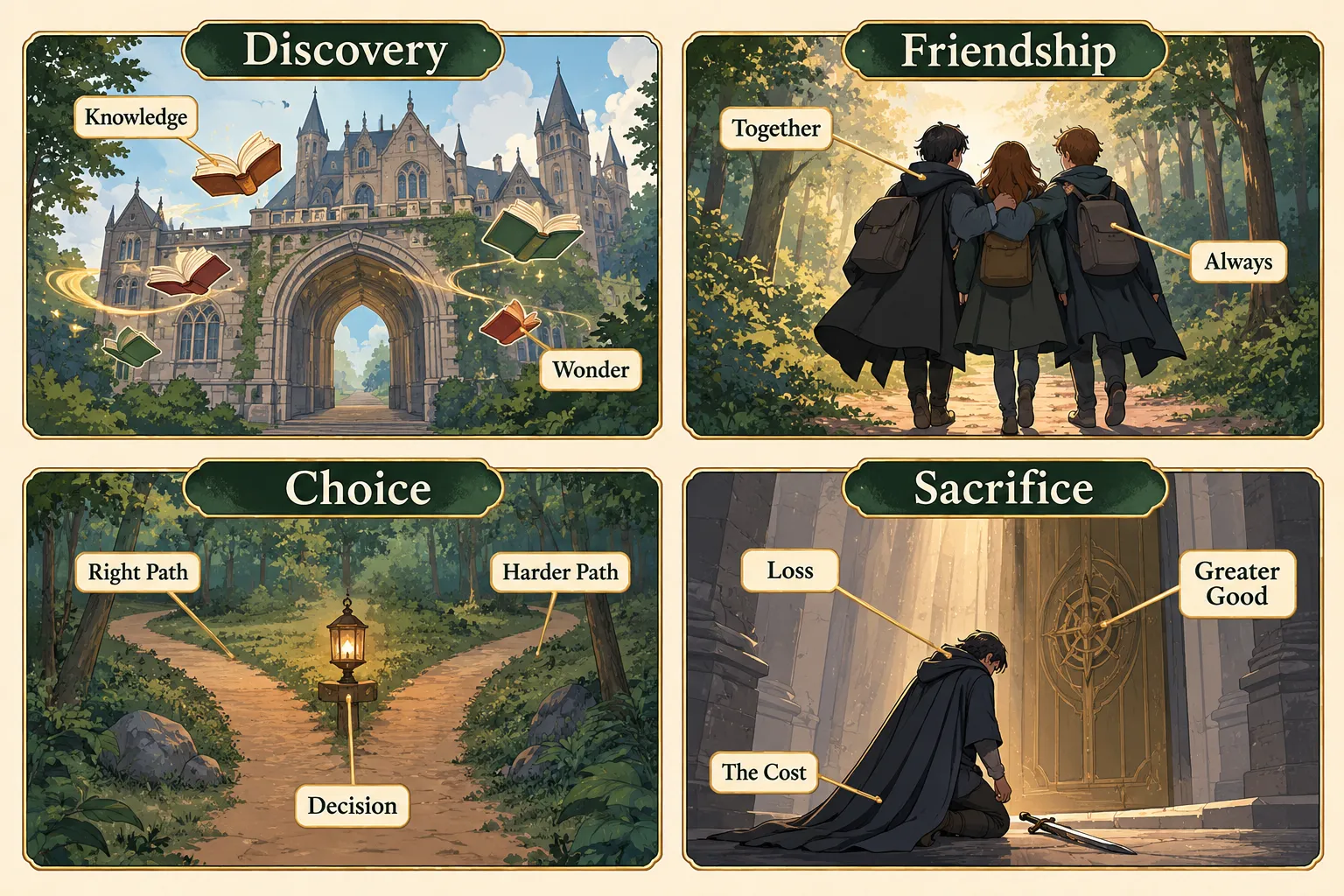
Most objections fall into three buckets, and only one is really about magic. Understanding which concern applies to your family makes book selection much faster.
- Occult practice treated as curriculum. Divination, charms, and spell-casting are taught as skills in Hogwarts, which some readers see as presenting real-world forbidden practice as neutral.
- Authority and rule-breaking. Protagonists frequently deceive adults and are rewarded for it.
- Darkening tone. Later volumes carry possession imagery, torture, and heavy death.
Plenty of Christian readers find none of this disqualifying, and plenty of Christian households read the series aloud. The point here isn’t a verdict. It’s that readers who’ve decided to look elsewhere deserve genuinely good books, not consolation prizes.
Best Fantasy Series Like Harry Potter for Christian Kids
For ages 8-12, start with The Wingfeather Saga. It is the single closest match for the Harry Potter reading experience inside a Christian framework.
| Series | Ages | Closest Harry Potter Appeal | Magic Level |
|---|---|---|---|
| The Wingfeather Saga (Andrew Peterson) | 8-12 | Found family, humor, escalating peril, hidden heritage | Mythic, Maker-centered |
| The Green Ember (S. D. Smith) | 8-12 | Loyal siblings, resistance against tyranny, hope | None |
| 100 Cupboards (N. D. Wilson) | 9-13 | Portal discovery, secret rooms, ordinary boy pulled into danger | Portal/supernatural |
| The Chronicles of Narnia (C. S. Lewis) | 7-12 | Wonder, talking creatures, sacrificial king | Allegorical magic |
| The False Prince (Jennifer A. Nielsen) | 10-14 | Clever underdog, court intrigue, shifting loyalties | None |
Wingfeather follows the Igby siblings, Janner, Kalmar, and Leeli, in Aerwiar as they uncover a dangerous family legacy and face the Fangs of Dang. It has monsters, bad jokes, real grief, and a sacrifice near the end that readers tend to remember into adulthood. Trade-off: the later books get genuinely frightening.
100 Cupboards now has a graphic-novel adaptation illustrated by Forrest Dickison, which gives reluctant or younger readers an illustrated way in.
Choose Wingfeather if your reader wants the full quest-and-humor package. Choose Green Ember if spell-casting is a non-starter.
Narnia as a Harry Potter Alternative for Families
Narnia remains the most explicit literary bridge between Christian theology and fantasy adventure, which is exactly why it suits read-aloud families. Aslan is a Christ figure, and the stories work through temptation, betrayal, repentance, and sacrificial love without stopping to explain themselves.
One honest caveat: Narnia is not magic-free. It contains witches, enchantments, talking beasts, battlefield violence, and mythic figures drawn from pagan sources. It’s best described as Christian allegorical fantasy [4]. Families who object to any depiction of magic should look at The Green Ember or The False Prince instead.
Lewis never argued the reader into belief. He built a world where a child could feel what sacrifice costs, and then let the feeling do the work.
Percy Jackson vs Christian Fantasy Recommendations
Percy Jackson readers are usually chasing voice: a funny first-person narrator, a modern kid dropped into ancient stakes, and friends who show up. The Christian equivalent is Wingfeather for humor and N. D. Wilson for the ordinary-world-to-other-world jolt.
Where the two diverge:
- Pantheon. Riordan’s gods are flawed, petty, and amoral by design. Christian fantasy generally puts a good Maker at the center.
- Fate vs. calling. Percy is a demigod by birth. Janner Igby is given a responsibility he keeps choosing to accept.
- Humor level. Riordan is funnier more often. Wingfeather is funny and then devastating.
Edge case: if your reader primarily loves mythology itself, no Christian series replaces it directly. Pair the mythology with a strong moral-choice series rather than hunting for a swap.
Christian Fantasy Books With Magic and Adventure, and Clean Series Without Dark Themes for Tweens
Yes, Christian fantasy with magic and adventure exists in volume, and 2026 has been a productive year for it. ChristianBook’s new-release fiction catalog included Lightborn: Dawn of Darkness by Daniel and Hernu Maritz from Harvest House [1], and the broader 2026 listings show a wave of clean Christian fairy-tale fantasy, including Of Pine and Pretense by Laurie Lucking and Of Wind and Whispers by Madisyn Carlin [2][5].
For tweens who want adventure without darkness:
- Lighter peril: The Green Ember, early Narnia, The False Prince
- Moderate peril: Wingfeather books 1-2, 100 Cupboards
- Heavier peril (older tweens): Wingfeather books 3-4, most YA Christian fantasy
Note that some overtly Christian fantasy still centers wizardry and enchantment in its plot mechanics, reviewers have flagged this in Donita K. Paul’s DragonSpell, which is both a clear allegory and a magic-driven adventure [4]. Christian allegory and magic-free are not the same promise.
For older readers who want the same moral weight at adult length, the Christian epic fantasy reading archive and this breakdown of how Christian epic fantasy authors keep pacing while exploring spiritual themes are good next stops.
How to Find Fantasy Books Without Inappropriate Content
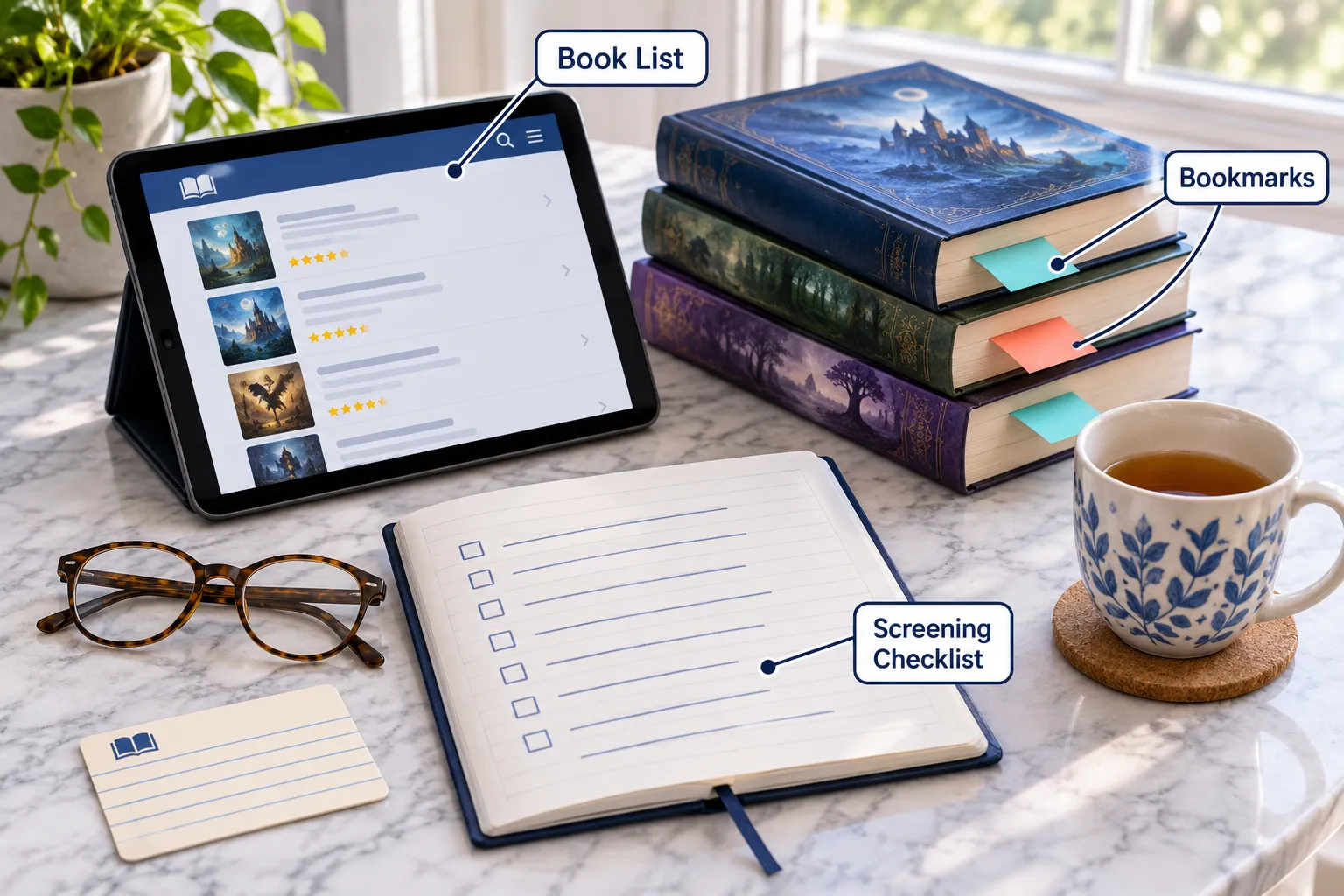
Screen in layers rather than trusting a single label. The fastest reliable method takes about ten minutes per book.
Checklist:
- Read the publisher’s stated age range, then treat it as reading level, not a content verdict.
- Search the title plus “content review” for a per-element breakdown of violence, fear, and romance.
- Skim one-star and three-star reviews; content complaints cluster there.
- Read the last two chapters’ tone, not the plot. Hope or despair?
- For series, check whether book four is still appropriate for a reader who started at book one.
Goodreads is useful for discovery, its “Clean Christian Teen Fantasy” list runs to dozens of titles including Kara Swanson’s Dust and Nadine Brandes’s Wishtress [6], but those lists are reader-curated, not certified. Our guide to navigating Goodreads lists and finding hidden clean reads covers the filtering process in more depth.
Common mistake: assuming a Christian publisher guarantees fit. Imprints vary widely on violence and romance.
Can Christians Read Fantasy, or Only Alternatives?
Christians can read fantasy. The historic Christian literary tradition is saturated with it, Lewis, Tolkien, MacDonald, and invented worlds have long been used to make moral truth visible rather than to obscure it.
The useful question isn’t “is this fantasy?” but “what does this story train me to admire?” A book that makes cruelty look clever is a problem in any genre. A book that makes faithfulness look costly and worth it is doing something a sermon can’t. That’s the whole argument behind fantasy allegory as a reading tradition.
Where to Buy Christian-Friendly Fantasy for Children
Four reliable channels, in rough order of curation strength:
- ChristianBook.com, browsable fantasy and science fiction category with current releases and clear publisher info [1][7].
- Amazon / Kindle Unlimited, widest selection and the best place to sample a series cheaply; the Christian fantasy new-release charts update constantly [8].
- Publisher direct, S. D. Smith’s Story Warren store and Andrew Peterson’s official site sell editions and bundles directly.
- Church and school libraries, free, and usually pre-screened by someone you can actually ask.
Decision rule: buy book one physically, read it yourself or alongside your child, then buy the bundle. Series tone shifts, and paper is easier to skim ahead in.
Age-Appropriate Fantasy Series With Faith Themes and Strong Character Development
For families who care most about character growth, pick series where the protagonist’s hardest moment is a decision rather than a battle. Wingfeather and The Green Ember both pass that test; so does The False Prince, which runs on deception, consequence, and earned trust.
| Reader age | Best fit | What it builds |
|---|---|---|
| 6-9 (read-aloud) | The Green Ember, The Lion, the Witch and the Wardrobe | Loyalty, courage, hope in the dark |
| 9-12 | The Wingfeather Saga, 100 Cupboards | Sacrifice, family duty, repentance |
| 12-15 | The False Prince, Lorehaven’s teen fantasy picks [3] | Integrity under pressure, consequence |
| 15+ / adult | Covenant and epic fantasy for grown readers | Mercy and justice, faith under fire |
Readers who age out of middle grade often want the same wonder with adult stakes. The Kethara Chronicles puts covenant and conscience against an empire that wants every act of mercy counted, and The Sarel Chronicles follows a disgraced map-scribe through the prayers nobody certified. For teen gamers, clean LitRPG without harem or isekai clichés keeps the progression hook while making cost mean something.
FAQ
What is the best Harry Potter alternative for Christian kids? The Wingfeather Saga by Andrew Peterson, for ages 8-12. It has four books, sibling protagonists, monsters, humor, and a Maker-centered moral framework.
Is Narnia a good Harry Potter replacement? Yes for wonder, allegory, and read-aloud families. No for families who want a magic-free story, since Narnia includes witches, enchantments, and mythic imagery [4].
Does Christian fantasy have to avoid magic entirely? No. Many Christian fantasy novels include magic as a created gift or mythic force. The distinction most families draw is between magic as a world property and occult practice presented as a teachable skill.
What’s a good magic-free option? The Green Ember by S. D. Smith. Rabbit siblings Heather and Picket resist tyrannical preylords, with faith, hope, and liberation as central themes and no spell-casting.
Are Goodreads clean-fantasy lists reliable? They’re excellent for discovery and weak as a guarantee. They’re reader-curated, so verify each title independently [6].
Is Christian fantasy still being published in 2026? Yes. ChristianBook’s 2026 new-release fiction included Lightborn: Dawn of Darkness from Harvest House, and 2026 listings show a substantial wave of clean Christian fairy-tale fantasy [1][2].
Does “clean” mean the same thing as “Christian”? No. Current recommendation lists use separate tags like “no-spice romance,” “non-magical fantasy,” and “Christian themes.” Check both content and worldview [2].
What should I read after Wingfeather? 100 Cupboards for the same ages, The False Prince for a step up in intrigue, or adult covenant fantasy for readers ready for longer books.
Conclusion
The honest reason Harry Potter worked is that it gave readers a place to belong and friends worth dying for. That’s not a magic problem. That’s a storytelling achievement, and faith-rooted fantasy can meet it.
Next steps:
- Buy The Wingfeather Saga book one and read the first three chapters yourself.
- Keep a short screening list, violence, fear, grief, romance, power source, and apply it per book, not per author.
- Match peril level to your actual reader, not to their grade.
- When they outgrow middle grade, hand them covenant fantasy rather than letting the shelf go quiet.
The best stories for children have never been the safest ones. They’re the ones where courage costs something and someone pays it anyway.
References
- New Release Fiction. christianbook.com.
- Christian Fantasy. risingshadow.net.
- Top 17 Christian Fantasy Novels for Teenage Boys. lorehaven.com.
- Best Christian Fantasy Books. christianwebsite.com.
- Christian Fantasy. risingshadow.net.
- Book Recs. goodreads.com.
- Fantasy and Science Fiction. christianbook.com.
- Christian Fantasy New Releases. us.amazon.com.