
Last updated: August 18, 2026
Quick Answer: Balancing action and faith in Christian epic fantasy means embedding spiritual stakes inside scene-level conflict rather than pausing the plot for theological explanation. The most effective authors treat faith as a force that shapes every choice a character makes under pressure, not as a lesson delivered between battles. When doubt, prayer, and mercy cost the character something real, the story keeps moving and the faith lands harder.
Key Takeaways
- Christian epic fantasy differs from secular fantasy by making faith load-bearing, God, covenant, or divine calling is structural to the plot, not decorative.
- The single biggest pacing mistake is inserting doctrine as dialogue. Faith should show through choice and consequence, not speech.
- Every scene should advance either the plot or the character’s spiritual development. If it does neither, it slows the book down.
- Battle scenes can carry deep spiritual weight without graphic violence, the internal cost to the character is the real conflict.
- Authors who handle faith well (C.S. Lewis, N.D. Wilson, Silas Bellhaven’s Sarel and Kethara Chronicles) build worlds where belief is tested by the plot, not explained by it.
- The earned grace principle: mercy and redemption hit hardest when they arrive after real cost, not as a shortcut to resolution.
- Christian fantasy appeals well beyond Christian readers when the spiritual stakes are human stakes, doubt, failure, and the weight of conscience are universal.
- Worldbuilding that reflects Christian values works best when it grows from the world’s internal logic, not from allegory that’s too on-the-nose.
- Religious publishing revenues rose 9.3% to $2.2 billion in 2025, signaling a healthy and growing market for faith-oriented fiction [1].
What Is Christian Epic Fantasy and How Does It Differ from Regular Fantasy?
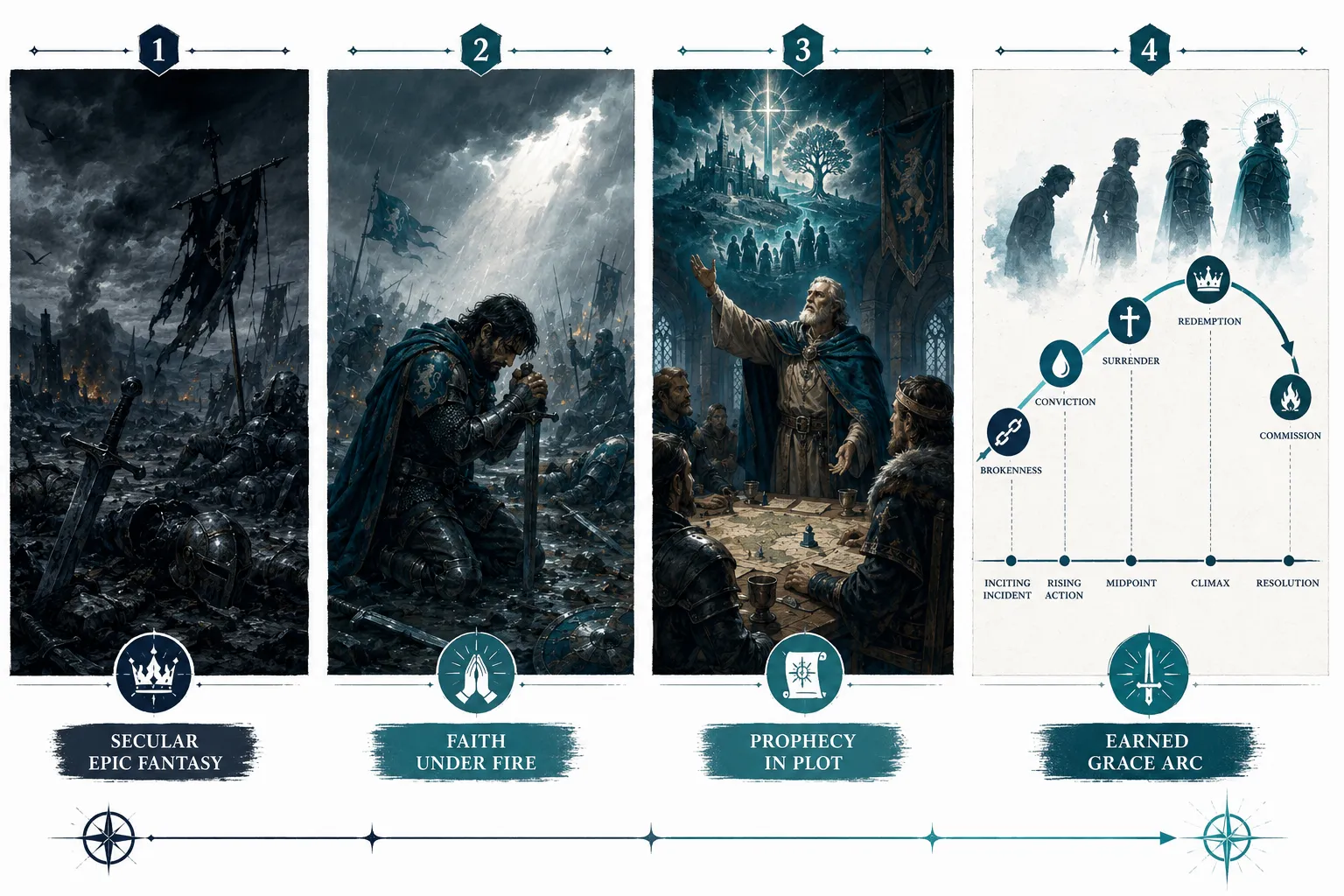
Christian epic fantasy is a subgenre where faith is structurally central to the story, not a backdrop detail, but the axis around which plot, character, and consequence turn. In secular epic fantasy, a character might pray or reference gods as worldbuilding texture. In Christian epic fantasy, the divine is real, responsive, and morally demanding in ways that shape every major story decision.
The distinction matters for pacing because it changes what’s at stake. A secular fantasy’s highest stakes are usually survival, power, or love. A Christian epic fantasy carries those same stakes plus the question underneath them: What will you do with the truth once you’re holding it? That question, whether a character will trust, obey, doubt, or betray, is the engine that drives the spiritual arc alongside the action arc.
Key distinctions:
- Secular fantasy: Faith elements are optional, cosmetic, or mythological. Remove them and the plot still works.
- Christian fantasy (explicit): Faith is structural. Remove it and the story collapses. The Maker, the covenant, or the divine call is load-bearing.
- Christian fantasy (implicit): The story is shaped by Christian ethics and values, but the theological content is subtle enough that non-Christian readers engage without friction.
The Sarel Chronicles, particularly The Map of Unanswered Prayers, illustrate the explicit model well: a black road appears on a map-scribe’s skin during a sacred ceremony, marking a prayer the religious institution refused to record. The spiritual crisis is the inciting incident. There’s no separating faith from plot.
How Do Authors Balance Fast-Paced Action with Deep Spiritual Themes?
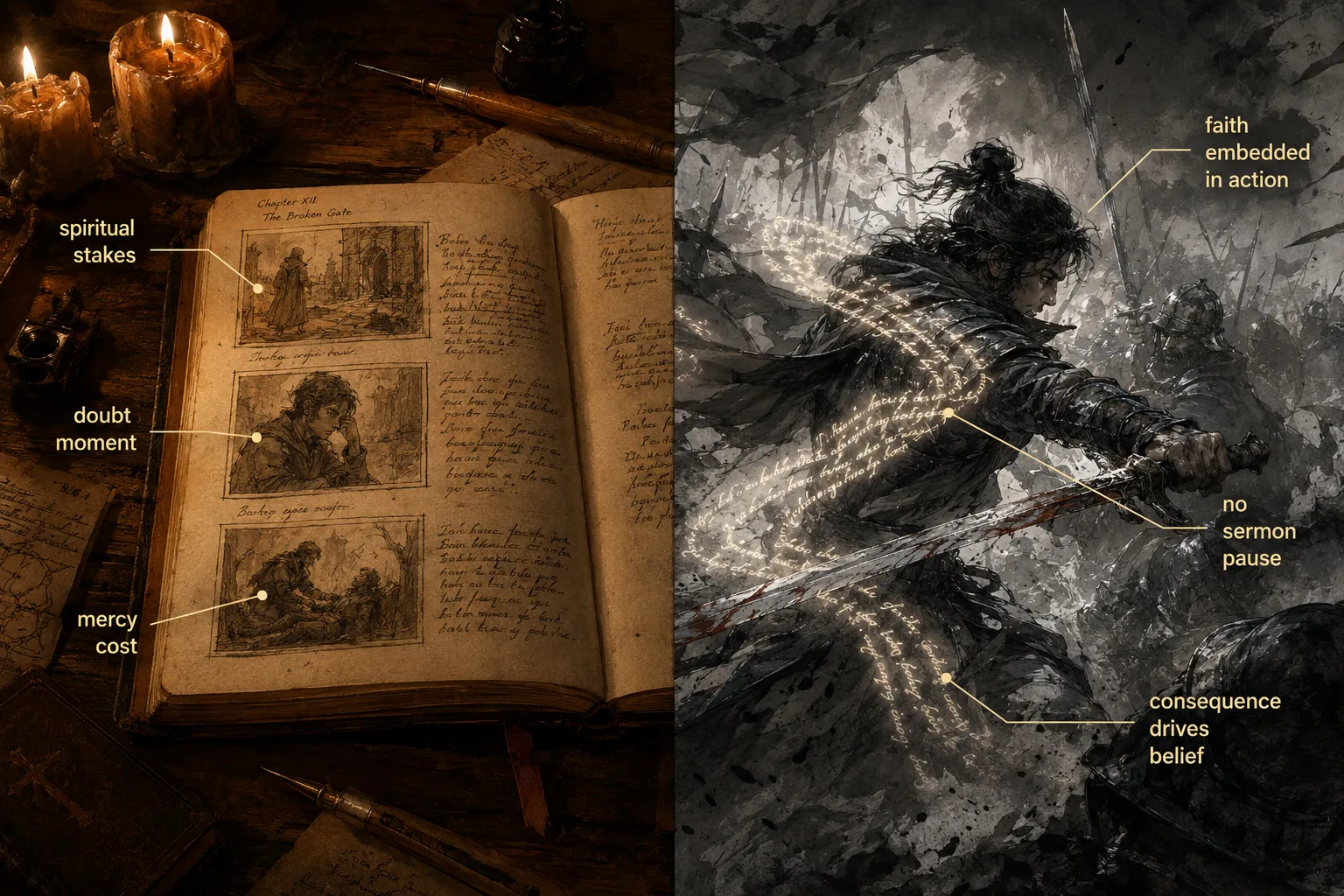
Balancing action and faith in Christian epic fantasy comes down to one rule: spiritual themes must ride inside the scene’s conflict, not arrive after it stops. When a character’s prayer happens mid-chase, when doubt surfaces during a battle decision, when mercy costs the protagonist a tactical advantage, faith and action fuse rather than compete.
Craft guidance from 2026 writing commentators converges on this point sharply. Layne McDonald’s writing framework argues that faith should emerge through “authentic choices and reactions” and “a desperate prayer in crisis” rather than through characters who pause to explain their theology. The moment a character becomes a mouthpiece for doctrine, the scene dies.
Practical scene-level techniques:
- Anchor spiritual stakes to physical stakes. The character doesn’t just risk death, they risk dying having betrayed what they believed. That’s a doubled stake, and it accelerates tension rather than slowing it.
- Use doubt as a plot engine. A character who isn’t sure God is listening in the middle of a siege has more forward momentum than one who prays with certainty. Doubt is action-compatible. Certainty can stall a scene.
- Let mercy have a cost. Choosing to spare an enemy, honor a covenant, or tell the truth when lying would be easier, these are spiritual acts that create immediate plot consequences. They don’t require narration.
- Put prophecy in the way. A divine word that complicates a character’s plan is more useful than one that confirms it. Prophecy as obstacle keeps pace; prophecy as comfort can feel like a pause.
- Cut any scene that does neither. If a scene doesn’t advance the plot or deepen the character’s spiritual development, it doesn’t belong in an epic fantasy, regardless of how theologically interesting it is [from Layne McDonald’s framework].
“Faith under fire isn’t a theme you add to a story. It’s what happens when a character with real belief hits a real wall, and the story is honest enough to show both.”
Best Christian Fantasy Authors Who Do Action and Faith Well
The authors who handle this balance best tend to share one approach: they trust the story to carry the theology rather than stopping to explain it.
Authors worth reading for craft study:
- C.S. Lewis, The Narnia series and the Space Trilogy show how faith can be structurally present without being preachy. Aslan doesn’t explain the Deep Magic; he enacts it.
- N.D. Wilson, The 100 Cupboards series and Leepike Ridge carry a distinctly Christian worldview through action, consequence, and earned resolution without devotional interruptions.
- Stephen Lawhead, His Pendragon Cycle weaves Celtic Christianity into Arthurian epic fantasy with real stakes and political complexity.
- Silas Bellhaven, The Kethara Chronicles and the Sarel Chronicles both demonstrate the earned grace principle: faith is tested by plot events, and redemption arrives only after real cost. The Stone That Remembered opens with a buried witness-stone breaking through a ritual court floor, a spiritual event that immediately creates political and physical conflict.
In 2026, new voices are entering the space as well. John Kowalski’s Heavenly Places 4: Diaspora (releasing September 2026) describes its spiritual stakes as “fear, rebellion, and the slow erosion of hope”, framing the greatest threats as internal rather than external. That’s exactly the kind of spiritual-stakes integration that keeps pace while deepening faith content [1].
Common Mistakes Christian Fantasy Writers Make with Pacing
The most common pacing mistake is treating spiritual content as a separate track from plot content, something to insert between action beats rather than weave into them.
Mistakes that kill momentum:
| Mistake | Why It Stalls the Story |
|---|---|
| Preachy dialogue | Characters stop acting and start lecturing |
| Info-dump theology | Doctrine delivered as exposition, not experience |
| Cheap grace | Redemption arrives without cost, so it doesn’t land |
| Prophecy as comfort | Divine words that confirm the plan instead of complicating it |
| Faith as backdrop | Spiritual elements that could be removed without changing the plot |
| Resolved doubt | Characters who doubt and then immediately believe, with no earned progression |
The clean Christian fiction space has a specific version of this problem: the impulse to resolve every spiritual question tidily can flatten characters into illustrations rather than people. Readers who want their faith represented honestly, not preached at, will disengage from a character whose spiritual life is too neat.
How Much Religious Content Is Too Much in a Fantasy Novel?
There’s no fixed ratio, but the practical threshold is this: religious content becomes too much when it stops the story to explain itself. A chapter-length theological discussion that doesn’t change what a character does next is too much. A three-sentence prayer that costs the character something and alters the plot is not too much, it’s load-bearing.
The spectrum runs from implicit to explicit:
- Implicit Christian fantasy: The story operates on Christian ethics (sacrifice, mercy, truth-telling) without naming them. Non-Christian readers engage fully.
- Explicit Christian fantasy: The divine is named, the covenant is central, and the spiritual journey is the plot. Readers who share the faith engage most deeply, but the human stakes (doubt, failure, conscience) can still reach broader audiences.
Most successful Christian epic fantasy sits somewhere in the middle, explicit enough that Christian readers feel seen, human enough that the stakes translate universally.
Can You Have Intense Battle Scenes in Christian Fiction Without Losing the Message?
Yes, and the key is locating the real conflict inside the character rather than in the violence itself. Clean Christian fiction doesn’t require bloodless battles; it requires that violence carry weight rather than spectacle.
How to write battle scenes that stay rooted in faith:
- Show the spiritual cost of killing, not just the physical danger. A character who takes a life and has to live with it is more spiritually interesting than one who doesn’t notice.
- Use the battle to force a faith decision. Does the character trust a promise that looks impossible in the middle of a losing fight? That’s faith under fire in its most literal form.
- Let mercy appear at the worst moment. Choosing not to kill an enemy when you could, and paying a price for it, is both theologically rich and dramatically tense.
- Keep violence purposeful. The scene should advance the plot or the spiritual arc. Graphic detail for its own sake serves neither.
The Kethara Chronicles model this well: the empire’s threat is political and physical, but the real battle is over whether a covenant word can survive institutional suppression. The action and the spiritual stakes are the same conflict.
How Do You Develop Spiritual Character Arcs Without Slowing Down the Plot?
Spiritual character arcs stay in motion when they’re tied to plot events rather than introspective pauses. The character’s faith should change because of what happens to them, not because they sat and thought about it.
A working arc structure for Christian epic fantasy:
- Establish belief, Show what the character trusts before it’s tested. This can be brief and concrete: a habit, a prayer, a conviction.
- Break the assumption, A plot event contradicts what the character believed. God didn’t prevent the loss. The covenant didn’t protect the innocent. The prophecy was wrong, or they misread it.
- Force a choice under pressure, The character must act before the doubt is resolved. This is where faith under fire lives.
- Let the cost land, Whatever they chose, it costs something real. Mercy costs tactical advantage. Obedience costs safety. Doubt costs relationship.
- Arrive at earned grace, Not resolution, exactly, but a new understanding that was paid for by the plot. Redemption that costs something.
Hallee Bridgeman’s 2026 craft guidance on weaving faith into fiction plots reinforces this: structure the inciting incident, midpoint, and climax around the spiritual journey so faith accumulates through escalating conflict instead of interrupting it.
Is Christian Fantasy Only for Christian Readers?
No. Christian fantasy reaches beyond its primary audience when the spiritual stakes are recognizably human. Doubt, failure, the weight of conscience, the cost of mercy, these aren’t exclusively Christian experiences. They’re human ones.
The readers who come to Christian epic fantasy from outside the faith often stay because the stories take moral weight seriously. A world where choices have real consequences, where grace isn’t free, and where the divine is not indifferent, that’s a compelling fictional world regardless of the reader’s theology.
Religious publishing revenues rose 9.3% to $2.2 billion in 2025 [1], and the broader fantasy market is expanding significantly, with romantasy and genre fiction driving major sales increases [7]. The overlap between those two trends suggests Christian fantasy has room to grow into a wider readership, especially when it’s written to walk with readers rather than talk at them.
What Techniques Keep Readers Engaged During Philosophical or Theological Discussions?
The most effective technique is to make the discussion a conflict. Two characters who disagree about what God requires, and who both have something at stake in being right, create dramatic tension out of theology. A character arguing with their own doubt in the middle of a crisis does the same.
Engagement techniques for theological content:
- Dramatize the question. Don’t have a character explain predestination; have them face a choice where it matters right now.
- Use the other character as pressure. Theological dialogue works when the person asking the question has power over the person answering it. An interrogation is more gripping than a discussion.
- Cut to consequence. After any philosophical exchange, the next scene should show the cost or result of what was decided. The discussion earns its place by changing what happens next.
- Keep it short and unresolved. Real faith questions don’t resolve cleanly. Leaving the theological thread open creates forward pull, the reader wants to know how it lands.
The 2026 subgenre is experimenting with new formats to solve this problem. Kenneth Bliss’s Canthany Rising uses LitRPG mechanics to embed faith questions inside game-structured progression, each level-up forces an identity and purpose question, keeping theological content tied to forward momentum rather than pausing for it [2].
How Do Successful Christian Fantasy Authors Handle Doubts and Struggles of Faith?
The best authors treat doubt as a plot force, not a problem to be solved quickly. A character who doubts and is immediately reassured by a vision or a mentor’s speech hasn’t really doubted, they’ve had a brief inconvenience. Real doubt changes what a character does next, and that’s where it becomes dramatically useful.
Principles for writing doubt well:
- Doubt should cost the character something before it resolves, or before it doesn’t resolve.
- Let doubt coexist with action. The character doesn’t have to stop and process; they can act while uncertain and live with what that choice produces.
- Avoid the dramatic conversion moment as a pacing shortcut. Earned grace shows up after cost, not instead of it.
- Show faith returning through small, specific acts, not a single climactic moment of certainty.
This is the difference between clean Christian fiction that feels honest and clean Christian fiction that feels sanitized. Readers who want their faith represented honestly are not asking for easy answers. They’re asking for a story that takes the hard questions seriously and doesn’t flinch from them.
Should Christian Epic Fantasy Have a Clear Moral Lesson or Let Readers Decide?
The strongest Christian epic fantasy trusts the story to carry its values without announcing them. A clear moral lesson delivered through narration or a character’s final speech tends to flatten everything that came before it. The story already made the argument, the lesson is redundant.
That said, there’s a difference between a story with a clear moral vision and a story with a stated moral lesson. Christian epic fantasy can have an unmistakable worldview, mercy matters, truth costs something, grace is real, without a character standing up to explain it at the end.
The practical rule: show the consequence, trust the reader. If the story has been honest about what faith costs and what it produces, readers will draw the right conclusions. The ones who share the faith will recognize it. The ones who don’t will still feel the weight of a world where choices matter.
How to Write Fantasy Worldbuilding That Reflects Christian Values Authentically
Worldbuilding that reflects Christian values works when it grows from the world’s internal logic rather than from allegory that’s too transparent. A world where covenant is real, where mercy has institutional enemies, where the powerful suppress the record of the weak, that’s a world shaped by Christian moral concern without requiring the reader to decode it.
Worldbuilding principles for Christian epic fantasy:
- Build the tension into the world’s structure. In the Kethara Chronicles, an empire that wants to count and contain every act of mercy is a world that generates spiritual conflict automatically. The worldbuilding is the theology.
- Make the divine presence felt but not explained. A Maker who answers prayers through silver roads on a map, as in the Sarel Chronicles, is theologically rich without requiring a catechism. The world shows what belief looks like; the characters live inside it.
- Give the world’s institutions a conscience problem. Religious institutions that have drifted from their founding covenant, courts that record truth selectively, prophets whose words are weaponized, these create the kind of moral complexity that keeps Christian fantasy from feeling like a Sunday school illustration.
- Let the secondary world have its own rules. Christian values don’t require a fantasy world to mirror Earth’s church history. They require a world where truth, mercy, and justice are real forces with real costs.
The 2026 market is rewarding this kind of structural faith integration. Religious press eBook revenues rose 23.5% year over year [1], suggesting readers are actively seeking faith-oriented fiction in digital formats, which means the audience for well-crafted Christian epic fantasy is both growing and accessible.
Conclusion: Faith That Earns Its Place in the Story
Balancing action and faith in Christian epic fantasy is not a compromise between two competing interests. Done well, they’re the same interest. The battle that tests a character’s courage is also the moment that tests their covenant. The political intrigue that threatens the kingdom is also the crisis that reveals whether mercy survives under pressure.
The authors who get this right, and the readers who find them, understand that hope in the dark isn’t the same as hope that avoids the dark. Earned grace is more powerful than cheap grace precisely because it arrives after cost. A story that walks with its readers through doubt, failure, and the weight of real choice is doing something a sermon cannot.
Next steps for readers and writers:
- If you’re exploring Christian epic fantasy as a reader, start with a series where the spiritual stakes are structural, The Map of Unanswered Prayers (Sarel Chronicles) or The Stone That Remembered (Kethara Chronicles) are strong entry points.
- If you’re writing in this space, apply the scene-level test: does this scene advance the plot, deepen the spiritual arc, or both? If neither, cut it.
- Follow the earned grace principle in every major character decision: let mercy cost something before it arrives.
- Trust your readers. Rooted in faith doesn’t mean explained by faith. The story carries the conviction, the writer’s job is to get out of the way and let it.
FAQ
What makes Christian epic fantasy different from Christian allegory? Allegory uses fantasy elements as direct stand-ins for theological concepts. Christian epic fantasy builds a world where faith is structurally real, characters believe, doubt, and act within a world that takes the divine seriously, without requiring a one-to-one symbolic key.
Can Christian epic fantasy have morally complex villains? Yes, and it’s stronger for it. A villain who believes they’re serving justice, or who was once faithful and fell, creates the kind of moral weight that makes mercy meaningful when it finally appears.
Does Christian epic fantasy have to include prayer or scripture? No. Faith can show through a character’s choices, the world’s moral structure, and the cost of grace without any explicit religious language. The story’s convictions don’t require a vocabulary list.
How do I avoid making my protagonist too perfect for a Christian fantasy? Give them a real failure that costs others, not just themselves. A protagonist whose faith is tested by their own sin, not just external enemies, is far more compelling than one who is simply faithful under pressure.
Is Christian epic fantasy appropriate for teen readers? Most of it, yes. The genre tends toward clean content by design, the spiritual stakes replace graphic violence and explicit content as the primary source of tension. Age-appropriateness depends on the specific series and its treatment of darkness.
How long should a Christian epic fantasy series be? Long enough for the spiritual arc to develop through multiple genuine tests. A single book can carry a complete faith arc, but series allow for the kind of accumulated cost that makes earned grace feel truly earned.
What’s the difference between “rooted in faith” fiction and “inspirational” fiction? Inspirational fiction often resolves toward uplift and comfort. Rooted in faith fiction is willing to sit in the hard place longer, hope in the dark rather than hope that bypasses the dark. The distinction is whether the story earns its resolution or shortcuts to it.
Can non-Christian readers enjoy Christian epic fantasy? Yes, consistently. When the spiritual stakes are human stakes, doubt, conscience, the cost of mercy, the story reaches anyone willing to take moral weight seriously, regardless of their personal faith.
How do I handle the tension between mercy and justice in a fantasy world? Make them both costly. Justice that ignores mercy becomes cruelty; mercy that ignores justice becomes enablement. The most compelling Christian epic fantasy puts characters in situations where both are real demands and neither is free.
What’s the biggest craft mistake new Christian fantasy writers make? Resolving the faith question too quickly. Doubt that disappears after one scene, grace that arrives without cost, redemption that doesn’t change anything, these are the marks of a story that doesn’t fully trust its own convictions.
References
[1] News – https://publishers.org/news/
[5] AAP April 2026 StatShot Report Overall Publishing Industry Up 4.4% For Month Of April And Up 1.7% Year To Date – https://publishers.org/news/aap-april-2026-statshot-report-overall-publishing-industry-up-4-4-for-month-of-april-and-up-1-7-year-to-date/
[7] Romantasy And BookTok Driving A Huge Rise In Science Fiction And Fantasy Sales – https://www.theguardian.com/books/2025/feb/03/romantasy-and-booktok-driving-a-huge-rise-in-science-fiction-and-fantasy-sales