Last updated: September 4, 2026
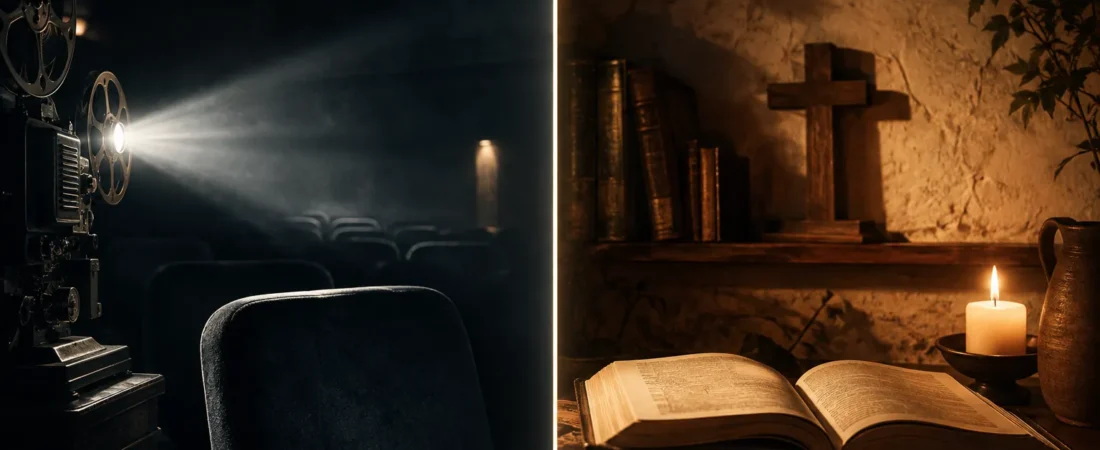
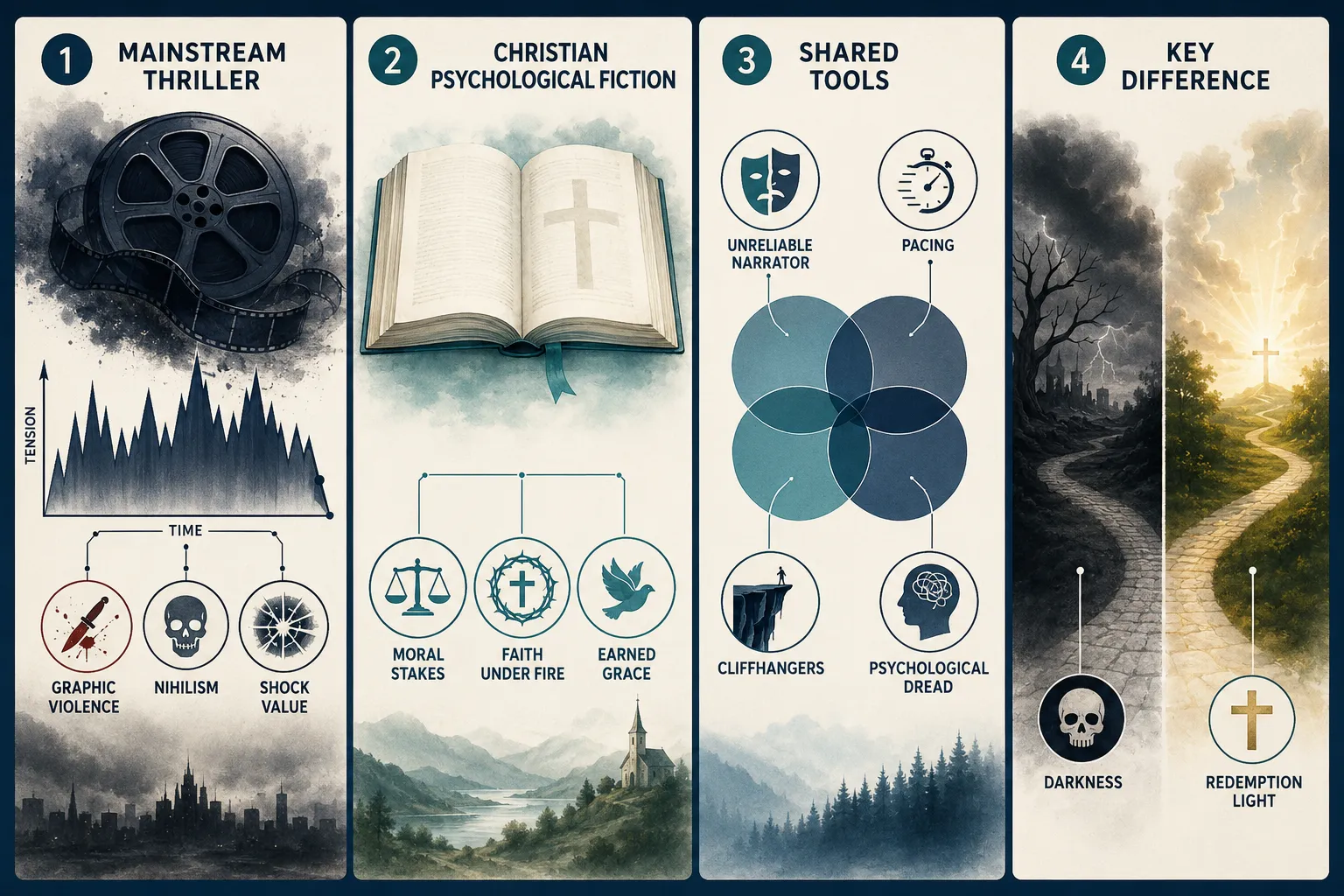
Quick Answer: Psychological thriller films and Christian psychological fiction both build tension through hidden information, moral stakes, and characters pushed past their limits, but they part ways on what that darkness is for. Mainstream thrillers often use graphic violence, nihilism, and shock as the engine. Christian psychological fiction keeps the same mind-bending pressure while grounding it in faith under fire, earned grace, and the conviction that truth costs something but is still worth finding. For clean-read Kindle Unlimited subscribers who want real suspense without the content they’d rather skip, Christian psychological thrillers are not a compromise, they’re a different kind of craft.
Key Takeaways
- Psychological thrillers create tension through information gaps, unreliable narrators, moral dilemmas, and time pressure, none of those tools require graphic content.
- Christian psychological fiction uses the same structural mechanics but roots the stakes in faith, conscience, and the cost of truth.
- The difference is not less darkness, it’s purposeful darkness, where suffering points somewhere rather than ending in nihilism.
- Common mistakes in Christian thriller writing include resolving tension too quickly with faith, dropping in scripture as a substitute for earned character growth, and pulling punches so hard the stakes disappear.
- Clean psychological thrillers exist as a growing, codified category, publisher editorial standards now explicitly define what “tension with restraint” means in practice.
- Christian fiction unit sales grew 12.4% year-over-year in 2025, with suspense and thriller subgenres driving much of that growth.
- Readers who want suspense without graphic violence are not a niche, they are a documented, growing market segment.
- Series like The Gathering Light (Silas Bellhaven) demonstrate that psychological dread, unreliable testimony, and institutional manipulation can carry a full thriller without a single scene of graphic violence.
What Makes a Psychological Thriller Different From Christian Fiction
Psychological thrillers are defined by internal threat, the danger lives in the mind, in what characters believe, in who is lying and who knows it. Christian fiction, broadly, is defined by worldview, God is present, faith is load-bearing, and moral consequence is real. These two things are not opposites.
The tension between them is almost entirely about method, not mission. Mainstream psychological thrillers like Gone Girl, Black Swan, or Shutter Island use graphic content, moral ambiguity without resolution, and sometimes nihilistic endings as part of their aesthetic. Christian psychological fiction asks the same questions, Who controls the record of someone’s truth? What happens when the institution you trusted turns on you?, but answers them inside a worldview where those questions have weight because God is real and truth matters.
The craft gap is not about sanitizing darkness. It’s about directing it. The psychology of faith in thriller narratives is its own discipline, and it’s more demanding than simply removing the offensive content and calling it done.
Psychological Thriller vs. Suspense vs. Mystery: What’s the Difference
These three genres overlap, but they’re not the same thing, and confusing them leads to books that feel off-genre for readers who came in expecting one and got another.
| Genre | Primary Question | Tension Source | Resolution Type |
|---|---|---|---|
| Mystery | Who did it? | Information withheld from reader | External: the crime is solved |
| Suspense | What will happen next? | Danger the reader sees coming | External: the threat resolves |
| Psychological Thriller | What is real? / Who can be trusted? | Internal: perception, identity, manipulation | Internal: the character’s reality shifts |
Psychological thrillers are the most interior of the three. The reader is often as disoriented as the protagonist. That disorientation is the engine, and it runs entirely on information architecture, not on body count or explicit content. Christian fiction can operate in all three modes, but the psychological thriller is arguably where faith-rooted storytelling has the most to say, because questions about what is real and who can be trusted are, at their core, theological questions.
Can You Have Real Tension and Conflict in Faith-Based Stories
Yes, and the absence of tension is actually a theological problem, not just a craft one. Faith that costs nothing proves nothing. Stories where the protagonist’s belief is never seriously threatened are not inspiring; they’re inert.
Christian authors writing in the thriller space often grapple with how much pressure to apply before a character’s faith [1]. The answer from working authors and editors is consistent: the pressure has to be real enough that the reader genuinely doesn’t know if the character will hold. That’s not a concession to secular storytelling, that’s the Book of Job.
Practical tools for real tension in faith-based fiction:
- Information asymmetry: The reader knows something the protagonist doesn’t, or vice versa. No graphic content required.
- Moral stakes: The character must choose between two things they value, loyalty and truth, mercy and justice, silence and witness.
- Institutional threat: A trusted system (a church, a retreat, a community) turns out to be the source of harm. This is psychologically devastating without a single violent scene.
- Time pressure: A deadline that forces a choice before the character is ready.
- Unreliable testimony: The character’s own memory or perception is in question.
For a deeper look at how these tools work in practice, see how Christian authors build suspense without darkness in psychological thrillers.
How Do Christian Authors Create Suspense Without Dark Content
Christian authors create suspense without graphic content by shifting the source of dread from the body to the conscience. The most effective tool is not violence, it’s the thing the character cannot bring themselves to say out loud [6].
Craft writer Kay DiBianca notes that Christian fiction writers must resist the urge to resolve tension prematurely, the moment a character prays and immediately receives peace, the story’s engine stalls [5]. The faith has to cost something before it gives something. That’s not a dark principle; it’s a true one.
Specific techniques that work:
- The withheld document: A letter, a file, a prayer list with a name that shouldn’t be there. The reader knows it exists before the protagonist does.
- The trusted voice that shifts: A mentor, pastor, or friend whose language starts to sound like control rather than care.
- The closed room: Not a locked-door mystery, but a psychological space, the thing the protagonist refuses to look at directly.
- Pacing through restraint: Short chapters that end before resolution. Scenes that stop one beat too early. Silence where the reader expected an answer.
Jessica Redmerski, writing about craft in July 2026, makes the point that “writing the hard stuff” in any fiction, including faith-based, requires the author to stay in the uncomfortable moment rather than flinching away from it [4]. The flinch is what produces bad Christian thrillers, not the faith.
For a full breakdown of non-violent suspense in Christian psychological thrillers, that resource covers the mechanics in detail.
How Much Darkness Is Too Much for Christian Psychological Fiction
The line is not about how dark the subject matter is, it’s about whether the darkness is gratuitous or purposeful. Christian publishing editorial standards, as codified by multiple imprints in 2025-2026, draw a consistent distinction: violence and suffering can appear, but they cannot be graphic, celebrated, or detailed for their own sake [22][23].
In practice, that means:
- Allowed: A character discovering that someone they trusted has been manipulating their testimony. The emotional devastation of that discovery. The slow unraveling of a false narrative.
- Allowed: A death that carries weight and consequence, described with enough specificity to be real but not rendered in clinical or sensational detail.
- Not allowed: Graphic descriptions of physical harm, sexual violence rendered explicitly, or suffering presented as entertainment rather than consequence.
The practical test: Does this scene exist to serve the character’s arc, or does it exist to shock the reader? If the answer is the latter, it’s too much, not because Christian fiction is squeamish, but because gratuitous content is bad craft regardless of genre.
This is also where Christian psychological fiction diverges most sharply from mainstream psychological thriller films. Films like Hereditary or Midsommar use graphic horror as a primary aesthetic. Christian fiction can explore the same themes of grief, manipulation, and spiritual threat without that aesthetic layer.
What Are Common Mistakes Christian Writers Make With Thriller Elements
The most common mistake is not too much darkness, it’s too little earned tension. Christian thriller writers frequently pull their punches in ways that destroy the genre contract [8][9].
The five most common mistakes:
- Premature grace: The character’s faith resolves the plot problem before the reader has felt the full weight of the danger. Grace that arrives before cost is cheap grace, and readers feel it.
- Scripture as shortcut: Dropping a verse into a scene as a substitute for showing the character work through their fear. The verse is real; the work has to be real too.
- The villain who isn’t threatening enough: Christian fiction sometimes softens antagonists to the point where the reader never believes the protagonist is in genuine danger.
- Tidy conversion moments: A dramatic, clean turn to faith at the climax that hasn’t been earned by the preceding chapters. Real faith under fire is messier and more specific than that.
- Avoiding the hard question: The story circles the theological question at its center but never actually asks it. Readers who came for a psychological thriller came for that question. Avoiding it is a betrayal of the genre.
See also: faith in fiction without preaching, how Christian authors keep story first.
How to Write Christian Fiction That Keeps Readers on Edge
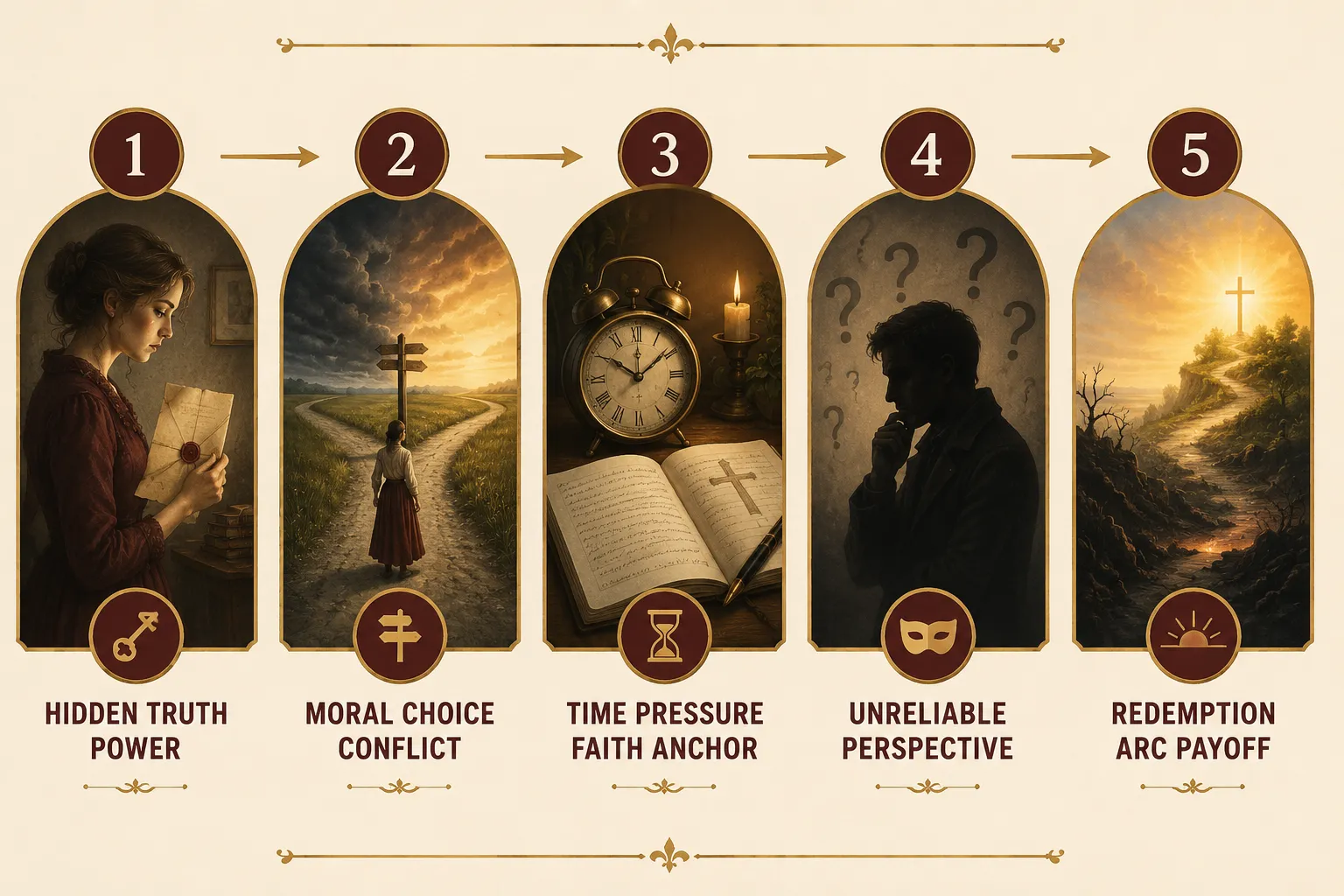
Keeping readers on edge in Christian psychological fiction requires the same structural discipline as any thriller, applied with a specific worldview constraint: the tension must be morally weighted, not just mechanically generated.
A working framework for pacing and cliffhangers in faith-based narratives:
- Open on a contradiction. The character believes something the reader already suspects is wrong. That gap is the first engine.
- Withhold the confirming information. Don’t resolve the contradiction early. Let it sit. Let the character make choices based on the wrong belief.
- Escalate through relationship, not action. The most effective Christian thriller scenes are conversations where one person knows more than the other. The reader feels the weight of what isn’t being said.
- End chapters on the wrong beat. Not a cliffhanger in the action-movie sense, but a moment where something small shifts and the reader can’t quite name what changed.
- Let faith be the complication, not the solution. The character’s belief should create dilemmas, not dissolve them. A woman who believes in mercy and justice faces a harder choice when she discovers the person who wronged her is also the person who needs help.
- Earn the resolution. Whatever peace or clarity arrives at the end should cost something specific. Not a general spiritual feeling, a named, concrete cost.
Examples of Christian Psychological Fiction That Actually Works
The best current examples of Christian psychological fiction that successfully maintains thriller-level tension are built around institutional manipulation and the control of testimony, which is inherently psychological territory without requiring graphic content.
Silas Bellhaven’s The Gathering Light series is the clearest current example of this approach done well. The series is set at a Christian restoration retreat where testimonies are preserved word for word, and that precision becomes the weapon. When Hannah Sleeps opens with a transcriptionist finding her own words in someone else’s file. When the Voice Breaks follows a woman whose careful professional language is turned against her by the very system she helped build. When the Prayer List Opens puts a protagonist’s name on a prayer list written by someone who was supposed to be safe.
None of these books require graphic violence to generate genuine dread. The threat is institutional, psychological, and deeply theological, because the question underneath each book is: Who gets to say what your story means?
For readers looking for a broader reading list, best Christian psychological thriller books for clean-read fans covers the category in depth.
Who Should Read Christian Psychological Thrillers Instead of Regular Thrillers
Christian psychological thrillers are the right choice for readers who want the experience of a psychological thriller, the disorientation, the moral stakes, the unreliable reality, without the content that makes mainstream thrillers difficult to read in good conscience.
This reader profile fits:
- Women 35-65 who read Kindle Unlimited and want suspense that doesn’t require skimming past graphic scenes
- Readers who loved mainstream thrillers in their twenties and want the same intellectual engagement without the content
- Faith readers who feel that most “Christian fiction” doesn’t take real danger seriously enough
- Book club readers who want something discussable, morally complex, not morally simple
This is not the right fit for:
- Readers who specifically want the aesthetic of graphic horror or extreme violence as part of the experience
- Readers who find any faith element in fiction intrusive, regardless of how it’s handled
The Christian psychological thrillers: doubt, redemption, and moral complexity resource covers the reader experience in more detail.
Best Psychological Thriller Films That Aren’t Too Dark or Violent
Some mainstream psychological thriller films are worth noting for readers who want to understand the genre’s mechanics before seeking out the Christian fiction equivalent, and several are significantly less graphic than the genre’s reputation suggests.
Films frequently recommended by readers looking for psychological tension without extreme content [2][3]:
- Rear Window (1954), Pure information asymmetry. No graphic content; almost entirely psychological.
- The Others (2001), Atmospheric dread built on perception and revelation, minimal graphic violence.
- Memento (2000), Structural disorientation as the primary thriller tool.
- The Truman Show (1998), Institutional manipulation of a person’s reality, played almost entirely without violence.
- Shutter Island (2010), More intense, but the horror is psychological rather than graphic.
These films are useful reference points for understanding what Christian psychological fiction is trying to deliver: the same cognitive and emotional experience, grounded in a different worldview.
Are there Christian psychological thrillers on streaming platforms? As of 2026, dedicated Christian psychological thriller content on major streaming platforms remains sparse. The strongest current catalog for this subgenre lives in Kindle Unlimited, where series like The Gathering Light are available to read in full.
What Do Mainstream Thriller Readers Think of Christian Alternatives
Mainstream thriller readers who discover Christian psychological fiction often report the same initial skepticism, and then the same surprise. The assumption is that “Christian” means “safe” in the sense of stakes-free. The reality of well-crafted Christian psychological fiction is that the stakes are often higher, because the moral weight is heavier.
The difference is in what the darkness is for. A mainstream thriller can end in nihilism and call it realism. Christian psychological fiction cannot, not because it denies that darkness exists, but because it holds that darkness is not the final word. That’s not a compromise of the genre. It’s a different answer to the same question.
Readers who cross over from mainstream thrillers to Christian psychological fiction consistently note that the absence of graphic content is less noticeable than they expected, because the presence of real moral stakes fills the same emotional space [7].
FAQ
Q: Do Christian psychological thrillers have real suspense, or is the ending always safe? A: The ending is not always safe, characters lose things, face real consequences, and sometimes don’t get the resolution they hoped for. What changes is the framework: suffering points somewhere, and grace, when it arrives, has cost something.
Q: Is “clean Christian fiction” just a marketing label? A: It’s a content standard with specific meaning: no graphic violence, no explicit sexual content, no profanity. The label describes what’s absent. What’s present, real stakes, moral complexity, earned tension, is what separates good clean fiction from sanitized fiction.
Q: Can a Christian psychological thriller have an unreliable narrator? A: Yes. Unreliable narrators are a structural tool, not a moral one. A character who misremembers, misinterprets, or actively deceives can carry a Christian thriller without the story endorsing deception.
Q: How is Christian psychological fiction different from inspirational fiction? A: Inspirational fiction typically centers on emotional uplift and faith affirmation. Christian psychological fiction uses the thriller genre’s tools, dread, disorientation, moral pressure, and faith is tested inside that pressure, not delivered as comfort from outside it.
Q: Where can I find Christian psychological thrillers on Kindle Unlimited? A: Silas Bellhaven’s The Gathering Light series, beginning with When Hannah Sleeps, is available on Kindle Unlimited and is specifically designed for readers who want clean, faith-rooted psychological suspense.
Q: Are there Christian psychological thrillers written for men? A: The majority of the current market skews toward female protagonists and female readers. For male-protagonist Christian fiction with high moral stakes, The Mercy Line western series covers similar thematic territory, conscience under pressure, the cost of truth, in a frontier setting.
Q: What’s the biggest craft difference between writing a secular thriller and a Christian one? A: In a secular thriller, the author can use nihilism as a valid ending. In Christian psychological fiction, the author must find a way to make hope earned rather than assumed, which is actually a harder craft problem, not an easier one [4][6].
Q: How do I know if a Christian thriller is actually suspenseful before I buy it? A: Look at the first chapter sample. If the tension comes from moral stakes, hidden information, or a character whose reality is in question, rather than from a tidy faith-affirming setup, the book is likely to hold its tension throughout.
Conclusion
The question at the center of Psychological Thriller Films vs. Christian Psychological Fiction: How to Keep the Tension Without the Darkness is not really about content restrictions. It’s about what darkness is for.
Mainstream psychological thriller films use darkness as atmosphere, as shock, sometimes as the point itself. Christian psychological fiction uses darkness the same way a good surgeon uses a scalpel, with precision and purpose, because the cut is in service of something. Redemption that costs something. Faith under fire. Hope in the dark that arrived after the dark was genuinely dark.
For readers who want that experience, the disorientation, the moral weight, the unreliable reality of a real psychological thriller, without the content that makes mainstream thrillers difficult to read in good conscience, the Christian psychological fiction category is not a consolation prize. It’s a craft tradition that asks harder questions, not easier ones.
Where to start:
- The Gathering Light series begins with When Hannah Sleeps, a clean Christian psychological thriller about a woman who finds her own testimony in someone else’s file.
- For the broader category, best Christian psychological thriller books for clean-read fans is the right next stop.
- For writers working in this space, how Christian authors build suspense without darkness covers the craft mechanics directly.
The record doesn’t have to have the last word. That’s the whole point.
References
[1] Suspense Panel Writing Crime Fiction Christian Authors – https://familyfiction.com/suspense-panel-writing-crime-fiction-christian-authors/
[2] Looking For Psychological Thrillers With Liminal – https://www.reddit.com/r/MovieRecommendations/comments/1kdkynj/looking_for_psychological_thrillers_with_liminal/
[3] Any Recommendations For Thrillers Without – https://www.reddit.com/r/MovieSuggestions/comments/1lw53yj/any_recommendations_for_thrillers_without/
[4] Writing The Hard Stuff – https://jessicaredmerski.com/2026/07/31/writing-the-hard-stuff/
[5] The Craft Of Writing Christian Fiction September 2025 – https://kaydibianca.com/2025/09/22/the-craft-of-writing-christian-fiction-september-2025/
[6] Crafting Christian Suspense – https://rhemalogy.com/2025/08/24/crafting-christian-suspense/
[7] Clean Psychological Thrillers – https://pdworkman.com/clean-psychological-thrillers/
[8] Suspense Panel 2020 Writing Crime Fiction Christian Authors – https://familyfiction.com/suspense-panel-2020-writing-crime-fiction-christian-authors/
[9] How To Write A Christian Thriller – https://glenchen.com/2019/01/02/how-to-write-a-christian-thriller/