
Last updated: September 14, 2026
Quick Answer: Christian psychological thrillers and True Detective-style storytelling share the same core engine, a morally serious investigation, a damaged protagonist, and a world where justice is never simple. The difference is not in the tension level. It’s in what the story believes about the darkness it’s willing to name. Faith-rooted thrillers can carry every ounce of that investigative weight while keeping the content clean, the hope earned, and the spiritual stakes real.
Key Takeaways
- High tension does not require graphic content. Psychological dread, institutional deception, and moral weight are just as gripping without explicit violence or language.
- True Detective’s real power is philosophical, not graphic, its questions about guilt, justice, and spiritual decay are exactly the questions Christian fiction is built to answer.
- Christian psychological thrillers work best when faith shows up through character choice, not narration or scripture-dropping.
- The fastest way to lose a faith audience is cheap grace, resolution that costs the protagonist nothing.
- Clean Christian fiction is not a toned-down genre. It’s a different set of tools for building the same level of dread.
- The Gathering Light series (When Hannah Sleeps, When the Voice Breaks, When the Prayer List Opens) is a working example of True Detective-style institutional suspense built entirely on clean, faith-rooted content.
- Streaming data confirms the market appetite: faith-based titles on Amazon Prime Video rose 209% in 2024, and true-crime-adjacent content about religious communities is among the fastest-growing subsets. [1]
- The biggest mistake Christian thriller writers make is resolving moral complexity too quickly, letting the faith answer arrive before the story has earned it.
- Readers of Christian psychological thrillers tend to be women 35-65 who want real stakes, not sanitized ones, they’ve read enough fiction that talks at them.
- The goal is not to remove darkness from the story. It’s to make sure the light in the story means something.
What Makes a Psychological Thriller Christian Without Being Preachy
A Christian psychological thriller earns that label when faith is load-bearing inside the plot, not decorative. The protagonist’s belief (or loss of it) should change what they do, what they risk, and what they’re willing to sacrifice. When faith is just atmosphere, it reads as preachy. When it’s structural, it reads as honest.
The practical test: remove every explicit faith reference from the manuscript. If the story still works the same way, the faith wasn’t doing any real work. If the story collapses, if the character’s choices no longer make sense, if the moral stakes disappear, then the faith was genuinely integrated.
What separates integrated faith from preachy faith:
| Preachy Faith | Integrated Faith |
|---|---|
| Character explains their beliefs to another character | Character’s beliefs drive a decision that costs them something |
| Scripture quoted at a turning point | Scripture remembered privately, shaping a choice the reader sees |
| Villain is punished; protagonist is vindicated | Protagonist faces real moral cost even in resolution |
| Conversion moment ends the conflict | Doubt and conviction coexist through the entire story |
| Faith is the answer to the mystery | Faith is what makes the protagonist keep asking the question |
The faith in fiction across genres question is not unique to thrillers, but it’s sharpest in the thriller genre, because suspense requires moral ambiguity, and moral ambiguity is exactly where shallow faith content breaks down.
True Detective-Style Storytelling for Faith Audiences
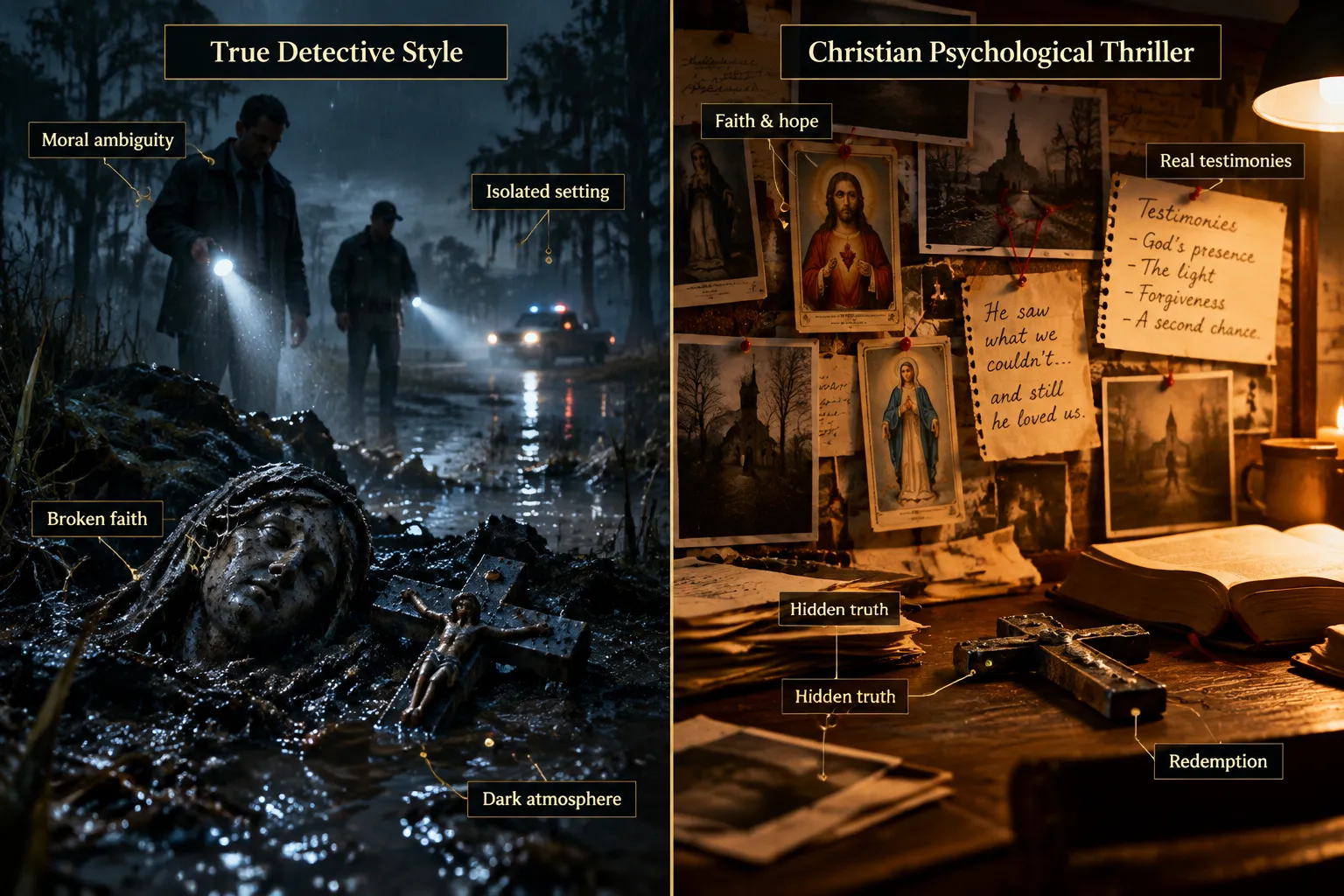
True Detective’s first season is the clearest modern template for what Christian psychological thrillers and True Detective-style storytelling can accomplish together, and also the clearest illustration of where secular prestige drama and faith-rooted fiction part ways.
The show’s genuine strengths: a nonlinear structure that forces the audience to question memory and testimony, a detective protagonist whose philosophical despair is inseparable from his investigative method, and a setting where religious imagery is everywhere and means something. The murders are ritualistic. The corruption is institutional. The questions, about guilt, about whether justice is even possible, about what a man owes the dead, are genuinely theological.
Those are exactly the questions Christian fiction is built to answer. The difference is not in the seriousness of the questions. It’s in what the story believes about whether answers exist.
What True Detective does that Christian thrillers can borrow:
- Nonlinear testimony structure (witnesses contradict each other; the reader assembles truth slowly)
- Institutional corruption as the real antagonist, not a single villain
- A protagonist whose personal faith history is inseparable from their investigative instincts
- Religious imagery used as genuine symbol, not just atmosphere
- Moral weight that accumulates across episodes rather than resolving cleanly each chapter
What True Detective does that Christian thrillers should redirect:
- Graphic violence used to establish dread (dread can be built through implication and psychological pressure instead)
- Nihilism as the default philosophical position
- Resolution that leaves justice permanently out of reach
The non-violent suspense in Christian psychological thrillers approach is not about softening the story. It’s about locating the terror in the right place, in what people do with power, with testimony, with someone else’s truth.
How Do Christian Authors Write Suspense Without Graphic Content
Christian authors build suspense without graphic content by shifting the source of dread from the body to the record. Physical violence creates immediate fear. Institutional deception, the slow realization that someone has been controlling the story, editing the testimony, shaping what gets believed, creates the kind of dread that stays with a reader for days.
Practical tools for clean suspense:
- Unreliable records: A prayer list, a testimony file, a ledger, when the reader suspects these have been altered, every page becomes a threat.
- Controlled information: The protagonist knows something she cannot prove. The antagonist knows she knows. Neither speaks directly about it.
- Institutional pressure: The danger comes from a system (a church, a retreat, a committee) rather than a single violent actor. Systems are harder to escape than people.
- Psychological isolation: The protagonist begins to doubt her own memory, her own version of events, not because she’s unstable, but because someone has worked very hard to make her feel that way.
- Faith under fire: The protagonist’s belief is the thing being targeted. The antagonist doesn’t need to threaten her physically, threatening her credibility, her community, her spiritual standing is enough.
This is the architecture behind The Gathering Light series. In When Hannah Sleeps, Hannah Garrick has transcribed a hundred women’s worst nights at a restoration retreat, until her own testimony starts appearing in someone else’s file. The horror is not physical. It’s the realization that the system she trusted to protect testimony has been using it as a weapon. That is clean Christian fiction with real stakes. See the full series at Amazon.
Difference Between a Christian Thriller and a Secular Psychological Thriller
The core difference is not content rating, it’s what the story believes about justice. Secular psychological thrillers often leave justice ambiguous or permanently deferred. Christian psychological thrillers operate from the conviction that truth matters absolutely, that someone is keeping the real record, and that mercy and justice are not opposites.
That conviction changes the story’s architecture from the first chapter. A secular thriller can end with the protagonist surviving but the system intact, the truth buried, the villain unpunished. A Christian thriller can go to exactly the same dark places, and often should, but the ending cannot be spiritually nihilistic. Not because the story has to be tidy, but because the worldview behind it holds that the record is not the last word.
Key structural differences:
- Secular: Resolution is survival. Christian: Resolution is truth, even when it costs the protagonist something.
- Secular: Moral ambiguity is the final state. Christian: Moral ambiguity is the condition the protagonist has to work through, not rest in.
- Secular: Religious imagery is often atmospheric or critical. Christian: Religious imagery is load-bearing, it means what it says.
- Secular: Redemption is optional and often ironic. Christian: Redemption that costs something is the point.
This is not a quality distinction. Some secular psychological thrillers are extraordinary. The distinction is in what the story is for, and for readers who want their faith represented honestly, not preached at, the difference is felt on every page.
Can You Have High Tension in Faith-Based Stories
Yes, and the tension in faith-based stories can be more sustained than in secular thrillers, because the stakes are higher. When a character’s spiritual standing, community, and sense of God’s presence are all being threatened simultaneously with her physical safety, the reader has more to lose alongside her.
The misunderstanding is that “clean” means “low stakes.” It doesn’t. Clean Christian fiction simply locates the stakes differently. A woman who might lose her family, her church, her testimony, and her grip on what she knows to be true, that is not a low-stakes story. That is a story where everything that matters is in danger.
“Hope in the dark” is not a soft promise. It’s the hardest kind, the kind that has to be earned through the plot, not delivered in the final chapter as a reward for enduring the story.
The best Christian psychological thriller books for clean-read fans demonstrate this consistently: the tension is real, the danger is real, and the faith is real, none of the three is decorating the others.
Common Mistakes Christian Thriller Writers Make
The most damaging mistakes in Christian thriller writing all come from the same source: resolving things too early. Grace arrives before it’s been earned. The antagonist is exposed before the protagonist has paid a real cost. The faith answer shows up in chapter twelve when the story needed it to arrive in chapter twenty-two.
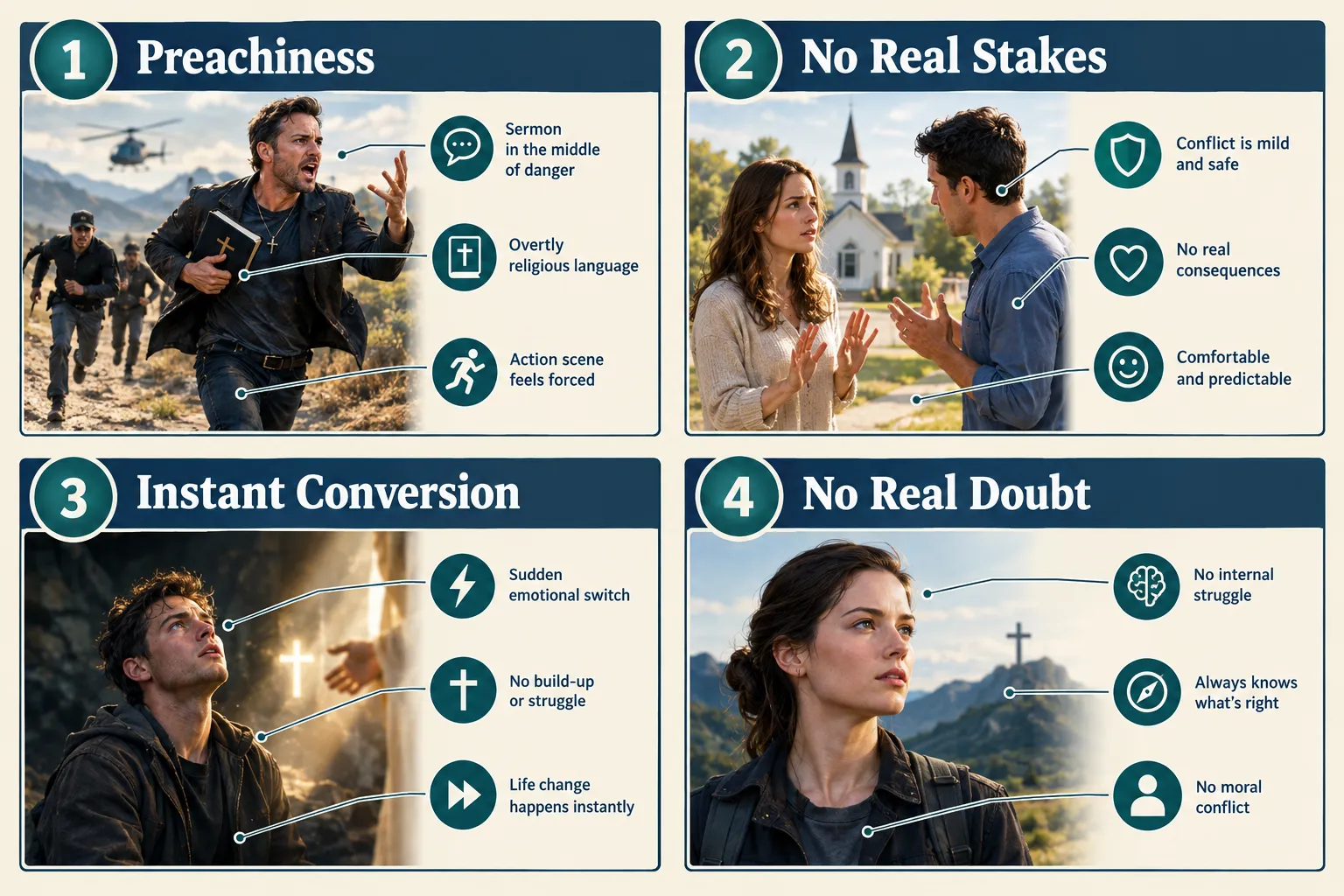
The five most common mistakes:
- Cheap grace: The protagonist is rescued from moral complexity by a convenient faith moment rather than working through it.
- The sermon scene: A character explains Christian theology to another character during a moment of crisis. This kills pacing and trust simultaneously.
- The clean villain: The antagonist has no sympathetic motivation. When the villain is purely evil, the moral stakes flatten, and so does the tension.
- The safe protagonist: The protagonist never genuinely doubts, never genuinely fails, never does anything that requires real repentance. Readers stop believing in her.
- The tidy ending: Every thread resolves. Every relationship heals. Every question gets answered. Real faith lives with unresolved things, and so should Christian fiction.
The role of redemption arcs in Christian thrillers covers this in depth: redemption that costs something is the point. Redemption that arrives for free is not redemption, it’s a reset button.
Who Reads Christian Psychological Thrillers
The core audience for Christian psychological thrillers is women between 35 and 65, most of them Kindle Unlimited subscribers, who want clean fiction with real psychological weight. They’ve read enough inspirational romance and cozy mystery to know what they’re getting, and many of them are actively looking for something with more tension, more moral complexity, and more honest engagement with the hard parts of faith.
This audience is not looking for devotional fiction in thriller packaging. They want stories that walk with them, not talk at them, characters who actually doubt, serve, fail, repent, and find grace in the ordinary Tuesday that suddenly isn’t ordinary anymore.
A 2014 survey cited in Variety found that among Christian moviegoers, only 4% said they preferred explicitly faith-based films, the majority preferred comedy, action, and drama. Even accounting for the age of that data, it points to something consistent: Christian audiences are not confined to devotional media. They want good stories. They want the faith to be real inside those stories. Those are not the same request.
What this audience is specifically looking for:
- Psychological stakes, not just physical danger
- A protagonist whose faith is tested and proven through the plot
- No graphic content, but no sanitized conflict either
- Resolution that feels earned, not imposed
- A story that takes their spiritual life seriously without lecturing them about it
How Much Darkness Is Too Much in a Christian Mystery Novel
The line is not about how dark the subject matter is, it’s about whether the darkness serves the story’s larger conviction. A Christian mystery novel can go into institutional abuse, spiritual manipulation, grief, and moral failure without crossing into territory that violates the clean content contract. The question is not “how bad can this get?” but “does the darkness here have a purpose the story is actually going to honor?”
Darkness that serves the story:
- Reveals something true about human nature that the protagonist (and reader) needs to understand
- Creates genuine cost for the protagonist, not just danger, but moral weight
- Points toward the need for mercy and justice without spelling it out
- Is acknowledged honestly rather than minimized or aestheticized
Darkness that doesn’t serve the story:
- Graphic violence or explicit content included for shock effect
- Suffering that exists only to motivate the protagonist, with no weight of its own
- Moral complexity that never resolves into any kind of reckoning
- A spiritual atmosphere that feels hostile to the faith it’s borrowing from
Netflix’s Unchosen (April 2026) is a useful case study in the tension: a six-episode psychological thriller set inside a fictional conservative religious community, using Christian communal imagery while centering coercion and institutional abuse. The show demonstrates real market appetite for serious, faith-adjacent suspense, and also illustrates why atmosphere alone isn’t enough if the story becomes spiritually alienating for the audience it’s drawing from. [7]
The clean Christian fiction for Kindle Unlimited framework is useful here: “clean” is not a ceiling on tension. It’s a set of commitments about what the story will and won’t do with the darkness it names.
Where to Find Clean Psychological Thrillers With Spiritual Themes
The practical home for clean Christian psychological thrillers in 2026 is Kindle Unlimited, with Amazon, Tyndale, Revell, and Love Inspired as the main publishing channels. September 2026 release trackers show an active pipeline of Christian suspense titles across romantic suspense, police procedural, and psychological thriller categories, the subgenre is healthy and growing. [7]
Where to start:
- The Gathering Light series by Silas Bellhaven (series page), institutional psychological suspense set at a faith-based restoration retreat. When Hannah Sleeps is the entry point.
- Kindle Unlimited Christian reads, the hidden gems and underrated series list covers titles beyond the bestseller charts.
- Library Journal has noted that thrillers are opening a new pathway in Christian fiction, with publishers actively expanding the subgenre. [7]
- The best Christian fiction authors across cozy mystery, western, fantasy, thriller, and LitRPG reading list covers the broader faith-fiction landscape for readers who want to explore beyond a single genre.
Decision rule: If you want True Detective-level institutional dread with clean content and a protagonist whose faith is genuinely tested, not just referenced, start with When Hannah Sleeps. If you want something lighter with mystery elements and a faith community setting, the Mercy House Mysteries series in Juniper Gap, Tennessee is the right starting point.
FAQ
Q: Do Christian psychological thrillers have to include prayer or scripture to count as Christian? No. Faith shows up through character choice and consequence, not through explicit devotional content. A protagonist who chooses to tell the truth at great personal cost, because she believes the record matters to God, that is Christian fiction, regardless of whether scripture is quoted.
Q: Can a Christian thriller have a morally ambiguous ending? Yes, with one condition: the ambiguity should not be spiritually nihilistic. Unresolved threads, imperfect justice, and ongoing grief are all honest. An ending that suggests truth is permanently inaccessible or that mercy is meaningless is a different thing.
Q: What’s the difference between Christian suspense and Christian psychological thriller? Christian suspense (especially romantic suspense) tends to prioritize danger, protection, and faith-centered resolution. Christian psychological thriller prioritizes the interior, the protagonist’s perception of reality, the manipulation of testimony and memory, the slow unraveling of what she thought she knew. The psychological thriller is slower, darker, and more concerned with institutional power.
Q: Is The Gathering Light series appropriate for readers who don’t usually read thrillers? Yes. The tension is psychological, not graphic. Readers who enjoy cozy mysteries but want more weight often find the series a natural next step.
Q: Why do so many Christian thrillers feel preachy? Usually because the faith content is carried by dialogue rather than plot. When a character explains their beliefs to another character, it reads as a sermon. When a character’s beliefs drive a decision that changes the story, it reads as lived faith.
Q: Are Christian psychological thrillers popular on Kindle Unlimited? Yes. The subgenre is growing. Ampere Analysis reported that faith-based titles on Amazon Prime Video rose 209% in 2024, and publishing release trackers show an active September 2026 pipeline of Christian suspense titles across multiple imprints. [7]
Q: What makes a Christian thriller feel like “True Detective” without the darkness? Nonlinear testimony structure, institutional corruption as the real antagonist, a protagonist whose faith history shapes her investigative instincts, and moral weight that accumulates slowly rather than resolving cleanly each chapter. Those are structural choices, not content choices, they work just as well without graphic violence.
Q: How do I know if a Christian thriller has real stakes or just surface tension? Ask whether the protagonist’s faith is actually threatened by the plot, not just her safety. If she could resolve the story without her beliefs ever being genuinely tested, the stakes are surface-level.
Conclusion
Christian psychological thrillers and True Detective-style storytelling are not opposites looking for a compromise. They are the same instinct, the conviction that truth matters, that justice is worth pursuing even when the system is broken, that a damaged person asking hard questions in a dark place is worth following, expressed from two different starting points about what the darkness means.
The secular prestige thriller says the darkness might be all there is. The Christian psychological thriller says the darkness is real, it costs something to name it, and the light on the other side of it is not guaranteed to be comfortable, but it is real.
That is not a softer story. That is a harder one. Earned grace is not cheap grace. Hope in the dark is not optimism. And a story that walks with its reader through genuine moral weight, without flinching and without preaching, is exactly what this audience has been looking for.
Next steps:
- Start with When Hannah Sleeps, the first book in The Gathering Light series, for a working example of this approach in practice.
- Explore the Christian thriller craft tag for deeper craft discussion on building tension without graphic content.
- Browse the full Silas Bellhaven catalog for faith-rooted fiction across psychological thriller, cozy mystery, frontier western, and epic fantasy.
References
[1] The Challenge And Goals Of Independent Catholic Filmmaking An Interview With Paul Roland – https://www.catholicworldreport.com/2024/06/23/the-challenge-and-goals-of-independent-catholic-filmmaking-an-interview-with-paul-paul-roland/ [7] Thrillers Open A New Pathway In Christian Fiction Lj240719 – https://www.libraryjournal.com/story/thrillers-open-a-new-pathway-in-christian-fiction-lj240719