}
Last updated: September 20, 2026
Quick Answer: Christian readers navigating violent pop culture are not simply avoiding dark content, they are making an active choice about what stories are for. Faith-based readers increasingly choose clean fiction, cozy mysteries, and psychological thrillers rooted in redemption because those stories carry real stakes without aestheticizing brutality. The surge in true crime media and killer-focused narratives (from John Wayne Gacy documentaries to killer clown horror franchises) has sharpened that discernment, not eliminated the appetite for suspense.
Key Takeaways
- Christian fiction unit sales grew 12.4% year-over-year in 2026, with revenue up 15.7%, led by thrillers, mysteries, and grief narratives that stay morally restrained [3]
- Faith-based readers do not reject crime or suspense, they reject aestheticized brutality and explicit sadism [3]
- The Bible does not prohibit engaging with dark themes; it calls readers to examine purpose and effect on the heart
- “Clean fiction” means no graphic violence, no profanity, and no explicit sexual content, but it does not mean no conflict, no death, or no moral weight
- True crime’s appeal is real and documented: roughly 52% of Americans consume true crime content regularly [2], but many Christian readers find its victim-focused framing spiritually draining
- The best clean Christian fiction offers psychological tension, earned grace, and real consequences, not sanitized plots with easy answers
- Baker Publishing’s Haven imprint (2026) explicitly targets readers who want “clean and wholesome” fiction across faith lines, signaling mainstream demand [3]
- Faith-based readers are not missing out, they are choosing stories where hope in the dark is load-bearing, not decorative
What Does the Bible Say About Consuming Violent Media and Entertainment?
The Bible does not give a content-rating system, but it does give a framework. Philippians 4:8 calls believers to fix their minds on things that are true, honorable, just, pure, lovely, and commendable, a standard of orientation, not a ban on difficult stories.
Scripture is itself full of violence: Judges, the Psalms of lament, the crucifixion narrative. The question the Bible actually asks is not “does this story contain darkness?” but “what is this darkness doing?” Is it illuminating something true about human nature and the need for redemption? Or is it packaging suffering as spectacle?
- Philippians 4:8, a filter for what the mind dwells on, not a prohibition on encountering difficulty
- Romans 12:2, “do not be conformed to this world” implies active discernment, not passive avoidance
- Proverbs 4:23, “guard your heart” suggests the cumulative effect of what we consume matters
- Ecclesiastes 3:11, God has “set eternity in the human heart,” which is why stories about death, justice, and meaning resonate so deeply
The practical upshot: a story that shows murder and its consequences honestly is different from a story that lingers on the act for the pleasure of the detail. Faith-based discernment asks which one you’re holding.
Can Christians Watch Violent Movies and Read Crime Thrillers?
Yes, with discernment. There is no universal Christian prohibition on crime fiction or thrillers. What matters is the purpose the violence serves and the effect it has on the reader or viewer over time.
Many of the most beloved stories in the Christian tradition, from Dostoevsky’s Crime and Punishment to Tolkien’s battles in The Lord of the Rings, contain significant violence. The difference between those and, say, a torture-porn horror franchise is not the presence of death but the moral architecture around it.
A practical discernment grid:
| Question | Healthy tension | Red flag |
|---|---|---|
| Does the violence have consequences? | Characters bear the weight of it | Violence is consequence-free entertainment |
| Is the victim a person or a prop? | Victim’s humanity is honored | Victim exists only to generate shock |
| Does the story move toward justice or meaning? | Resolution involves moral reckoning | Resolution is irrelevant or absent |
| How do you feel after? | Sobered, thoughtful, even hopeful | Desensitized, anxious, or craving more intensity |
This is why navigating violent pop culture as a Christian reader is less about a banned-content list and more about learning to read the architecture of a story.
Why Do Some Christians Avoid True Crime Podcasts and Shows?
True crime is genuinely compelling, it engages the human instinct for justice, pattern recognition, and moral clarity. Roughly 52% of Americans consume true crime content regularly [2], and the genre continues to grow as a dominant documentary category [6]. But many Christian readers step back from it, and their reasons are worth taking seriously.
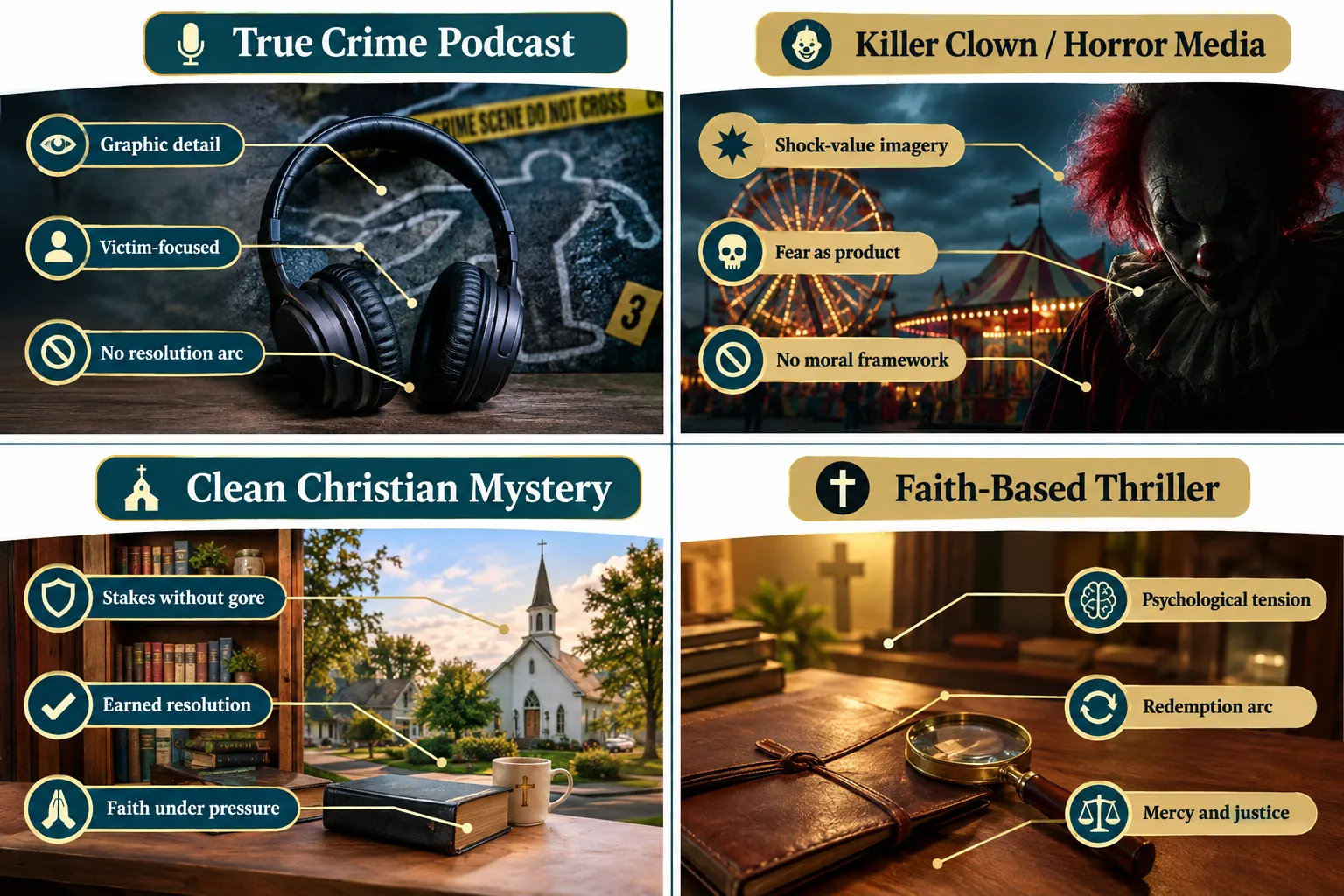
True crime’s structural problem is not that it covers murder. It’s that the format often:
- Centers the perpetrator’s psychology rather than the victim’s dignity
- Commodifies suffering, real people’s worst moments become entertainment product
- Offers no redemptive frame, the story ends with a verdict or a cold case, not with meaning
- Normalizes a posture of morbid fascination that can become spiritually numbing over time
The John Wayne Gacy documentary cycle is a useful example. The killer clown narrative, Gacy’s actual crimes overlaid with the horror-movie iconography of clowns, packages a real man’s real victims inside a genre aesthetic designed to thrill. For many Christian readers, that packaging feels like a violation of the victims’ humanity, not a reckoning with it.
That’s not a judgment on every person who watches. It’s a recognition that the format itself shapes what you take away.
For a deeper look at how faith-based whodunits handle crime without that exploitation, see Christian Cozy Mystery vs. True Crime: How Faith-Based Whodunits Satisfy Suspense Without Exploitation.
Is It Wrong to Enjoy Horror as a Christian Believer?
Not inherently, but horror is a genre worth examining carefully because its mechanism is fear, and fear can be used honestly or manipulatively.
Horror that uses dread to illuminate something true about mortality, evil, or the need for grace has a long and legitimate history. Horror that exists purely to generate adrenaline through graphic suffering is a different animal, and many Christian readers find it leaves them worse, not better.
Choose horror if:
- The fear points toward something, mortality, moral consequence, the reality of evil
- The story has a moral architecture, even if it’s bleak
- You can engage it without it reshaping your baseline anxiety or appetite for intensity
Step back if:
- The content lingers on graphic suffering for its own sake
- You find yourself needing increasingly extreme content to feel the same effect
- The story treats victims as props rather than people
The killer clown subgenre, from Pennywise to Gacy-inspired horror, often sits on the wrong side of that line, not because clowns are inherently sinister but because the genre frequently uses real or realistic atrocity as aesthetic fuel. Faith under fire looks different from fear as product.
How Much Violence Is Too Much for a Christian to Consume?
There is no single threshold, but there are reliable indicators that a reader has crossed from honest engagement with darkness into something that costs more than it gives.
The cumulative effect matters more than any single scene. A story can include death, betrayal, and moral failure, those are the materials of serious fiction, without requiring graphic depiction of the act itself. The question is whether the violence is purposeful or gratuitous.
Indicators that content has crossed a line:
- It depicts suffering in detail that serves no narrative purpose except intensity
- It generates excitement rather than gravity around acts of harm
- It leaves the reader desensitized rather than sobered
- It treats real victims (as in true crime) as entertainment without honoring their humanity
Indicators that dark content is being handled well:
- Characters carry the weight of violence, it changes them
- The story does not reward cruelty
- Mercy and justice are both present as moral forces, even if neither wins cleanly
- Hope in the dark is genuinely present, not tacked on
What Counts as Clean Fiction vs. Explicit Content?
Clean fiction, in the Christian market’s working definition, means no graphic violence, no profanity, and no explicit sexual content. That’s the content contract. But “clean” does not mean “easy” or “conflict-free.”
The best clean Christian fiction has:
- Real stakes, characters can die, fail, lose, and doubt
- Psychological tension, manipulation, deception, and moral ambiguity are all in play
- Earned resolution, grace shows up after cost, not instead of it
What it does not have:
- Graphic depictions of wounds, torture, or sexual violence
- Profanity used for emphasis or atmosphere
- Explicit sexual content of any kind
Baker Publishing’s Haven imprint, launched to mainstream audiences in 2026, explicitly targets this definition, “clean and wholesome” fiction written largely by Christian authors but aimed at readers of any faith who want stories without graphic content [3]. The demand is not niche; it’s growing.
For a fuller breakdown of how these standards work across subgenres, Clean Christian Fiction vs. Inspirational Romance: Content Standards, Faith Focus, and Reader Expectations is a useful reference.
Best Clean Fiction Books for Christian Readers Who Want Good Stories
Christian readers who want suspense, mystery, and psychological tension without graphic content have more options in 2026 than at any point in the last decade [3]. The key is knowing where to look.
For cozy mystery readers: The Mercy House Mysteries by Silas Bellhaven, set in Juniper Gap, Tennessee, follow Nora Bell Hartley through church socials and charity drives that keep turning up bodies. The series handles death honestly without dwelling on it, and every mystery turns on a question of truth-telling that costs someone something real. Start with A Donation to Die For.
For psychological thriller readers: The Gathering Light series, beginning with When Hannah Sleeps, delivers institutional manipulation and psychological dread without graphic content. The spine question across the series: who controls the record of someone’s truth?
For western readers who want moral weight: The Mercy Line works through frontier justice, land fraud, and conscience in a railroad town where law and grace rarely arrive at the same time. The False Warrant opens the series.
For fantasy readers: The Kethara Chronicles and The Sarel Chronicles offer covenant fantasy with genuine stakes, empires, buried truths, and characters who carry faith under fire into situations that test it without resolving it cheaply.
For a broader reading plan across genres, Clean Christian Fiction That Isn’t Just Romance: Mysteries, Westerns, Fantasy, Thrillers, and LitRPG for KU Readers is a strong starting point.
How to Find Faith-Based Fiction That’s Actually Engaging and Not Preachy
The single biggest complaint about Christian fiction, even from Christian readers, is that it preaches at them. Characters deliver spiritual conclusions rather than living through spiritual questions. The faith feels like a label, not a load-bearing wall.

The fix is not less faith. It’s faith that shows up the way it actually works in real life: through doubt, through choice, through the ordinary Tuesday that suddenly isn’t ordinary anymore.
What to look for:
- Characters who doubt and work through it, rather than arriving at faith in a single dramatic moment
- Faith that shapes decisions, not just internal monologue
- Stories where grace is earned through cost, not delivered as a tidy resolution
- Redemption that costs something, cheap grace is as unsatisfying in fiction as it is in theology
What to avoid:
- Books where a character’s faith problem is solved by a conversation with a wise pastor
- Stories that treat non-Christian characters as problems to be converted
- Plots where the villain’s evil is explained entirely by their lack of faith
Silas Bellhaven’s catalog is built on the principle of “walking with them, not talking at them”, faith handled as lived experience rather than lesson. That’s the standard worth holding any clean Christian fiction to.
For a deeper look at what makes this work at the character level, Faith-Based Character Development: Creating Protagonists Readers Believe In breaks it down practically.
Do Faith-Based Readers Miss Out by Avoiding Dark Stories?
No, and the assumption behind this question is worth examining. It assumes that darkness equals depth, and that clean fiction is therefore shallow. Neither is true.
The best clean Christian fiction engages darkness honestly. Characters face manipulation, injustice, grief, and moral failure. Stories ask hard questions about power, truth, and what a person will do when no one is watching. The difference is that the darkness serves a purpose, it is not packaged as spectacle.
An August 2026 Publishers Weekly report noted that editors are seeing strong demand for “clean, faith-centered mysteries” in the vein of Agatha Christie, high stakes, genuine crime, restrained violence, no graphic gore [3]. Christie built an entire career on murder without a single torture scene. The puzzle, the moral reckoning, and the community stakes were sufficient.
Readers who choose clean fiction are not choosing safety over story. They are choosing stories where hope in the dark is structural, not decorative, where mercy and justice are both present as forces, even when neither wins cleanly.
How to Talk to Other Christians About Different Media Choices Without Judgment
This is one of the quieter tensions in Christian community: one reader finds true crime spiritually neutral, another finds it draining. One person watches prestige crime drama without difficulty; another stepped away from it years ago and has no desire to return.
Neither position requires a verdict on the other person’s faith.
Practical guidelines for these conversations:
- Lead with your own experience, not a principle. “I found I was spending a lot of mental energy on those stories” lands differently than “true crime is spiritually harmful.”
- Ask questions before offering conclusions. What draws someone to a genre often reveals something worth understanding, not correcting.
- Distinguish between personal conviction and universal standard. Romans 14 is specifically about this, the person who eats meat offered to idols and the person who doesn’t are both answering to God, not to each other.
- Avoid the implication that consuming dark content is evidence of weak faith. Some of the most spiritually serious readers engage difficult material precisely because their faith is strong enough to hold the weight of it.
- Recognize that discernment develops over time. Where someone is at 25 with violent media may look different at 45, and both positions can be honest.
The goal is not uniformity. It’s a community where people can think out loud about what they consume and why, without the conversation becoming a test of orthodoxy.
Christian Alternatives to Popular Violent TV Shows and Books
For readers and viewers who have stepped back from true crime, prestige crime drama, or horror franchises and are looking for alternatives with comparable tension, the options are better than they were five years ago.
If you liked the procedural tension of true crime:
- Cozy mystery series with real stakes, the Mercy House Mysteries handle death, deception, and community secrets without the victim-as-spectacle framing
- Christian Cozy Mystery vs. True Crime: Why Private Investigator-Style Whodunits Work Better as Clean Faith-Rooted Fiction maps this transition well
If you liked the psychological complexity of shows like True Detective:
- The Gathering Light series (When Hannah Sleeps, When the Voice Breaks, When the Prayer List Opens) delivers institutional manipulation and unreliable perception without graphic content
- See also: Best Christian Psychological Thriller Books Like The Wire and True Detective (Without the Graphic Content)
If you liked the moral weight of prestige westerns:
- The Mercy Line brings frontier justice, conscience, and the cost of obedience to a railroad setting where law and grace rarely agree
If you liked fantasy with genuine darkness:
- The Kethara Chronicles and Sarel Chronicles carry empire, covenant, and buried truth into secondary worlds where faith is tested by plot, not delivered by narration
Can You Be a Christian and Still Enjoy Thriller and Suspense Novels?
Absolutely. Suspense is not a morally compromised genre, it is a structure that creates stakes, and stakes are what make stories matter. The question is never “does this story have danger?” but “what does the danger reveal?”
Christian psychological thrillers, clean suspense, and cozy mysteries with real stakes are among the fastest-growing segments of the Christian fiction market in 2026 [3]. Romantic suspense alone accounted for 28% of Q3 2024 Christian fiction bestsellers [3], which tells you that Christian readers are not running from tension, they are running toward it, as long as the story handles it with honesty and moral weight.
Thriller and suspense work in clean Christian fiction because:
- Jeopardy creates meaning, when something real is at risk, choices matter
- Psychological tension does not require graphic content, manipulation, deception, and moral ambiguity are all available without gore
- Resolution through justice and mercy is more satisfying, not less, than resolution through violence
The Psychological Thriller Films vs. Christian Psychological Fiction: How to Keep the Tension Without the Darkness piece addresses this directly for readers making the transition.
Best Christian Book Clubs That Discuss Content Thoughtfully
For readers who want community around faith-based fiction, the best book clubs in 2026 are not the ones that avoid hard questions, they’re the ones that have learned to hold them without turning every discussion into a theology exam.
What to look for in a Christian fiction book club:
- Groups that distinguish between “this content challenged me” and “this content is wrong”
- Discussions that ask what the story did with its darkness, not just whether darkness was present
- Space for readers at different points of discernment without pressure toward uniformity
Where to find them:
- Kindle Unlimited reading groups on Facebook often have Christian fiction subgroups with active discussion
- Goodreads lists for Christian fiction readers are a strong discovery tool, Goodreads for Christian Fiction Fans: Finding Clean Cozy Mysteries, Westerns, Fantasy, and LitRPG Lists That Match Your Faith covers how to use them effectively
- Church women’s groups that have moved beyond inspirational romance into mystery and thriller are increasingly common, particularly among readers 35-65
The best discussions are the ones where someone can say “I found this hard” and someone else can say “I found it clarifying”, and both answers are treated as honest.
FAQ
Q: Is reading about murder in a cozy mystery the same as consuming violent media? A: No. Cozy mysteries acknowledge death as the inciting event but do not depict it graphically. The genre’s focus is on community, puzzle-solving, and moral reckoning, not the act of violence itself. The distinction matters.
Q: What makes something “clean fiction”, is it just no swearing? A: Clean fiction means no graphic violence, no profanity, and no explicit sexual content. It does not mean no conflict, no death, or no moral complexity. Real stakes and difficult questions are fully compatible with clean content standards.
Q: Can a thriller be both clean and genuinely suspenseful? A: Yes. Psychological tension, manipulation, deception, and moral jeopardy do not require graphic content. The Gathering Light series is a direct example, institutional control and unreliable perception create genuine dread without a single graphic scene.
Q: Why do so many Christian readers find true crime draining rather than engaging? A: True crime’s format often centers perpetrator psychology and packages real suffering as entertainment without a redemptive frame. Many Christian readers find that posture, morbid fascination without moral resolution, spiritually costly over time, even if individual episodes feel neutral.
Q: Is the John Wayne Gacy killer clown narrative appropriate for Christian viewers? A: This is a personal discernment question, but the structural concern is clear: the killer clown framing overlays real atrocity with horror-genre aesthetics, which risks turning real victims into entertainment props. Many Christian readers find that framing incompatible with honoring human dignity.
Q: Do Christian readers have to stick to books published by Christian publishers? A: No. The standard is the content and moral architecture of the story, not the imprint. Many general-market mysteries and thrillers are clean by any reasonable definition. Equally, not every book from a Christian publisher handles faith with honesty or depth.
Q: What if my church community disagrees about what media is acceptable? A: Romans 14 is the relevant framework, these are matters of personal conviction, not salvation. The goal is thoughtful discernment, not uniformity. Lead with your own experience rather than a verdict on others’ choices.
Q: Is Christian LitRPG a real genre, and is it clean? A: Yes. Christian LitRPG applies game-mechanic progression structures to faith-rooted stories with earned advancement and real moral stakes. The Measured Debt series is a direct example, no graphic content, genuine tension, and grace that costs something before it arrives.
Q: How do I find clean Christian fiction beyond romance? A: Start with Kindle Unlimited, where Christian mystery, western, fantasy, thriller, and LitRPG series are well-represented. The Silas Bellhaven catalog covers all five genres under one faith-rooted brand. Clean Christian Fiction: How to Build a Cross-Genre Reading Plan for Kindle Unlimited is a practical starting point.
Q: Does avoiding violent media make someone a “better” Christian? A: No. Discernment is not a holiness metric. What matters is whether a person is engaging their media choices thoughtfully, with attention to what those choices are doing to their heart and mind over time, not whether they’ve achieved the right content list.
Conclusion
Navigating violent pop culture as a Christian reader is not about building a wall between faith and story. It’s about learning to read the architecture of what you consume, asking not just “does this contain darkness?” but “what is this darkness for?”
The surge in true crime content, killer clown narratives, and graphic horror franchises has not made that question obsolete. It has made it more urgent. And for the growing number of faith-based readers choosing clean fiction in 2026, the answer is not retreat, it’s a clearer sense of what stories are actually for.
Stories rooted in faith carry real stakes. Characters doubt, fail, and pay costs. Grace shows up after something has been spent, not instead of it. That’s not a lesser version of suspense or mystery. It’s a version that knows what it’s doing with the dark.
Next steps:
- Browse the Mercy House Mysteries if you want cozy mystery with genuine moral weight
- Start When Hannah Sleeps if psychological tension is what you’re after
- Use the Goodreads for Christian Fiction Fans guide to build a reading list across genres
- Revisit your media diet not as a checklist but as a question: what is this story doing with its darkness, and is it worth what it costs?
References
[1] Christian Fiction 14 7 Yearly Surge Dramatic Market Expansion Data – https://www.firmenpresse.de/pressrelease734029/christian-fiction-14-7-yearly-surge-dramatic-market-expansion-data.html
[2] True Crime Popularity Statistics – https://gaugius.com/true-crime-popularity-statistics/
[3] The Rise Of Christian Fiction Market Trends Regional Dynamics And Future Predictions For 2026 – https://www.alibaba.com/product-insights/the-rise-of-christian-fiction-market-trends-regional-dynamics-and-future-predictions-for-2026.html
[6] True Crime Top Tv Doc Genre Ampere Analysis 1237103796 – https://deadline.com/2026/09/true-crime-top-tv-doc-genre-ampere-analysis-1237103796/