
Last updated: September 10, 2026
Quick Answer: Christian cozy mysteries and true crime both satisfy the human hunger to see wrongs exposed and justice served, but they do it very differently. The Christian cozy mystery, especially when built around a private investigator-style amateur sleuth, delivers the full satisfaction of a whodunit without the graphic violence, moral ambiguity, or spiritual emptiness that often defines true crime. For faith-rooted readers, that distinction isn’t a compromise. It’s the whole point.
Key Takeaways
- Christian cozy mysteries are whodunits set in close-knit communities where faith shapes character choices, not just the setting
- True crime content relies on graphic detail and moral ambiguity; clean Christian mystery delivers equal suspense through character, motive, and consequence
- Mystery and suspense are among the fastest-growing segments in Christian fiction, with editors and agents confirming rising reader demand [1][7]
- PI-style amateur sleuths in faith-rooted fiction work because investigation is a moral act, finding truth matters spiritually, not just narratively
- Clean Christian fiction readers are not settling for less suspense; they are choosing a different kind of tension, one rooted in conscience and cost
- The primary audience skews women 35-65, Kindle Unlimited subscribers who want real stakes without graphic content
- Faith in these stories shows up through character choice and consequence, never as a sermon dropped into the plot
- Small-town settings are not decoration, they create the closed-circle logic that makes every suspect feel personal and every revelation feel costly
What Is a Christian Cozy Mystery Book?
A Christian cozy mystery is a whodunit set in a small, familiar community where the protagonist, usually an amateur sleuth rather than a professional detective, investigates a crime, most often a murder, while faith informs how she sees people, weighs evidence, and responds to what she finds.
The “cozy” label signals specific content expectations: no graphic violence shown on the page, no explicit content, no profanity, and a tone that is warm even when the subject is dark. The “Christian” layer adds something more than a content filter. It means faith is load-bearing, characters pray, doubt, wrestle with mercy and justice, and make choices that cost them something spiritually, not just practically.
In the Mercy House Mysteries, set in Juniper Gap, Tennessee, protagonist Nora Bell Hartley keeps finding bodies where she meant to find donations. The church thrift store setting is not a cute backdrop, it is the engine of the plot. Every donated item carries a secret. Every secret carries a soul. That is what separates a Christian cozy mystery from a generic small-town thriller with a cross on the cover.
For a deeper look at the tropes that define the subgenre, see Christian Cozy Mystery Tropes: Sleuthing, Secrets, and Small-Town Faith Communities Explained for New Readers.
How Is Cozy Mystery Different From True Crime?
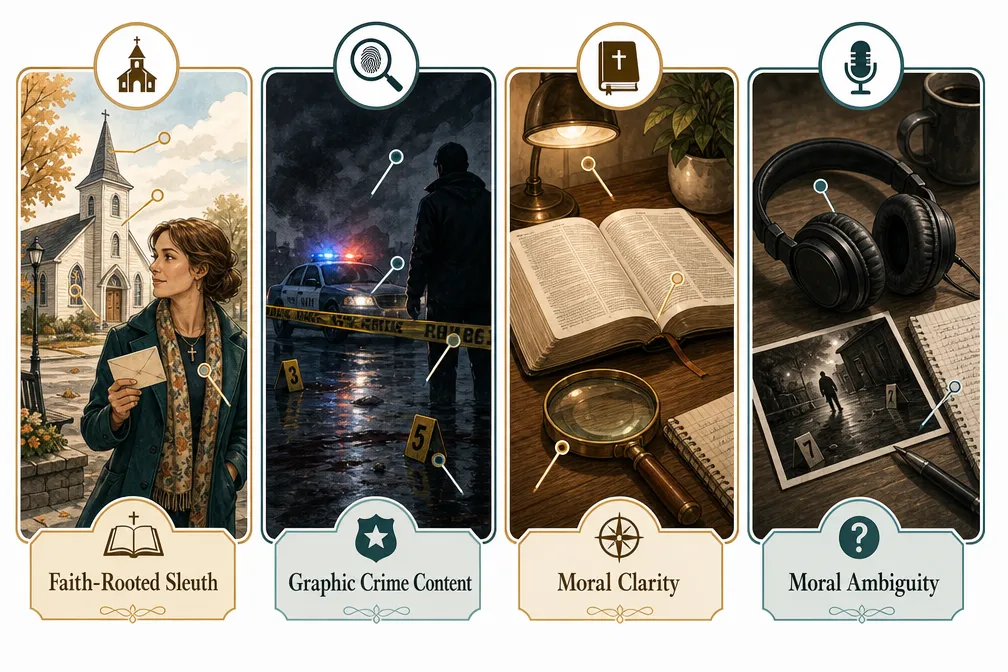
Cozy mystery is fiction built on puzzle logic, a closed community, a limited suspect pool, clues hidden in ordinary life, and a resolution that restores moral order. True crime is non-fiction (or dramatized non-fiction) built on documentation of actual violence, often without resolution, and frequently without moral clarity.
The structural differences matter enormously for faith-rooted readers:
| Feature | Christian Cozy Mystery | True Crime |
|---|---|---|
| Violence | Implied, off-page | Graphic, detailed |
| Moral outcome | Justice restored | Often unresolved |
| Protagonist motive | Conscience-driven | Curiosity/voyeurism |
| Faith role | Load-bearing | Absent or incidental |
| Emotional tone | Warm tension | Dread and shock |
| Reader experience | Earned comfort | Lingering disturbance |
True crime, even well-produced true crime, asks the reader to sit with real suffering for entertainment. Christian cozy mystery asks the reader to sit with a fictional puzzle and trust that truth will surface, because in a faith-rooted story, it always does, and the cost of that surfacing is the point.
Why Do People Prefer Clean Fiction Over Graphic True Crime?
Clean fiction is not a retreat from difficulty, it is a different contract about how difficulty gets handled. Readers who choose clean Christian mystery over true crime are not avoiding hard things; they are choosing stories where hard things lead somewhere.
Several factors drive this preference:
- Spiritual sustainability: Graphic true crime content can produce what researchers describe as secondary trauma responses. Clean fiction allows readers to engage with themes of death, deception, and injustice without absorbing the imagery that accompanies them in true crime.
- Moral framework: True crime often presents evil without resolution. Faith-rooted fiction insists that truth matters and that justice, even imperfect, earthly justice, is worth pursuing.
- Earned comfort: A cozy mystery that handles grief honestly and then offers genuine resolution gives the reader something true crime rarely can: the sense that the story meant something.
- Content trust: Christian fiction readers, especially those on Kindle Unlimited, report that content predictability is a feature, not a limitation [10]. Knowing a book will not ambush them with graphic content allows deeper emotional investment.
The market reflects this. Christian suspense and mystery are identified as a growing segment, with readers specifically seeking “high-stakes, intrigue, and moral clarity”, a combination true crime structurally cannot provide [7].
Christian Cozy Mystery vs. True Crime: What Makes a Faith-Rooted Whodunit Actually Work?
A faith-rooted whodunit works when faith is the engine of the investigation, not a label on the cover. This is the core of the Christian Cozy Mystery vs. True Crime debate, and it is where clean fiction earns its credibility.
What makes it work:
- The sleuth’s motive is moral, not professional. She investigates because she cannot let an injustice stand, because someone she loves is wrongly suspected, or because her conscience will not let her look away. That is a spiritual posture, not a plot device.
- Clues are embedded in community life. A hymnal margin, a recipe tin, a flood-relief donation box, these objects carry meaning because they come from a world where ordinary things hold weight. See The Family Bible Secret for how a single document can carry a whole community’s buried truth.
- Suspects are people, not types. A faith-rooted mystery resists the villain-as-monster shortcut. The person who committed the crime is someone the protagonist knows, possibly loves, and must face with both honesty and mercy.
- Resolution costs something. Cheap grace, the tidy ending where everyone is fine and faith is vindicated, is the enemy of good Christian fiction. The best whodunits in this space leave the protagonist changed, not just satisfied.
For writers, the most common failure is treating faith as decoration rather than consequence. See Faith in Fiction: How to Weave Believable Spiritual Journeys Into Plot Without Preaching for the practical side of this.
Are Christian Mysteries Less Suspenseful Than True Crime?
No. Christian mysteries are not less suspenseful, they use a different kind of tension. True crime generates dread through graphic detail and unresolved violence. Christian cozy mystery generates tension through relationship stakes, moral cost, and the fear of what the truth will do to the community once it surfaces.
That second kind of tension is often harder to sustain, because it requires the author to make the reader care about people rather than events. When it works, the moment a suspect is revealed in a faith-rooted mystery hits harder than any crime scene photograph, because the reader has spent the whole book hoping it wasn’t them.
The suspense toolkit in clean Christian mystery:
- Who knew, and when, the timeline of knowledge is always a source of dread
- What the protagonist risks by continuing to investigate (relationships, reputation, safety)
- Whether the community will accept the truth once it is found
- Whether mercy and justice can coexist in the same outcome
Editors at Bethany House have confirmed that “Agatha-style mysteries” are now a credible and growing niche in Christian publishing precisely because this kind of puzzle-driven tension translates well to faith-rooted fiction [1].
Best Christian Cozy Mystery Series to Read
The best Christian cozy mystery series combine genuine puzzle construction with characters whose faith is tested by what they find, not confirmed by it.
Top picks for 2026:
- The Mercy House Mysteries by Silas Bellhaven, Ten-book series set in Juniper Gap, Tennessee. Protagonist Nora Bell Hartley investigates murders hidden inside church ministry objects: donation boxes, recipe tins, hymnals, seed packets. Faith is load-bearing throughout. Start with A Donation to Die For. Series page.
- Authors like Colleen Coble and Dani Pettrey are frequently cited as driving growth in Christian mystery and suspense, particularly for readers who want higher-stakes plots alongside clean content [7].
- For a broader reading list across Christian fiction genres, see Best Christian Fiction Authors Across Cozy Mystery, Western, Fantasy, Thriller, and LitRPG.
Choose a series based on what you want from the faith element:
- If you want faith as lived doubt and cost → Mercy House Mysteries
- If you want faith as moral backbone in high-stakes suspense → Colleen Coble, Dani Pettrey
- If you want faith woven into psychological tension → The Gathering Light series
Can You Have a Good Mystery Without Violence or Gore?
Yes, and the best argument for that claim is the entire history of the classic British cozy, from Agatha Christie forward. The murder happens. The body is found. But the violence itself is not the point and is never shown in graphic detail.
What makes a mystery satisfying is not the crime. It is the puzzle. It is the question of who and why, and in a faith-rooted mystery, also what will it cost to tell the truth?
Clean Christian mystery series maintain this contract across their entire catalog. No profanity, no graphic violence, no explicit content, and yet readers describe them as genuinely suspenseful, emotionally engaging, and hard to put down [2]. For a full breakdown of what “clean” means in this context and how it differs from general clean reads, see Clean Christian Fiction vs. General Clean Reads: What Sets Faith-Rooted Stories Apart on Kindle Unlimited.
The craft requirement is higher, not lower. Without gore to create visceral shock, the author must build dread through character, relationship, and consequence. That is harder to write and more rewarding to read.
Private Investigator Cozy Mysteries With Faith Themes: Why the PI Structure Works
The private investigator structure, an individual who investigates outside official channels, driven by personal conscience rather than institutional authority, maps naturally onto Christian cozy mystery because it mirrors the moral posture of faith.
A PI-style amateur sleuth in a faith-rooted story is not solving a puzzle for professional satisfaction. She is solving it because she believes truth matters, because she serves a community she loves, and because she answers to something higher than the local sheriff’s opinion of her involvement.
This is why the Christian Cozy Mystery vs. True Crime comparison ultimately favors clean faith-rooted fiction for readers who want their detective story to mean something: the PI structure externalizes a spiritual conviction. The investigation is an act of conscience. Every clue followed is a small act of faithfulness. Every suspect confronted is a moment where mercy and justice have to be held in the same hand.
That is not a genre convention. That is a theology of investigation, and it is what makes these books feel different from every other whodunit on the shelf.
Who Reads Cozy Mysteries vs. True Crime Fans?
The audiences overlap more than the content suggests, but they diverge sharply on what they want from the experience.
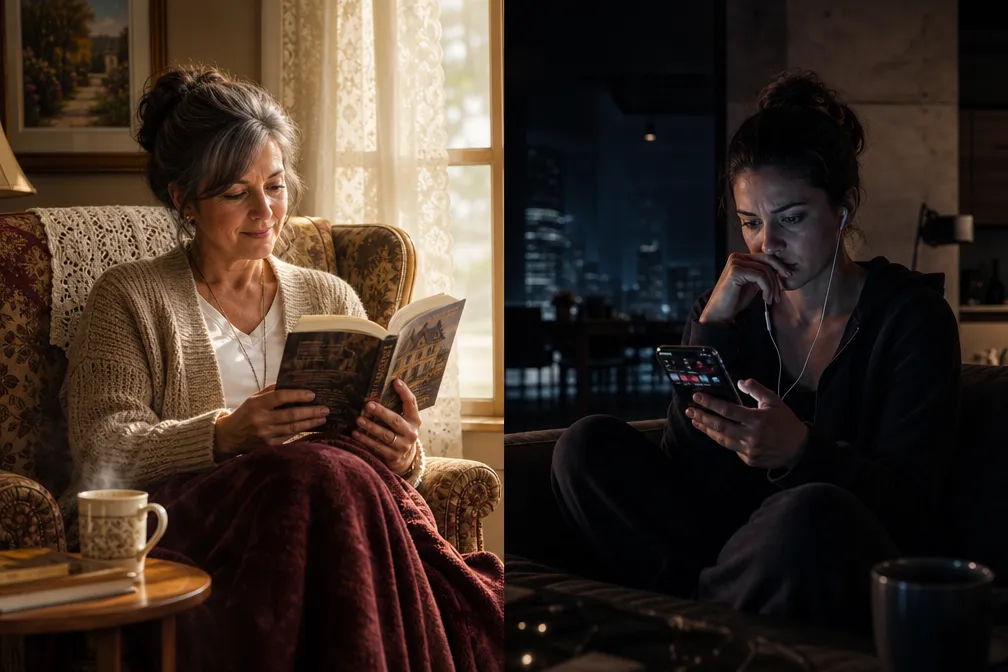
Christian cozy mystery readers are primarily women aged 35-65, many of them Kindle Unlimited subscribers, who want:
- Real stakes and genuine suspense
- Characters whose faith is honest, not performed
- Resolution that earns its comfort
- Content they can read without bracing for graphic material
True crime audiences skew younger and more mixed-gender, and they tend to want:
- Documentary authenticity
- Unresolved moral complexity
- The feeling of being inside an actual investigation
- Shock and dread as part of the experience
The ChristShare 2026 reading trends report notes that Christian fiction readers specifically value content predictability as a trust signal, they return to authors and series because they know what the content contract is [10]. That loyalty is a structural advantage for clean Christian fiction that true crime, by its nature, cannot replicate.
Common Mistakes in Writing Christian Mysteries
The biggest mistake is treating faith as a content filter rather than a narrative force. Removing graphic content is not the same as writing Christian fiction. The faith has to do work in the story, it has to cost the protagonist something, shape her choices, and be tested by what she finds.
Other common failures:
- The sermon scene: A character stops the plot to explain a theological point. Readers feel talked at, not walked with.
- Cheap grace: The mystery resolves, everyone repents, the community heals too neatly. Real grace is harder than that and more honest.
- Faith as decoration: A cross on the wall, a prayer before meals, a church setting, none of these make a story Christian. Faith has to be load-bearing in the plot.
- The villain as pure evil: Faith-rooted fiction requires that the person who did the terrible thing is still a person. The mystery of why someone crosses a moral line is as important as the mystery of who.
- Ignoring the community cost: In a small-town mystery, revealing the truth always damages something. A story that skips that damage is not being honest about what truth costs.
For writers working in this space, Faith-Based Character Development: Creating Protagonists Readers Believe In is worth reading alongside any craft guide on mystery structure.
Is True Crime Too Dark for Faith-Based Readers?
For many faith-based readers, the issue with true crime is not darkness itself, it is purposeless darkness. Faith-rooted fiction does not avoid hard things. It insists that hard things lead somewhere.
True crime, by definition, deals with real suffering. That suffering is often unresolved, the perpetrators sometimes unpunished, and the victims’ stories frequently reduced to their worst moments. For readers who believe that every person bears the image of God, that reduction is not just uncomfortable, it is spiritually dissonant.
This does not mean faith-based readers cannot engage with true crime. Many do. But it explains why clean Christian mystery satisfies the same investigative craving without the spiritual cost. The puzzle is real. The stakes are real. The darkness is real. But the story insists, through structure, through character, through the act of resolution, that truth matters and that justice is worth pursuing even when it is painful.
That insistence is not naivety. It is a conviction. And it is what makes clean faith-rooted fiction something more than a sanitized version of the real thing.
What Age Group Enjoys Christian Cozy Mysteries?
Christian cozy mysteries are most popular with women aged 35-65, though the genre has a meaningful readership outside that range. The appeal is not primarily age-based, it is value-based.
Readers who choose Christian cozy mystery tend to prioritize:
- Community and relationship over individual heroics
- Moral clarity over moral ambiguity
- Comfort earned through honest storytelling
- Faith represented as lived experience, not performance
Younger readers (25-35) are a growing segment, particularly on Kindle Unlimited, as the platform makes it easier to discover clean fiction without relying on traditional retail gatekeepers [10]. The market data from 2026 confirms that Christian fiction overall is growing, with mystery and suspense among its most active segments [1][7].
Conclusion: The Case for Clean Faith-Rooted Whodunits
The debate between Christian Cozy Mystery vs. True Crime is, at its core, a question about what mystery fiction is for. If it is for shock, dread, and the voyeuristic thrill of documented violence, true crime wins. If it is for the satisfaction of seeing truth surface, justice served, and a community, however imperfectly, restored, then the clean faith-rooted whodunit is not a lesser option. It is a better one.
Private investigator-style sleuthing works in Christian cozy mystery because investigation, done with conscience, is a moral act. Every clue followed is a small act of faithfulness. Every truth told is a cost paid. Every resolution is grace, not cheap grace, but the kind that comes after something real.
Actionable next steps:
- Start the Mercy House Mysteries with A Donation to Die For to experience what faith-rooted investigation looks like in practice
- Browse the full Mercy House Mysteries series for ten books of small-town, clean, conscience-driven mystery
- Explore how church life and local traditions shape the whodunit in Christian cozy fiction
- Build a full clean faith-based reading list with Kindle Unlimited Christian Reads: How to Build a Clean, Faith-Filled TBR
- Visit Silas Bellhaven’s author page for the full catalog across mystery, western, fantasy, thriller, and LitRPG
The ordinary Tuesday can turn out to matter more than anyone expected. That is the promise of clean Christian fiction, and it is a promise true crime was never built to keep.
FAQ
What is the difference between a Christian cozy mystery and a regular cozy mystery? A regular cozy mystery uses clean content conventions (no graphic violence, no explicit material) but has no faith element. A Christian cozy mystery adds faith as a load-bearing part of the story, the protagonist’s choices, the community’s moral life, and the meaning of justice are all shaped by belief.
Do Christian cozy mysteries have real suspense? Yes. The tension comes from relationship stakes, moral cost, and the question of what the truth will do to the community, not from graphic violence. Many readers find this kind of tension more emotionally engaging than shock-based suspense.
Is the Mercy House Mysteries series appropriate for all ages? The series is written for adult readers but maintains clean content throughout, no profanity, no graphic violence, no explicit content. It is appropriate for teens and older readers who enjoy faith-rooted mystery.
Why do Christian readers avoid true crime? Many do not avoid it entirely, but those who prefer clean fiction often find true crime spiritually draining because it presents real suffering without resolution or moral framework. Clean Christian mystery satisfies the same investigative craving with a story structure that insists truth matters.
What makes a PI-style sleuth work in Christian cozy mystery? The amateur investigator who operates outside official channels mirrors a spiritual posture: she investigates because her conscience demands it, not because it is her job. That motivation makes the investigation feel like an act of faith rather than a plot device.
How long is a typical Christian cozy mystery? Most run between 60,000 and 80,000 words, long enough to build a genuine puzzle and develop the community, short enough to read in a few sittings. Series like the Mercy House Mysteries are designed to be read in order but work as standalone entries.
Are Christian cozy mysteries only for women? The primary audience is women 35-65, but the genre has male readers, particularly those who enjoy classic puzzle-style mysteries in the Agatha Christie tradition. The faith element appeals across gender lines when it is handled honestly rather than sentimentally.
What is “earned grace” in Christian fiction? Earned grace means that mercy in the story comes after real cost, a character fails, repents, faces consequences, and finds grace on the other side of that. It is the opposite of cheap grace, where forgiveness arrives without the story requiring anything of the character first.
Can Christian cozy mysteries handle dark themes? Yes. The best ones do. Clean content means the darkness is not shown graphically, it does not mean the darkness is avoided. Secrets, betrayal, grief, and moral failure are all present; they are simply handled with honesty rather than exploitation.
Where should a new reader start with Christian cozy mystery? A Donation to Die For by Silas Bellhaven is a strong entry point, it establishes the Juniper Gap community, introduces Nora Bell Hartley, and demonstrates what faith-rooted investigation looks like from the first chapter.
References
[1] Mysteries On The Rise In Christian Fiction – https://www.publishersweekly.com/pw/by-topic/industry-news/religion/article/100974-mysteries-on-the-rise-in-christian-fiction.html
[2] Cozy Christian Mystery Novel For Adults Early Christmas Gift Option Available – https://markets.financialcontent.com/wral/article/marketersmedia-2025-10-23-cozy-christian-mystery-novel-for-adults-early-christmas-gift-option-available
[6] Top Selling Christian Fiction – https://www.accio.com/business/top-selling-christian-fiction
[7] Top Selling Christian Novels – https://www.accio.com/business/top-selling-christian-novels
[10] Christshare Releases Report On Christian Reading Trends In 2026 – https://markets.financialcontent.com/lightport.lightport8/article/marketersmedia-2026-4-17-christshare-releases-report-on-christian-reading-trends-in-2026