Last updated: September 23, 2026
Quick Answer: Christian Western fiction places faith, conscience, and moral consequence at the center of frontier storytelling, not as decoration, but as the engine that drives every choice a character makes. Clean saddle stories continue to find loyal readers in 2026 because they offer something the broader market undersupplies: genuine ethical tension with real stakes, and grace that costs something before it arrives.
Key Takeaways
- Christian Western fiction differs from secular westerns by treating faith as load-bearing to the plot, not background color.
- “Clean” means no graphic violence, no explicit content, and no profanity, but it does not mean no conflict or consequence.
- The Western’s traditional code (keeping your word, personal integrity, justice) maps naturally onto Christian themes of sin, repentance, and restoration.
- Religious publishing revenue rose 9.3% to $2.2 billion in 2025, signaling a commercially healthy environment for faith-rooted fiction. [Source: Publishers Weekly]
- Award infrastructure, active series pipelines, and bundled digital editions all confirm the genre is producing and selling in 2026. [1][3]
- Christian westerns are not exclusively for churchgoing readers, publishers increasingly position them for anyone who wants values-oriented storytelling without explicit content.
- The biggest mistake writers make is using faith as a sermon rather than a story, dropping scripture into narration instead of showing belief through character choice and consequence.
- Kindle Unlimited has become a primary discovery channel for Christian Western readers, with boxed sets and complete-series editions priced between $2.99 and $14.99 expanding access. [5]
What Is Christian Western Fiction and How Is It Different from Regular Westerns?
Christian Western fiction is frontier storytelling in which faith functions as a structural element of the narrative, shaping character motivation, moral conflict, and resolution, rather than appearing as incidental background detail. A secular western might feature a lawman who happens to attend church; a Christian western asks what that lawman does when the law and his conscience point in opposite directions, and lets the answer cost him something.
The traditional Western already carries a strong ethical code. Literary genre analysis identifies responsibility, keeping one’s word, courage, and personal integrity as the genre’s recurring moral architecture. [Source: Barton Community College] Christian Western fiction inherits that structure and deepens it: sin has weight, forgiveness is not free, and mercy and justice are both present in the same scene rather than one canceling the other out.
For a closer look at how these two traditions diverge in practice, see Christian Western Fiction vs. Secular Westerns: What Makes Faith-Rooted Frontier Stories Different.
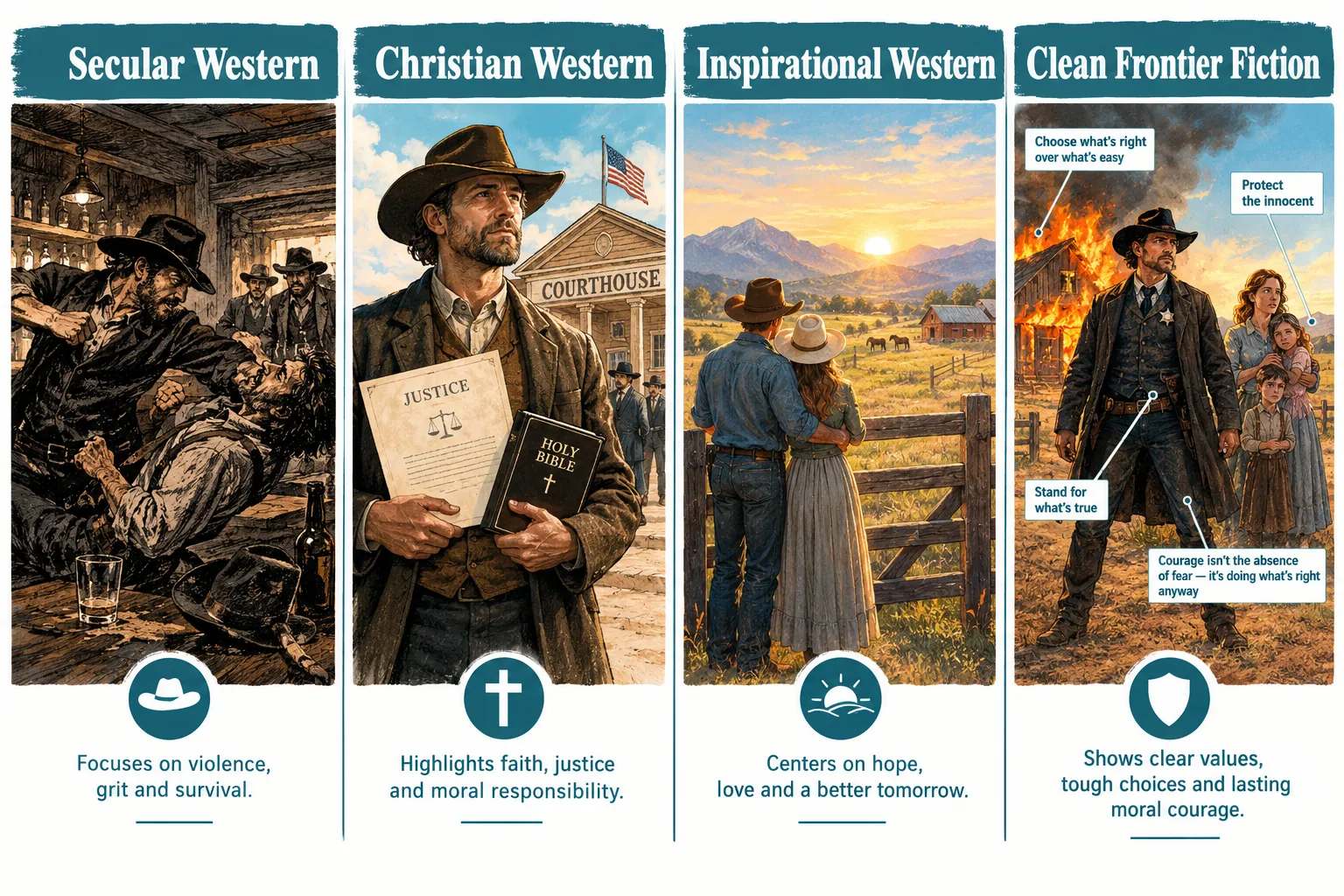
The practical differences at a glance:
| Element | Secular Western | Christian Western |
|---|---|---|
| Faith role | Background or absent | Load-bearing to plot |
| Moral conflict | Personal code vs. society | Conscience vs. law vs. God |
| Resolution | Justice or revenge | Mercy, justice, or both, at a cost |
| Content | Often graphic violence, language | Clean: no profanity, no explicit content |
| Grace | Rare or ironic | Present, but earned, not cheap |
What Makes a Western Story Considered Clean or Wholesome?
A clean western avoids graphic violence, explicit sexual content, and profanity, but the more useful definition is what it keeps rather than what it removes. Clean frontier fiction retains moral complexity, genuine danger, and characters who fail. What it refuses is gratuitousness: the scene that exists only to shock rather than to advance character or consequence.
Publishers Weekly reported that Haven senior acquisitions editor Jessica Sharpe described a “healthy market” for clean and wholesome fiction, defining it as faith-informed or values-oriented storytelling without explicit sex, coarse language, or graphic violence. Notably, some titles are designed to appeal to readers of any faith background or none, the “clean” positioning is about content, not creed.
What clean content includes:
- Moral jeopardy and real stakes
- Characters who doubt, fail, and face consequences
- Conflict that is emotionally and spiritually serious
- Danger conveyed through tension rather than gore
What clean content excludes:
- Graphic depictions of violence or injury
- Sexual content beyond mild romantic tension
- Profanity or crude language
- Gratuitous darkness that serves no narrative purpose
The distinction matters because clean does not mean safe or predictable. A man can face a false warrant, a corrupt land claim, or a labor bond that traps a family in debt, and the story can carry genuine weight, without a single graphic scene.
How Do Christian Values Show Up in Western Fiction?
Christian values appear in frontier fiction through character choice and consequence, not through narration or scripture-dropping. A character who chooses to return a falsely issued warrant rather than use it, knowing it will cost him his position, is living out a conviction. The reader feels the faith before any theological language appears.
The recurring themes that connect Christian belief to frontier narrative include:
- Earned grace: Forgiveness arrives after cost, not instead of it. A man who has wronged others cannot simply declare himself changed; the story requires him to demonstrate it.
- Mercy and justice held together: The Western’s traditional code already demands both. Christian frontier fiction refuses to let either cancel the other out.
- Faith under fire: Belief is tested by circumstance, drought, disputed land, a false accusation, and proven or broken through the plot, not announced in the prose.
- The record as moral weight: Documents, ledgers, deeds, and testimonies carry enormous power in frontier settings. Who controls the record, and whether it tells the truth, becomes a spiritual question as much as a legal one.
This is why the frontier setting works so well for faith-rooted fiction. When law runs thin and institutions are unreliable, what a person answers to internally becomes the whole story. For more on this dynamic, see Frontier Fiction For Readers Who Want Faith Without A Sermon.
Why Do Clean Westerns Appeal to Modern Readers?
Clean western fiction appeals to modern readers because it offers ethical tension without the content tax that comes with much of the broader market. Readers who want genuine stakes, moral dilemmas, danger, consequence, do not have to choose between substance and content standards.
Religious publishing revenue rose 9.3% to $2.2 billion in 2025, with religious books identified as a major growth driver across total U.S. publishing revenue of $33.4 billion. [Source: Publishers Weekly / Association of American Publishers] That commercial signal reflects something real: a large audience that has always wanted stories with moral weight and has found the mainstream market increasingly unwilling to provide them without graphic content attached.
Why the appeal holds in 2026 specifically:
- Kindle Unlimited discoverability has made clean Christian fiction easier to find and sample without financial risk, expanding the audience beyond traditional Christian bookstore shoppers.
- Social media recommendation culture, particularly on BookTok and Instagram, has created organic discovery channels for wholesome fiction that bypass traditional retail gatekeeping.
- Reader fatigue with “grimdark” has pushed a segment of general-market readers toward cleaner alternatives, even readers with no specific faith commitment.
- Series depth and bundled editions (complete-series digital sets priced $2.99,$14.99) lower the barrier to entry for new readers. [5]
For a detailed look at the commercial dynamics, see Why Clean Christian Fiction Outsells Graphic Alternatives: Reader Loyalty, Borrow Behavior, and Kindle Unlimited Trends.
Best Christian Western Authors and Books to Read
The Christian Western space is active and producing in 2026, with award recognition, new series launches, and bundled editions all visible in the current market. [1][3]
Award-recognized titles (2026 Selah Awards, Blue Ridge Mountains Christian Writers Conference):
- Wendy Galinetti, A Dangerous Heart, Selah Award finalist, Western category
- Jennifer Uhlarik, Love and Order, Selah Award finalist, Western category
- Grace Hitchcock, The Vanishing of Miss Victoria, BRMCWC third-place winner, Western Fiction [Source: Blue Ridge Conference]
Active series and recent releases:
- Natalie Bright & Denise F. McAllister, Rafter O Ranch: The Complete Christian Western Romance Series (CKN Christian Publishing, September 2026) [3]
- Heather Blanton, Brides of Evergreen series (CKN Christian Publishing)
- Jill Dewhurst, Clara’s Courage (September 2026 release) [1]
- Alyssa Schwarz, Goldie: A Wild Ridge Novella (September 2026 release) [1]
The Mercy Line series (Silas Bellhaven), nine-book Christian frontier western set in the railroad town of Mercy Crossing, built around the conscience question: where law runs out, a man finds what he answers to. The series opens with The False Warrant, in which a territorial seal does not make a custody lawful, and a man named Caleb must decide what obedience is worth. The series carries a romance-absent content contract and masculine-only leads, making it a distinct option within a market that skews heavily toward frontier romance. Browse the full series at the Mercy Line series page.
For a broader reading list across Christian fiction genres, see Best Christian Fiction Authors Across Cozy Mystery, Western, Fantasy, Thriller, and LitRPG.
What’s the Difference Between Christian Westerns and Inspirational Westerns?
Christian westerns and inspirational westerns overlap significantly but are not identical. The distinction is primarily one of intensity and explicitness of faith content.
- Christian westerns treat faith as a named, active force in the story. Characters pray, wrestle with Scripture, and make decisions that are explicitly grounded in their relationship with God.
- Inspirational westerns carry moral and values-oriented themes, courage, integrity, sacrifice, but may handle faith more lightly or leave it implicit. A character might be quietly spiritual without the story foregrounding their belief.
Publishers increasingly blur this line intentionally. CKN Christian Publishing, for example, markets titles simultaneously as Christian western, inspirational romance, clean romance, and historical romance, broadening discoverability beyond explicitly Christian retail audiences. [3] For readers, the practical question is whether the faith content feels central or peripheral to the story’s engine.
Choose Christian western if you want: Faith tested by plot events, characters who doubt and return, grace that arrives at a cost.
Choose inspirational western if you want: Strong moral themes with a lighter or more implicit faith presence, often with more romance emphasis.
Common Tropes in Christian Western Romance Novels
Christian western romance is the dominant commercial subgenre within Christian Western fiction, and it draws on a recognizable set of frontier conventions.
Recurring tropes:
- Mail-order bride / marriage of convenience, two strangers building trust before love, with faith as the foundation rather than romantic chemistry
- Captivity and rescue, danger that tests both physical courage and moral character
- Ranch life and land disputes, property as a stand-in for legacy, family, and what a person is willing to protect
- Reunion romance, separated characters whose faith has either held or fractured in the intervening years
- The reformed outlaw, a man whose past requires active reckoning, not just declaration of change
September 2026 releases such as Clara’s Courage and Goldie: A Wild Ridge Novella both engage frontier romance conventions including captivity, ranch life, danger, and reunion. [1] The Rafter O Ranch complete series similarly centers ranch life and relationship dynamics within a Christian framework. [3]
The tropes work because they create natural pressure points for faith: a marriage of convenience requires trust before feeling, which maps directly onto what faith asks of a person. A reformed outlaw cannot simply announce his redemption, the story has to prove it.
Are Christian Westerns Only for Religious Readers?
No. Christian westerns are written for readers who want moral complexity and values-oriented storytelling, and that audience is broader than any single faith community.
Publishers Weekly reported that some clean and wholesome fiction titles are specifically designed to appeal to readers of any faith or none, with the content positioning (no explicit sex, no graphic violence, no profanity) doing as much work as the faith content in attracting general-market readers who are simply tired of gratuitous content. Haven’s marketing team reported success reaching both Christian and general-market communities through social media, particularly for romance readers seeking entertaining stories without “spicier” content.
The honest caveat: if a reader is actively hostile to any faith presence in fiction, Christian westerns will not suit them. Faith is not decorative in these books, it is structural. But a reader who is spiritually curious, morally serious, or simply content-fatigued will find the genre more accessible than the “Christian” label might suggest.
What Age Group Reads Christian Western Fiction?
The core audience for Christian Western fiction skews toward women aged 35-65, with strong representation among Kindle Unlimited subscribers who read across multiple clean fiction subgenres, cozy mystery, historical romance, and frontier western often overlap in the same reader’s library.
That said, the genre is not age-locked. Younger readers who have discovered clean fiction through BookTok and Instagram recommendation culture are entering the space, and male readers, particularly those drawn to action-forward frontier fiction without romance emphasis, represent a smaller but distinct segment.
Fiction represented 10.3% of unit sales at reporting Christian retailers in 2025, with the market showing modest but meaningful resilience. [Source: Publishers Weekly] The Kindle Unlimited channel has expanded the demographic reach beyond traditional Christian bookstore shoppers, bringing in readers who self-identify as “clean read” seekers rather than specifically “Christian fiction” readers.
Can You Recommend Christian Westerns With Strong Female Characters?
Yes, and the market is well-supplied in this area, particularly within the frontier romance subgenre.
Female-led Christian western titles and series:
- Clara’s Courage by Jill Dewhurst (September 2026), frontier heroine in a captivity/danger scenario [1]
- Goldie: A Wild Ridge Novella by Alyssa Schwarz (September 2026), ranch-life female protagonist [1]
- Brides of Evergreen series by Heather Blanton, female protagonists navigating frontier marriage and faith
- Rafter O Ranch series by Natalie Bright & Denise F. McAllister, women at the center of ranch-life and relationship dynamics [3]
- Grace Hitchcock’s The Vanishing of Miss Victoria, award-placing female-led western mystery
Within the Silas Bellhaven catalog, The Survey Line (Mercy Line, Book 2) features Mara Whitcomb, a woman who can see beneath the polished surface of a disputed land plat to the truth it is hiding. Her role is not romantic; she is a moral witness in a story about what the record conceals.
For readers who want female protagonists in clean frontier settings without the romance emphasis, the Western Fiction and Christian Frontier Novels tag archives offer a useful starting point.
Where Can I Find Christian Western Fiction Books Online?
Christian western fiction is available across all major digital retail and subscription platforms, with Kindle Unlimited carrying the largest volume of indie and small-press titles.
Primary discovery channels in 2026:
- Amazon / Kindle Unlimited, the dominant platform for indie and small-press Christian western fiction; search “Christian western romance” or “clean frontier fiction” for broad results, or browse series pages directly
- CKN Christian Publishing, an active small press with a dedicated Christian western catalog, including complete-series editions [3]
- Wolfpack Publishing, lists Christian western collections including complete-series digital editions priced $2.99,$14.99 [5]
- ACFW (American Christian Fiction Writers), maintains a new-releases feed that includes western titles [Source: ACFW]
- Iola Goulton’s review site, monthly new-release roundups that consistently include Christian western titles [1]
For Kindle Unlimited subscribers specifically, see Kindle Unlimited Christian Reads: Hidden Gems and Underrated Series Beyond the Bestseller Lists.
How Do Authors Balance Action and Moral Lessons in Westerns?
The answer is simpler than it sounds: show the moral weight through action, not alongside it. When a character makes a choice that costs him something, turns down a bribe, returns a false warrant, speaks a truth that will destroy his own position, the moral lesson is the action. No narration required.
The mistake most writers make is treating faith as a separate layer to be added on top of the plot. A character rides hard, catches the outlaw, then sits by a fire and reflects on what God has taught him. That structure announces the theme rather than earning it.
What works:
- Place the character’s faith conviction in direct conflict with what the plot is asking them to do
- Let the cost of the right choice be visible and real, not softened by a convenient rescue
- Allow doubt without resolving it too quickly; faith under fire is more honest than faith that never wavers
- Use the setting’s physical details (the land deed, the survey line, the labor bond) as concrete moral objects rather than abstract symbols
What doesn’t work:
- Scripture quoted in narration as a way of explaining what the reader should feel
- Conversion moments that arrive without sufficient dramatic cost
- Antagonists who are purely evil rather than people making wrong choices for understandable reasons
- Redemption that comes too easily, grace that costs nothing teaches nothing
For a deeper treatment of how redemption arcs function in faith-rooted fiction, see The Role of Redemption Arcs in Christian Thrillers and Dark Fantasy.
What Mistakes Do Writers Make When Writing Christian Westerns?
The most common mistake is preaching. The second most common is avoiding hard things in the name of keeping it clean. Both failures produce the same result: a story that doesn’t trust its reader.
The seven most common errors:
- Faith as narration, not action, telling the reader a character is a man of God rather than showing what that costs him
- Cheap grace, redemption that arrives without sufficient dramatic preparation or cost
- Cardboard antagonists, villains who exist only to be defeated rather than people whose choices illuminate the same temptations the protagonist faces
- Sanitized conflict, removing genuine danger or moral complexity in the name of keeping content clean
- Scripture-dropping, inserting Bible verses into narration as a substitute for earned emotional resonance
- Resolved doubt, characters whose faith is never seriously tested, or whose doubts are answered too quickly and too neatly
- Genre formula over character truth, hitting the expected beats (conversion, forgiveness, happy ending) without earning them through the specific people in this specific story
The best Christian westerns are honest about hard things. A widow losing her land to a fraudulent debt is a hard thing. A man choosing to speak truth when silence would protect him is a hard thing. The clean content contract does not require those things to be softened, only that they be handled without gratuitousness.
Do Christian Westerns Still Sell Well Today?
Yes. The commercial evidence from 2026 points to a genre that is producing, selling, and earning award recognition rather than declining.
Religious publishing revenue rose 9.3% to $2.2 billion in 2025, making it the strongest major trade segment in a year when total U.S. publishing revenue reached $33.4 billion. [Source: Publishers Weekly / AAP] Active series pipelines at CKN Christian Publishing, Wolfpack Publishing, and multiple indie imprints confirm ongoing production. [3][5] The 2026 Selah Awards included a dedicated Western category with multiple finalists, indicating that the genre’s award infrastructure remains intact. [Source: Blue Ridge Conference]
Bundled and complete-series digital editions, a format that signals reader appetite for binge-reading rather than casual sampling, are increasingly common in the Christian western space, with prices generally ranging from $2.99 to $14.99. [5] That pricing structure is designed for Kindle Unlimited subscribers who want to commit to a series rather than test a single title.
The genre is not the largest segment of Christian fiction (cozy mystery and historical romance carry more volume), but it is commercially viable, actively growing its catalog, and finding new readers through digital distribution channels that did not exist a decade ago.
FAQ
What is Christian Western fiction? Christian Western fiction is frontier storytelling in which faith is a structural element of the plot, shaping character choices, moral conflict, and resolution, rather than background detail. It combines the Western’s traditional ethical code with Christian themes of sin, conscience, forgiveness, and earned grace.
Is Christian Western fiction the same as inspirational Western fiction? Not exactly. Christian westerns treat faith as explicitly active and named in the story. Inspirational westerns carry moral and values themes but may handle faith more lightly or implicitly. Publishers often market titles under both labels to broaden discoverability.
Do Christian westerns have to include romance? No. Many Christian westerns are frontier adventure or moral-thriller stories without romance. The majority of commercially available titles do include romance, but series like The Mercy Line by Silas Bellhaven maintain a romance-absent content contract.
What does “clean” mean in Christian Western fiction? Clean means no graphic violence, no explicit sexual content, and no profanity. It does not mean no conflict, no danger, or no moral complexity. Clean fiction can and should have real stakes.
Where is the best place to find Christian western novels? Amazon and Kindle Unlimited carry the largest selection. CKN Christian Publishing and Wolfpack Publishing are active small presses in the space. ACFW’s new-releases feed and review sites like Iola Goulton’s are useful for discovering new titles.
Are Christian westerns only for women? The core demographic skews toward women 35-65, but male readers who want action-forward frontier fiction with moral weight and no explicit content represent a real secondary audience. Series with masculine-only protagonists and no romance emphasis specifically serve that reader.
Can non-religious readers enjoy Christian westerns? Yes, particularly readers who want values-oriented storytelling without explicit content. Faith is structural in these books, not decorative, so readers who are actively hostile to any faith presence will not enjoy them, but spiritually curious or simply content-fatigued readers often find the genre more accessible than expected.
What are the most common tropes in Christian Western romance? Mail-order bride, marriage of convenience, captivity and rescue, ranch life and land disputes, reunion romance, and the reformed outlaw. Each trope creates natural pressure points for faith-testing scenarios.
How do I know if a Christian western is well-written? Look for faith that shows up through character choice rather than narration, antagonists who are more than cardboard villains, grace that arrives after cost rather than instead of it, and conflict that is honest about hard things rather than softened into safety.
What is the Mercy Line series? The Mercy Line is a nine-book Christian frontier western series by Silas Bellhaven, set in the railroad town of Mercy Crossing. Each book follows a different protagonist facing a moral and legal crisis in which faith and frontier law collide. The series carries a romance-absent content contract. It begins with The False Warrant.
Conclusion
Christian Western fiction and the moral frontier remain a productive pairing in 2026 because the frontier setting does something few other genres can: it strips away institutional safety nets and forces a character to answer only to what they actually believe. When law runs thin, when the land deed is false, when the record has been altered, what a person does in that moment is the whole story.
The genre is not surviving on nostalgia. It is producing award-recognized titles, active series pipelines, and bundled digital editions that meet readers where they are. It is finding new audiences through Kindle Unlimited and social media recommendation culture. And it is doing all of this while maintaining a content standard that a large, underserved readership has been asking for.
For readers: start with a series that matches your appetite, frontier romance, action-forward moral thriller, or faith-under-fire adventure, and follow the characters into the hard places the story doesn’t soften. That’s where the genre earns its keep.
For writers: trust the story. Put the faith conviction in direct conflict with what the plot demands, let the cost be real, and let grace show up after it has been paid for. A reader who finishes a clean Christian western and feels the weight of what mercy actually required, that reader will be back.
Explore more:
- Western Fiction for Readers Who Love Moral Complexity: Christian Frontier Stories Without the Preaching
- Clean Western Novels With No Swearing
- The Mercy Line series on Amazon
References
[1] New Releases Sept 2026 – https://www.iolagoulton.com/new-releases-sept-2026/ [3] Our News 2 – https://cknchristianpublishing.com/our-news-2/ [5] wolfpackpublishing – https://wolfpackpublishing.com/ [7] New Releases – https://acfw.com/category/new-releases/